
What Is Strategic Leadership If Not Just for the C-Suite?
Struggling to understand what is strategic leadership? It's the skill that separates great teams from the rest. Learn what it means and how you can apply it.
Dan Robin
We throw around the term "strategic leadership" a lot. But what does it actually mean when the rubber meets the road? Let's cut through the buzzwords. It’s not some abstract theory for the C-suite. It’s the simple, practical skill of connecting what you do today to where you want to be tomorrow.
It’s about seeing what’s coming, questioning the old way of doing things, and getting everyone on the same page—whether you’re running a global company or a local coffee shop.
What Is Strategic Leadership, Really?
I remember managing a team that was always busy. Constantly. We shipped features and closed tickets. Our activity dashboards looked great. The problem? We weren't actually moving the needle on the things that mattered. We were busy, but we weren’t effective.
It's a classic trap. We get so caught up in doing things right that we forget to ask if we’re even doing the right things. That’s the core of strategic leadership. It’s less about managing tasks and more about framing the future.
Think of it like being the captain of a ship. Your job isn't just to steer. It's to read the weather, watch the horizon, and make sure every crew member knows why their job matters for reaching the destination.
From Tactical Fixes to a Clear Vision
Most of us are trained to be operational managers. We solve today’s problems and keep things running smoothly. Strategic leadership demands a different set of questions:
Where are we really trying to go in the next year or two?
What trends could completely change our industry?
Does my team truly understand how their daily work connects to our company's larger goals?
It’s a shift from short-term fixes to a long-term direction. And this mindset isn't a "nice-to-have" anymore. It's a must-have at every level. A study from the Wharton School, based on over 20,000 executives, identified six core skills of strategic leaders: the ability to anticipate, challenge, interpret, decide, align, and learn. These aren't just fluffy concepts; they are practical abilities that help companies adapt and win.
At its heart, strategic leadership is the discipline of shaping your direction and capabilities to secure a long-term advantage. It’s less about having all the answers today and more about asking the right questions for tomorrow.
For a deeper dive, exploring how to build and communicate strategic thought leadership is a great next step. It's how you make your vision resonate beyond your immediate team.
Strategic Leadership vs. Operational Management
It's easy to confuse strategic leadership with day-to-day operational management. Great leaders do both. But they’re driven by different mindsets. The operational manager focuses on efficiency. The strategic leader focuses on direction and impact.
Here’s a simple breakdown:
Focus Area | Operational Management (Doing Things Right) | Strategic Leadership (Doing the Right Things) |
|---|---|---|
Time Horizon | Short-term: daily, weekly, monthly | Long-term: quarterly, annually, 3-5 years |
Main Goal | Efficiency, consistency, problem-solving | Growth, innovation, competitive advantage |
Key Question | "How can we do this better?" | "Why are we doing this at all?" |
Focus | Managing resources, processes, and tasks | Shaping vision, culture, and direction |
Metrics | KPIs, output, budget adherence | Market share, innovation rate, long-term value |
You need both. Great operations keep the business running. But strategic leadership ensures it's running in the right direction.
Anyone can be a strategic leader. It doesn't require a title; it requires a mindset. It starts with choosing to look up from the daily grind, scan the horizon, and connect the what with the why.
Curious about which style fits you? You might find our guide on the different types of leaders interesting.
So, what does it take to be a strategic leader? It’s not some secret only CEOs know. It’s more like developing a muscle. It’s a discipline built through consistent practice—a set of habits you cultivate over time.
Experts who studied thousands of executives pinpoint six core habits: Anticipate, Challenge, Interpret, Decide, Align, and Learn.
I know, those words sound a bit academic. But they’re actually simple actions anyone can start practicing.
The Strategic Leadership Loop
These six habits aren't a checklist. They're a continuous cycle. You Anticipate a shift, Challenge old assumptions, Interpret what new data means, Decide on a course, Align your team, and then Learn from the result. That learning then sharpens your ability to anticipate the next thing.
This simple flow shows how it all connects:
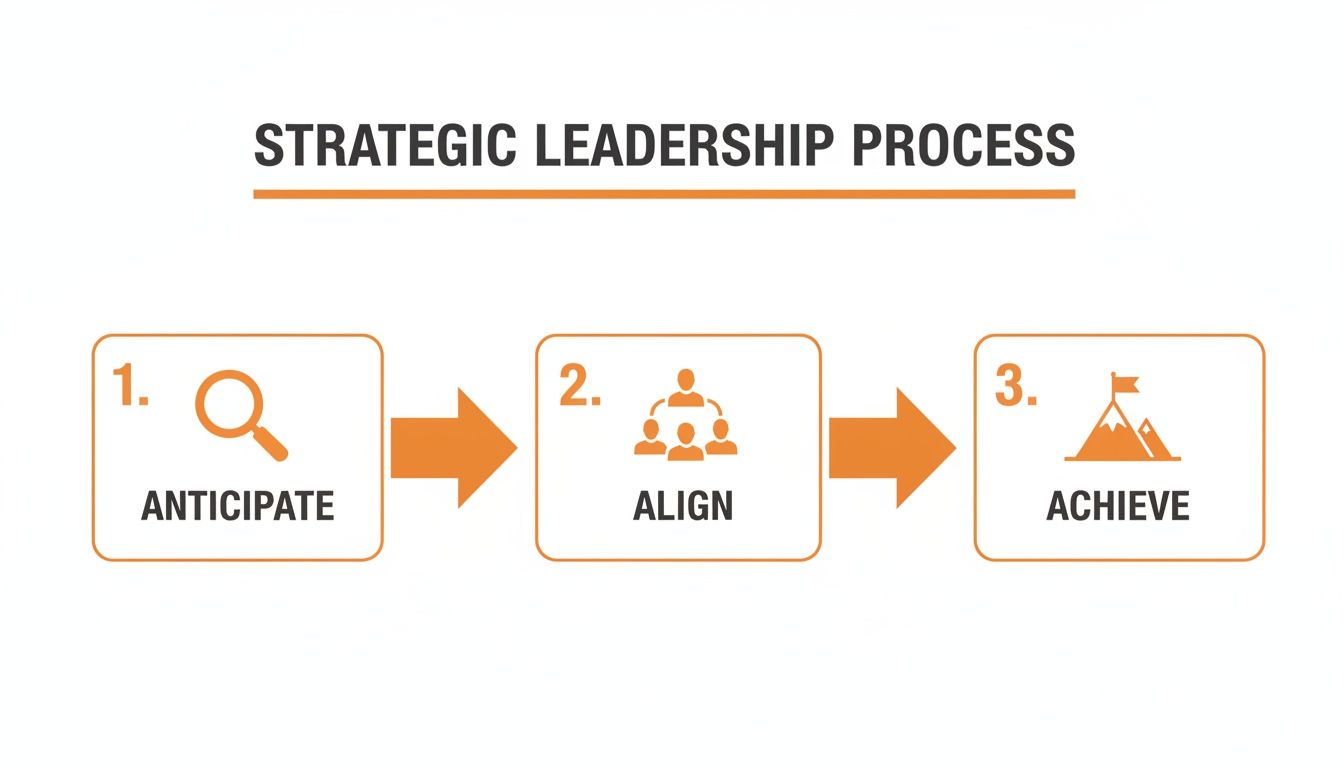
It all starts with looking ahead (Anticipate) and getting everyone on the same page (Align). Those are the pillars that support real results (Achieve).
The First Three Habits: Seeing What Others Miss
The first three habits are about perception. It’s about getting your head out of the day-to-day and seeing the bigger picture.
Anticipate: This is your early-warning system. It’s the retail manager who notices a slight dip in weekend foot traffic and adjusts schedules before sales take a hit. They’re not just reacting. You can build this skill by talking to your customers, reading outside your industry, or asking your team, "What’s one thing you think might change for us in the next six months?"
Challenge: Strategic thinkers don't just accept "the way we've always done it." They respectfully ask, "Why do we still do it this way?" Think of the engineer who questions if a legacy feature is still adding value, or if it's just being maintained out of habit. Challenging assumptions isn't about being difficult—it's about making sure your foundation is solid.
Interpret: We're drowning in data but starving for insight. Interpretation is the art of connecting the dots. It’s taking sales numbers, customer feedback, and the team's mood and finding the hidden story. A great leader can look at three unrelated pieces of information and spot the unifying trend.
The Final Three Habits: Turning Insight into Action
Seeing the field is one thing; making a play is another. This is where you translate observation into results.
Decide: This is where the rubber meets the road. Strategic leaders have the courage to make a call, even without all the answers. In business, waiting for 100% certainty is how you get left behind. DHR Global’s full talent outlook for 2026 found that agility is the #1 most critical competency for leaders today. The pressure is real—indecision creates stress and burnout.
The biggest risk isn’t making the wrong decision. It’s making no decision at all. Progress requires momentum, and momentum requires a choice.
Align: A brilliant strategy is worthless if your team doesn't understand it or believe in it. Alignment is the essential human side of leadership. It’s the warehouse manager who doesn't just announce a new inventory system but explains how it helps achieve company goals, giving purpose to a routine task. It's about connecting every individual's work to the bigger mission.
Learn: True strategic leaders are relentlessly curious. They see every outcome—good or bad—as a chance to get smarter. When a project succeeds, they dig into why. When it fails, they ask, "What did we miss?" without pointing fingers. This creates a culture where people feel safe enough to experiment and grow.
Mastering these habits isn't about perfection. It's about a steady rhythm of thinking and acting that keeps you focused on where you’re going, not just what’s in front of you.
How Strategic Leadership Changes the Game for Your Team
It’s easy to get lost in the theory, but what does this look like on a Tuesday morning? Why should your team care?
Honestly, it’s the difference between a crew punching the clock and a team building something meaningful together. For most people, work feels like an endless list of disconnected tasks. When a leader starts connecting those dots, everything changes.
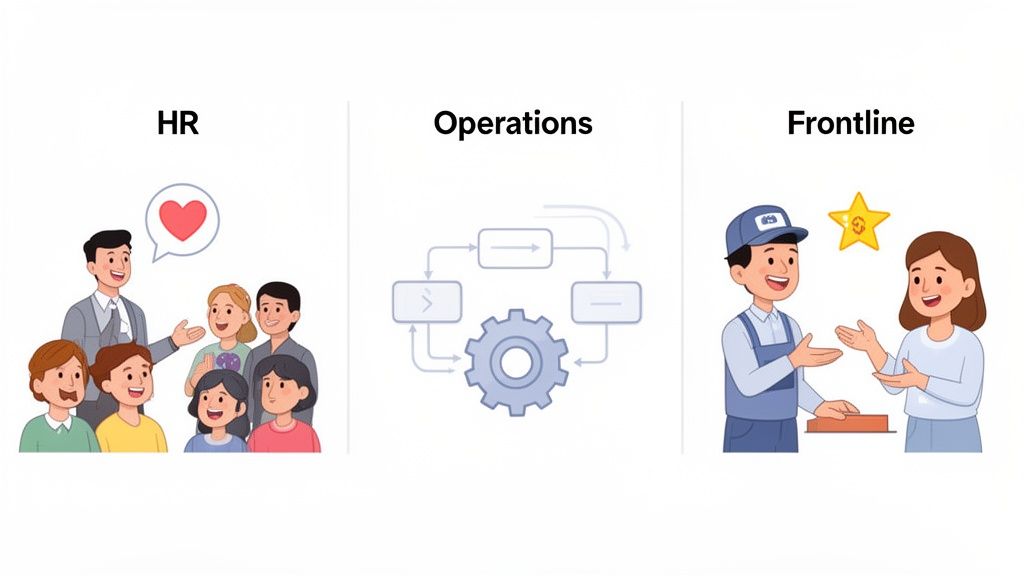
For HR: From Reactive to Proactive
For many HR teams, the day is a reactive fire drill: fixing payroll, mediating conflicts, pushing paperwork. It's all necessary, but it’s a defensive game.
A strategic leader flips the script. They help HR become a proactive force for culture. Instead of just reporting on turnover, they dig into the reasons people leave—and the reasons they stay. They question if policies actually help people do their best work or just create red tape.
Think about it. Rather than sending a generic annual survey, a strategic HR leader might use real-time feedback to spot burnout in a department. Then, they can work with that manager to adjust workloads before their best people leave. It's a move from administrator to culture architect.
A strategic leader helps HR evolve from a cost center into a value driver that builds an environment where people want to work and grow.
For Operations: From Busywork to Smart Work
In operations, the grind is relentless. Warehouse teams pick orders, logistics routes trucks, and the assembly line moves. Without a clear "why," it’s a soul-crushing cycle.
Here's where a strategic leader makes a tangible impact. They don't just push for more speed; they give people the context to work smarter. They'll explain that the new inventory scanning process isn't just another annoying step. It’s the key to slashing shipping errors, which directly protects the company's reputation.
Let's be real—nobody gets excited about filling out a new form. But people do get excited about being part of a plan that eliminates pointless work. A strategic operations leader ties every little process tweak to a bigger goal, turning task-doers into problem-solvers. This is one of the most powerful frontline leadership skills you can learn.
For Frontline Teams: From Invisible to Valued
Nowhere is this shift felt more than on the frontline. These are the people talking to your customers and handling your products every day. All too often, they feel like invisible cogs in a machine.
Strategic leadership makes them feel seen.
A nurse manager doesn’t just announce a new patient protocol. She shares a story about a patient whose recovery was faster because of it. Suddenly, the team’s actions are connected to their core purpose: healing people. A restaurant manager doesn’t just post the schedule. He uses shift data to have real conversations about work-life balance, proving he cares about his staff as people.
Ultimately, fostering a cohesive, motivated, and engaged team is a strategic necessity, not a nice-to-have. It’s about turning the daily grind into moments of connection. When people feel their work has a purpose, they stop just showing up and start showing they care.
Putting Strategic Leadership Into Practice Tomorrow
Talk is cheap. We can nod along with big ideas in meetings, but doing it on a hectic Tuesday? That's a different game.
So, let's get real. How do you move from good intentions to real action, starting tomorrow?
Forget grand, five-year plans for a minute. The path to strategic leadership is paved with small, deliberate shifts in how you listen, communicate, and connect the daily grind to the big picture.
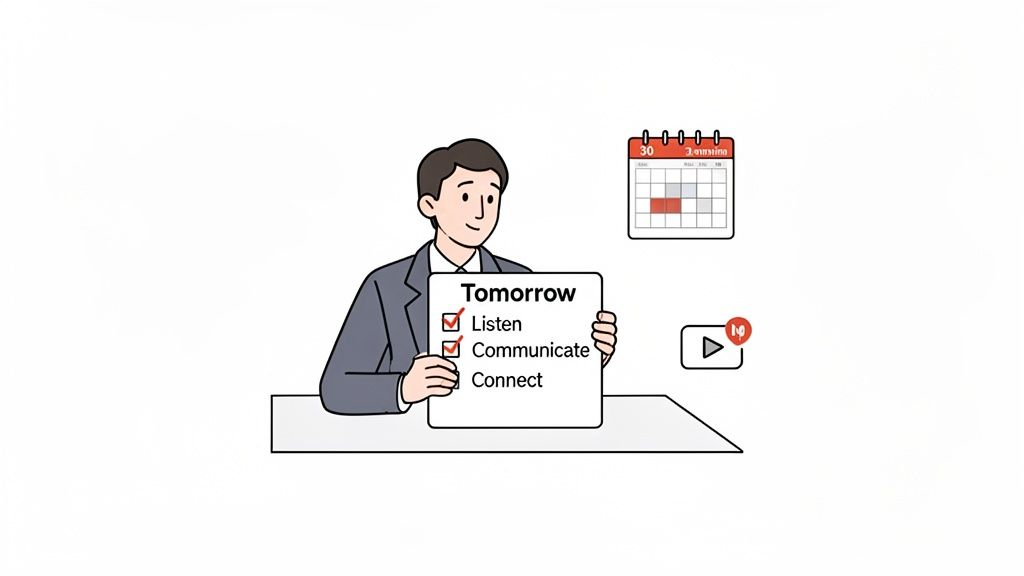
This isn't about adding more to your plate. It’s about changing your approach to the work that’s already there.
Step 1: Start Listening for Patterns, Not Just Problems
Most managers are conditioned to be expert problem-solvers. A customer has an issue, you solve it. A team member is stuck, you unstick them. This is valuable, but it’s entirely reactive. You're playing whack-a-mole.
A strategic leader listens for patterns.
Instead of just handling one complaint, you ask, "Is this the third time we've heard this feedback?" Instead of scrambling to fix a delay, you wonder, "What's the common thread in our last two shipping hiccups?"
You have to pull back from the fire to see the whole landscape. It’s the difference between fixing a leaky faucet and realizing the entire building’s plumbing is from the 70s.
Here’s how you can start tomorrow:
Block 30 minutes on a Friday. Don't plan next week’s to-do list. Review the week's "fires." What were the recurring headaches? Hunt for the theme, not just the isolated incidents.
In your next one-on-one, change your questions. Instead of, "What are you working on?" try, "What slowed you down this week?" or "What’s one thing our customers seem to be buzzing about?" You aren't just looking for a task; you're gathering intelligence.
This simple change in how you listen is the first step toward anticipating challenges before they become crises. It’s how you go from firefighter to architect.
Step 2: Communicate with Purpose and Connect the Dots
Every announcement, update, and huddle is a chance to reinforce the why. Strategic leaders don't just relay information; they frame it so the purpose is impossible to ignore. This might be the most powerful change you can make.
Think about all the routine things you communicate. How can you add one sentence of context that tethers that task to a bigger goal?
The goal is simple: Never let your team wonder why they are doing something. Make the connection between their work and the company's vision so obvious they can't miss it.
Let's look at a quick before-and-after.
Before (Operational Update): “Hey team, the new inventory tracking software goes live on Monday. Please complete the training by Friday.”
After (Strategic Communication): “Hey team, the new inventory software goes live Monday. I know learning a new system is a pain, but this is a critical step toward our goal of reducing shipping errors. Getting this right means happier customers and fewer frantic calls for all of us. Please wrap up the training by Friday so we can hit the ground running.”
See the difference? The first is a directive. The second is an invitation to be part of a solution. That context isn't just nice to have—it's essential fuel. It’s how you transform a checklist item into a shared mission. To explore this further, check out our guide to building an effective communications strategy.
Simple Ways to Communicate with Purpose
When you post the weekly schedule: Add a quick note: "I've added an extra person for the Saturday afternoon shift to help with the weekend rush we've been seeing. The goal is to make things feel less chaotic for everyone."
When you share performance numbers: Never just show the data. Explain what it means. "Our customer response time dropped by 10 seconds last month. That's fantastic—it shows we're delivering on our promise of fast, personal service."
When you kick off a new project: Take two minutes to explain why this project matters to the company's goals for the quarter. Connect their effort to the company’s success.
This isn’t about writing long, corporate memos. It’s about using every small interaction to build a bridge between the daily work and the larger vision. It's how you make strategy a living part of your team's culture.
Common Traps That Kill Strategic Thinking
Becoming a strategic leader sounds great in a meeting, but it’s dangerously easy to let the idea fall apart in the daily chaos. Let's be honest about the common pitfalls that sabotage even the best intentions. These aren't big failures; they’re subtle habits that chip away at your ability to look ahead.
The biggest one? The tyranny of the urgent.
This is that relentless drumbeat of daily firefighting—the unexpected customer complaint, the server outage, the last-minute schedule change. You wrap up the day drained but with a sense of accomplishment because you handled every crisis.
Here’s the problem: while you were busy stamping out small fires, no one was on the bridge scanning the horizon. You were so consumed by what felt urgent that you lost sight of what was actually important.
The Paralysis of Too Much Information
On the flip side, you have the opposite problem: analysis paralysis. This is when you get so buried in data and reports that you fail to make a decision. You're always waiting for just one more chart to confirm what you already suspect.
But you'll never have perfect information. A 2024 McKinsey study found that organizations with faster decision-making had significantly higher financial returns. Waiting for 100% certainty is a recipe for being overtaken by a competitor who was willing to move with 70%.
Strategic leadership isn’t about finding the perfect answer. It’s about having the courage to make a good decision now with the information you have, and the wisdom to learn and adjust as you go.
A good plan today is almost always better than a perfect plan next month.
The Strategy That Dies in Silence
Finally, there’s the trap of poor communication. This is what happens when a brilliant strategy dies on the vine because the team never really got it. They never understood how their tasks connected to the bigger picture.
It’s the classic story of a strategy that lives and dies in a PowerPoint deck. The leader is fired up, but to the frontline team, it just looks like another confusing change of direction. They don't know the why.
Here’s a simple way to start building safeguards:
Block Time to Think: Carve out 30-60 minutes on your calendar every Friday and label it "Strategic Review." Use this time to look at the week's trends, not just its tasks. Protect this time like it’s your most important meeting of the week—because it is.
Embrace "Good Enough" Decisions: For your next low-stakes decision, give yourself a hard one-hour deadline. Gather what you can, make the call, and move on. It's a workout for your decision-making muscle.
Translate, Don't Announce: The next time you share an update, add one sentence that explains why it matters to your team. Instead of saying, "We're changing the process," try, "We're changing this to cut down on manual errors, which will save everyone time and a few headaches."
These are small, intentional habits that create breathing room for strategic leadership. Think of them as quiet acts of rebellion against the pull of the urgent.
Thinking Beyond Tomorrow
We’ve all had those days, haven't we? The ones where we're buried in emails, putting out one fire after another. We get to the end, completely wiped, but with a weird sense of accomplishment because the inbox is finally at zero.
The problem is, that's just managing the chaos. While we're all heads-down, bailing water, who’s actually steering? Who’s scanning the horizon for what’s next?
This is where strategic leadership comes in. It’s not some lofty theory. It’s the deliberate choice to lift your head up and ask two simple questions: “Where are we really going?” and “Why?”
It’s less about predicting the future and more about building a culture where everyone feels like they're part of the voyage. It’s about making the “why” so powerful it becomes the compass for every single person.
The real question isn't whether you have time for strategic leadership. It's whether you can afford not to.
This shift in focus makes all the difference. It’s what separates a team just trying to get through the week from one that’s excited to build the future. It’s the gap between a company that’s always reacting to market shifts and one that’s actually causing them.
We obsess over optimizing our tools, but we often forget to optimize for purpose. When people see a direct line between their daily work and the company's mission, something clicks. They don't just work harder—they work with more creativity and genuine investment.
So, I'll leave you with a challenge: what's one small thing you can do this week to connect one person's daily work to that bigger picture? It doesn’t have to be a big announcement. A quick comment in a team chat or a two-minute conversation can be enough.
Sometimes, the most strategic thing a leader can do is simply connect the dots for someone else.
Your Questions Answered
Strategic leadership is one of those terms that gets thrown around a lot. It sounds impressive, but what does it mean in the real world? Let's cut through the jargon and tackle a few common questions.
How Is Strategic Leadership Different From Strategic Planning?
It’s easy to mix these two up, but the difference is huge. A company can spend months creating a beautiful strategic plan—a perfect, detailed map of where they want to go.
That map is the strategic plan. But strategic leadership? That’s the person steering the ship, navigating the real-world storms, and keeping the crew motivated when they’re a thousand miles from shore. One is a document; the other is a dynamic, human action. One lives in a binder; the other lives in your daily decisions.
Can a Frontline Manager Really Be a Strategic Leader?
Not only can they, but they must be. It's a massive missed opportunity if they aren't. Your frontline managers are closer to your customers and your day-to-day operations than anyone. They’re the first to notice a new customer complaint, a brilliant workaround an employee discovered, or a process that’s grinding to a halt.
A great frontline leader doesn't just pass down orders. They act as a vital intelligence officer, sending crucial insights up the chain of command. They are the ones who translate the company's grand vision into meaningful, daily tasks for their team.
The most powerful strategic insights often don't come from the boardroom. They come from the people doing the actual work every day.
What Is the First Step to Developing Strategic Leadership Skills?
This is my favorite question because the answer is simple. Start asking "why" more often.
It’s a tiny habit with an enormous ripple effect. Before delegating a task, explain why it’s important. When you’re in a performance review, connect that person’s work directly to the team’s purpose.
Want a concrete way to practice? Try dedicating just 10% of your one-on-one meetings to talking about the future—goals, ideas, and possibilities—instead of only reviewing past work. Shifting your focus from just the "what" to the "why" and "what's next" is the foundational muscle of strategic thinking. You can start building it today.
Bringing your strategy to life requires keeping everyone on the same page, from the front office to the frontline. Pebb is the all-in-one work app that unifies communication and operations, helping you connect your team's daily work to your company's biggest goals. See how Pebb can help you build a more connected and strategic organization.
