
10 Project Manager Strategies We Actually Use
A calm, opinionated guide to the 10 project manager strategies that deliver results, not just reports. Learn to manage projects with confidence and clarity.
Dan Robin
Let’s be honest. Most project management "strategies" are just repackaged jargon. They promise clarity but deliver complexity, burying teams in Gantt charts and status meetings that go nowhere. We’ve been there. For years, we wrestled with frameworks that felt disconnected from the actual work. We spent more time managing the process than the project.
It’s a common trap. You spend more time updating your project tool than making progress. The pressure to stick to a rigid plan, even when reality changes, is exhausting. A project manager’s real job isn’t to enforce a system; it’s to guide a team toward a goal, adapting as you go. But before you can guide anyone, you need to know your own role. It's easy to blur the lines with other key players, which is why understanding the distinction between Product Manager and Project Manager is the first step. Clarity in your own responsibilities is the foundation for any strategy.
Over time, through trial and a lot of error, we found what actually works: a handful of core principles that cut through the noise. This isn't a textbook list. It's a collection of battle-tested project manager strategies we rely on every day, from Agile to the Critical Path Method. They’re about focusing on people, progress, and sanity.
This article will walk you through these approaches. We'll show you not just what they are but how we use them, with real examples from our work and others. Here’s what we learned, one project at a time.
1. Agile Project Management
If you've ever worked on a project where the goalposts kept moving, you know how frustrating rigid plans can be. That’s where Agile comes in. It’s a mindset that values responding to change over blindly following a plan. At its core, Agile breaks big projects into small, manageable cycles called sprints. This makes it one of the most effective project manager strategies for complex work.
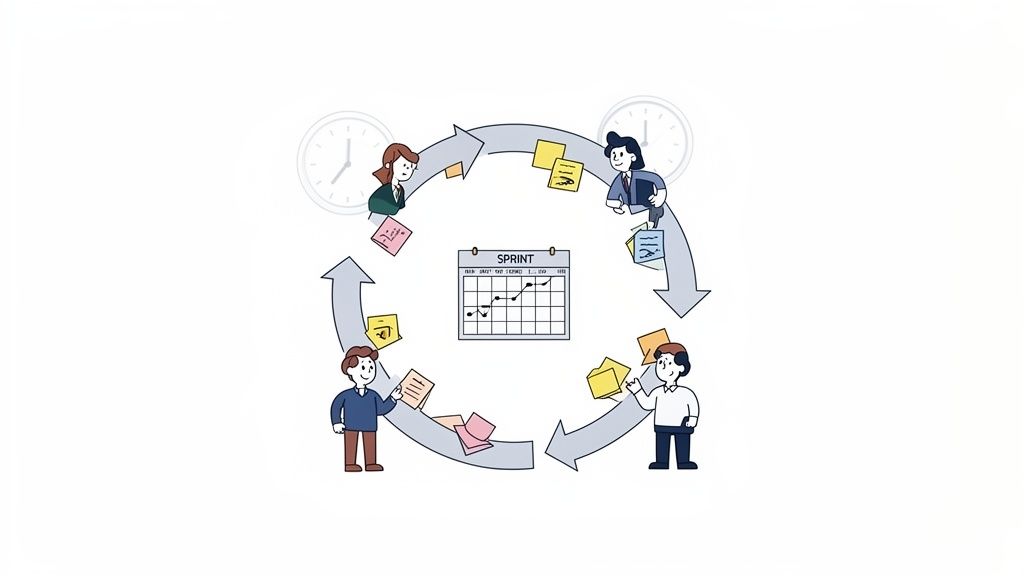
Think of companies like Spotify, which organizes its teams into autonomous "squads" to develop features. They use Agile principles to stay nimble and deliver value quickly. The goal isn't just speed; it's about building the right thing. Continuous feedback from users is baked into the process, allowing teams to adjust course with each sprint.
How we put it into practice:
Getting started with Agile doesn’t require a massive org change. We've made huge progress with just a few simple moves, especially when everyone has the right tools.
Run asynchronous standups: For distributed teams, daily standups can be a pain. We use a chat tool like Pebb to have everyone post their updates in a dedicated channel. It keeps everyone in the loop without disrupting their flow.
Keep sprints visible: A shared task board is non-negotiable. We built Pebb’s Tasks so teams can track sprint items, see who is working on what, and flag blockers in real time.
Create dedicated project spaces: Context-switching kills productivity. We give each project its own digital space where all conversations, files, and tasks live. This helps everyone stay focused.
Agile shines when you’re navigating uncertainty. It gives your team the structure to move forward and the freedom to adapt.
2. Waterfall Project Management
While modern work often favors flexibility, sometimes the best path forward is a straight line. That’s the Waterfall method. It’s a classic, sequential approach where you complete one phase fully before moving to the next. Like a cascade of water. This linear process makes it one of the most dependable project manager strategies for projects where requirements are crystal clear from the start.
Think of constructing a building. You can’t start building the walls before the foundation is poured. This is where Waterfall excels. It’s a staple in highly regulated sectors like healthcare or government for large infrastructure projects. The emphasis on thorough documentation and formal sign-offs at each stage provides a clear audit trail and minimizes risk when compliance is non-negotiable.
How we put it into practice:
Adopting Waterfall is about bringing discipline and order to your workflow. We’ve found that teams in regulated industries thrive with this structure, especially when they have a central place to manage everything.
Centralize project documents: For Waterfall to work, everyone needs access to the official plans. We use a central knowledge base in Pebb to store all project documentation, ensuring everyone works from the same playbook.
Create dependent task lists: We build a master checklist in a task tool that clearly shows which phase must be completed before the next can begin. We designed Pebb’s Tasks to handle these dependencies.
Communicate phase completions formally: We use a dedicated updates channel to announce when a phase is complete and has been signed off. This keeps all stakeholders, from leadership to frontline staff, informed and aligned.
3. Lean Project Management
Ever felt like your team is drowning in busywork? Lean might be the answer. It’s a philosophy centered on one idea: maximize value by eliminating everything that doesn't add it. Originating from the Toyota Production System, Lean isn't just for manufacturing anymore. It's a way of thinking that cuts through the noise, making it one of the most practical project manager strategies for operational efficiency.
Think of Amazon's obsession with operational efficiency, where every second and movement is optimized. They are applying Lean principles to systematically remove "waste," which can be anything from unnecessary meetings and redundant paperwork to idle time waiting for approvals. The goal is a smooth, uninterrupted flow of work that delivers exactly what the customer needs.
How we put it into practice:
You don’t need to be a car manufacturer to benefit from Lean. We've seen significant strides by focusing on small, continuous improvements, especially when there's a central tool to see what’s really happening.
Map your real-world processes: We use a dedicated Pebb Space to visually map out a team's workflow. We invite team members to comment on where they see delays or redundant steps. This simple act often reveals surprising bottlenecks.
Automate routine tasks: Manual data entry for payroll or HR is pure waste. We integrate our systems with Pebb to automate these tasks, freeing up our team from mind-numbing work.
Make standard procedures accessible: Don’t let knowledge get stuck in binders or someone’s head. We create clear, simple standard operating procedures (SOPs) in a shared Knowledge Library so every team member can access the best way to do a task, right from their phone.
Lean is perfect for projects where the process is as important as the outcome. It encourages a culture of continuous improvement and helps achieve operational excellence.
4. Six Sigma Project Management
If you feel like your team is constantly putting out the same fires, it’s a sign that the underlying process is broken. That's what Six Sigma is built to fix. It’s a data-driven approach that aims to remove defects and reduce variability, striving for near-perfect quality. As a project manager strategy, it’s less about managing a single project and more about perfecting the systems that produce the work.
This method was famously used by Motorola to improve quality and later championed by General Electric, where it reportedly saved the company billions. But it’s not just for manufacturing. Bank of America used it to refine customer service processes, and hospitals apply it to improve patient safety. The core idea is to find the root cause of a problem with data, not guesswork, and then systematically eliminate it.
How we put it into practice:
You don’t need to be a statistician to bring a Six Sigma mindset to your team. We've made big strides by focusing on measurement and standardization, which is much easier when your tools are built for it.
Gather your baseline data: You can't improve what you don't measure. We use Pebb’s analytics to get a clear picture of team performance, like task completion rates or response times.
Standardize quality checks: To reduce errors, make your process repeatable. Within Pebb’s Tasks, we create standardized checklists and approval workflows that every item must pass through. This ensures consistency.
Build a control system: We document our improved processes in a central Pebb Knowledge Library, complete with before-and-after metrics. This gives everyone a single source of truth and prevents old habits from creeping back in.
Six Sigma works best when you need to deliver consistent, high-quality results at scale. It gives you the framework to stop firefighting and start building processes that work.
5. Scrum Framework
If Agile is the mindset, Scrum is the playbook. It’s a specific, structured way to put Agile principles into action, giving teams a clear set of rules and roles to follow. Scrum is designed to help teams tackle complex problems by breaking them into smaller pieces and delivering value in short, consistent cycles. This makes it one of the most popular project manager strategies for software development and beyond.
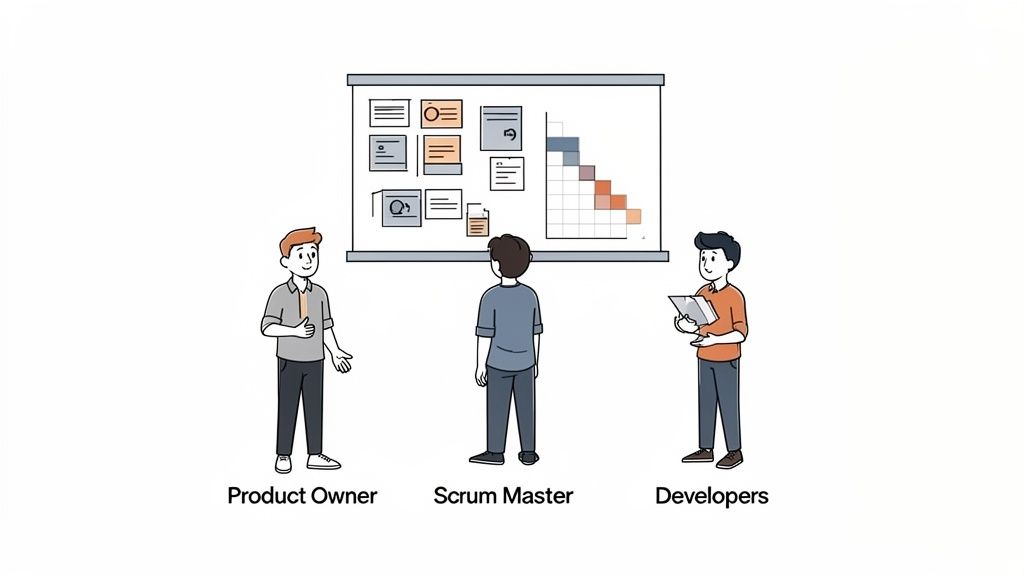
Tech giants like Google and Microsoft built iconic products using Scrum. It provides a rhythm for the work with defined roles (Product Owner, Scrum Master, Development Team) and ceremonies (sprints, standups). The goal is to create a tight feedback loop that keeps the team focused, accountable, and always shipping something valuable.
How we put it into practice:
Scrum can feel a little rigid at first, but we’ve found that having the right central hub for communication and tasks makes all the difference.
Set up dedicated Scrum spaces: We create a specific Space in Pebb for each Scrum team. Within that Space, we make separate channels for daily standups, retrospectives, and backlog grooming. This keeps all conversations organized and context-rich.
Manage your backlogs visually: A messy backlog is a project killer. We use Pebb’s Tasks feature to build and manage our product and sprint backlogs. You can easily drag and drop items to prioritize them, assign owners, and track progress.
Run effective ceremonies: We schedule daily standups using Pebb's events and encourage asynchronous updates in a dedicated chat channel for remote team members. This keeps everyone aligned without forcing another meeting. We also use @mentions to tag the Scrum Master or Product Owner with questions and blockers.
Scrum thrives on transparency and routine. It gives your team the structure to build momentum and the clarity to know what to work on next, sprint after sprint.
6. Kanban Project Management
If your team is drowning in a sea of overlapping tasks and unclear priorities, Kanban might be the lifeline you need. Instead of working in time-boxed sprints, Kanban is all about visualizing your workflow and improving it continuously. It's a pull-based system that helps your team focus on finishing work, not just starting it. This makes it one of the most practical project manager strategies for teams handling a constant stream of requests.
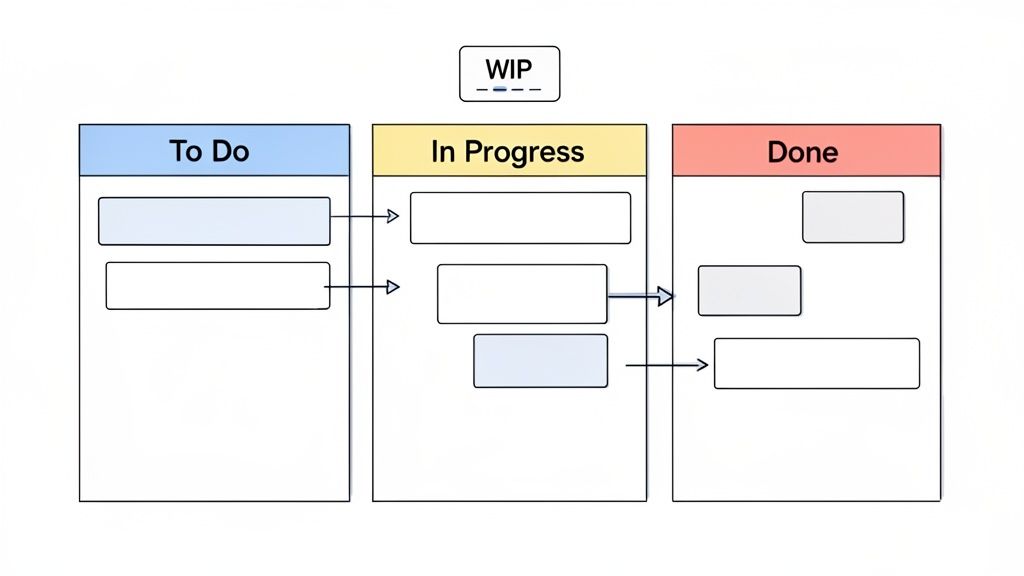
This method comes from Toyota's production system. Think of a software support team handling daily tickets or a content team managing an editorial calendar. They use Kanban to see exactly where every piece of work stands. The goal is to create a smooth, predictable flow by limiting how much work is "in progress" at any given time. This simple constraint prevents team burnout and helps everyone get more done.
How we put it into practice:
You don’t need a massive overhaul to start with Kanban. We've found that a simple digital board is the most important first step, especially for teams who need a single source of truth.
Create a visual board: We use a tool like Pebb's Tasks to build a simple board with columns for each stage of our workflow (e.g., Backlog, In Progress, Review, Done). This makes the work visible to everyone.
Set Work-in-Progress (WIP) limits: This is the magic of Kanban. Decide how many tasks can be in each "in-progress" column at once. We document these limits in the description of our Pebb Space to keep the team focused on finishing tasks.
Pin your policies: We keep our workflow rules and policies pinned in our team’s Space. This ensures everyone knows the process and can access it easily, which is great for new hires or shift handovers.
Kanban is perfect for teams that need to stay flexible while maintaining a steady output. It brings clarity to chaos and helps you continuously improve how your team delivers.
7. Critical Path Method (CPM) Project Management
When you’re managing a massive project, the biggest fear is a tiny delay on a small task creating a catastrophic domino effect. The Critical Path Method (CPM) is designed to prevent exactly that. It maps out every task and its dependencies to find the longest sequence of activities. This sequence, or "critical path," dictates the minimum time your project will take.
This method was used by DuPont in the 1950s and became a staple for NASA. Think about a major hospital renovation or an enterprise-wide software deployment. Any delay on a critical task, like completing data migration, pushes the entire project finish line. CPM gives you the clarity to know which tasks have zero wiggle room and which have some slack. It’s one of the most powerful project manager strategies for time-sensitive, high-stakes work.
How we put it into practice:
You don’t need to be building rockets to use CPM. We’ve found that the discipline of mapping dependencies brings immense focus, especially when you have a tool that makes those connections clear.
Map out dependencies visually: We use a project management tool like Pebb’s Tasks to create a hierarchy of activities, linking tasks together to show which ones must be completed before others can begin. This makes the critical path obvious.
Create a master schedule: We build a single source of truth in a shared space like Pebb’s Knowledge Library, documenting the critical path milestones so everyone knows what matters most and when.
Automate dependency notifications: Waiting for someone to tell you their task is done is a recipe for delays. We use Pebb’s @mentions to automatically notify the next person in the chain the moment a preceding task is marked complete.
CPM excels when projects are intricate and deadlines are firm. It takes the guesswork out of prioritization and helps you focus your energy where it will have the biggest impact on your timeline.
8. DevOps Project Management
If your development team ships a feature, but the operations team can't support it, the project isn't a success. DevOps tackles this by erasing the line between development (Dev) and IT operations (Ops). It’s a cultural shift that encourages shared responsibility, automation, and constant feedback, making it a critical project manager strategy for tech-driven companies.
This isn’t just theory. Companies like Netflix and Amazon live this every day, deploying code thousands of times a day because their dev and ops teams work as one. DevOps focuses on building a reliable pipeline for continuous integration and delivery (CI/CD), where automation handles the heavy lifting of testing and deploying code. The goal is to deliver better software, faster, by making sure everyone is on the same team.
How we put it into practice:
You can foster a DevOps culture without overhauling your entire org chart. It starts with creating shared spaces and workflows that break down traditional silos. We designed Pebb to be the connective tissue for this kind of work.
Create dedicated communication hubs: We set up a Pebb Space for our dev and ops teams with specific channels for
#deployments,#incidents, and#retrospectives. This keeps critical conversations organized and visible to everyone.Track workflows transparently: We use Pebb’s Tasks to map out our deployment pipeline or incident response plan. Everyone can see the status of a release or who is handling a critical issue.
Centralize critical information: We share monitoring dashboards, alerts, and runbooks using Pebb’s file sharing and Knowledge Library. When an incident occurs, no one has to scramble to find the right playbook.
DevOps thrives on tight feedback loops and shared ownership. It gives teams the ability to not only build and ship quickly but also to maintain and improve what they’ve built, together.
9. Hybrid Project Management
What if you could have the best of both worlds? Sometimes a project needs the predictable structure of a waterfall plan, but other parts demand the flexibility of Agile. The one-size-fits-all approach rarely works. Hybrid project management is the pragmatic answer, mixing predictive and adaptive methods to fit the job. It’s one of the most practical project manager strategies because it acknowledges that not all project phases are created equal.
Think about a large enterprise software rollout. The initial infrastructure setup and requirements gathering might follow a strict waterfall approach because those elements are well-defined. But once the foundation is set, the development of new features can switch to an Agile, sprint-based cycle. This allows the team to adapt based on user feedback. It’s a common approach in government modernization projects and digital transformations.
How we put it into practice:
Adopting a hybrid model is about being intentional. It requires clear communication to avoid confusion. We’ve managed this complexity well by creating distinct digital environments for each methodology.
Organize spaces by phase: In Pebb, we create separate Spaces for different project phases. A “Planning” space can follow a waterfall model with sequential tasks, while a “Development” space operates with an Agile board and sprints.
Define clear governance: We use a knowledge library to document which methodology applies to which part of the project. This document becomes the single source of truth.
Use distinct workflows: Pebb’s Tasks can be configured with different statuses for each methodology. The waterfall phase might have statuses like “Planned,” “In Progress,” and “Complete,” while the Agile phase uses “To Do,” “Doing,” and “Done.”
Communicate transitions clearly: When moving from a waterfall phase to an agile one, we make a formal announcement. We use a project-wide update to explain the shift in process and expectations.
A hybrid approach gives you the structure you need for predictable work and the freedom you need for uncertain work. It’s a smart way to manage complex projects without forcing a single methodology where it doesn’t fit.
10. Stakeholder-Centric Project Management
A project can meet every deadline and budget, but if it fails to win over the people it affects, it's a failure. This approach makes stakeholder needs, expectations, and feedback the core of the project. It's one of the most crucial project manager strategies because projects are ultimately for people.
This isn't just about sending more emails. It's about genuine engagement. Think about large-scale digital transformation programs. The projects that succeed are the ones where every impacted group, from leadership to the front line, feels heard. The goal is to build alignment and shared ownership, turning potential critics into project champions.
How we put it into practice:
Making your project truly stakeholder-centric requires a structured approach to communication. We've seen how a central hub can make all the difference, connecting disparate groups and giving everyone a voice.
Map your stakeholders: Who is impacted by this project? We use a tool like Pebb’s People Directory to identify everyone by role, department, and location. This map is our starting point for all communication.
Create dedicated communication channels: Not everyone needs the same information. We set up separate Spaces in Pebb for different groups, like a "Steering Committee" space for high-level updates and a "Frontline Team" space for practical training info. A solid plan is key to strategic internal communication.
Gather feedback proactively: Don't wait for problems. We use chat and events to run regular feedback sessions and create dedicated Spaces for advisory groups to maintain an open dialogue.
This strategy is essential when a project's success depends on adoption and buy-in. You don't just manage a project; you lead a coalition toward a shared goal.
Project Management Strategies: 10-Point Comparison
Methodology | 🔄 Implementation Complexity | ⚡ Resource Requirements | ⭐📊 Expected Outcomes | Ideal Use Cases | 💡 Key Advantages |
|---|---|---|---|---|---|
Agile Project Management | Medium — iterative governance, regular ceremonies | Moderate — cross-functional teams, collaboration tools, stakeholder time | High ⭐⭐⭐⭐ — faster time-to-market, incremental value delivery 📊 | Product development, distributed teams, rapid-feedback platforms (e.g., Pebb) | Flexible to change; strong stakeholder engagement; tip: use async standups and track velocity |
Waterfall Project Management | Low–Medium — linear, phase-gated process | Moderate — heavy upfront planning and documentation | Predictable ⭐⭐⭐ — stable budgets/timelines, clear milestones 📊 | Regulated industries, infrastructure, projects with stable requirements | Clear audit trail and compliance; tip: centralize documentation in Knowledge Library |
Lean Project Management | Medium–High — requires process analysis and cultural change | Moderate — training, analytics, process-mapping effort | High ⭐⭐⭐⭐ — reduced waste, cost and time savings, improved quality 📊 | Operations-heavy orgs (retail, warehouses, hospitality) | Maximizes value by eliminating waste; tip: use analytics to identify bottlenecks |
Six Sigma Project Management | High — structured statistical methodology (DMAIC) | High — specialist training (belts), data collection and tooling | Very high ⭐⭐⭐⭐ — dramatic defect reduction and consistent quality 📊 | High-volume operations, healthcare, manufacturing, process-critical workflows | Data-driven and scalable; tip: document control charts and baseline metrics |
Scrum Framework | Medium — defined roles, ceremonies, and artifacts | Moderate — Scrum Master/PO roles, backlog tools | High ⭐⭐⭐⭐ — rapid feedback, transparency, team accountability 📊 | Tech teams, iterative feature delivery, distributed teams | Structured agility with clear roles; tip: separate Spaces for ceremonies and backlogs |
Kanban Project Management | Low–Medium — visual system with WIP discipline | Low — lightweight tooling and ongoing board maintenance | Moderate–High ⭐⭐⭐ — improved flow, visibility, reduced context switching 📊 | Support/maintenance, customer service, continuous ops | Low barrier to entry and flexible; tip: set WIP limits and monitor cycle time |
Critical Path Method (CPM) | High — detailed dependency mapping and scheduling | Moderate — planning effort, scheduling tools | High ⭐⭐⭐⭐ — accurate timelines, risk/dependency visibility 📊 | Complex infrastructure, large deployments, healthcare implementations | Identifies tasks that drive schedule; tip: maintain dependency-driven task lists |
DevOps Project Management | High — cultural change plus tooling and automation integration | High — CI/CD, infra-as-code, monitoring, automation skills | Very high ⭐⭐⭐⭐ — faster, more frequent releases and resilience 📊 | Software delivery organizations, platforms requiring CI/CD pipelines | Improves release velocity and reliability; tip: document runbooks and use shared Spaces for incidents |
Hybrid Project Management | High — governance across different methodologies | Moderate–High — mixed tooling and skillsets | High ⭐⭐⭐⭐ — balanced predictability and adaptability 📊 | Enterprise implementations, digital transformations with mixed phases | Combines structure and flexibility; tip: define governance and when each approach applies |
Stakeholder-Centric Project Management | Medium — extensive engagement and communication effort | Moderate — stakeholder time, communication channels, mapping | High ⭐⭐⭐⭐ — higher adoption, alignment, reduced resistance 📊 | Change management, enterprise rollouts, M&A, high-adoption projects | Prioritizes adoption and alignment; tip: map stakeholders and use targeted communication plans |
The Only Strategy That Matters
We’ve just walked through ten different project manager strategies, from the rigid structure of Waterfall to the fluid cycles of Agile. It’s a lot. You could spend years mastering the Critical Path Method or getting a Six Sigma black belt.
But let’s be honest. After all the charts are drawn and the stand-ups are done, most projects fail because of a breakdown in something far more fundamental: communication. Thoughtfulness.
The single most effective strategy isn't a framework. It’s a mindset. It’s the habit of being consistently, relentlessly thoughtful.
Beyond the Buzzwords
All these methodologies, at their core, are just systems designed to force us to do the things we should be doing anyway. They make us plan ahead, talk to each other, check our work, and learn from our mistakes. You can get bogged down in the jargon and the "correct" way to run a retrospective, or you can cut to the chase.
The best project managers I've known didn't live and die by a single book. They were masters of adaptation. They cherry-picked. They borrowed a little from Lean for efficiency, used a Kanban board for visibility, and still created a high-level Gantt chart for the CEO because that’s what the stakeholder understood.
The goal is not to perfectly execute a methodology. The goal is to successfully deliver a project with a team that still wants to work with you afterward.
That’s the real work. It’s less about managing projects and more about guiding people. It’s about creating an environment where someone can say, "I think this deadline is unrealistic," without fear. It's about translating a client's vague request into a concrete task. It's about shielding your team from organizational chaos so they can actually focus.
Your Next, Smallest Step
So, what should you do tomorrow? Don't try to implement Six Sigma by lunchtime. Don't announce a company-wide shift to Agile in a single email. That’s a recipe for confusion.
Instead, find one point of friction and make it a little better.
Is your daily stand-up a waste of time? Ask the team: "What's one thing we could change to make this meeting more useful?"
Are tasks getting lost in email chains? Set up a simple, shared task board. It doesn’t have to be perfect; it just has to be better than what you have now.
Do stakeholders seem disconnected? Instead of a dense report, send a one-paragraph summary with three bullet points covering progress, problems, and next steps.
This is the essence of all good project manager strategies: small, continuous, thoughtful adjustments. A tool like Pebb can help by bringing tasks, team chat, and documentation into one calm, organized space. It reduces the noise of switching between five different apps, making it easier to have the right conversation in the right place. But the tool doesn’t do the work for you. It just gets out of your way so you can.
The real strategy is you. It’s your judgment, your empathy, and your courage to ask the simple, powerful questions. Start there. The rest will follow.
Tired of juggling spreadsheets, chat apps, and project tools? Pebb brings your team’s work into one simple, unified platform. See how a single source of truth can help you put these project manager strategies into practice without the chaos. Get a closer look at Pebb.
