
A Real-World Effective Communications Strategy That Actually Works
Stop talking past each other. Learn a practical and effective communications strategy to unify your teams, especially frontline staff, and drive real results.
Dan Robin
An effective communications strategy isn't a document you file away. It's the central nervous system of your business. It’s what ensures the right people get the right information at the right time, turning scattered teams into a single, cohesive force.
But let’s be honest. Most "strategies" are just a jumble of good intentions. A mess of disconnected apps and a flood of messages that miss the mark. We’ve all seen this movie before.
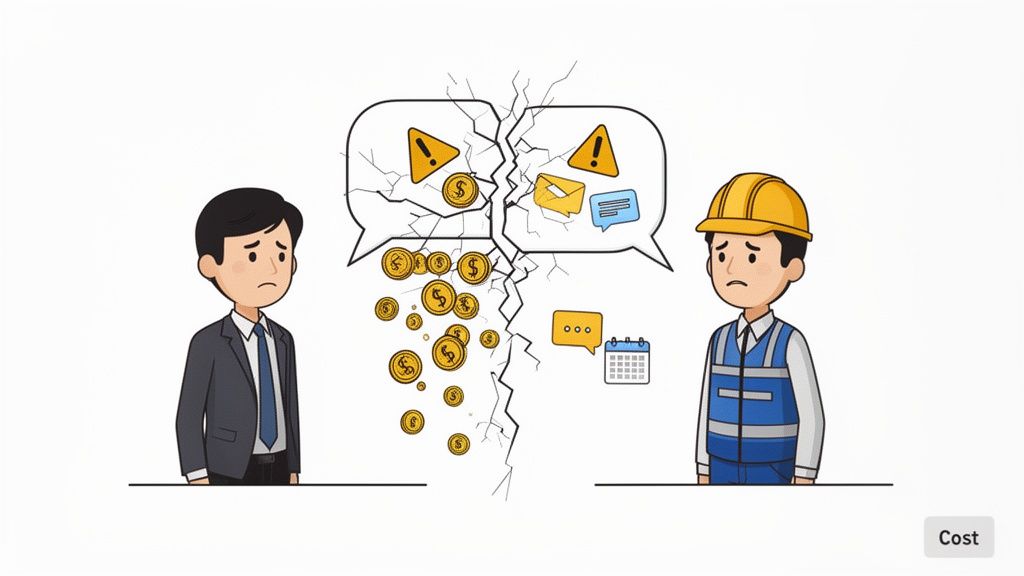
It’s the all-hands meeting your frontline crew can’t join. The critical safety update buried in an email no one reads. The engagement survey that comes back with feedback from a team that feels unheard.
This isn’t just a morale problem. It’s a massive financial drain hiding in plain sight.
The Real Cost of Bad Communication
We treat communication as a “soft skill,” but its absence has hard costs. The numbers are staggering. By 2026, U.S. businesses are on track to lose an estimated $1.2 trillion to $2 trillion every year because of poor communication.
A stunning 86% of employees and executives point to a lack of effective collaboration as a main cause of workplace failures.
This isn’t some abstract theory. For a single company, the cost can be anywhere from $9,284 to over $30,000 per employee, per year.
This is the real-world cost of project delays, safety incidents, and good people burning out and leaving. It’s the hidden tax you pay for being disconnected.
The Frontline Disconnect
This problem is especially painful for businesses with frontline teams—think retail, healthcare, and logistics. For them, the communication gap is a chasm. When your workforce isn't tied to a desk, tools like email and intranets just don't work.
I’ve seen the consequences play out again and again:
Operational Errors: A logistics team misses a small protocol change, leading to a massive, expensive shipping mistake.
Customer Dissatisfaction: A retail associate gives a customer wrong information about a new promo because they never saw the announcement.
Sky-High Turnover: A new hire in a busy warehouse feels isolated and quits after a month, forcing you to restart the costly hiring cycle. The lack of communication in the workplace has a direct, devastating impact on your teams.
Fixing this often starts with the basics, like helping managers improve verbal communication skills with their direct reports. It’s time to stop treating communication as an afterthought and see it for what it is: a core business function.
Before you draft that next company-wide announcement, stop. Ask yourself two simple questions: Who am I really talking to? And what do they actually care about?
It sounds obvious, I know. But this is where most internal communication plans unravel. We get so wrapped up in the message we want to send that we forget about the person on the other end. The result? A generic blast sent to everyone that connects with no one.
A truly effective strategy starts by seeing your people not as one big audience, but as distinct groups with different daily realities.
Think in Real-World Groups, Not Fictional Personas
Let’s be honest: building elaborate personas with stock photos and fake hobbies is marketing homework. For internal comms, you need to get practical. Your goal is to connect with real people based on their actual role.
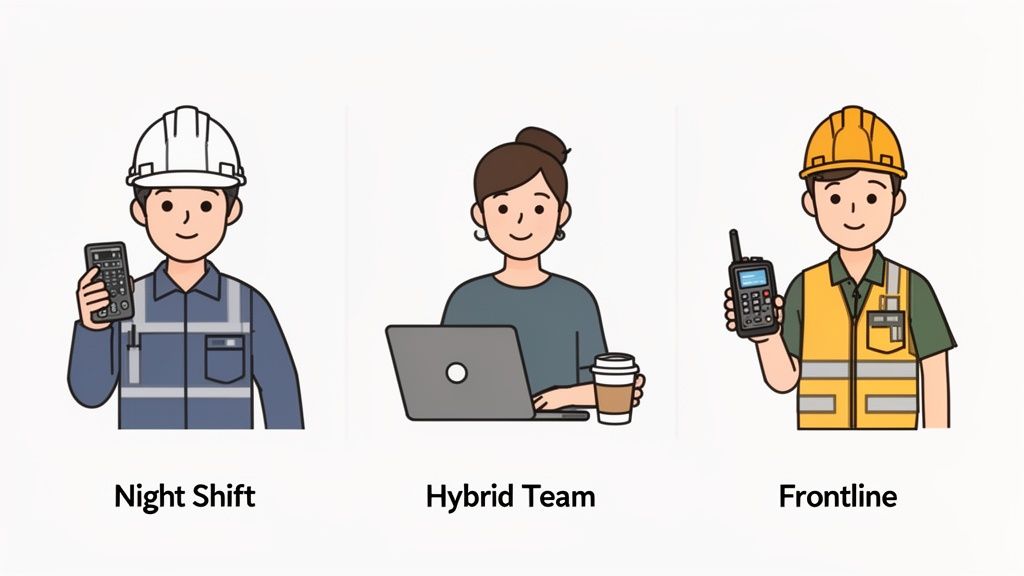
Think about it. The ‘Warehouse Night Shift’ has a completely different set of needs than the ‘Hybrid Marketing Team.’ One group needs to know about a safety protocol change on the loading dock, and they need that alert on their phone, right now. The other is more invested in Q3 strategic goals, which can be delivered during a scheduled video call.
To get this right, you need a clear picture of who makes up your workforce. In the B2B world, this is a lot like creating an Ideal Customer Profile to focus sales efforts. We can do the same thing internally.
Start by mapping out your people into simple, functional groups:
By Location: Corporate HQ, Dallas Warehouse, East Coast Retail Stores
By Role: Salaried Managers, Hourly Associates, Delivery Drivers
By Shift: Day Shift, Night Shift, Weekend Crew
By Team: Marketing, Engineering, Customer Support
This isn't about creating red tape; it's about building empathy and delivering information that’s genuinely useful.
Here's a simple table showing how this might look for a retail company. Notice how the same topic—a new inventory system—is communicated differently to each group.
Audience Segmentation Example For a Retail Business
Audience Segment | Primary Communication Need | Best Channel | Example Message |
|---|---|---|---|
Frontline Cashiers | Quick, scannable "how-to" for the new checkout process. | Mobile App Push Notification, Poster in breakroom. | "Heads up! New scanner training is now live in the app. Complete it before your next shift to earn a $10 bonus." |
Warehouse Team | Details on new receiving and stocking procedures. | Team Huddle, Manager Cascade, Mobile App Task. | "Big changes to our receiving process start Monday. Watch the quick video and see your manager for a live demo." |
Store Managers | Strategic overview, team training plan, and performance metrics. | Email, Dedicated video call. | "Here’s the full rollout plan for the new inventory system, including the training deck and KPIs for your store." |
Corporate HQ | High-level project status and business impact. | All-Hands Meeting, Intranet Post. | "Project Phoenix is on track for a Q3 launch, projected to improve inventory accuracy by 15%." |
Segmenting your audience forces you to think about what each group needs to succeed. It turns generic announcements into valuable, targeted updates.
Crafting Messages That Actually Land
Once you know who you’re talking to, you need a simple gut-check for your message. We’ve all gotten those rambling, five-paragraph emails from leadership where the actual point is buried. It's frustrating, and it's a waste of time.
Before you hit send, every communication should pass this simple 3-point test:
What’s the one-sentence purpose? Why are you bothering them with this right now?
What’s the key takeaway? If they only remember one thing, what must it be?
What’s the call to action? What do you need them to do or know next?
This isn’t about dumbing things down. It’s about respecting your team’s focus.
A message with a clear purpose, a memorable takeaway, and a direct action is a message that works. Anything else is just noise that trains people to ignore you.
Applying this filter forces discipline. It shifts your focus from "what I want to say" to "what they need to hear." That’s the heart of effective communication. It ensures that when you speak, people listen. And that makes all the difference.
Ditch the Chaos for a Single Source of Truth
Think about how information actually flows through your company. An urgent email from corporate lands, but a group chat is blowing up with questions, and a manager is texting about a last-minute shift swap. Don't even get me started on the ancient intranet where policies collect digital dust.
That’s not a communication strategy. It’s digital chaos. When your team is pinged from a dozen different places, important messages get lost. The constant app-switching is exhausting. It trains people to tune everything out.
The answer isn't another tool. The goal is to create one reliable place where everyone—from the front desk to the C-suite—knows to go for information that matters.
Why a Unified Platform Is a Game-Changer
For any organization with frontline or distributed teams, a unified, mobile-first platform isn't a nice-to-have. It’s the backbone of your operation. When your people are on a factory floor, in a hospital, or at a retail counter, their phone is their primary link to the company. Asking them to log into a clunky desktop portal after a long shift is a losing game.
What you're really building is a single source of truth. A digital headquarters that makes communication simple and accessible for everyone.
It’s the difference between chaos and clarity. Instead of fragmented conversations across apps, you get dedicated spaces where teams can chat, see updates, manage tasks, and find documents—all in one place.
Don’t underestimate the real cost of this fragmentation. Studies show the average employee toggles between 10 different apps every hour. That’s more than inefficient; it’s a massive drain on focus and a direct hit to productivity. Consolidating isn't just about saving money on software; it’s about giving your people back their time and attention.
The Non-Negotiable Features You Actually Need
When you start looking for a central communication tool, it’s easy to get wowed by flashy features. But based on our experience helping dozens of companies make this shift, only a handful of things are truly non-negotiable.
Your entire system has to be built on clarity and accessibility. Here's what that looks like in practice:
A Central News Feed: This is your official broadcast channel. A single, authoritative place for company-wide announcements that cuts through the daily chatter. No more, "Wait, did you see that email?"
Dedicated Team Spaces: Every department or location needs its own space to collaborate. The logistics for the warehouse team shouldn't get mixed up with the marketing team's brainstorming. Keep it relevant.
Powerful, Simple Search: This is huge. When an employee needs to find the new PTO policy, they should be able to find it in seconds. Great search turns your app into a true knowledge base. We cover this in-depth in our guide on how to build a central knowledge hub for your team.
Reaches Every Single Employee: I can't stress this enough. Your tool must reach everyone, whether they have a corporate email or not. For frontline teams, that means a mobile app they can sign up for with just a phone number. If 20% of your workforce is left out, your strategy is already broken.
The moment you let critical information live in multiple places, you've lost the battle. The goal is to build a habit where everyone instinctively knows, "If it's important, it's in the app."
This isn't about top-down control. It's about serving your employees by giving them a reliable, simple way to stay informed and connected. Moving away from chaos is the most powerful first step you can take.
Putting Your Communication Plan Into Action
A strategy document, no matter how brilliant, is just a piece of paper. It doesn't do anything on its own. The real work begins when you bring that plan to life. This is where your strategy stops being an idea and starts becoming a reality.
I like to think of it as moving from chaos to clarity. You start with a tangled mess of information, funnel it through a clear process, and end up with a single, trusted source of truth.
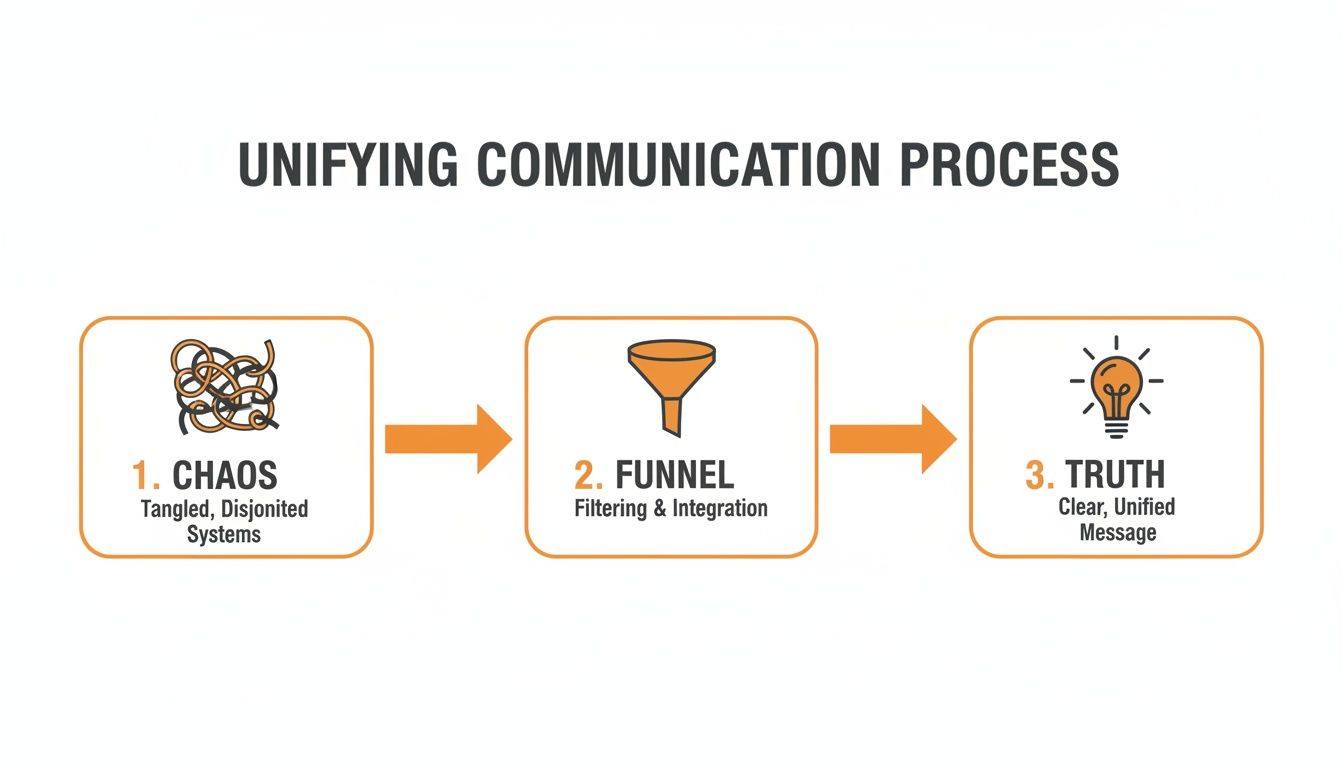
This visual captures the exact shift we’re aiming for. So, how do we actually do that?
First, Figure Out Who Owns What
It all starts with clear ownership. If you skip this, your beautiful plan will devolve into a frustrating game of “I thought you were sending that.” This isn’t about a complex org chart; it’s about simple, common-sense roles. We call this governance, but really, it just answers one question: who is responsible for what?
In most companies we've worked with, it breaks down pretty neatly:
A Central Admin (or Small Team): This is typically someone from HR, Internal Comms, or Operations. They are the gatekeepers for big, company-wide news—think major policy changes, quarterly results, or new benefit rollouts.
Team Leads and Managers: These are your most critical communicators. Period. They handle the day-to-day updates and team-specific announcements relevant only to their crew.
HR and People Ops: This team owns the sensitive and official stuff, like performance review cycles, important legal updates, and new hire onboarding materials.
Getting clear on these roles prevents crossed wires and makes sure messages come from the most trusted source. A frontline employee will always pay more attention to a direct update from their manager than a generic email from an executive they’ve never met.
Build a Simple Content Calendar
Once you know who’s in charge, you need a calendar. A communication calendar isn’t about micromanaging every post. It’s about creating a predictable rhythm your people can rely on. Think of it as a map that helps you communicate proactively, not just react to whatever fire is burning brightest.
A communication calendar turns random acts of communication into a reliable, steady drumbeat. It builds trust because your team knows what to expect and when.
This doesn't have to be complicated. A simple spreadsheet is a great place to start. Begin by plotting out all the recurring events and build from there.
Weekly: Team-specific updates from managers, shout-outs for great work.
Monthly: Recaps from the all-hands meeting, a summary of key project milestones.
Quarterly: Big announcements from the top, CEO messages on company direction.
This simple structure gives you a framework to plan around. Now, when a big announcement comes up, you can immediately see where it fits and how to prepare your team for it.
Use Templates to Move Faster and Smarter
For important announcements, you need a repeatable game plan. We use a straightforward, one-page Communication Brief to get everyone on the same page. It’s a quick document that forces you to answer the most important questions before you start writing.
Our brief includes:
The Goal: What do we want to achieve with this message?
The Audience: Who, specifically, are we talking to?
The Key Takeaway: What is the one thing they must remember?
The Channel: Where will we post this?
The Owner: Who is responsible for sending it and fielding questions?
And for when things go wrong, you need a Crisis Comms Checklist. Not some 50-page binder on a shelf. A simple, actionable list that outlines who needs to be involved, what needs to be said first, and how to manage the narrative.
Finally, there's the launch itself. Rolling out a new tool or process requires a human touch. It’s not just an IT project; you're asking people to change their behavior. Start with your leaders. Get them comfortable and excited first. Their buy-in is your most powerful tool. From there, focus on small wins and clearly explain "what's in it for me?" for every employee. Your plan, no matter how great, lives or dies on its execution.
Measure What Actually Matters
You know the old saying: if you can't measure it, you can't improve it. It’s a classic for a reason. But the problem I see is that most internal communication metrics are pure vanity. We get hung up on likes and view counts, but those numbers don’t tell you if a critical message was understood or—more importantly—acted upon.
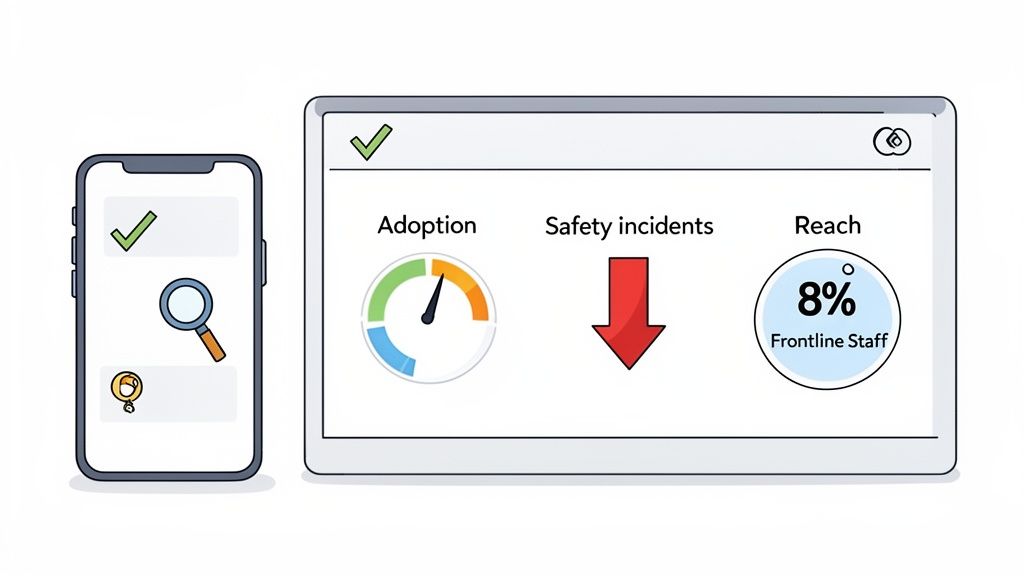
Let's be real. A post getting 1,000 views means nothing if your team still doesn’t follow the new safety protocol. To build an effective communications strategy, we have to stop chasing vanity metrics and start measuring what truly matters. This means shifting from tracking outputs to focusing on outcomes.
Beyond Vanity Metrics
The real test of your communication isn't "did they see it?" but "did it work?" Instead of getting lost in raw activity, we need to track the leading indicators that show if your communication is actually changing behavior.
Here’s what you should be focusing on instead:
Platform Adoption Rate: What percentage of your total workforce has activated their account on your central tool? This is your most fundamental health metric.
Active "Unreachable" Staff: Of your frontline, non-desk employees, what percentage is logging in and engaging weekly? This shows if you're finally reaching the people you used to miss.
Message Acknowledgment: For critical updates, what percentage of the target audience has confirmed they’ve read and understood the message? This is how you move from hope to certainty.
These metrics tell you if your foundation is solid. If people aren't even in the system or actively using it, the rest of your efforts are just noise. For a deeper dive, check out our guide on how to measure communication effectiveness.
The goal isn’t to prove how much you’re communicating; it's to prove how well you’re connecting. Good metrics tell a story about understanding and action, not just activity.
Connecting Communication to Business Outcomes
Here’s a hard truth: your CEO doesn't care about your open rates. They care about business results. The most powerful way to show your strategy's value is to draw a straight line from your communication efforts to tangible business outcomes.
It’s simpler than you might think. It just requires asking the right questions. For instance:
Did a safety campaign reduce incidents? After you launched that new safety protocol communication, did you see a 15% drop in reported incidents on the warehouse floor?
Did a policy update lower HR tickets? Following your clear post and Q&A on the new PTO policy, did support tickets on that topic decrease by 40%?
Did a sales update boost performance? After sharing tips from top performers, did the average deal size for the rest of the team increase?
This is how you turn communication from a "cost center" into a strategic driver of the business. You start proving its direct impact on efficiency, safety, and even revenue.
Mind the Leadership Gap
Even with the best strategy, a dangerous gap can form between what leaders think they're communicating and what employees actually hear. This is especially true with complex topics like AI in the workplace.
The disconnect can be jarring. For example, a 2024 study from DHR Global's detailed report shows that while 69% of C-suite leaders believe they've communicated very clearly about AI, only 12% of entry-level staff agree. This chasm directly impacts engagement; 74% of leaders report higher engagement due to GenAI, compared to just 27% of their entry-level employees.
This isn't about pointing fingers. It's about using measurement to shine a light on these blind spots. Simple pulse surveys after a major announcement can give you real visibility into whether your message landed as intended. Don't guess—ask. The answers will show you exactly where your strategy needs a tune-up.
Your Questions, Answered
Even with the best strategy, questions always pop up. That's a good thing. Over the years, we’ve heard a handful of the same smart, practical questions from leaders trying to get this right. Here are our honest, no-fluff answers.
How Do We Get Our Leaders to Actually Back This?
Let's be blunt: you have to speak their language, and that language is money and risk. Your executive team is judged on the health of the business, so you need to frame your entire pitch around that. Forget the soft talk about "improving culture" and focus on the cold, hard business case.
Start by auditing the real cost of your broken communication. Point to the tangible numbers—the cost of high employee turnover, lost productivity, and customer service failures. You can even mention that poor internal communication costs businesses a staggering $2 trillion a year collectively. This isn't just your problem; it's a massive, universal business expense.
Don't pitch a "new comms app." Pitch a solution to a multimillion-dollar operational problem. This isn't about buying software; it's about plugging a massive leak in your budget.
My best advice? Don't ask for a huge, company-wide commitment right away. Propose a small pilot program. Pick one department or a single retail location and prove the concept there. Generate a specific success story with real data, like a 20% reduction in onboarding time or a measurable drop in safety incidents. Once you have a clear win on a small scale, scaling it up becomes a much easier conversation.
Most of Our People Don't Have Company Emails. How Do We Reach Them?
This isn't a stumbling block—it's the entire point. The fact that a huge portion of your workforce is unreachable through traditional channels is precisely why any strategy centered on email is dead on arrival for a company like yours.
Your communication strategy absolutely, positively must be mobile-first. This is non-negotiable.
The solution is a modern communication tool that lets people sign up securely using just their phone number. No corporate email needed. That single move instantly brings 100% of your workforce into the fold, finally closing the information gap that has plagued frontline teams for decades.
You're giving your frontline workers the same access to information that your desk-based employees have always taken for granted. It's a powerful act of inclusion. The key is to find a tool that’s as simple as the social apps they already use. When you give them a secure home for work communication on the device in their pocket, you aren't just including them—you're showing you respect their role.
What's the Single Biggest Mistake to Avoid When We Launch?
The biggest mistake we see, time and time again, is treating the launch like a one-and-done IT project. It’s not. You are not just rolling out a new app; you are fundamentally rewiring how your company communicates.
If you just send a company-wide email saying, "We have a new tool, please use it," and then walk away, I can guarantee it will fail. People are busy and resistant to change. They won't adopt something new unless they clearly understand what’s in it for them.
A successful launch is human-centered and has three crucial parts:
Lead with the "Why": Before you talk about features, explain the problems this solves for your employees. Will it mean fewer confusing group texts? Faster answers from their manager? Less time wasted hunting for that one PDF? Make it personal.
Empower Your Champions: Your managers and team leads are your most powerful allies. Get them involved from day one. Train them first, ask for their feedback, and empower them to be the on-the-ground champions of this change.
Lead by Example—No Exceptions: This is the make-or-break element. The moment the new system goes live, all critical company news must happen there. If leaders continue to use old channels like email for important announcements, they send a clear signal that the new tool isn't actually that important. The commitment has to start at the very top.
Launching a new plan isn't about flipping a switch. It's a sustained, deliberate process of building trust and proving value, one message at a time. What will your first message be?
Ready to ditch the chaos and unite your team? Pebb is the all-in-one work app that brings your communication, operations, and engagement into one simple, modern home. See how it works.
