
What Type of Leader Are You Really?
What type of leader are you? Discover your authentic style, from servant to transformational, and learn to adapt for modern frontline and hybrid teams.
Dan Robin
Let’s be honest. Figuring out what “type of leader” you are isn’t an academic exercise. It’s not about matching your personality to a textbook definition. It’s about looking in the mirror and getting real about your gut instincts—and, more importantly, how those instincts land with your team.
The Question We All Ask
It usually starts as a quiet thought in the back of your mind. You’re juggling projects, the team is hitting its numbers, but you still wonder, “What kind of leader am I, really?”
We all know the clichés. The bulldog boss who barks orders. The hands-off dreamer who’s all vision and no direction. But I’ve learned from years in the trenches that great leadership isn't about picking one style and sticking with it. It’s about knowing your go-to moves and having the self-awareness to call a different play when the moment demands it.
Leadership by intimidation and insult is a bad strategy. Belittling people doesn't boost their productivity; it diminishes it. Disrespect doesn't just demotivate. It also disrupts focus, causing costly mistakes.
That’s not just a nice thought; it's a business reality. The old command-and-control approach might get you compliance, but it kills engagement. It builds a culture where nobody speaks up, good ideas die on the vine, and costly mistakes get hidden. Fear is where good work goes to die.
From Instinct to Impact
The first step is understanding your own tendencies. It’s about having the courage to ask a few honest questions:
Do you jump in with direct orders, or do you ask for input first?
When a mistake happens, is your first reaction to find who’s at fault or to figure out what went wrong?
Are you more energized by brainstorming the big picture or by managing the day-to-day details?
There are no right answers here. These questions just show you your starting point. The real work begins when you connect those habits to your team’s performance and morale. For a deeper dive, it's worth exploring these questions to ask about your own leadership.
This guide is a practical look at how we show up for our teams, especially when they’re not all in one place—think of your people in warehouses, hospitals, or working from home. In a distributed world, your leadership style is either the glue holding everything together or the friction pulling it apart. We're going to get honest about what works, what doesn't, and why knowing your type of leader is the foundation for building a team that actually thrives.
Your Leadership Toolkit: 7 Core Styles to Know
When you dig into leadership theories, you quickly realize they all circle back to a few core approaches. I’ve always found it helpful to think of these not as rigid boxes, but as different tools in a toolkit. The goal is to know which tool to pull out for the right job. To lead with intention, not just on autopilot.
The best leaders I've ever worked with are masters of adaptation. They don’t just stick to one style; they blend them. They understand their identity as a leader is a constant feedback loop between their gut instincts and the real-world impact of their actions.
This map nails the idea—how your instincts drive what you do, and how the results circle back to shape who you are.
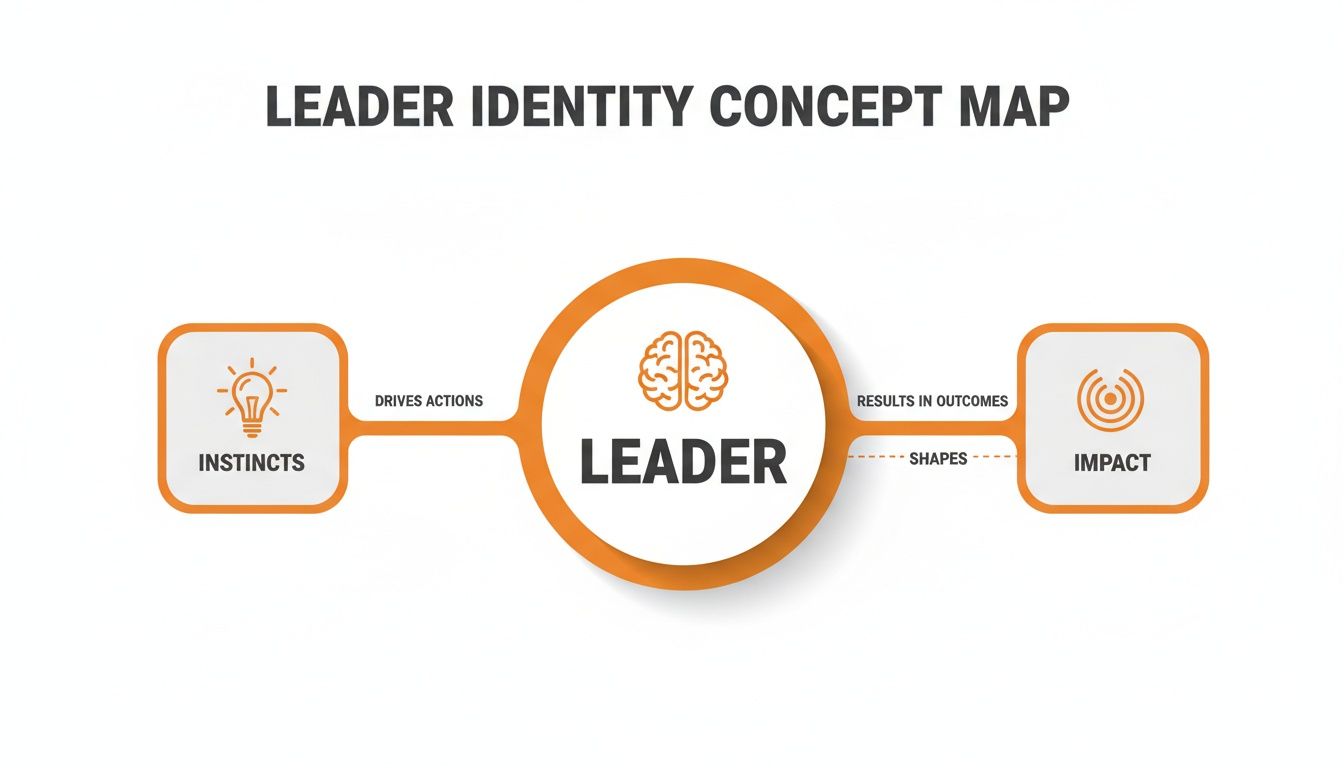
It’s all about that feedback loop. Your instincts lead to actions. The impact of those actions should constantly refine your instincts. That’s how you grow.
Here’s a simple breakdown of the main styles to help you get a handle on them.
Leadership Styles At a Glance
This table is a quick snapshot of the core leadership styles. Think of it as a cheat sheet for your toolkit.
Leadership Style | Primary Focus | Best For | Potential Downside |
|---|---|---|---|
Transformational | Inspiring a shared vision | Driving change, innovation, and motivating teams toward a big-picture goal | Can burn teams out if the vision feels disconnected from daily reality |
Transactional | Clear processes and outcomes | Structured tasks, compliance-heavy environments, and short-term projects | May stifle creativity and feel impersonal or micromanage-y |
Servant | Supporting the team's needs | Building long-term trust, morale, and helping experienced teams | Can be slow to make tough, unpopular decisions or be taken advantage of |
Democratic | Group collaboration and consensus | Complex problem-solving, fostering buy-in, and using diverse expertise | Inefficient for urgent decisions; can lead to "design by committee" |
Autocratic | Top-down decision-making | Crisis management, inexperienced teams, and situations requiring rapid action | Demoralizes and disempowers skilled team members; creates bottlenecks |
Laissez-Faire | Delegating and trusting the team | Highly skilled, self-motivated experts who don't require supervision | Can feel like abandonment for teams needing guidance and structure |
Coaching | Developing individual potential | Long-term team growth, skill-building, and increasing employee engagement | Time-intensive and may not be effective for immediate performance issues |
Now that you have the overview, let’s explore what each of these looks like in the real world.
1. Transformational Leadership: The Visionary
The transformational leader is the storyteller-in-chief. They don't just manage tasks; they paint a compelling picture of the future and help every person see their part in it. This is the type of leader who inspires a team to look beyond the daily grind and rally around a shared purpose.
They are all about the "why." When your team is distributed across locations or shifts, this shared vision is the glue that holds everything together. It keeps everyone pulling in the same direction.
2. Transactional Leadership: The Clear-Cut Planner
On the flip side, you have the transactional leader. This person is a master of clarity and structure. They operate on a straightforward system of rewards and consequences. It's a clear exchange: "If you do X to Y standard, you will get Z reward."
This style is incredibly useful when the work is predictable or when safety and compliance are everything. For a frontline team that just needs to know exactly what’s expected, the lack of ambiguity is a relief.
The goal isn’t to pick one style and wear it like a uniform. It's to build a clear mental map of your options so you can lead with intention, not just on autopilot.
This is the whole point. Relying on a single default setting is lazy leadership. Consciously choosing the right approach for the people and the situation in front of you? That’s where the real work happens.
3. Servant Leadership: The Supportive Guide
A servant leader works from a simple but powerful premise: take care of your people, and they'll take care of the business. They lead by clearing roadblocks, fighting for resources, and making sure the team has what it needs to win.
This isn’t about being a pushover. It's a pragmatic approach built on a simple truth: a supported team is a high-performing one. Their first question is almost always, "What can I do to help?"
4. Democratic Leadership: The Collaborative Facilitator
The democratic leader is all about collective wisdom. They believe the best ideas don’t come from one person, but from the group. They actively seek input, encourage healthy debate, and work to build consensus before making a move.
This style is gold when you're facing a complex problem and need different perspectives. It definitely slows things down, but the final decision is often stronger and has automatic buy-in because everyone felt heard.
5. Autocratic Leadership: The Decisive Commander
When a crisis hits, you don't have time for a vote. This is where the autocratic leader shines. They are decisive, direct, and take full ownership of making the hard calls—fast. They provide clear, top-down direction when speed and control are essential.
"Autocratic" can sound harsh, but think of it as "the buck stops here" leadership. It’s a necessary tool in high-stakes environments or when a team is floundering and needs someone to provide stability. A clear path forward.
6. Laissez-Faire Leadership: The Hands-Off Trust Builder
The laissez-faire leader's currency is trust. They hire smart people and then get out of their way. They provide the high-level goals and resources but have faith that their team can manage the details on their own.
For a team of seasoned, self-starting experts, this approach feels empowering. It shows deep respect for their autonomy. The danger? For a team that needs more support, it can feel like you’ve abandoned them.
7. Coaching Leadership: The People Developer
Finally, the coaching leader is playing the long game. Their main focus is on unlocking the potential within each person on their team. Instead of giving orders, they ask good questions, provide honest feedback, and guide people toward their own growth.
This is a patient, one-on-one approach that builds a skilled and loyal team over time. You’re not just investing in the current project; you're investing in people's careers. Knowing when to direct and when to develop is a true sign of a mature leader.
Leading with a Transformational Vision
Some leaders manage tasks. Others inspire movements. That’s the heart of being a transformational type of leader. They aren't fixated on today's to-do list; they're obsessed with painting a vivid picture of tomorrow and getting their team fired up to help build it.
This isn’t about some fluffy mission statement on a wall. It's about connecting the dots between a person's daily work—packing a box, coding a feature, helping a customer—and a bigger, shared purpose. When people feel that connection, their motivation comes from within. You don't have to push them. They're already pulling for the team.

The Glue for Distributed Teams
I’ve seen this style work wonders, especially with teams spread across different locations and time zones. When your crew doesn’t share the same room, that shared vision becomes the gravity holding everything together. It’s the ultimate currency of trust. The engine for self-motivation.
A transformational leader is the company's storyteller-in-chief. They might use a company news feed in an app like Pebb to constantly reinforce the "why." They celebrate wins publicly, share customer stories, and make sure everyone, from the warehouse floor to the remote developer, feels like a crucial part of the same journey.
The core job of a transformational leader is to make the vision so clear and compelling that people can make their own great decisions, even when the leader isn't in the room. This fosters true autonomy, not just delegation.
This approach builds a culture where people feel valued for their minds, not just their hands. They’re encouraged to challenge the status quo and find better ways of working. It’s no surprise this style consistently leads to huge boosts in employee engagement and innovation.
Why It Works
Here’s the thing: people want to believe in what they do. Global studies back this up, showing that when leaders inspire with a clear vision, employees become far more dedicated. In fact, research shows engagement can be 14 times higher when trust is present, yet a shockingly low 15% of employees worldwide feel truly engaged today. For more on this, it's worth understanding what defines effective transformational leadership.
In industries like healthcare and logistics, this isn't just a "nice-to-have." It’s essential. Studies from the US to Kenya show this leadership style has a major positive impact on everything from innovation to simple task performance. And get this: a stunning 92% of employees say they're more likely to stay with a company when their leaders show empathy—a core transformational trait that cuts turnover in distributed teams.
This is a world away from other styles. Transactional leadership might get the job done for now, but it rarely inspires loyalty. And laissez-faire leadership? It often has a negative impact. At Pebb, where our clients operate in over 42 countries, we see it every day. A shared vision, communicated consistently, is what turns a scattered group of individuals into a unified, powerful team.
Knowing When to Be Democratic or Decisive
We all love the idea of “collaboration.” It sounds great in a meeting, right up until the clock is ticking and a decision needs to be made. This is the classic tug-of-war every leader knows: the pull between inviting everyone in and making the final call.
A democratic style is about being a facilitator. You’re not just the boss; you're the one drawing out ideas, building consensus, and making sure the people on the ground feel heard. This approach is gold when you're wrestling with a complex problem. Tapping into different perspectives almost always leads to a smarter solution.
But that’s only half the story.
When a crisis hits, or when a quick, clear direction is the only thing that matters, a more decisive (or even autocratic) style isn't just an option—it's your responsibility. Taking a vote when the fire alarm is blaring isn't leadership. It's a failure to lead. The mark of a great leader is knowing which hat to wear and when.
The Facilitator vs. The Commander
Let's say you're an operations manager at a hospital thinking about redoing the patient intake process. Perfect time for a democratic approach. You could open a dedicated channel in your Pebb app for the discussion, run a quick poll, and let the nurses and admin staff—the ones who live this workflow every day—steer the conversation. The final plan will be better because of it.
Now, flip the script. A critical safety alert comes through for medical equipment used on every floor. This is a moment for decisive, top-down action. You don't need a discussion. You need a clear, unmissable update in the company-wide news feed laying out the new safety protocol, effective immediately. Speed and clarity save lives.
Great leadership happens in that switch.
The art of leadership isn't about picking one style. It’s recognizing that being decisive doesn’t make you a dictator, and being collaborative doesn’t make you weak. They’re just different tools for different jobs.
Choosing the right tool for the moment is everything. It’s what separates a team that feels empowered from one that feels confused.
The Payoff of a Democratic Style
When you get the timing right, the benefits of democratic leadership are huge. This works wonders for an ops manager in retail or hospitality, who can use a work hub like Pebb to create specific Spaces for team chats or shift planning, giving everyone a real voice in how things are run.
This isn’t just about making people feel good; it has a real impact. Research shows that 69% of employees would work harder if they felt their efforts were truly appreciated, a feeling that grows from being included in decisions. It’s no surprise that companies with strong, flexible leadership cultures often see up to 20% higher performance. If you want to dig into the data, you can explore more leadership statistics and what they mean for your team.
At the end of the day, leadership is about reading the room, understanding what’s at stake, and having the confidence to act—whether that means opening the floor or making the tough call yourself. It's a balancing act worth mastering.
Adapting Your Style for the Modern Workforce
The old-school, top-down leadership model just doesn’t cut it anymore. Your team isn't a collection of names on a schedule; they’re spread out, connected by their phones, and looking for more than a paycheck. We have to stop managing people and start enabling them.
This isn’t about picking one perfect type of leader from a list. The best leaders I’ve known are more like chameleons. They understand that leadership isn’t a fixed title—it’s a living practice that has to change depending on the team, the task, and the realities of the job.
The Right Style for the Right Situation
The true mark of a great leader is the ability to read the room and pivot. What works for a remote creative team will fall flat with a crew on a busy production floor. It’s all about context.
Picture a warehouse manager trying to get a big shipment out. They might use a transactional approach to make sure every task is clearly assigned and completed on time. Safety and efficiency are non-negotiable. But with a new hire, they’ll switch to a coaching style, patiently walking them through the process. That blend gets the job done right while building a more capable team for the future.
Now, think about a leader of a remote software team. In that world, a servant leadership mindset often wins. Your main job is to run interference, clear roadblocks, and give your experts the space they need to innovate. Micromanaging specialists is a recipe for disaster. Clearing the path for them to do brilliant work? That’s invaluable.
It comes down to asking yourself a few simple questions:
What does my team need from me right now?
What does this specific job require?
What’s the best approach for our current situation?
That’s situational leadership in a nutshell. It’s a constant dance of observing, acting, and adjusting as you go.
Using Your Tools as a Co-pilot
Your tech should be your ally, not a straitjacket. A unified work hub like Pebb can be a fantastic co-pilot, giving you the information and flexibility you need to shift your style based on real-time feedback.
For instance, a unified app can help you:
Read the room with data. Analytics can show if your message is landing. Are people engaging with your vision posts? Are task completion rates dipping? This isn't about spying; it's about seeing if your approach is connecting.
Embrace democratic input when it counts. Need ideas for a new workflow? Quickly switch into democratic mode by spinning up a discussion space or running a poll. It gives everyone a voice without grinding every decision to a halt.
Share the vision, over and over. The company news feed is perfect for keeping your transformational vision front and center. Sharing wins, strategic updates, and team successes keeps everyone connected to the mission. Remember, how you handle your leadership communication has a massive impact on employee engagement.
Leadership is no longer about having all the answers. It’s about creating an environment where the best answers can emerge, whether they come from you, your team, or the data you’re seeing.
Leading a modern workforce is less about being one specific type of leader and more about having a full toolkit and knowing which tool to pull out. It's about being observant, flexible, and authentic. The goal is to meet your team where they are and give them what they need to succeed. The right tools make that a lot easier.
Finding Your Authentic Leadership Voice
After all this talk of different models, you might feel pressured to be a chameleon, constantly switching masks. But let's get one thing straight: great leadership isn't about faking it. It's about finding what’s genuine to you and then learning how to stretch that style when your team needs you to.
This is where theory meets reality. It starts with honest self-reflection, and no, a personality quiz won't cut it. To find your true leadership voice, you've got to be willing to take a hard look in the mirror.

Start with an Honest Look
Pinpointing your natural type of leader isn't rocket science, but it does demand that you pay attention. Notice what parts of your job fill your tank versus which ones leave you running on empty. Do you get a jolt of excitement in a big-picture brainstorming session, or does seeing a project executed flawlessly give you a bigger thrill?
Then, look at your team. Are they just doing what they're told, checking boxes to get through the day? Or are they leaning in, bringing their own ideas to the table? The answer says volumes about how your style is landing.
Here’s a simple way to start:
Ask for honest feedback. Pull aside a couple of people you trust. Ask them point-blank: "When am I at my most effective? And where do I get in my own way?" Brace yourself—the truth might be surprising, but it’s pure gold.
Track your energy. For one week, make a quick note of which conversations or tasks left you feeling energized and which ones drained you. You'll start to see a clear pattern.
Read the results. Look at your team's work. Are they simply compliant, or are they creative? A team that’s just meeting expectations often points to a more directive style. A team that’s innovating usually has an empowering leader.
Experiment with Intention
Once you have a handle on your default setting, the fun part begins. This is about building a flexible approach—one that’s rooted in who you are but can adapt. You don’t need a personality transplant. You just need more plays in your playbook.
This idea is closely related to becoming a leader with no title, which is all about leading through influence, not just authority.
Try a small experiment this week. If you’re usually the one with the plan, try running your next team huddle with a more democratic flair. Instead of laying out the solution, present the problem and ask, "How should we tackle this?" If you tend to be hands-off, schedule a one-on-one and consciously practice a coaching style, asking good questions instead of just getting a status update. For more ideas, check out our guide on essential frontline leadership skills.
Your authentic leadership voice isn’t found in a book. It’s built through a thousand tiny moments of self-awareness, courage, and practice.
This isn't a one-and-done fix. It’s a continuous cycle of trying something, seeing how it lands, learning, and adjusting. That’s how you become the leader your team needs you to be, without ever losing yourself in the process.
Common Questions I Hear
We’ve covered a lot of ground. It's normal for questions to be bubbling up. That's a good thing. It means you're already thinking about how to apply this to your own team. Here are a few of the most common ones I hear.
What is the most effective type of leader for frontline teams?
The million-dollar question. If only it were that simple. In my experience, the most successful frontline managers are masters of blending, leaning heavily on a mix of Transformational and Coaching leadership.
The transformational part connects the dots. It answers the 'why'—why stocking this shelf or handling this call matters to the bigger mission. That’s a huge morale booster. Then, the coaching style brings it down to the day-to-day, focusing on hands-on training so your team feels confident and capable.
Of course, that all goes out the window when there's an urgent safety issue. In those moments, you need to be direct and Autocratic. The art of frontline leadership is knowing when to inspire, when to develop, and when to simply give clear direction.
Can I actually change my leadership style?
Absolutely. But let’s be clear: this isn’t a personality transplant. It’s more like adding new tools to your toolbox or building muscle memory. You're not changing who you are. You're expanding what you can do.
The first step is being honest about your default setting—your go-to style on autopilot. Once you know that, you can practice other approaches in small ways. If you’re naturally directive, challenge yourself to ask more open-ended questions in your next team huddle. If you tend to be too hands-off, set up a small project with crystal-clear milestones to practice being more hands-on.
It will feel awkward at first. That’s normal. But with practice, you’ll build the flexibility to use the right approach at the right time, without even thinking about it.
One of the biggest myths is that Servant Leadership is just about being nice. It's not. It’s a strategic, people-first approach to driving performance by systematically removing roadblocks for your team.
A great servant leader still holds people accountable and pushes for incredible results. They just operate on the belief that the most reliable way to get there is by serving the team’s needs first. It’s about help, not just being agreeable.
How can a tool like Pebb support different leadership styles?
The best technology should feel like an extension of your leadership, not a box you have to fit into. A unified work hub like Pebb is designed to be flexible, giving every type of leader the channels they need to be effective.
Think about it this way:
The Transformational leader can use the company-wide news feed to consistently share the vision, post inspiring stories, and celebrate wins that tie back to the mission.
The Democratic leader can use polls and discussion threads within team Spaces to get quick feedback on a new schedule or process.
The Transactional leader can lean on the Tasks feature to assign work with total clarity, set deadlines, and track progress without chasing people for updates.
The Coaching leader can use private chat to provide one-on-one feedback, share helpful videos, and check in on development goals.
Ultimately, good technology doesn’t force a style on you. It gives you the right tools to lead well, no matter which approach a situation calls for.
Ready to lead your team with more clarity and connection? Pebb brings communication, tasks, and engagement together in one simple app for your entire workforce. See how it supports your leadership style.
