
What Is a Digital Workplace?
What is a digital workplace? Discover how it unifies your team's tools, communication, and culture into one calm, productive space.
Dan Robin
Let’s be honest. That term ‘digital workplace’ gets thrown around a lot. It sounds like the latest buzzword from a corporate seminar. But here’s the thing: you already have one.
A digital workplace is just the collection of digital tools your team uses every day to talk, collaborate, and get work done.
Your Company Already Has a Digital Workplace
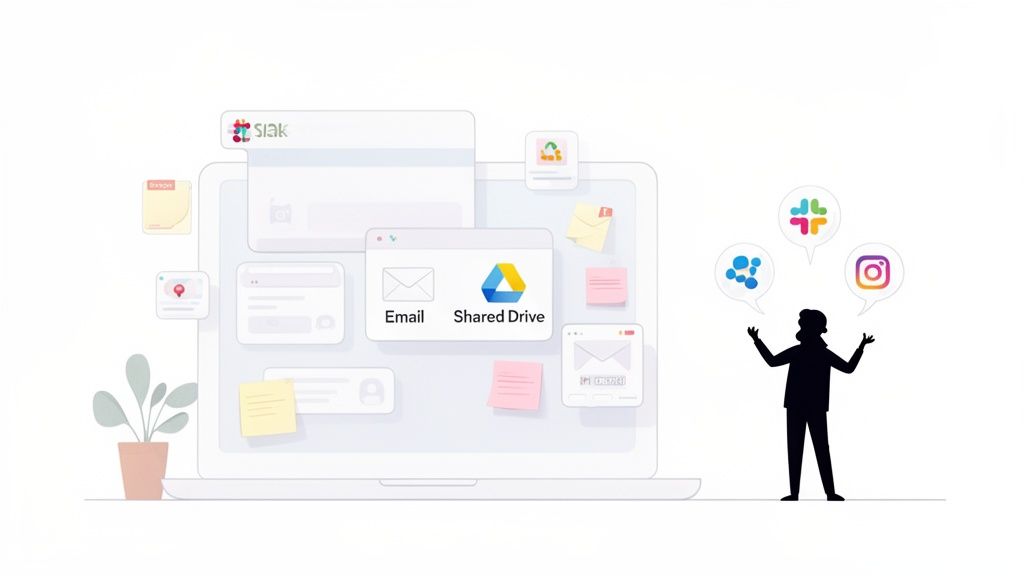
Think about it. It’s that mess of Slack channels, overflowing inboxes, and a maze of shared Google Drive folders. It’s the digital version of a desk so buried in paper that finding a single memo feels like an archaeological dig.
The issue isn’t a lack of tools. It’s the chaos they create when they all pull in different directions.
The Daily Scramble Is Real
We see this all the time. A manager gets a call—someone’s sick and a shift needs covering, now. So she posts in a group chat, sends an email just in case, and then, once someone replies, logs into a separate scheduling app to make the change. Three tools for one simple task.
That’s not a worst-case scenario. It’s just another Tuesday. It’s draining, inefficient, and a real morale killer. This is what we call the accidental digital workplace—a pile of apps that were adopted one by one, never meant to work together.
The core problem is that most companies don't intentionally design their digital workplace. It just… happens. A tool is added to fix one pain point, then another, until you're left with a system that creates more work than it solves.
This fragmented reality is why businesses are hitting the brakes and rethinking their approach. The global digital workplace market, valued at an estimated USD 48.8 billion in 2024, is projected to hit USD 166.27 billion by 2030. According to the analysis from Grand View Research, this growth shows a major shift from siloed apps toward a more unified experience.
From Accidental Chaos to Intentional Calm
The good news? You don’t have to live with the digital clutter. The alternative is an intentional digital workplace—a single, central hub for everything work-related. This isn’t about adding another app. It’s about replacing the mess with a calm, organized space where work just flows.
Here’s a quick comparison of a fragmented workplace versus an intentional one.
The Accidental Workplace vs. The Intentional Workplace
Symptom | Fragmented 'Accidental' Workplace | Unified 'Intentional' Workplace |
|---|---|---|
Information | "Where's that policy? I'll check Slack, email, and the shared drive..." | "It's in the company library. Always." |
Communication | "Did you see my email? Or the chat? Or the text?" | "It's in the main feed. Everyone sees it." |
Operations | "Log in here for time off, but log in there to check the schedule." | "My schedule and requests are all in one place." |
Employee Vibe | "I can never find what I need. This is frustrating." | "I know exactly where to go. It's simple." |
The difference is night and day. Moving to an intentional setup transforms the employee experience from one of constant friction to one of quiet productivity.
Building an intentional digital workplace isn't about chasing shiny new tech. It’s about being deliberate. It’s about choosing simplicity over complexity and giving your people a reliable home base. For many, moving from old systems to a modern platform is a key part of this, and an intranet on the cloud can be the foundation for this new way of working.
It’s the difference between that messy desk and a clean workspace. Which would you rather have?
It Is a Place for Connection and Clarity
So, what is a digital workplace? It's easy to confuse it with a company intranet or just another chat app. But a true digital workplace is more foundational.
We see it as the single, central home for your company culture—a space designed for two things: connection and clarity. That’s it.
Think of it like this: your accidental workplace is a sprawling suburb. It has houses, stores, and offices, but they’re all scattered. You have to drive everywhere, wasting time and energy just to get things done.
A well-planned city, on the other hand, is built for connection. It has a central square for news, distinct neighborhoods for teams, and a public library for shared knowledge. Everything you need is right there. That’s an intentional digital workplace.
More Signal, Less Noise
The real magic of this "digital city" is how it cuts through the noise. It’s where a cashier gets an instant, official update from HQ without checking five different group chats. It's where a new hire finds the right training manual without asking five people and getting five different answers.
For a manager, it’s seeing who’s clocked in for the day without toggling between three screens. This isn't just a nice-to-have. When information is reliable and easy to find, it builds trust. Work starts to feel less like a scavenger hunt and more like a focused, collective effort.
A great digital workplace isn’t defined by how many features it has. It’s defined by how much friction it removes from an employee's day.
This focus on simplicity is what separates a truly useful tool from just another piece of software. The goal is to create a single source of truth that everyone—regardless of their role or location—can depend on. It’s about making essential work so easy that it becomes second nature.
The Human Element of Work
But that’s only half the story. A digital workplace is also about your people. It's about making a large, distributed company feel a little smaller and a lot more human.
When your tools are a mess, your people feel it. A 2024 McKinsey study found that employees waste a huge part of their week just searching for information. That's more than a productivity issue; it’s a culture killer. It leaves people feeling isolated and inefficient, as if they're just trying to keep their heads above water.
An intentional digital workplace flips that script. It offers a central hub where people not only find what they need but also find each other. It becomes the place where a team celebrates a win, a new hire finds a mentor, and a CEO’s message reaches every single person. You can discover how other organizations achieved connection and clarity by creating these unified environments.
It’s this blend of operational clarity and human connection that makes a digital workplace so powerful. This isn't about technology for its own sake. It's about building a calmer, more coherent, and more connected place to work.
The Three Pillars of an Effective Digital Workplace
A great digital workplace isn’t built on a mountain of features. It’s simpler than that. After working with countless teams, we've seen that a truly effective digital home rests on just three pillars. Get these right, and everything else falls into place.
These pillars are Communication, Operations, and Engagement. They transform a chaotic mess of apps into a calm, unified space for your people.
Communication: The Lifeline of Your Company
Communication is more than just chat messages. It’s the entire flow of information that keeps your business moving. A healthy system has to handle two speeds: the fast-paced, real-time chatter and the slower, crucial broadcasts that everyone needs to see.
Real-time chat is for immediate work. Imagine a retail team quickly coordinating floor coverage when a surprise shipment arrives. It's fast, a little messy, and essential for staying agile.
But you also need a reliable channel for asynchronous updates—official announcements, policy changes, and company news. This is your single source of truth that cuts through the noise, ensuring the CEO's message reaches the newest hire on the warehouse floor with total clarity. When both fast and slow communication live in the same place, everyone stays in the loop.
This is how a digital workplace becomes the central hub connecting your culture, clarity, and connection.
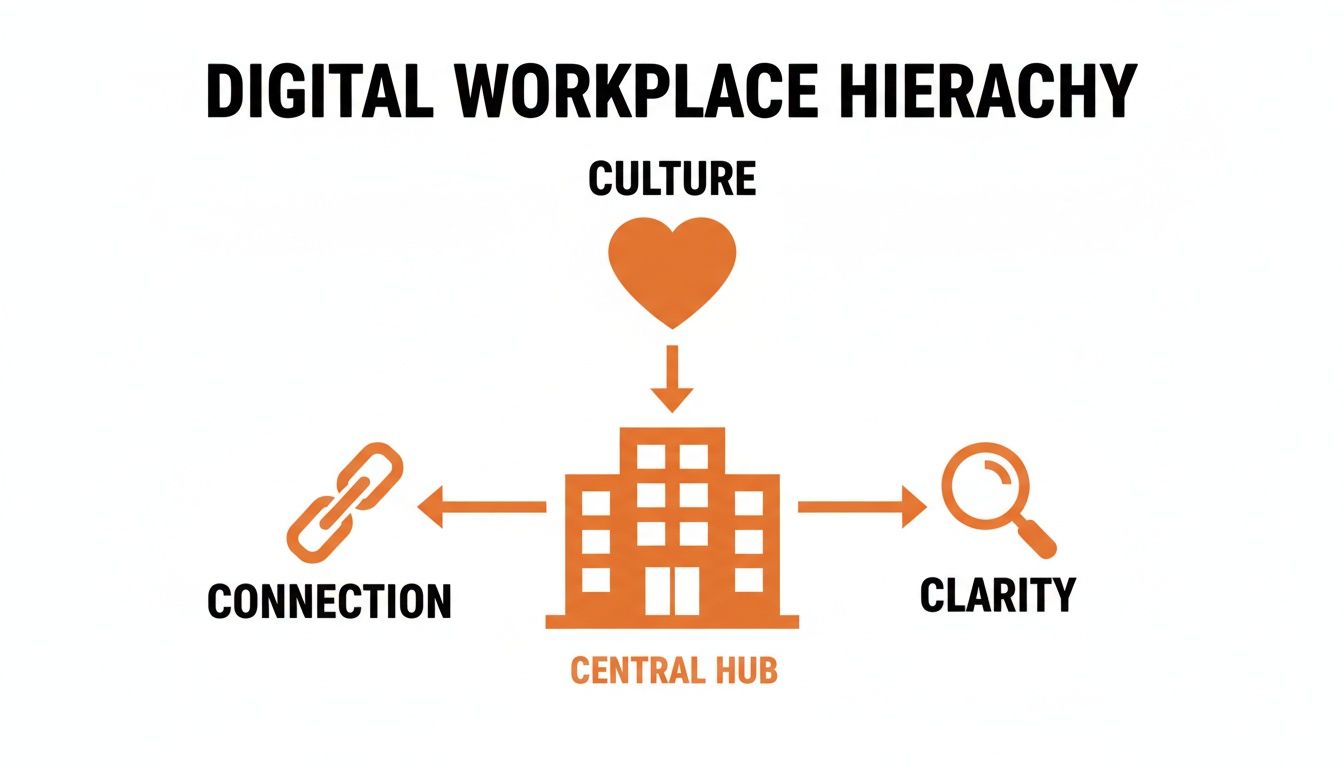
A well-built digital workplace doesn't just hold information; it organizes it, creating a solid foundation for the entire company.
Operations: The Engine of Daily Work
If communication is the lifeline, then operations are the engine. This pillar covers all the practical tasks that make up a workday. It’s the stuff that, when done poorly, causes endless frustration.
This is where the rubber meets the road. We’re talking about managing tasks, scheduling shifts, checking who has clocked in, and handling time-off requests. For frontline teams especially, these are the core of their daily experience.
Picture a busy restaurant. In a great digital workplace, a server can see their schedule, instantly swap a shift with a coworker, and clock in—all from a single app on their phone. No more frantic texts to the manager, no more digging for paper forms.
The best operational tools are the ones you barely notice. They simplify essential work so thoroughly that employees can focus on their actual jobs, not on fighting with clunky software.
This drive for simplicity is fueling major investment. North America, for instance, is projected to command over 40.2% of the global digital workplace market revenue in 2025. The tools segment—which includes unified communications and mobility—captured a massive 68.6% share in 2025 as businesses realized the power of integrated tools. You can find more data and insights on these trends from Fundamental Business Insights.
Engagement: The Human Connection
The final pillar is engagement, and it’s the most important. This is the human side of work. It’s the feeling of belonging, recognition, and shared purpose that turns a job into something more.
Here’s the thing: you can’t manufacture culture with virtual pizza parties. Real engagement comes from feeling seen, heard, and connected to your peers. It’s about creating a space where people can celebrate successes, offer praise, and build real relationships.
Let's go back to that retail team. After setting up a brilliant new store display, a team member snaps a photo and shares it in their team’s digital space. A manager from another location sees it and leaves an encouraging comment. The head of merchandising chimes in with a public shout-out.
That simple act fosters pride and builds community across different shifts and locations. It’s these small, human moments that make people feel part of something bigger. Ultimately, improving the digital employee experience is how you unlock this pillar.
When communication, operations, and engagement are all under one digital roof, the result is a healthier, more connected, and more productive organization.
Why It Must Work for Frontline and Office Teams
Let’s be honest. Most digital tools are designed by office workers, for other office workers. They’re built for people who spend their day at a desk, glued to a laptop. But what about the other 80% of the global workforce? I’m talking about the nurses, cashiers, warehouse staff, and drivers who aren't at a desk.
A software developer's day looks nothing like a barista's. This is where most digital workplace strategies fail. They accidentally create a two-tiered system where some people feel connected and everyone else feels like an afterthought.
A truly effective digital workplace has to bridge that gap. It needs to bring both worlds together.
The Tale of Two Employees
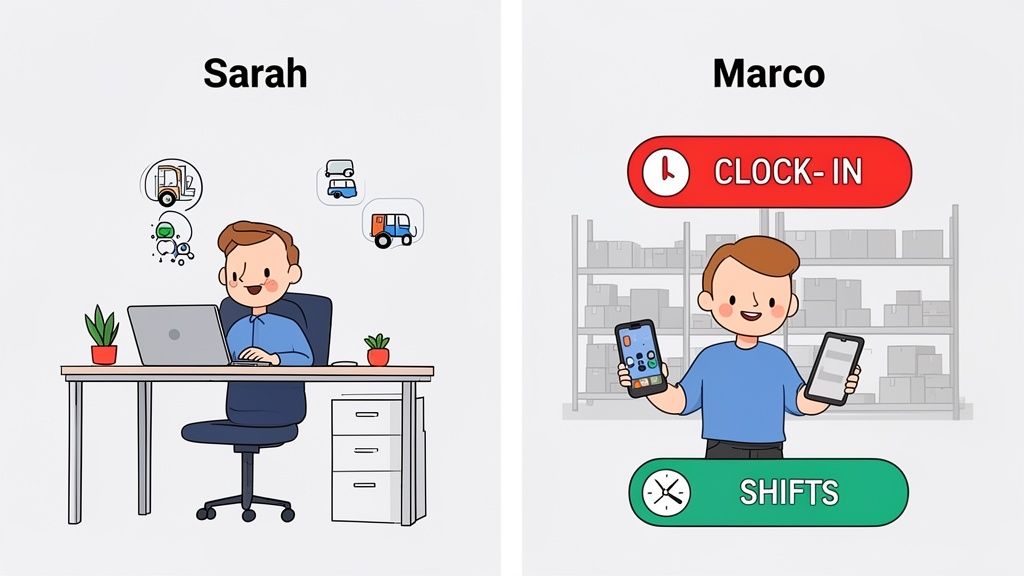
Let's imagine two employees: Sarah, a project manager, and Marco, a warehouse supervisor.
Sarah lives at her desk. Her day is a whirlwind of video calls, spreadsheets, and project management tools. She needs powerful features and deep integrations.
Marco is always on the move. He's on the warehouse floor, using a tablet or just his phone. He needs to quickly see who's clocked in, adjust schedules, and push out urgent safety alerts. His ideal tool is simple, fast, and works perfectly on mobile.
Here’s the classic mistake: giving them both the same complicated, desktop-first software. Sarah might find it clunky, but Marco will find it useless. He doesn’t have time to hunt through complex menus on a small screen while a truck is waiting to be loaded. This is the frustrating reality for millions of people every day.
The Frontline Experience Is the True Test
For too long, frontline teams have been a secondary concern. A new system gets rolled out to corporate, and then someone tries to awkwardly force it into the hands of the mobile workforce. It never works.
The real measure of a digital workplace isn't how well it serves your tech-savvy office employee. It's how well it serves your busiest, most mobile frontline worker. If it doesn't work for them, it doesn't really work.
Why? Because on the frontline, work is immediate. A missed update can lead to a safety incident. A confusing schedule can mean a missed shift and an unhappy customer.
To really nail this, a tool has to be built with the frontline in mind from day one. This means a few things are non-negotiable:
Simplicity is everything. The app must be so intuitive that a new hire can figure it out in minutes, with zero training.
It must be mobile-native. Every task, from clocking in to reading an announcement, has to be effortless on a phone.
It must solve real-world problems. If the app is the fastest way for an employee to check their schedule or trade a shift, they’ll use it. If not, they’ll find a workaround.
Unifying the Two Worlds Without Compromise
This doesn’t mean you need two separate systems. That just brings back the same old disconnects. The goal is a single, flexible tool that meets the needs of both Sarah and Marco.
A great digital workplace does this by pairing a powerful backend for desk workers with a radically simple mobile experience for frontline teams. Sarah can dive deep into project plans on her desktop, while Marco manages his team’s daily operations from his pocket.
The key is that information flows seamlessly between them. When Sarah posts a company-wide policy update, Marco gets a clear, easy-to-read notification on his phone. They’re in the same digital home, part of the same culture, but they interact with it in a way that makes sense for their role.
This is what the future of work looks like. One unified hub where every employee feels seen, heard, and valued.
How to Avoid the 'More Tools' Trap
We’ve all seen it. Communication gets messy, so you buy a chat app. Task tracking is a headache, so you find a project management tool. HR announcements get lost, so you find a specialized tool for that, too.
Soon, you’re juggling five different subscriptions, your team is more confused than ever, and work feels more chaotic, not less. This is the "more tools" trap, a productivity killer disguised as a quick fix.
Let’s be honest: chasing a “best-of-breed” app for every single function sounds smart, but it’s a recipe for real-world disaster.
The Hidden Costs of Tool Sprawl
When you cobble together a collection of disconnected apps, the price goes beyond the monthly subscription fees. The real costs are hidden—friction, confusion, and wasted time.
Context-Switching Overload: Think about how much focus is lost every time an employee has to jump from their chat app to their task manager to their scheduling software. Research from the American Psychological Association shows this can eat up as much as 40% of a person's productive time. It's a constant, draining tax on your team's attention.
Information Silos: When your conversations live in one app and your documents are stored somewhere else, key information gets lost. Important updates get buried, creating a frustrating divide between those who saw the message and those who didn't.
Training and Security Headaches: Every new tool is another login to remember, another interface to learn, and another potential security risk. This complexity doesn't just annoy your employees; it opens up real vulnerabilities.
This constant app-switching is a massive hurdle to building a great digital employee experience platform, because it undermines the goal of having one simple, unified place for work.
The 'Less but Better' Philosophy
The way out isn’t to find more features. It’s to find more clarity by adopting a "less but better" philosophy.
Instead of searching for a niche tool for every tiny task, the goal should be to find a single, integrated platform that handles 80% of your daily work exceptionally well. What are the absolute essentials? For most businesses, it's communication, daily operations like scheduling and tasks, and a central hub for company news.
The point isn't to find an app that does everything. The point is to find one app that does the essential things together, in one calm, reliable place.
Imagine a world where your team knows exactly where to go for their schedule, their tasks, and their conversations. Work just becomes simpler. They stop fighting their tools and start focusing on the work itself.
This consolidation is key to freeing your people from the chaos of app-switching. The question shouldn't be, "What's the best tool for this one problem?" Instead, ask, "What's the simplest way to bring our people and their work together?"
Building a Place to Call Work Home
When you strip away all the talk about features and platforms, what's the real goal? It’s not about a slicker way to manage tasks or send messages. It’s about building a place where every employee feels fundamentally more human.
We’re trying to create a central hub where everyone—from the corner office to the warehouse floor—feels seen, heard, and connected to something bigger than their to-do list. A place they can call their digital home at work.
It Is All About Trust
A great company culture, especially when teams are spread out, isn’t built on forced fun or virtual pizza parties. That's just window dressing.
The real foundation of any strong culture is trust.
Trust is the quiet confidence that you have the information you need to do your job. It's believing that when leadership shares an update, you’ll actually see it. It’s knowing your voice can be heard, even if you’re miles from headquarters. A great digital workplace is the reliable engine that makes this trust possible, working quietly in the background.
We believe the measure of a company’s digital workplace isn’t how many tools it has, but how close it brings its people together.
This kind of trust doesn't happen by accident. It requires a clear framework, especially for distributed teams. That's why having a robust remote work policy is so critical; it provides the structure that lets trust grow.
A Question to Ponder
So, what does this all boil down to? Take a hard look at the collection of tools your teams use right now. The email threads, the chat apps, the shared drives, the project boards—the whole messy picture.
Now, ask yourself one simple question:
Does all of this bring your people closer together, or is it slowly pushing them further apart?
Your answer tells you everything. It’s the difference between a random collection of apps and a true digital home for your company.
And that’s the choice every business gets to make.
A Few Questions We Hear All the Time
When we talk to companies about what a true digital workplace could mean, the same few questions always pop up. It's natural—you want to know what you’re really getting into. So, let's get right to it.
Is This Just a Fancy New Name for an Intranet?
Fair question, but no. A traditional intranet is a dusty digital bulletin board. It’s a top-down place where the company posts news and you go to find an HR form. You visit it, but you don't live there.
A real digital workplace is the opposite. It’s where work actually happens. It's the hub for team chats, shift schedules, and daily tasks. It’s where your culture is built, not just announced. Think of it as the difference between a static company brochure and the bustling workshop where everything gets made.
How Do We Get Our Frontline Teams to Actually Use It?
The million-dollar question. And the answer is simpler than you think. You don't get adoption with a big launch party or mandatory training. You get it by making the app essential.
From day one, the platform needs to be the easiest way for your team to do their most important tasks. Can they check their schedule faster than any other way? Can they request time off in two taps? Is it where they get urgent updates from a manager? If the answer is yes, they'll use it. It has to solve their real-world problems with zero friction.
We Already Use Slack and a Task Manager. Why Add Something Else?
That's a common setup, and for purely office-based teams, it can work. But let me ask you: is your warehouse crew on Slack? Is your weekly shift schedule synced with your project task list?
For most, the answer is no. This is where a unified platform isn't about adding another tool—it's about simplifying and connecting everything. A proper digital workplace pulls everyone into the same digital space. This means crucial information gets to every single employee, not just the ones at a desk. It's about creating one calm, central home for all work, instead of juggling three different apps.
At Pebb, we built the all-in-one work app designed to be that single, simple home for your entire team. If you’re ready to end the chaos of disconnected tools and bring your people together, see how Pebb works.
