
How to Calculate Direct Labor Cost Without Lying to Yourself
Learn how to calculate direct labor cost with our 2026 guide. We break down the formula with real examples to help you budget better and avoid surprises.
Dan Robin

If you ask most business owners how to calculate direct labor cost, they’ll give you a simple formula: hourly wage times hours worked. It sounds right. It feels easy. But if you’re actually running the business, that formula is a dangerous oversimplification. The real number is what matters, and it’s always higher than you think.
The True Cost of an Hour of Work
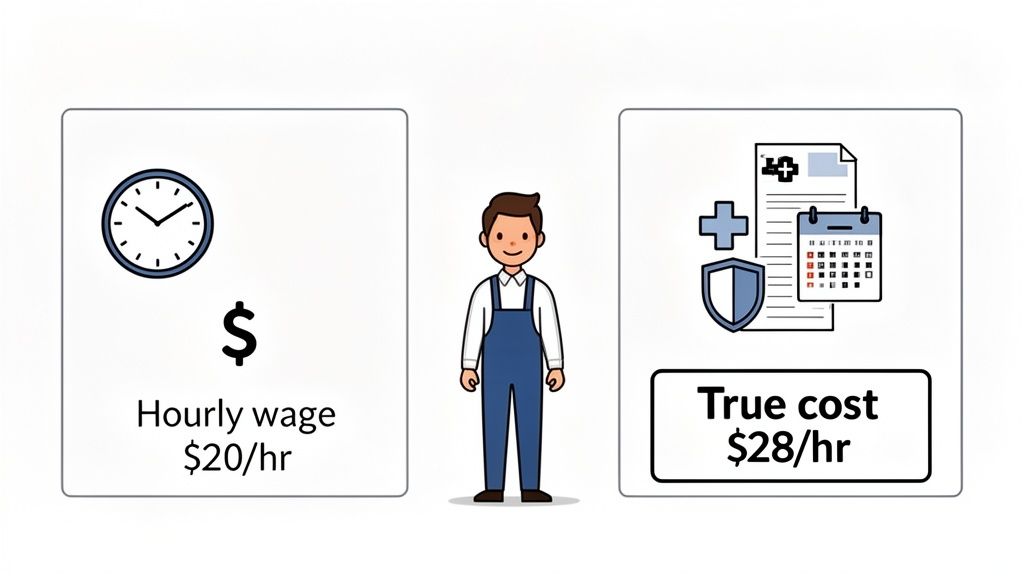
It’s tempting to look at a wage, do the quick math, and move on. But that number is a small lie, and it's one with big consequences.
I’ve seen it happen more times than I can count. A founder looks at their P&L, feels good about a profitable quarter, and then gets blindsided by payroll expenses they never saw coming. That isn't bad luck; it’s a failure to look at the real, fully loaded cost of your team's time.
Looking Beyond the Wage
The hourly rate you put in an offer letter is just the start. The true cost of an employee includes every other expense required to keep them on your team. This isn’t about being a pessimist; it’s about being a realist.
These so-called “hidden” costs aren’t trivial. They can easily add 25-40% on top of an employee's base pay.
Think about it. You're also paying for:
Payroll Taxes: Things like FICA and unemployment insurance are mandatory additions to every single paycheck.
Benefits: Health insurance, 401(k) contributions, and paid time off add up fast.
Workers' Compensation: This is a direct cost tied to having people on the floor, in the kitchen, or on the road.
Understanding this isn't a boring accounting exercise. It's a strategic necessity. It’s how you price your services accurately, create budgets that don't fall apart, and make smart staffing decisions. This is especially critical as labor costs continue to climb.
The U.S. labor cost index recently hit an all-time high, a significant leap from its historical average. This trend makes precise labor tracking essential for anyone managing a budget.
Why This Matters for Your Business
When you only focus on the base wage, you’re operating with a massive blind spot. You might think a project is wildly profitable when, in reality, it’s barely breaking even. You might approve overtime without realizing the true hit to your bottom line.
Getting a handle on your real labor cost is the first step toward financial clarity. It replaces guesswork with confidence. Honestly, it’s one of the most powerful numbers you can have in your back pocket. Once you know your true costs, you can see how a digital time clock for employees that captures every minute accurately isn't a nice-to-have, but a tool to protect your margins.
This is about seeing the complete picture, not just the part that's easy to calculate. Now, let’s dig into the ingredients you'll need to find your own number.
The Ingredients of Real Labor Cost
Alright, let's get into it. If you’ve been using a simple “hourly wage times hours worked” formula, you’ve been flying blind. That number is a myth—a dangerously optimistic one.
To get a real handle on your labor costs, you have to play detective. The true cost of an employee isn't just their wage. It's a collection of other expenses, often scattered across different spreadsheets and departments.
The True Cost Is More Than a Paycheck
Let’s be honest. Digging up these numbers can feel like a chore. You’ll probably need to talk to someone from HR, send a few emails to accounting, and get cozy with your payroll software’s reports.
It’s a bit of legwork, for sure. But this is the work that separates a wild guess from a genuinely useful business metric.
Think of these costs in two buckets: the obvious one (direct wages) and the one everyone forgets (labor burden). Direct wages are straightforward—it’s the gross pay you give an employee for their time. The labor burden is where all the expensive, "hidden" costs live.
Your labor burden is everything else you pay on top of a wage just to have that employee on your team. It often adds another 25-40% to your total labor cost, turning a $20/hour employee into a $28/hour reality.
So, where do you find these numbers? It’s time to gather the key components for an accurate calculation.
Components of Your True Direct Labor Cost
Before you can add anything up, you need a clear list of what to look for. This table breaks down the essential inputs, showing you what they are and where you can typically find the data inside your business.
Cost Component | What It Is | Where to Find It |
|---|---|---|
Hourly Wage | The base pay rate for an employee. | Employee records, HRIS, or payroll system |
Payroll Taxes | Your share of FICA, FUTA, and SUTA taxes. | Payroll reports or your finance department |
Benefits Costs | Your contributions to health insurance, 401(k), etc. | HR department or benefits administration platform |
Workers' Comp | Insurance premiums to cover on-the-job injuries. | Your insurance provider's statements |
Paid Time Off | The cost of vacation, sick, and holiday pay. | Payroll system or HR records |
Other Perks | Uniform allowances, training costs, free meals, etc. | Departmental budgets or expense reports |
Once you have these puzzle pieces, you're no longer just looking at a wage. You're looking at the fully-loaded cost of a team member.
A Practical Checklist for Finding the Numbers
Let's make this tangible. Here’s a quick rundown of the most common costs you absolutely need to track down.
Payroll Taxes: These are non-negotiable. This includes your employer portion of Social Security and Medicare (FICA), plus federal (FUTA) and state (SUTA) unemployment taxes. Your payroll provider can give you these exact figures.
Benefits Contributions: What do you actually pay toward each employee's health insurance, dental, or vision plan? What about that 401(k) match you offer? These are significant and recurring line items.
Workers' Compensation: This is a direct cost of having people on staff. The insurance rate can vary wildly depending on the job's risk, but it's a number you must factor in.
Paid Time Off (PTO): When an employee is on vacation or out sick, you're paying them for non-productive time. The cost of that PTO needs to be averaged out across the hours they actually work.
Pulling all this data together isn't just an accounting exercise; it’s about building a toolkit for making smarter business decisions. It turns abstract expenses into concrete figures you can actually manage.
When you have this level of detail, you suddenly see the real power of good employee time tracking software. You’re not just tracking hours anymore—you’re tracking the true, fully-loaded cost of those hours. And that changes everything.
Let's Run the Numbers: A Real-World Example
Okay, enough theory. Let's get our hands dirty with a practical example. It's one thing to list all the components, but it’s another to see them come together and reveal a number you can actually use.
We'll use a common scenario: a full-time retail employee, "Alex," who earns a base wage of $20 per hour. It’s incredibly tempting to just plug that $20 figure into your planning and call it a day. But as we've said, that's a mistake. The base wage is just the starting line.
Think of it like this: the hourly wage is the foundation. You have to layer on all the other expenses to see the full picture.
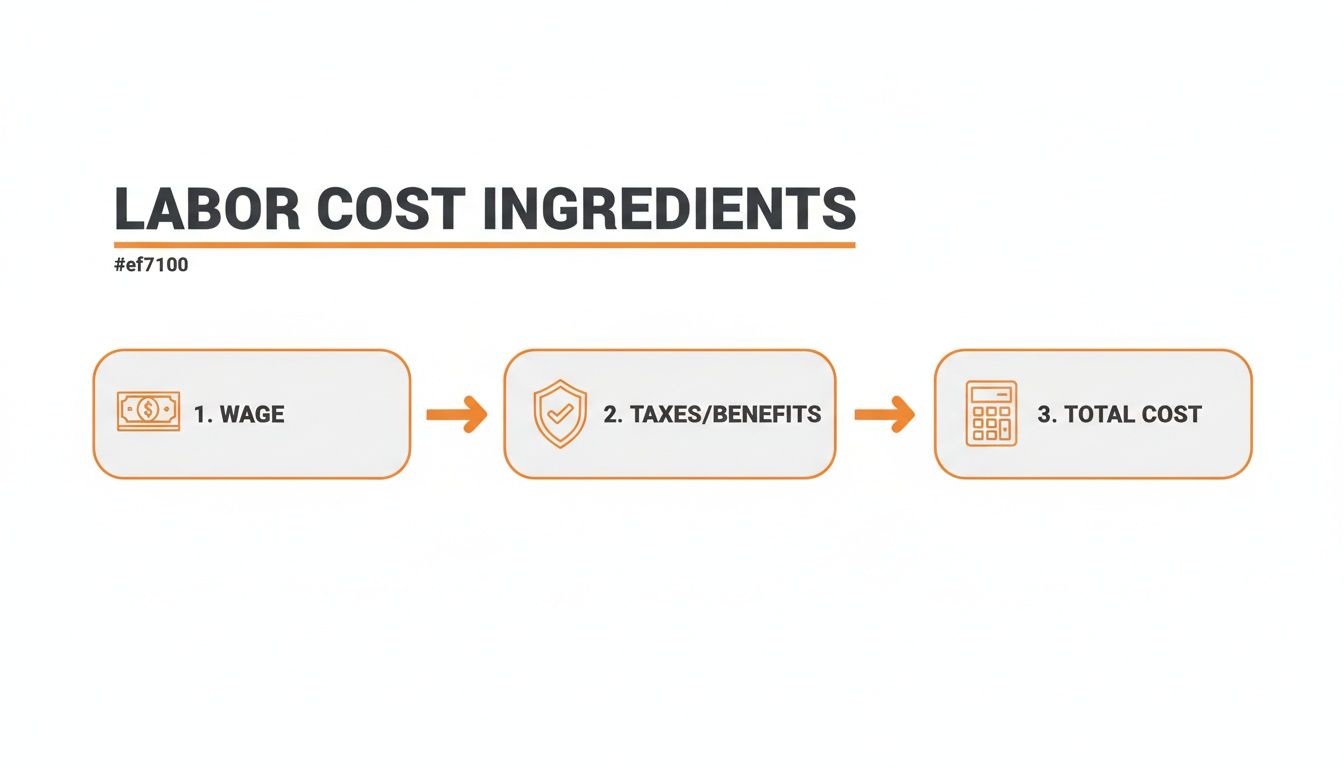
The true cost is a combination of that initial wage plus all the necessary taxes and benefits.
Building Alex’s True Hourly Cost
Let's break down Alex's numbers piece by piece. We'll look at the annual figures first to get a clear view, then drill down to find that elusive "true" hourly rate.
First, the straightforward annual wage.
Base Pay: $20/hour x 2,080 hours/year = $41,600
Next, you have to account for payroll taxes—the employer's share, not what's withheld from Alex's check. This includes FICA (Social Security and Medicare) at 7.65%, plus state unemployment taxes (SUTA). We’ll use a conservative 9% all-in for our calculation.
Payroll Taxes: $41,600 x 9% = $3,744 per year.
Now for benefits, which are often the heaviest part of the labor burden. Let's say your company contributes $400 a month to Alex's health insurance and also offers a 3% 401(k) match.
Health Insurance: $400/month x 12 months = $4,800
401(k) Match: $41,600 x 3% = $1,248
Don't forget workers' compensation insurance. For a lower-risk role like retail, a typical rate might be around $0.75 per $100 of payroll.
Workers' Comp: ($41,600 / 100) x $0.75 = $312
The Big Reveal: The Final Calculation
Let's add it all up to find what Alex really costs your business for the year.
$41,600 (Wages) + $3,744 (Taxes) + $4,800 (Health) + $1,248 (401k) + $312 (Workers' Comp) = $51,704 Total Annual Cost
So, what does that mean on an hourly basis? This is the final, crucial step. Alex is paid for 2,080 hours, but they aren't working all of them. After subtracting 80 hours for paid vacation and another 40 for sick days and holidays, you're left with 1,960 productive, working hours.
Now we can find the true hourly cost:
$51,704 / 1,960 hours = $26.38 per hour
Suddenly, that $20/hour employee actually costs you $26.38 per hour—more than 30% above their base wage. This number completely changes how you should view overtime, scheduling gaps, and even a 15-minute late arrival.
Knowing your true labor costs is also fundamental to bigger financial calculations. For example, trying to calculate prime cost is impossible without an accurate direct labor figure, especially in industries like hospitality.
This isn't a one-and-done calculation, either. With compensation costs for private industry workers rising by 4.0 percent over the last year, this number is a moving target. It's smart to recalculate this figure at least quarterly to keep your budget honest.
When Your Perfect Formula Meets the Real World
Okay, you've got the formula down. It’s clean, logical, and gets you in the ballpark. But let's be honest—reality is always messier than a spreadsheet.
I remember chatting with a manager at a logistics company who thought they had their labor costs dialed in. Then peak season hit. The amount of overtime wasn't a small bump; it was a tidal wave that completely swamped their quarterly budget.
They knew overtime was coming, but they treated it like a rounding error instead of the significant, amplified cost it truly was. This isn't a rare cautionary tale. It’s what happens when a static formula runs headfirst into a dynamic business.
Why a Single Number Will Fail You
A fixed, one-size-fits-all labor cost is a fragile thing. It works perfectly right up until the moment it doesn't. The second overtime kicks in, a shift differential gets applied, or seasonal staff walk through the door, your neat little calculation starts to fall apart.
This is especially true in industries where "standard" schedules are anything but.
Healthcare: A nurse working a weekend night shift isn't just earning their base wage. They could have multiple pay differentials stacked on top, dramatically changing the cost of that single hour.
Retail: The holiday rush brings a surge of overtime that can make or break your Q4 profitability.
Hospitality: A hotel's staffing can swing wildly between a quiet Tuesday in February and a packed holiday weekend, making a single labor cost figure almost meaningless.
The point isn't to scare you. It's to get you to build resilience into your financial planning. You have to account for these variables before they hit your P&L.
Building a Model That Bends, Not Breaks
The solution is to stop thinking of your labor cost as a single number and start treating it as a dynamic model. Instead of one calculation, you might build out three: one for a standard hour, one for an overtime hour, and another for a holiday hour. You build buffers into your budget by anticipating that a certain percentage of hours will inevitably fall into those more expensive buckets.
You also have to keep an eye on broader economic trends. For instance, manufacturing unit labor costs in the United States recently jumped 1.7 percent in a single quarter. That number tells a story: compensation is growing faster than productivity, a trend that directly squeezes margins for anyone managing a team. You can dive into this kind of data yourself and see the latest reports from Statista.
A static formula is an assumption waiting to be proven wrong. A dynamic approach—one that accounts for variables like overtime and seasonality—is a plan built to withstand reality.
Ultimately, the goal isn't just to calculate a number. It's to truly understand your labor cost's behavior. This means tracking everything, including non-productive paid time, which is why knowing how to calculate PTO accrual is critical for an accurate picture.
When you see your labor cost as a range of possibilities rather than a fixed point, you stop reacting to budget surprises. You start anticipating them.
Moving Beyond Spreadsheets and Manual Headaches
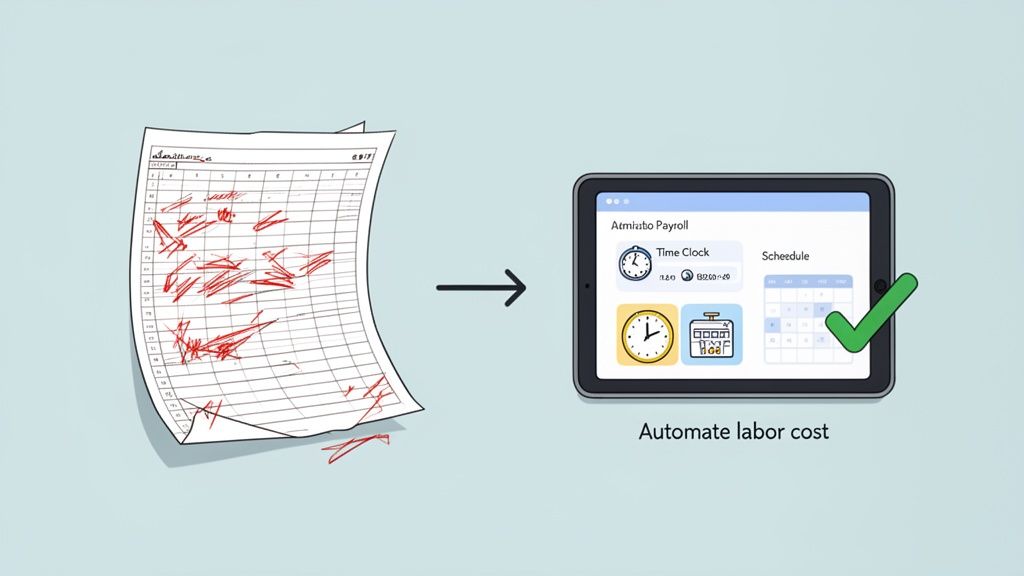
If you're tracking labor costs for more than a couple of people, you know the feeling. You're staring at a spreadsheet, terrified that one broken formula or typo is throwing off your entire budget. We've all been there.
What starts as a simple, organized grid quickly spirals into a monster.
You’re constantly chasing down numbers from HR, hunting for paper timesheets, and wrestling with formulas to account for overtime, benefits, and payroll taxes. By the time you’ve pieced it all together, the data is a week old. A report that’s a week old isn’t a management tool; it’s a history lesson.
The Real Cost of Manual Tracking
The problem with spreadsheets isn't just the tedious work. It’s that the entire process is disconnected from the reality of your day-to-day operations. It’s slow, riddled with opportunities for human error, and forces you to manage by looking in the rearview mirror.
That spreadsheet you're so carefully maintaining? It's the bottleneck. It keeps you buried in administrative work instead of leading your team, making you a data entry clerk instead of a manager.
This is the point where smart managers stop trying to perfect their spreadsheet and start looking for a better way. The goal isn’t just to calculate the number more accurately—it’s to get the calculation to happen on its own so you can get your time back.
From Manual Guesswork to Real-Time Clarity
What if your time clock, employee schedule, and payroll were all talking to each other? Imagine an employee clocks in, and the system instantly starts tracking their actual, fully loaded labor cost for that shift. It would know their specific wage, their benefits load, and even flag when they’re about to hit overtime.
Suddenly, there are no more spreadsheets to update. No more manual data entry. And definitely no more end-of-month surprises when the labor bill is way over budget.
An integrated tool solves the biggest headaches of manual tracking. You get live data, not history. Everything is in one place. And you can be proactive, not reactive, seeing overtime costs pile up before they blow your budget, not after. This allows you to make smart staffing adjustments on the fly.
For businesses with unique pay structures, like tutoring centers, this automation is even more crucial. Moving beyond manual math and ensuring every instructor is paid correctly often requires a specialized tool, like a tutor payroll software, that can handle complex pay rates automatically.
This is about more than just slick software. It's about changing how you manage your business. It means trading hours of frustrating admin for a few minutes of clear, actionable insight—freeing you up to focus on what you’re actually there to do: lead your people and grow the business.
Common Questions About Calculating Labor Cost
Even after you’ve run the numbers, a few questions always seem to stick around. It’s a tricky subject, so let's clear up some of the most common points of confusion we see.
What’s the difference between direct and indirect labor costs?
Think of it this way: direct labor is the cost of paying the people who are hands-on in creating your product or delivering your service. We're talking about the assembly line worker, the barista pulling espresso shots, or the roofer nailing down shingles. You can draw a straight line from their wages to what you sell.
Indirect labor, on the other hand, covers everyone else who keeps the lights on. This is your HR manager, the security guard, or the accountant handling payroll. Their work is absolutely essential, but it supports the entire business, not one specific product. These costs get filed under general overhead.
Getting this right isn't just about tidy bookkeeping. It directly impacts how you price your goods and whether you truly understand your profit margins.
If you accidentally classify an indirect cost as a direct one, you'll think your products are more expensive to make than they really are. That leads to bad pricing decisions. Nail this distinction, and you'll have a much clearer picture of your business.
How often should I recalculate my direct labor cost?
Probably more often than you are right now. At the very least, you have to do this once a year, especially after annual pay raises or changes to your benefits plans have been locked in.
But honestly? A quarterly review is a much safer bet.
Things are always in flux. Overtime hours can spike during a busy season, payroll tax rates might get adjusted, and every new person you hire could have a different benefits package. A quarterly check-in stops your "true" labor cost from drifting too far from reality and ensures your budgets are built on fresh data, not old assumptions.
Can I use an average labor burden rate for all employees?
You can, but you're taking a shortcut—and shortcuts have risks. Using a single average rate for everyone is definitely simple, but it papers over the very details that drive your costs up or down.
For example, a senior employee who's been with you for a decade likely has a higher salary, more PTO, and a more expensive health plan. A brand-new, part-time hire? Their burden is significantly lower. If you're pricing a project that needs your most experienced people, using an average rate will make you underbid the job. Every time.
For high-level, back-of-the-napkin budgeting, an average rate can give you a decent starting point. But when you need to get serious about job costing or departmental budgets, you’ll get a much sharper and more reliable number by calculating separate rates for different groups, like full-time vs. part-time or senior vs. junior staff.
Wrestling with spreadsheets to calculate labor cost is a constant headache. Pebb combines your time clock, scheduling, and team management into one platform, giving you real-time labor insights without the manual number-crunching. See how it works.
