
An Intranet on the Cloud? Here’s What That Actually Means.
Tired of clunky intranets? An intranet on cloud connects your entire team, especially frontline workers, with a simple, mobile-first app. Here's why it works.
Dan Robin
Let's be honest. The old company intranet is a digital ghost town. It's where announcements go to die and where company culture feels like a memo from a forgotten era. We've all been there: staring at a clunky, decade-old interface, trying to find a simple document, and feeling like the tool was designed to make our lives harder, not easier.
An intranet on cloud is supposed to be the answer. But that term gets thrown around a lot. It’s often sold as a technical upgrade—moving your digital filing cabinet from a dusty server room to "the cloud." But that’s only half the story. The real shift has nothing to do with servers. It's about changing how people connect to their work and to each other.
Why Your Old Intranet Is Broken
That feeling of frustration with your old intranet? It’s not your fault. It’s a tool built for a different time, a different way of working. It was designed when everyone came to a central office, sat at a desk from nine to five, and had a wired connection to a server humming in a closet down the hall.
That world is gone.
Work happens everywhere now: on a shop floor, in a delivery truck, from a home office, or at a client site. Yet many companies are still trying to run on software designed for a single building. It’s like trying to navigate a new city with a map from 1985. The streets have changed.
A Relic From Another Time
The problem with on-premise systems wasn’t just the technology. It was the philosophy. They were built on the assumption that work was a place you went to, not a thing you did.
This created a two-tiered system. The people at headquarters got the information. The people on the front lines—the ones interacting with customers, making the products, and delivering the services—were left out. It was a failure of imagination, not just engineering. We dive deeper into this in our article about why your intranet isn't working and how to fix it.
The rest of the world has moved on. The numbers don't lie. By 2026, the global cloud computing market is expected to reach an incredible $947.3 billion. More than 60% of all corporate data is already in the cloud. An intranet on cloud isn't a futuristic idea anymore; it's the standard.
The friction you feel with your old intranet isn't a bug. It’s a sign that the tool is no longer fit for purpose. It's like trying to send a text with a rotary phone. It just wasn’t built for the job.
If you suspect your current system is holding your team back, it’s worth looking at these 7 signs your enterprise CMS needs an urgent upgrade. Acknowledging the problem is the first step toward finding a calmer, more human way to connect your entire company.
What We Really Mean By An Intranet On Cloud
Let's clear something up. When we talk about an intranet on cloud, we’re not just talking about giving your old company portal a technical facelift. This is a complete reimagining of your company’s internal world. It’s less like a static website and more like your company’s digital home—a living, breathing space that your team can access from anywhere, on any device.

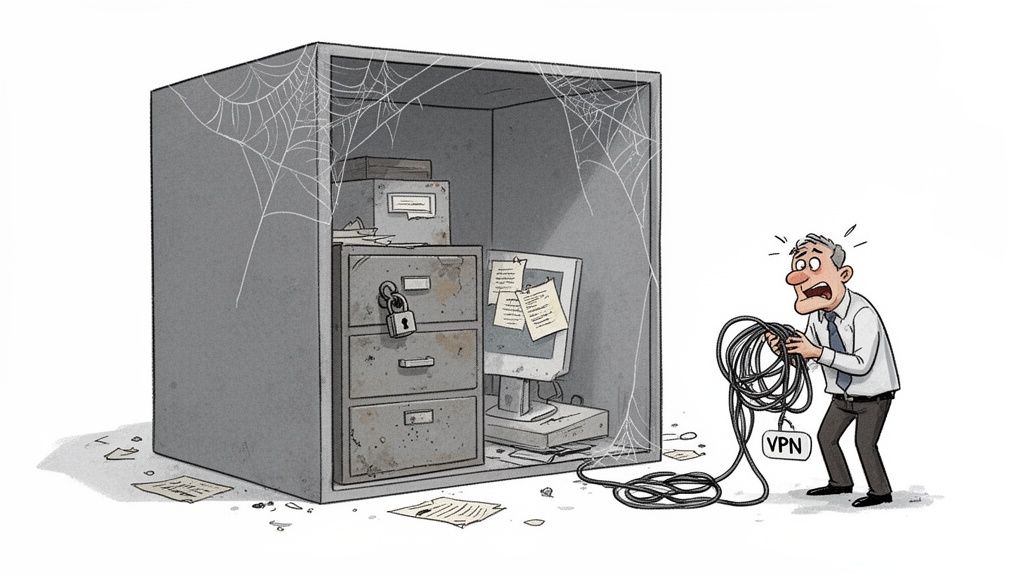
Here's a better way to think about it. A traditional, on-premise intranet is like a locked filing cabinet in a back office. To get anything, you have to be physically there, have the right key, and know exactly which drawer to search. It’s restrictive by design.
A modern intranet on the cloud is the opposite. It’s a shared, real-time workspace where everyone is already inside. The door is always open, whether you’re on a laptop at headquarters, on your phone in a warehouse, or checking in from a client site.
A Unified Digital Home
Here’s where it gets interesting. A true cloud intranet isn’t just one thing. It pulls three critical parts of your business into a single, seamless app. This isn't just a place to post news anymore. It’s where your team actually gets work done.
Communication: This is the company's heartbeat. It’s where you see instant updates in a familiar news feed, have quick chats with your team, and feel the pulse of the entire organization.
Operations: This is the engine room. It’s where an employee checks their schedule, clocks in for a shift, and instantly finds the procedure for a specific task.
Culture: This is the connective tissue. It’s where you can find a coworker in a people directory, send a quick note of recognition, and feel like part of a team, not just a name on a payroll.
Bringing these elements together is a big deal. It's no wonder that global public cloud spending is projected to soar past $1 trillion by 2026. This growth is fueled by this exact kind of integrated thinking—giving businesses one simple app where calls, company news, and work schedules all live together.
Designed For Everyone, Not Just A Few
Let's be honest: for decades, most business software was built for people sitting at desks. A modern cloud intranet finally flips that script. It’s designed from the ground up for the people who are never sitting still—the retail associate on the sales floor, the warehouse manager coordinating shipments, the nurse doing their rounds.
If you're curious about how these internal networks evolved, we wrote a simple guide on the differences between an intranet and an extranet that might be helpful.
An intranet on cloud isn't a tech project; it's a people project. It's a statement that every employee, regardless of their role or location, deserves to be connected and informed.
This mobile-first approach isn't optional today. To appreciate the benefits, it helps to understand the broader advantages of cloud computing for small businesses. The core idea is simple: give your people tools that make their jobs easier, not more complicated. When the tools are intuitive, accessible, and designed for them, you build the foundation for a truly connected company.
The Features Your Team Will Actually Use
Let's be real—most intranets are ghost towns. They’re packed with features that look great in a sales pitch but are ignored by the people they're supposed to help. A great intranet on cloud cuts through the noise. It’s not about having more features; it’s about having the right ones that your teams need to connect and get their jobs done.
Nobody is asking for another complicated piece of software. Your people want simple tools that solve real, everyday problems. Here’s what that actually looks like.
A Heartbeat News Feed, Not a Corporate Megaphone
The old way was a one-way street. Corporate would post an announcement and hope people stumbled upon it. A modern cloud intranet trades the megaphone for a living, breathing news feed—like a private social network just for your company.
It’s where a store manager can post a quick photo of a new product display, a team lead can celebrate a weekly win, and the CEO can share a candid video update from their phone. It’s interactive, engaging, and relevant. We're not just talking about dry company announcements; we're talking about building a shared pulse that connects every location, team, and shift.
Chat That Unifies, Not Scatters
On the front line, communication is often a chaotic mix of personal texts, random WhatsApp groups, and last-minute phone calls. It’s disorganized, insecure, and cut off from the rest of the business. A modern intranet must have integrated private and group chat.
This one feature brings every work conversation into a single, secure, and searchable home. Need someone to cover a shift? Post in the group chat. Have a quick question for your manager? Send them a direct message. It replaces chaos with clarity and ensures critical conversations don't get lost in a sea of personal texts.
Imagine a retail manager, Sarah, gets a last-minute text from a sick employee. Instead of frantically scrolling through her phone contacts, she opens the company app. She posts in the "Shift Swap" chat, and within minutes, another team member claims it. Everything is documented. That’s the power of unified chat.
A Knowledge Library You Can Actually Use
How many times have you given up trying to find a simple policy on an old intranet? The "document library" of the past was more like a digital black hole. A searchable Knowledge Library is non-negotiable.
This becomes your company’s single source of truth, instantly accessible from any phone. New cleaning protocol? It’s there. Onboarding checklist? Find it in seconds. The point is to make information findable the moment it's needed. For an employee on the floor, this means getting an answer on the spot without having to track down a manager.
After seeing how these tools work together, you might want to explore more about what to look for in a modern intranet and what to leave behind.
Tasks and Schedules That Bring Clarity
For hourly and shift-based teams, clarity is everything. A true intranet on cloud has to bring daily operations right into the app your team already uses. This means simple task management and crystal-clear shift schedules are must-haves.
Employees should be able to see their upcoming shifts, request time off, and clock in—all from their phones. Managers should be able to assign daily to-dos and see what’s been completed in real-time. This isn’t about micromanaging; it's about giving everyone a shared, transparent view of what needs to get done.
When you bring all these pieces together—chat, news, knowledge, and tasks—it stops being just a collection of tools. It becomes a digital home that makes work simpler and more connected.
Making The Switch Without The Headache
Let's be honest. The thought of launching a new company-wide system can be enough to give anyone a migraine. We’ve all heard stories of those massive IT projects that drag on forever, blow the budget, and deliver a tool nobody uses.
Here’s what we’ve learned from being in the trenches: rolling out a modern intranet on cloud shouldn’t be a nightmare. It’s not a six-month saga. If you have the right tool, you can get your teams up and running in a matter of days.
If a vendor hands you a 50-page implementation guide and a multi-month timeline, that's a red flag. The process should be as simple as the platform itself. You're busy. Your teams are busier. You don’t have time for a complicated affair.
Start Small, Learn Fast
The number one mistake we see is trying to boil the ocean with a "big bang" launch. Unveiling a new tool to everyone on the same day is a recipe for chaos and a flood of support tickets.
A calmer approach is to start with a pilot group. Pick a single team, one department, or one store location. Give them the tool and a simple mission: use it for your daily work. This isn't about stuffy, formal training; it's about seeing how it works in the real world.
A small pilot isn't just about testing the tech. It’s about testing your strategy in a low-stakes environment. It’s your chance to see what resonates and what falls flat before you go live for the whole company.
The feedback from this group is gold. You'll quickly discover which features are a hit and which parts need a clearer introduction. This also creates a team of champions who can help their colleagues get comfortable when it's time for a wider rollout.
Make Onboarding Effortless
When you're ready to expand, getting people on board needs to be incredibly simple. Your frontline employees aren’t going to sit through a two-hour webinar. They need to get in, get oriented, and get back to work in minutes.
The benchmark for this is a single invite link. A manager should be able to text a link to a new hire, who can then join the workspace, set up their profile, and see their first shift in less time than it takes to make a cup of coffee. Anything more complicated is just friction nobody needs.
This simple loop is the heart of a well-designed system: sync up with the team, chat to solve problems, and find what you need without missing a beat.
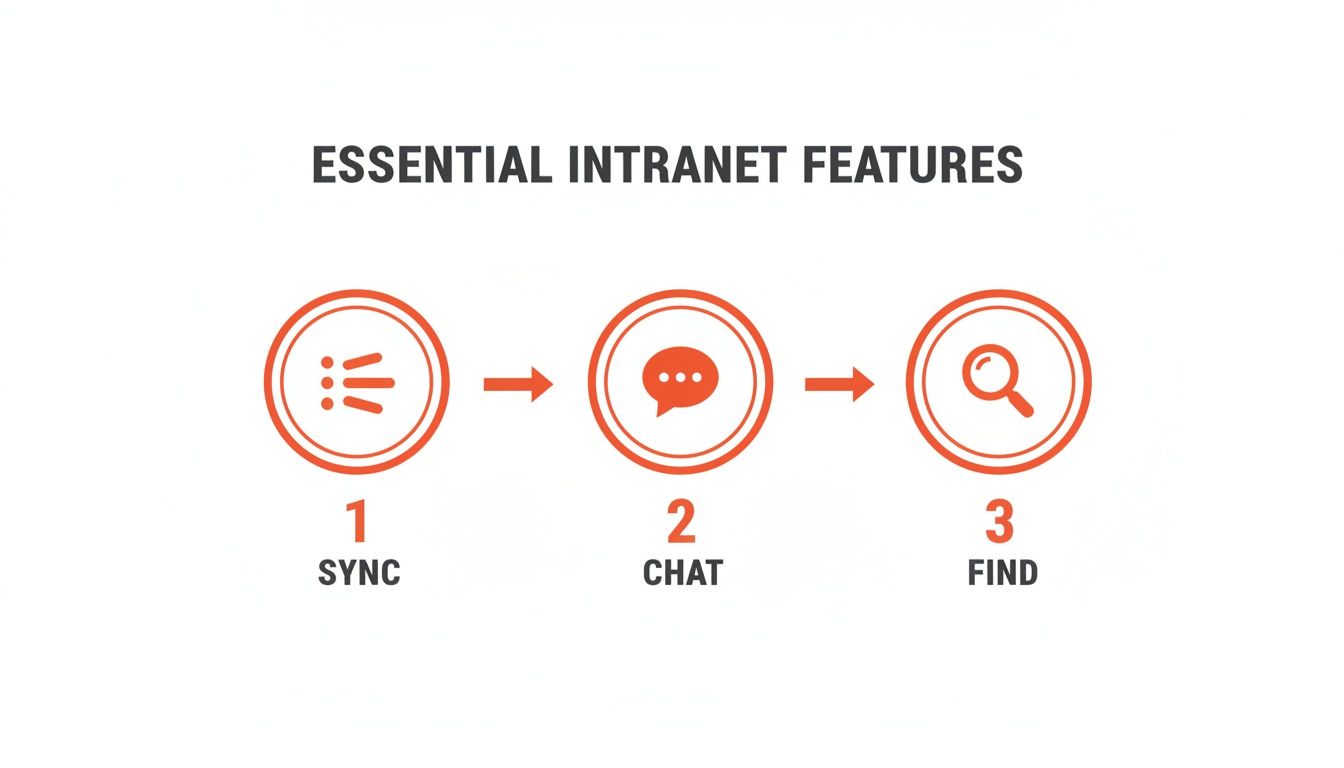
This flow shows that a great intranet on cloud is built around quick, seamless actions that actually support an employee's day, not add to it.
Integrate, Don’t Duplicate
A new tool should make life easier, not create more work. That's why integrating with the systems you already rely on is a must.
If you can connect your new intranet to your existing HR or payroll software, you can eliminate countless hours of manual data entry and keep all your employee information in sync. It’s a huge win.
Just as important is setting up your roles and permissions right from the start. A sales associate in Dallas shouldn't be swamped with notifications meant for the warehouse team in Denver. Smart permissions aren’t about locking everything down; it’s about making sure every employee sees only what’s relevant to their job. This keeps the platform clean, useful, and secure.
Moving to an intranet on cloud is your chance to simplify. Your rollout should reflect that new simplicity: take small steps, listen to your people, and choose a tool that helps them from the very first click.
How To Know If Your New Intranet Is Working
Alright, the new intranet on cloud is live. The pilot team gave it a glowing review. Most people have the app on their phones. So… now what? How can you tell if it’s actually paying off?
The first impulse is to obsess over "adoption rate." But let’s have an honest conversation. Chasing a vanity number like 90% adoption tells you very little. It proves people logged in, maybe once, to get you off their back. It doesn't prove the tool is making anyone's job easier.
True success isn’t found in a login report. It's a shift you can feel. You'll know it's working when things start to get… quieter.
Look For The Quiet Wins
The real ROI of a great intranet isn't a loud, explosive change. It's the sound of problems that simply stop happening.
You'll notice fewer panicked calls scrambling to find someone to cover a shift.
The flood of emails asking "Where can I find…?" slows to a trickle.
New hires don't seem so lost during their first few weeks.
These are the quiet wins. They won't show up on a dashboard, but they are the most reliable signs that your new platform is doing its job. When that constant, low-grade hum of operational chaos begins to fade, you know you’re on to something. The point isn't just to get people to use an app; it's to create a culture of clarity you can feel from the front desk to the factory floor.
The ultimate measure of a great intranet is that it makes the organization calmer, smarter, and more self-sufficient. It solves problems before they become noisy disruptions.
Are your frontline teams more in the loop? Is there less confusion about daily priorities? Are new people getting up to speed faster? The answers to these questions tell a much richer story than any sterile "adoption rate" ever will.
Use Analytics For Insight, Not Surveillance
This isn’t to say you should ignore data. Your cloud intranet will have analytics, and they can be powerful—if you approach them with the right mindset. The goal is to spot trends, not to play Big Brother.
Think of yourself as the editor of a community newspaper, not a security guard. Your job is to discover what your people find useful.
Here’s what to look for:
Which posts get the most love? Are people reacting to posts about team wins, policy updates, or personal stories from leadership? This tells you what kind of content your culture craves.
Is anyone using the directory? If you see employees from different sites looking each other up, that's a fantastic sign. It means they’re building bridges and breaking down silos.
What are people searching for? The search log in your knowledge library is pure gold. If "PTO policy" is the top search term, that's a signal that the information is either hard to find or confusing. It’s direct, unfiltered feedback.
This kind of analysis is about curiosity, not control. It’s how you listen to the digital body language of your organization to figure out what’s working.
The Real ROI Is A Connected Culture
When it’s all said and done, an intranet on cloud is just a tool. The magic happens when that tool helps your people feel more connected—to their work, to the company's mission, and to each other.
Success is when a warehouse associate on the night shift feels just as informed as someone at headquarters.
It’s when a new retail employee can confidently answer a customer’s question by pulling up a spec sheet on their phone, feeling capable in that moment.
The final test isn't a number on a spreadsheet. It's a feeling. Does your company feel more like one team? Is information flowing freely and calmly? If the answer is yes, then your new intranet isn’t just working—it’s a success.
This Is About People, Not Just Technology
We could get lost in the weeds talking about servers, uptime, and cloud architecture, but we'd be missing the entire point. Moving to an intranet on cloud isn't really a technology decision. It's a people decision. At its core, it’s a commitment to finally trust your employees and give them the tools they deserve.
For too long, a massive gap has existed between the tools we give office staff and those we hand to our frontline teams. A developer gets the latest and greatest, while a cashier has to share a decade-old computer in a cramped breakroom. Moving to the cloud is about closing that gap for good.
It’s a powerful way to say that the employee experience for a nurse on a twelve-hour shift is just as vital as it is for an executive in the C-suite. It’s a recognition that every single person drives the company's success, and they all deserve to feel connected.
More Than a Tool, It’s a Connection
Let’s be honest. When you give your team a tool that’s clunky and a pain to access, you’re sending a message, whether you mean to or not. You’re telling them their time isn't valuable. You're creating friction where there should be flow.
A modern, mobile-first intranet does the opposite. By making it easy for an employee to check their schedule on their phone or get a quick "great job!" from their manager, you're showing them they matter. You’re proving that the company sees them, hears them, and respects their contribution.
This isn’t about chasing a few extra productivity points. It’s about building a foundation of trust that pays off in ways no spreadsheet can measure. A well-designed intranet on cloud can take a fragmented group of employees and turn them into a genuine community.
The best tools aren't the ones with the most features. They are the ones that get out of the way and let your people shine. The goal is to make communication so simple that it becomes second nature.
This rings especially true for companies with distributed teams. When your workforce is spread across dozens of locations, a shared digital space is often the main thread holding everyone together. It becomes the virtual town square where your company culture actually comes to life.
It Starts With a Simple Idea
When you strip everything else away, the move to a cloud intranet is rooted in a simple idea: a company is at its strongest when every person feels seen, heard, and connected—no matter where they clock in.
It’s a bet on your people. It’s an investment in clarity over chaos and in connection over isolation. This isn’t just about installing new software; it's about fostering a better, more human way to work together.
The technology is just the vehicle. The real destination is a company where information flows freely and every employee—from the front line to the back office—feels like they truly belong.
As you weigh this shift, don't just get bogged down in feature lists. Ask yourself a much more important question: what kind of company do we want to be? The right tool won't just support your answer; it will help you build it.
Frequently Asked Questions
Whenever we talk about moving a company’s central hub to an intranet on cloud, a few questions always pop up. I'm glad when they do. It means people are thinking through what this shift really means for their business and their people. Let’s walk through a few of the most common ones.
How Secure Is An Intranet On The Cloud?
This is usually the first question, and for good reason. The short answer? A modern cloud intranet provider’s business hinges on a level of security that’s far more robust than what a single company could realistically maintain on its own. We're talking about enterprise-grade data encryption, round-the-clock monitoring, and strict adherence to standards like GDPR.
Think of it this way: for a cloud platform, security isn't just a feature; it's their reputation on the line. For an in-house IT team, security is one of a dozen critical tasks they’re juggling.
A cloud intranet's security isn't just about technology; it's a business model. The provider's survival depends on protecting your data, which means their investment in security is relentless.
But security goes beyond the provider. The platform itself gives you incredible control. With granular permissions, you can make sure employees only see what’s relevant to them. A cashier has no need to view financial reports, and a warehouse worker in Dallas shouldn't see the shift schedule for the Miami location. This kind of precise control is one of the most effective ways to reduce risk.
How Do We Get Frontline Teams to Adopt A New App?
Ah, the million-dollar question. This gets to the heart of why older systems fail. Adoption isn’t about forcing people to use a clunky tool. The secret isn't more training; it's finding a tool that people want to use.
The solution is a mobile-first design that feels as intuitive as the social media apps your team already uses. You'll know you've found the right platform when getting a new employee started is as simple as sending them a single text message link, not handing them a 20-page guide.
Instead of a big, formal launch, try a more practical approach. Start by making the new app the only place to find the weekly work schedule. When your team sees that the tool actually makes their life easier by giving them direct access to information they care about, adoption stops being a chore. It happens naturally.
Can A Cloud Intranet Replace All Our Other Tools?
The goal is to simplify, not to add another app to the pile. While it might not replace every single specialized software you use, a great all-in-one cloud intranet can get you surprisingly close.
Think about it. A good platform can pull your team out of scattered email threads and into organized chats. It can replace messy shared drives with a single, searchable Knowledge Library. It can even take over for separate scheduling apps by bringing shift planning, clock-ins, and time-off requests under one roof.
The real win is creating a single source of truth. When all your communication, operational tasks, and company resources live in one place, you kill the constant app-switching and start trimming subscription costs. For a team spread across different locations, having one digital home isn't just a nice-to-have—it's essential.
Ready to unify your team with a single, simple app? Pebb brings communication, operations, and engagement together for frontline and office teams. See how it works.
