Why Your Digital Employee Experience Platform Is Failing You
Tired of juggling apps? A digital employee experience platform can unify your tools, cut through the noise, and boost productivity. Here's how to do it right.
Dan Robin
We’ve all been there. You’re digging through endless email chains for a policy update, or juggling four different apps just to get one thing done. It feels like swimming upstream, every single day.
This isn’t a small annoyance. It’s a quiet tax on your team’s energy and focus. It’s the hidden cost that chips away at good work and morale. A digital employee experience platform is supposed to solve this, to create one calm place where work happens. But often, it just adds to the noise.
The Hidden Tax of a Disconnected Workplace
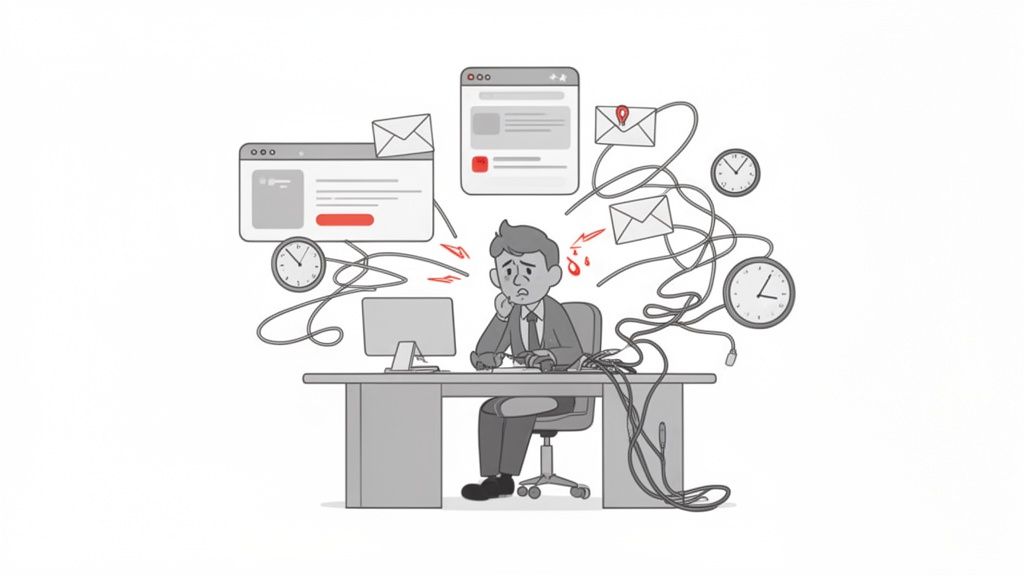
Let’s be honest—the daily grind of digital friction is exhausting. Every time an employee has to switch between apps, they pay a mental toll. It's called context-switching, and it’s a productivity killer. You pop into your chat app to ask a quick question, see five other notifications, and the original task is gone from your mind.
This constant shuffle doesn’t just waste time; it slowly poisons the culture. When conversations live in scattered emails, project boards, and siloed chat groups, the sense of a shared mission unravels. People feel less like a team and more like a collection of individuals working in the same general direction.
The Real Cost of Digital Friction
The consequences of this mess are real. We've seen how poor communication in the workplace can undermine a business from the inside out. It’s a huge barrier to doing great work, a headache every leader in HR and Operations knows well.
This goes beyond simple inconvenience. It’s about the human side of work. When your digital environment is a chaotic mess, your people feel it. They get frustrated, they disengage, and they’re far less likely to go the extra mile. The weight of these small, daily struggles leads to burnout. Eventually, people walk out the door.
The problem is we’ve given our teams a patchwork of tools instead of a unified digital headquarters. Each new app, meant to solve a problem, just adds another layer of complexity.
Beyond Minor Annoyances
This isn't just a headache; it's a systemic issue holding your company back. Think about the direct impact:
Productivity: Research suggests that tiny mental blocks from switching tasks can eat up as much as 40% of a person's productive time.
Onboarding: New hires are thrown into a digital maze, making it incredibly hard for them to feel competent and connected from day one.
Knowledge Sharing: Crucial information gets lost in personal inboxes or forgotten chat channels, forcing people to reinvent the wheel.
For too long, we've accepted this digital tax as a cost of doing business. It doesn’t have to be this way. The alternative is a workspace designed for people—a place that helps everyone focus, connect, and do their best work without all the noise.
Moving Beyond The Company Intranet
For years, the company intranet was supposed to be the answer. It was pitched as a digital town square, but what did it become? A digital filing cabinet. A dusty, forgotten corner where documents went to die. It was a destination, somewhere you had to consciously decide to visit.
Let's be honest. Nobody ever wanted to go to the intranet. It was a chore.
A true digital employee experience platform is built on a different philosophy. It’s not a website you visit; it’s the digital environment where your work happens. It’s woven into the fabric of your workday, not just another tab you have to remember to open.
Think of it this way: an intranet is a public library you have to make a special trip to. A good DEX platform is like having the exact book you need appear on your desk the moment you need it.
From Static Pages To Living Workspaces
The old intranet was all about static information. It was fine for housing the employee handbook, but it failed at the human parts of work: conversation, collaboration, and real connection. It was a one-way street for information, broadcasting messages from the top down.
A modern digital employee experience platform is a two-way conversation. It’s alive. It’s where a manager shares a project update, a new hire asks a question, and a team solves a problem together—all in one place. It pulls work out of separate, siloed apps and into a single, breathing hub.
This isn’t a minor upgrade; it's a total reimagining of a company's digital headquarters. And the market is catching on. The global digital workplace market is projected to hit $44.9 billion by 2026, growing at a staggering 21.5% annually. This isn’t a trend; it’s a fundamental shift. You can dig into the full analysis over at KBV Research.
Old Tools vs. DEX Platform: A Quick Comparison
To see the difference, it helps to put the old and new side-by-side.
Characteristic | Traditional Tools (Intranet, Email) | DEX Platform |
|---|---|---|
Primary Focus | Information storage & one-way broadcast | Action, communication & collaboration |
User Experience | A destination you must visit | Integrated into the daily workflow |
Communication | Top-down, formal announcements | Two-way, dynamic conversations |
Integration | Siloed; requires switching between apps | Unified hub connecting multiple functions |
Employee Role | Passive information consumer | Active participant and creator |
This isn't about a better interface; it's about building a digital space that supports how people work today.
The Problem With Digital Patchwork
Many companies tried to fix the intranet by just adding more tools. A chat app here, a project management tool there. The intention was good, but the result was more chaos.
Each new tool added another login to remember, another stream of notifications, and another place for information to get lost. Instead of a seamless experience, we ended up with a digital Frankenstein's monster—a clumsy patchwork of systems that barely spoke to each other.
The goal isn’t more tools. The goal is the right tool that brings everything together. A platform shouldn’t add to the noise; it should quiet it.
A digital employee experience platform is the antidote. It unifies the essential functions of work into one coherent place. It understands that communication is tied to tasks, documents, and people. By bringing them together, you eliminate the friction that slows teams down.
Making this change is a big step. If you're weighing the pros and cons, we've broken down whether an employee experience platform can replace your intranet in detail.
The real magic happens when your digital space feels less like a sterile office and more like a bustling workshop—a place designed for creating, connecting, and getting work done. It's no longer a luxury. It's a necessity.
The Three Pillars of a Great DEX Platform
So, what separates a useful digital employee experience platform from just another piece of software? It’s not about cramming in more features. It's about how well a few core ideas work together to make life simpler.
After years in this space, I've found that a great platform rests on three sturdy pillars. It’s a simple framework that clarifies what a DEX platform should actually do.
Pillar 1: Seamless Communication
Email was never designed for the quick, dynamic conversations modern work demands. It’s become a dumping ground for everything from urgent requests to company newsletters. Seamless communication means moving all of that into one organized, intuitive feed.
This is about creating a single source of truth. Company-wide announcements, team-specific updates, and direct chats all living in the same house. When a manager shares a policy change, it shouldn’t get lost between a pizza party invite and a dozen reply-all threads.
A platform built on this pillar ends inbox anxiety for good. It creates a space where communication is immediate, contextual, and easy to find later.
This diagram shows how a DEX platform acts as a central hub, simplifying the old, clunky structure of separate tools.
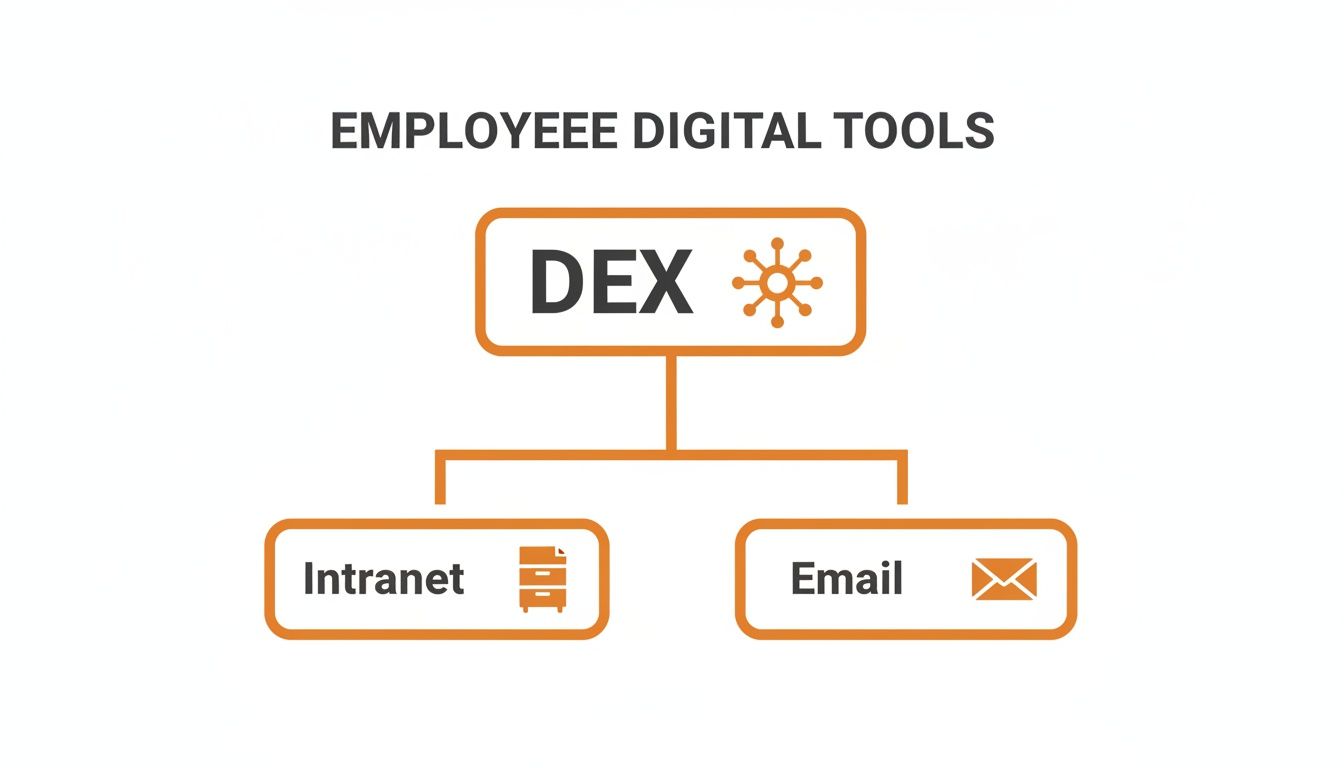
Here's the thing: a DEX platform doesn't just add to the pile; it sits above existing tools to create a single, unified experience.
Pillar 2: Integrated Operations
The second pillar is about action. A great digital workspace isn't just for talking; it's for doing. This is where the platform moves from a communication tool to an operational command center.
Integrated operations means your team can manage tasks, check schedules, request time off, and find documents without leaving the app. Imagine a retail associate swapping a shift with a coworker in the same place they get updates from their manager. That’s where the magic is.
This pillar is critical because it connects conversation to work. Instead of saying, “I’ll email you the file,” you just share it right there. The friction between talking about the work and doing the work disappears.
An effective platform doesn't just host conversations about work; it becomes the place where the work gets done.
This focus on integrating daily tasks is why these tools are taking off. Research from Gartner suggests that by 2026, 50% of digital workplace leaders will have a dedicated DEX tool in place, up from just 30% in 2024. This is a rapid shift in how companies support their people.
Pillar 3: Genuine Engagement
The final pillar is the most human. It’s about building a real sense of connection and culture, even when your team is spread across different locations or shifts.
Genuine engagement goes beyond superficial likes. It’s about creating channels for meaningful interaction. This could be a space for peer recognition, where people can publicly thank a colleague. It could be simple polls and surveys that give everyone a voice. It could be a human directory with profiles that show the person behind the job title.
These features might seem small, but their effect is profound. They make a large organization feel smaller. They help new hires find their footing and tenured employees feel seen.
This isn’t about forced fun. It’s about providing simple, organic ways for people to connect as humans. You can learn more about the core concepts in our guide to the digital employee experience.
When these three pillars—communication, operations, and engagement—are built into one platform, you get more than a new tool. You get a digital home for your company. It becomes the central nervous system that keeps everyone, from the front office to the frontline, connected and informed.
What a DEX Platform Looks Like in the Real World
Theory is one thing. Buzzwords don’t capture the feeling of relief when a nagging, everyday problem just disappears. The real test of any tool is how it performs out in the wild, when things get messy.
So, let's talk about what a digital employee experience platform actually does for people on the ground. It’s not about some grand, sweeping change overnight. It’s about fixing the hundreds of small, frustrating moments that make work a grind.
On the Retail Floor
Imagine you're a store manager. Corporate just dropped a new 30-page PDF on visual merchandising. The old way? You’d print it, stick it in a binder, and hope your team finds a moment to read it.
Instead, you open one app on your phone. You post a quick update with three key photos from the guide and a short message: “Team, here’s the new endcap setup. Let’s get this rolled out by EOD. Ping me here with questions.”
Instantly, every employee gets a notification. Someone on break sees it and starts setting it up. Another person replies with a quick question, which you answer in seconds. By lunchtime, the new display is up, consistent across all your stores. No paper wasted. That’s the difference.
In the Hospital Ward
Now, picture a nurse on a busy hospital floor. A new sanitation protocol has just been approved. Before, this update might have been mentioned in a huddle, sent in an email, or buried in a binder at the nurses' station. Trying to find that one update under pressure was a nightmare.
With the right platform, it’s a non-issue. The charge nurse posts the updated protocol—a short video and a one-page checklist—in the "Clinical Updates" channel. Every nurse can pull it up on their phone in seconds, right in the hallway.
This isn't just about convenience; it's about patient safety. When critical information is instantly accessible, you reduce the risk of human error. You give your team the confidence to act because they know they have the right information.
The nurse doesn't have to leave the floor or hunt for a binder. The answer is just… there. That’s what a calm, connected workplace feels like.
In the Logistics Warehouse
Let's head to a bustling warehouse. An unexpected shipment arrives, and the manager needs extra staff for the next shift. The old way was a frantic spiral of phone calls and text messages.
Now, the manager posts one message in the "Shift Openings" group: “Urgent need for two pickers for the night shift. Bonus pay approved.” Everyone qualified sees it. A forklift driver on his way home replies, “I can take it.” A part-time worker confirms she’s available, too.
In five minutes, the shift is filled. No dozen phone calls, no confusion. The entire process was handled in one place. The manager can now focus on the actual work, not playing switchboard operator. This isn't some futuristic dream. It's what a good digital employee experience platform delivers.
How to Choose The Right Platform Without The Headache
Let's be real—the market for these tools is a mess. Every vendor's website is a wall of buzzwords, with everyone claiming to have the magic "all-in-one solution." It's enough to make your head spin. So, how do you cut through the noise and find a platform your team will actually use?
The standard approach of comparing feature checklists is a trap. It's a surefire way to pick the tool with the most bells and whistles, not the one that solves your problems. I’ve seen this movie before. It ends with you paying for a powerful tool that nobody logs into.
Instead, let’s focus on three things that genuinely matter.
The Five-Minute Test
Here’s the first and most important test: Can a new employee figure it out in five minutes without a manual?
If the answer is no, walk away. It doesn't matter how many "powerful" features it has. If the tool isn't immediately intuitive, your people won't use it. End of story.
Look for a clean, simple design that feels familiar, like an app they already have on their phone. If it’s cluttered with menus, confusing icons, and corporate jargon, it’s doomed. Simplicity isn't a nice-to-have; it's the foundation of adoption.
When you're starting this journey, understanding IT vendor management best practices is a huge advantage. It helps you avoid common traps.
Is It Built for The Frontline?
Next, ask yourself: Is this built for someone on their feet, not just someone at a desk? This one question separates the real frontline tools from office software pretending to be a solution for everyone.
Pull it up on your phone. Does it work flawlessly? Are the buttons big enough to tap? Can you do key things—like send a message or check a task—with one hand?
Most business software is designed with a desktop computer as the default. A true frontline platform starts with the mobile experience. This isn’t a small detail; it’s the entire design philosophy.
If the mobile app feels like a clunky, stripped-down version of the desktop site, that’s a massive red flag. Your frontline teams live on their phones. Their main work tool needs to reflect that.
Does It Unify or Just Add Another Login?
The final question: Does this tool replace other systems, or just add another login to the pile? The whole point of a digital employee experience platform is to reduce chaos, not add to it.
Be skeptical of any platform that "integrates" with a dozen other apps. Often, that just means you’re getting a dashboard of links that still forces your team to jump between systems. A great platform brings core functions—communication, tasks, resources, and recognition—under one roof. It doesn't just point to them.
This market is booming, with forecasts showing it will hit US$35.6 billion by 2033. That growth is driven by companies that see the value in a truly unified digital home for their teams.
By focusing on these three tests—simplicity, a frontline-first design, and true unification—you can cut through the marketing hype. You’ll be in a better position to choose a tool that your people will actually love. For a more detailed breakdown, check out our ultimate guide to picking an employee experience platform.
The goal isn't to buy software. It's to build a calmer, more connected place to work.
Building a Calmer, More Connected Company
Let’s be honest. Choosing a digital employee experience platform isn't a technology decision. It's a people decision. It’s a statement about what your company values. It tells your team you respect their time and their sanity.
This is a choice to step away from the digital chaos we’ve all accepted as normal. It’s about creating a calmer, more focused environment where people can do their best work without the whiplash of switching between a dozen apps. It's about giving your team their headspace back.
It’s More Than Just Productivity Metrics
We often focus on the numbers—minutes saved, dollars earned. Those are important. But they're only half the story. The real return on investment is something you can't plot on a graph.
It’s the quiet hum of a team that’s in sync.
It’s the new hire who feels confident after their first week, not overwhelmed. It's the manager who can solve a staffing crisis in two minutes from their phone. It’s the feeling of shared purpose that builds when everyone is part of the same conversation.
When you give people one place to connect, find information, and manage their day, you’re not just making them more productive. You’re building a more coherent and human company culture, one small interaction at a time.
The Real Endgame
The point was never to add another piece of software. The real endgame is to build a better place to work. A place where technology serves people, not the other way around. A place where work feels less like a frantic scramble and more like a focused, collaborative effort.
This is about simplifying. It's about stripping away the complexity that wears people down so they can focus on the work that matters. This is how you build a company that doesn't just grow, but endures. A company that people are proud to be a part of. That’s the real promise of getting this right.
At Pebb, we built our all-in-one work app specifically to help teams create that calm, connected, and productive environment. If you’re ready to move beyond the digital chaos, see how we can help at https://pebb.io.
