
Warehouse Workforce Management That Actually Works
A calm guide to warehouse workforce management. Learn to forecast, schedule, and manage your team without the chaos. For leaders who want a better workplace.
Dan Robin
Tuesday at 8:07 a.m. is when weak warehouse workforce management shows itself.
A picker calls out. Two temps are late. Receiving is backed up because one forklift operator got pulled to shipping. Customer orders jump without warning, and the schedule on the supervisor's clipboard was already wrong before the first break. Then the phone starts. Then the radios. Then the blaming.
Most warehouses don't have a people problem first. They have a coordination problem. People feel that problem in their backs, in their breaks, and in the text message asking them to stay late again.
Good warehouse workforce management is what turns that kind of morning from chaos into something manageable. Not perfect. Warehouses are never perfect. But calm, fair, and predictable enough that the floor can keep moving without burning everyone out.
Taming the Warehouse Chaos
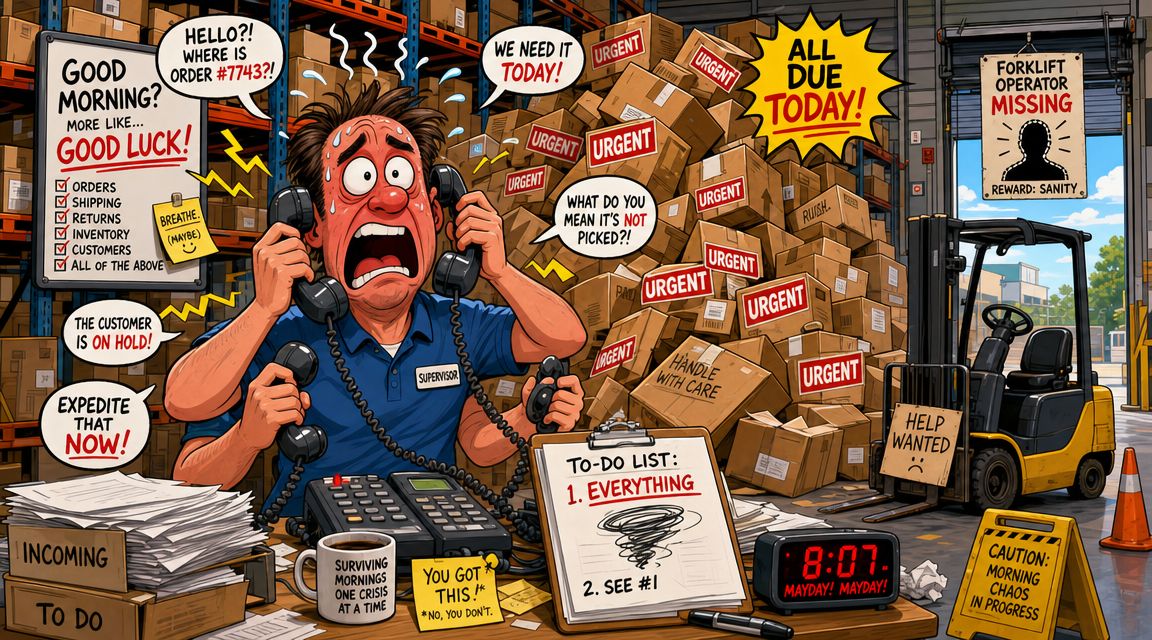
I've seen warehouses try to solve daily disorder with hustle. More calls. More favors. More heroics from the same reliable people. That works for a shift or two. It doesn't work as an operating model.
The hard truth is that labor sits at the center of the whole machine. Element Logic notes that labour costs typically account for 50% to 70% of a warehouse's total operating expenses in its guidance on warehouse workforce management and labor planning. When your biggest expense is also your least well-coordinated resource, small mistakes get expensive fast.
Chaos is usually a system issue
Most bad days aren't random. They come from the same few cracks in the system.
The schedule is built in isolation. It doesn't reflect expected order mix, inbound loads, or who can run which equipment.
Attendance lives in too many places. A spreadsheet says one thing, a text thread says another, and the floor finds out the truth when work starts piling up.
Supervisors manage by memory. They know who usually steps up, so the same people keep getting leaned on.
That doesn't just hurt cost. It hurts trust.
The fastest way to make a warehouse feel unfair is to make the schedule feel arbitrary.
People can handle hard work. What they struggle with is unpredictability. If one team gets crushed while another stands around, if overtime keeps falling on the same names, or if no-shows trigger a scramble every week, workers stop believing the place is being run with any care.
What workforce management really means on the floor
I don't think of warehouse workforce management as software first. I think of it as a discipline. It's the practice of matching real work to real people under real constraints, then adjusting before problems spread.
That means planning labor with demand in mind. It means knowing who is available, who is trained, who is drifting toward burnout, and where coverage is thin. It also means respecting people's time. A bad labor plan wastes payroll. A sloppy one wastes human energy.
Element Logic also emphasizes using historical data to predict seasonal demand, cross-training employees for flexibility, and monitoring KPIs such as productivity, order accuracy, and turnover so staffing can be adjusted in real time. That's what mature shops do. They stop treating staffing like a fixed weekly template and start treating it like an operating system.
When warehouse workforce management works, the floor feels different. Fewer surprises. Fewer panic calls. Better handoffs. Less resentment. You still have pressure, but you don't have confusion stacked on top of it.
The Core Components of Workforce Management
A strong workforce management setup works like a good conveyor. Every section depends on the next one doing its job. If forecasting is weak, scheduling gets shaky. If scheduling is shaky, attendance turns into guesswork. If attendance is messy, task assignment falls apart by mid-shift.
This is the backbone of it:
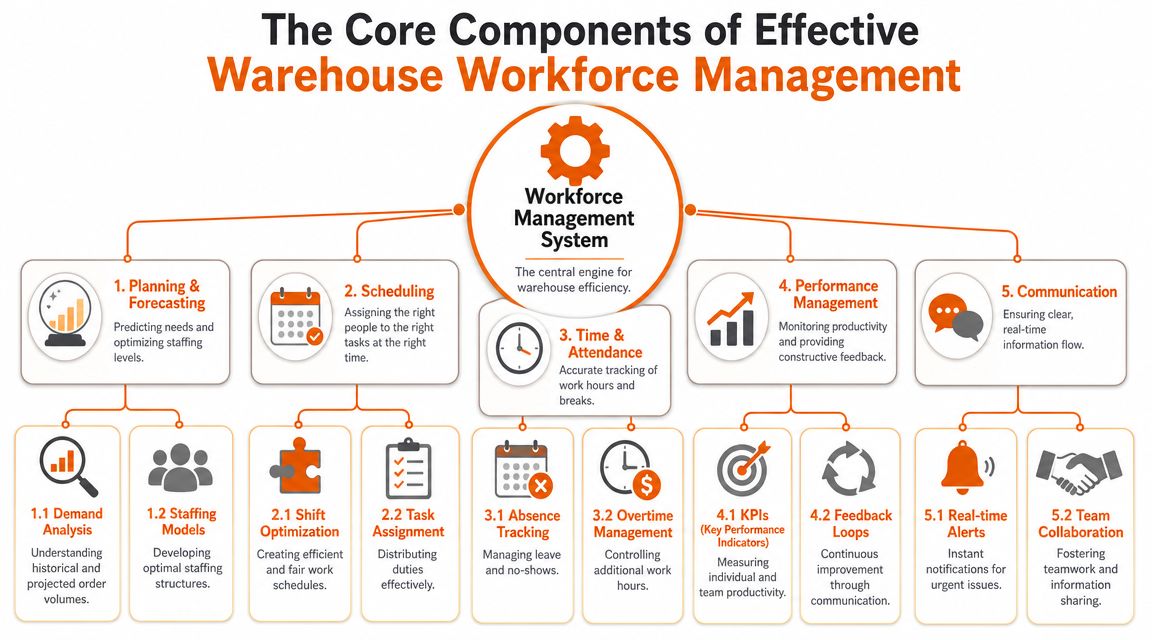
Forecasting tells you what the day is asking for
This part gets neglected because it doesn't feel urgent until you're short. But the whole system starts here. The work has to be estimated before it can be staffed.
ORTEC puts it plainly in its guidance on warehouse labor scheduling and planning. Warehouse workforce management is a forecasting and constrained optimization problem. Schedulers should gather employee schedules, attendance, productivity, and demand patterns, then analyze trends to assign the right employees to the right shifts and tasks.
That matters because not all labor is interchangeable. Receiving, putaway, picking, packing, and shipping each pull on different skills at different times. If you only plan by total headcount, you'll still end up short where it hurts.
Scheduling turns demand into something workable
A schedule isn't just a list of names. It's a set of decisions about workload, fairness, and risk.
Good scheduling answers practical questions:
Who can do the work safely
Who is available
Where are the peak windows
Which areas need backup if volume shifts
The best schedules aren't the tightest ones. They're the ones with enough structure to be efficient and enough flex to survive reality. That's one reason more teams move from patchwork tools to dedicated platforms. If you're comparing approaches, this guide to workforce management software for logistics is a useful starting point because it frames scheduling as part of the wider operating flow, not a standalone admin task.
On the floor: A schedule should survive first contact with the shift.
Time, tasks, training, and communication hold it together
After the schedule is built, execution takes over. At this point, many operations lose the plot.
A reliable system needs a clear source of truth for time and attendance. If breaks, no-shows, late arrivals, and overtime live in separate places, supervisors start making decisions off stale information. That creates bad downstream calls, especially when customer demand changes during the day.
Task management matters just as much. People need to know where to go, what matters now, and what changed. That sounds basic, but plenty of warehouses still depend on radio chatter, sticky notes, and hallway conversations.
Then there's training. Cross-trained employees give you room to breathe when volume shifts or someone is absent. Without that flexibility, one missing certified operator can ripple through the whole building.
A simple way to think about the core components is this:
Component | What it does | What breaks when it's weak |
|---|---|---|
Forecasting | Estimates labor demand by task and timing | Overtime, undercoverage, idle time |
Scheduling | Matches people to shifts and work | Last-minute changes, unfair load, burnout |
Time and attendance | Shows who is present and when | Payroll disputes, poor coverage decisions |
Task management | Directs effort on the floor | Congestion, confusion, missed priorities |
Training and safety | Expands flexibility and protects people | Bottlenecks, unsafe work, fragile staffing |
A warehouse can limp along with one weak part for a while. It can't perform that way for long.
Measuring What Actually Matters
Bad metrics create bad management. I've watched teams obsess over labor cost for the week while ignoring the reasons the week went sideways in the first place. If the schedule was wrong, if absenteeism rose, if trained coverage was thin, the cost number at the end just tells you the damage after it's done.
A useful dashboard listens to the operation as it's running. It doesn't just create something tidy for a review meeting.
Don't measure everything. Measure what changes decisions
The best workforce KPIs help a supervisor act sooner. They show where the plan is drifting before the floor starts compensating with overtime, rushed work, or frustrated people.
This is the short list I come back to.
KPI | What It Measures | Why It Matters |
|---|---|---|
Schedule accuracy | How closely the planned staffing matched actual work demand | Shows whether planning is grounded in reality or guesswork |
Shift fill rate | Whether open shifts are covered on time | Reveals staffing pressure before service suffers |
Absenteeism trend | Patterns in call-outs, lateness, and no-shows | Often signals burnout, weak communication, or schedule instability |
Overtime use | How often extra hours are needed to finish work | Helps spot chronic understaffing or poor labor allocation |
Task coverage by skill | Whether trained people are available for critical work | Prevents bottlenecks in equipment-heavy or specialized tasks |
Order accuracy | Whether the workforce is executing cleanly under pressure | Connects labor planning to customer outcomes |
Turnover trend | Whether the operation is keeping or losing people | Exposes whether the work environment is sustainable |
One practical foundation for all of this is accurate hour tracking. If your time data is messy, every labor conversation gets fuzzy. This guide on how to track employee hours is useful because it focuses on building a clean record first, before layering on broader analysis.
Watch the relationships between metrics
No KPI should be judged alone. That's where managers get themselves into trouble.
If overtime drops but absenteeism climbs, that isn't a win. If productivity rises while order accuracy slips, the team may be rushing. If fill rates look strong but the same people keep absorbing extra shifts, you're borrowing stability from next month.
A healthy workforce dashboard should tell one story, not seven unrelated ones.
I like to separate metrics into two buckets. The first bucket is immediate operating signals, things like schedule accuracy, attendance, and shift coverage. The second bucket is lagging health signals, things like turnover and recurring quality misses. The first bucket helps you run today. The second tells you whether your current habits are subtly breaking the team.
What a good dashboard feels like
It should be boring in the best way. Clear. Focused. Updated often enough to trust. Light enough that leads will use it.
When a warehouse starts measuring the right things, the conversation changes. Supervisors stop arguing over impressions and start fixing visible patterns. The team notices that, too. People can tell when management is paying attention to reality instead of just asking them to work harder.
Simple Principles for Better Management
Most warehouses don't need a grand reinvention. They need a few solid rules applied consistently.
The worst management habits usually come from false precision. Leaders build labor plans around the average day, the average staffing need, the average arrival pattern. Warehouses don't run on averages. They run on variation.
Plan for variance, not the happy path
If your plan only works when everything arrives on time and nobody calls out, it isn't a plan. It's a wish.
Build staffing with some slack where the operation is most fragile. That doesn't mean carrying waste everywhere. It means knowing where a small disruption causes a big jam, then protecting those points first. Shipping cutoffs, forklift coverage, break overlap, and handoffs between inbound and outbound are common failure spots.
Cross-training belongs here. Not as a poster idea. As daily operating insurance.
Train beyond one home station. Pickers who can help in packing, or receivers who can support putaway, give the building options.
Protect critical certifications. If only a small handful of people can do key equipment-based work, you don't have flexibility. You have exposure.
Refresh skills before you need them. Emergency cross-training in the middle of peak is usually too late.
Build schedules people can live with
A schedule is a management message. It tells the team whether leaders think their time matters.
Predictable scheduling doesn't remove every change, but it lowers the amount of avoidable churn. Fairness matters just as much. If your strongest workers always get the messiest hand, they'll eventually stop carrying the place for you.
For teams trying to make shifts more stable, this article on shift work schedules is worth reading because it looks at schedule design from the employee side, not just the planner's side.
A simple rule: If you wouldn't want your own week managed this way, don't hand it to your team.
Explain the why, not just the what
Warehouse teams usually know when the building is under pressure. What they don't know is why certain choices were made. That gap breeds rumors and resentment.
You don't need a speech every morning. You need enough transparency that leads and associates can connect the plan to the workload. Tell them why staffing moved. Tell them what changed. Tell them which priorities matter most today.
Good communication lowers friction because people stop guessing. It also makes accountability easier. A team can adapt to a tough day when the expectations are clear. They struggle when management stays vague and then gets frustrated later.
None of this is flashy. That's why it works. Better warehouse workforce management usually comes from steadier habits, not cleverer slogans.
Common Pitfalls and How to Avoid Them
The easiest way to wreck workforce management is to treat it like a cost-cutting exercise and nothing more.
That mindset sounds disciplined at first. Trim hours. Push utilization. Tighten every schedule. But when managers squeeze too hard, the operation starts paying in other places. Fatigue rises. Mistakes increase. Good workers stop volunteering for extra effort because they already know what comes next: more of the same.
Mistaking labor control for labor management
This is the trap I see most often. Leaders think they are improving efficiency when they're really just pushing instability downstream.
One analysis cited by Productiv puts average annual warehouse turnover at about 49%, and Prologis reports that 73% of warehouse operators struggle to source enough labor in the same discussion of workforce pressure and resilience at Productiv's warehouse workforce overview. With turnover and hiring already that difficult, burning out the people you have is one of the most expensive mistakes you can make.
What works better is simpler. Cut avoidable friction first. Reduce schedule churn. Make attendance visible. Stop overloading the same reliable people. If you're constantly plugging holes with heroics, the system is asking for redesign.
Overbuilding the spreadsheet monster
Spreadsheets aren't evil. Every warehouse has used them. The problem starts when the spreadsheet becomes the only brain in the building.
You know the version I'm talking about. Multiple tabs. Color codes only one person understands. Manual edits everywhere. A formula breaks and nobody sees it until payroll or staffing falls apart.
A brittle planning process creates three problems:
It hides errors. People trust the sheet because it looks complete.
It slows response time. Supervisors spend time updating the plan instead of managing the floor.
It traps knowledge. If one scheduler is out, the whole system gets shaky.
Adding tech without fixing the work
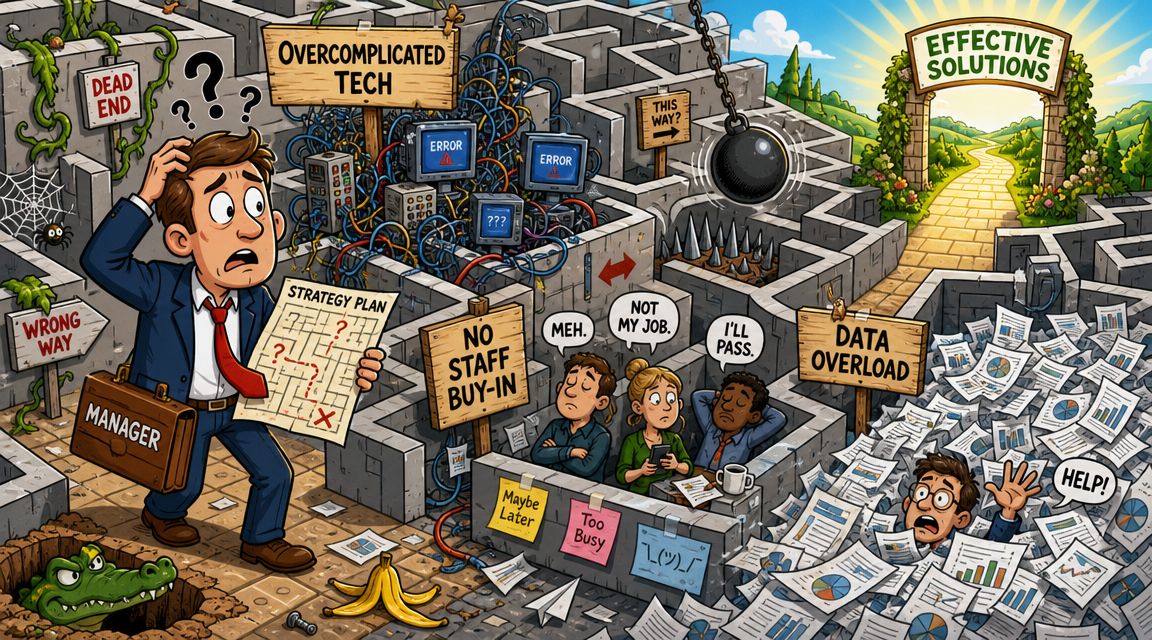
Some operations buy tools hoping software will clean up management habits on its own. It won't. If the rules are unclear, the rollout is rushed, or nobody explains how the tool helps the people using it, adoption goes cold fast.
Safety is a good example. A warehouse can add digital checklists, but if lockout procedures are still inconsistent, the risk hasn't gone away. For managers tightening their process around equipment shutdown and maintenance work, this LOTO guide for facility managers is a useful reference because it grounds the conversation in clear physical practice, not just paperwork.
Technology should remove confusion. If it adds another layer of it, you've chosen badly or rolled it out badly.
The common thread in these failures is simple. Managers try to optimize numbers without improving the experience of work. That never holds for long.
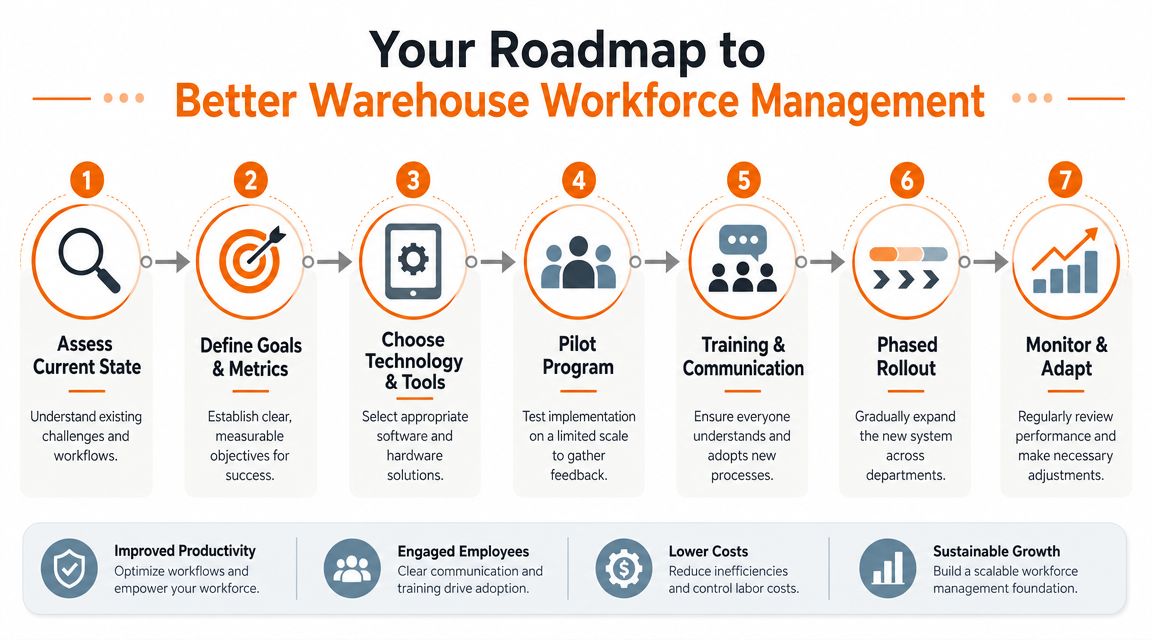
Building Your Roadmap and Bringing People Along
You don't fix warehouse workforce management in one project. You improve it by getting the basics under control, tightening one weak point at a time, and making sure the team understands the point of the change.
That's the part leaders often skip. They focus on the tool, not the transition.
Start with a baseline you can trust
Before changing anything, get honest about the current state. Where does scheduling break down? Where do no-shows hit hardest? Which teams are cross-trained, and which ones are one absence away from a mess? What information is still trapped in texts, whiteboards, or someone's memory?
Talk to supervisors, but also talk to associates. They'll usually tell you where the friction lives. Slow shift swaps. Confusing task handoffs. Late communication. Time-off requests disappearing into a black hole. Those details matter because they shape whether people experience the workplace as fair and manageable.
Then define a few goals that are easy to explain. Not abstract transformation goals. Plain ones. Fewer last-minute changes. Better attendance visibility. Cleaner handoff between shifts. More stable coverage in critical zones.
Choose tools that reduce handoffs
Disconnected systems create management drag. One tool for schedules. Another for time. Another for chat. Another for tasks. Then someone still has to stitch the whole picture together.
A unified work app can help because it puts the daily basics in one place: schedules, attendance, communication, task updates, documents, and shift changes. That matters in a warehouse because the floor moves too fast for people to keep checking five systems. Tools such as Pebb combine communication, shift scheduling, time tracking, and task management in one app, which can make rollout easier than bolting together separate products if the operation wants one shared place to work.
But the tool choice is only half the decision. The key question is whether it removes friction for leads and associates on day one. If it takes more steps to post a change, confirm attendance, or see today's priorities, people will route around it.
Bring leads in early and make the benefit obvious
Warehouse changes live or die with frontline leaders. If leads think a new process is extra admin work, they'll continue using old habits. If they see that it saves time and reduces scramble, they'll carry it.
Train them first. Not with a giant manual. With real workflows. Show how a missed shift gets handled. Show how a task change gets communicated. Show how a time-off request becomes visible before it becomes a staffing surprise.
Then tell the broader team what's in it for them.
More predictable schedules
Faster updates when plans change
Clearer task direction
Less confusion about hours, shifts, and requests
People don't resist change just because it's new. They resist when the burden lands on them and the benefit lands somewhere else.
Use better planning to protect people, not just output
This matters more than most leaders admit. Prologis argues in its discussion of warehouse labor planning and retention that improving retention isn't only about pay. Strategic labor planning can improve satisfaction by preventing burnout, and automation or better tools can reduce physical strain and make jobs more manageable.
That's the right lens. Better warehouse workforce management isn't about squeezing another drop out of the shift. It's about building a workplace where pressure is organized instead of dumped on people at the last minute.
When the work feels more predictable, people stay steadier. When it feels random, they start looking elsewhere.
The best roadmap is usually the least dramatic one. Clean up visibility. Simplify scheduling. Cross-train where you're exposed. Put communication, tasks, and time data somewhere people can use. Then keep tuning.
A warehouse doesn't become better managed because someone said the word optimization in a meeting. It gets better when the day becomes more understandable for the people doing the work.
If you're trying to replace scattered scheduling, chat, task, and time tools with one calmer system, Pebb is worth a look. It gives warehouse teams one place for shifts, clock-ins, team communication, updates, tasks, and documents, which makes workforce management easier to run without adding another layer of admin.
