Shift Work Schedules That Don't Burn Out Your Team
Stop using spreadsheets to manage people's lives. Learn how to create humane shift work schedules that reduce chaos, boost morale, and keep your best people.
Dan Robin
When your business runs outside the classic 9-to-5, your schedule is everything. It's the silent engine keeping the lights on and the work flowing, whether you're running a hospital, a restaurant, or a factory floor. But here’s the thing we don't talk about enough: a bad schedule is a quiet killer of morale, a huge drain on your finances, and one of the fastest ways to lose your best people.
The Real Cost of Broken Shift Work Schedules
Let’s be honest for a minute. The way most businesses handle scheduling is broken. We treat people like interchangeable parts on a spreadsheet, shuffling names around without a thought for the lives attached to them. But for an employee, that schedule dictates everything—whether they can make a doctor's appointment, pick up their kids, or have any kind of life at all.
It’s not just a roster. It’s the architecture of their daily existence.
And this isn't some niche problem. In the U.S. alone, about 16% of the workforce is on some kind of non-daytime schedule. And while you’d think that would come with flexibility, a shocking 43% of these workers get their schedules with less than a week’s notice, according to the U.S. Bureau of Labor Statistics. Imagine trying to build a life on that quicksand.
The Hidden Price Tag of Bad Scheduling
That last-minute chaos isn't just an inconvenience. It’s a direct flight to burnout, stress, and sky-high turnover. Every time a good employee quits because they just can't take the unpredictability anymore, you lose more than a pair of hands. You lose their experience, their institutional knowledge, and the trust they built with your customers. Then you're stuck paying to find, hire, and train someone new. All over again.
This constant churn is more than a headache. It's a significant financial drain. It erodes trust, fuels anxiety, and introduces a low hum of chaos that infects the entire team.
It’s easy to forget that an employee's cost goes far beyond their hourly wage. When you factor in the relentless cycle of hiring and training, you start to see the real cost of employing kitchen staff and other frontline workers.
This is about so much more than filling slots on a calendar. It's about building a sustainable system that respects people’s time and energy. It's time we stopped managing shifts and started designing schedules that actually work for human beings.
Getting to Know Common Shift Patterns and Why They Matter
Before you can build a better schedule, you have to understand the tools you’re working with. Too many of us inherit a system and just keep it running on autopilot. But stepping back to ask why we use a certain pattern can be a game-changer. This isn't about memorizing dictionary definitions. It's about getting a feel for what works in the real world—your world.
Think of shift patterns as different plays in a playbook. The one that works for a 24/7 hospital would be a total disaster for a retail store.
Common Shift Schedules at a Glance
To get started, here’s a quick look at some of the most popular patterns. Each one has its own rhythm and fits certain situations better than others.
Schedule Type | Best For | Pros for Business | Cons for Employees |
|---|---|---|---|
Fixed Schedule | Roles needing consistency (e.g., office admin, retail) | Easy to manage; predictable coverage | Can feel rigid; creates "day vs. night" divide |
Rotating Schedule | 24/7 operations (e.g., manufacturing, healthcare) | Fairly distributes undesirable shifts | Disrupts sleep cycles and personal life |
Split Shift | Restaurants, hospitality (covering peak hours) | Fills gaps during busy rushes | Can consume an employee's entire day |
4 On, 4 Off | Emergency services, call centers, utilities | Ensures continuous coverage with long rest periods | Long shifts can be fatiguing; days off change weekly |
This table is just a starting point. The real magic happens when you understand the human impact behind each option and start crafting something that fits your team.
From Fixed to Rotating: Finding Your Flow
The simplest approach is the fixed schedule, where someone works the same days and hours every single week. People love the predictability. It makes planning a life outside of work possible. The downside? It can create a rigid divide, where the "day shift" and "night shift" feel like two separate companies that never interact.
On the other side of the coin, you have rotating schedules. Here, employees cycle through different shifts—mornings one week, nights the next. The upside is that it spreads the less popular hours around, so no single person gets stuck with the "bad" shift forever. But let's be honest: it can seriously wreck a person's body clock and personal life if you're not careful.
Well-known systems like the DuPont schedule or the 2-2-3 schedule are complex rotating patterns built for constant coverage, often with long stretches of days off. They aren’t just random numbers; they’re complete systems with real-world consequences for your team’s well-being.
The goal isn’t to find a "perfect" schedule that works for everyone. It's to find the one that strikes the best possible balance between what the business needs and what your people need to stay sane.
When that balance is off, you feel it almost immediately. This infographic paints a clear picture of the chain reaction that starts with a broken schedule.
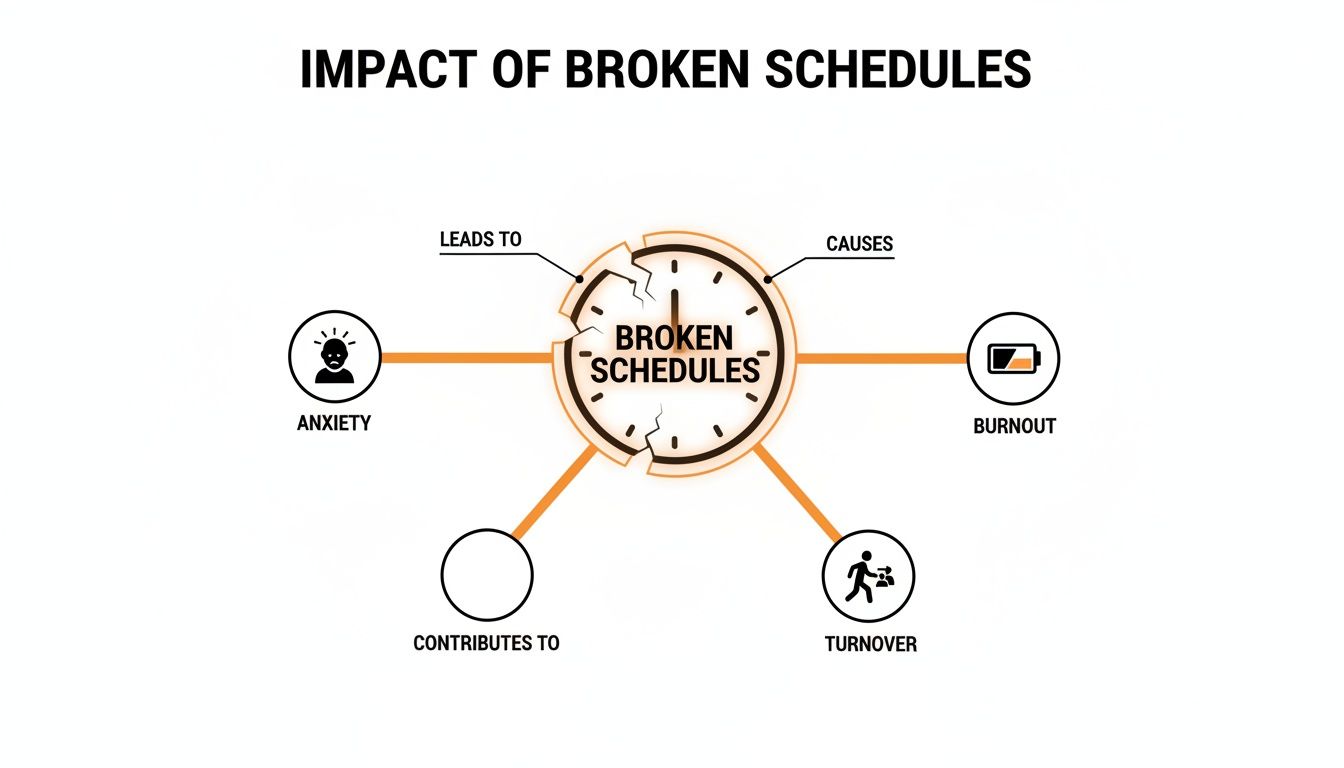
As you can see, a poorly designed schedule is a direct line to the exact things we're all trying to avoid: anxiety, burnout, and high turnover.
Finding the Right Rhythm for Your Team
The key is looking at every schedule from both sides. A split shift, for example—where someone works a few hours in the morning and a few more at night—might look perfect on paper for covering the lunch and dinner rush in a restaurant.
But for that employee? Their whole day is chopped up and owned by work, with an awkward, unusable gap in the middle. It’s tough to run errands, see family, or just decompress.
Every pattern has its place. Some, like the 4 on 4 off work schedule, give employees long, consecutive blocks of time off that can be a massive morale booster. Getting a handle on these foundational patterns is the first step toward building a schedule that feels less like a top-down mandate and more like a smart, considerate plan.
How to Design Schedules That People Actually Like
Let’s get practical. We often get so wrapped up in operational efficiency that we forget we're dealing with people, not pawns on a chessboard. A great schedule isn't just a perfect puzzle of coverage; it's a document that shows your team you respect their lives outside of work.
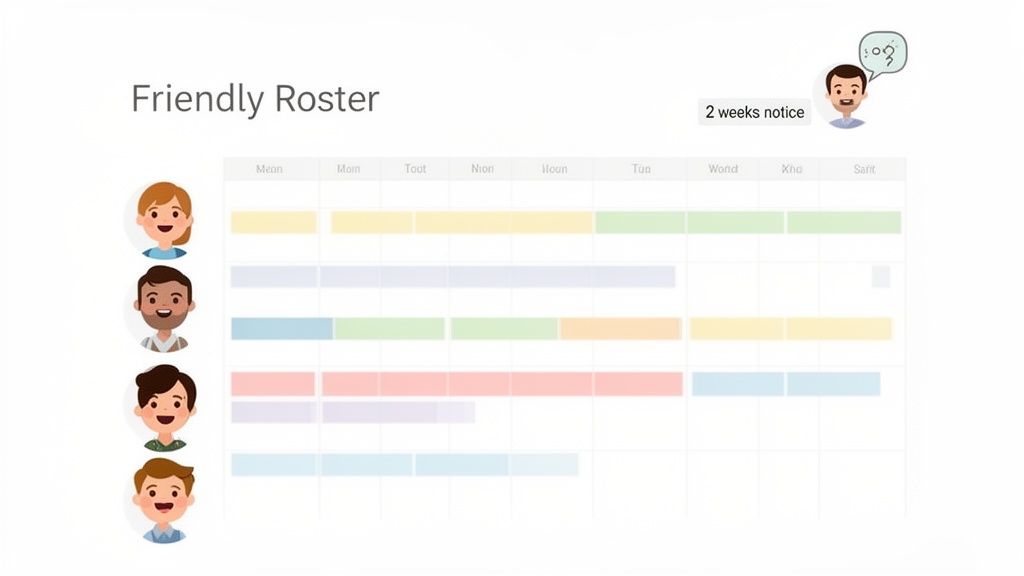
This all starts with one simple act: giving people their schedules well in advance. Two weeks should be the bare minimum. Anything less throws your team into a constant state of chaos, making it nearly impossible to plan for a doctor's appointment, arrange childcare, or even just make plans with a friend.
Beyond that, a good schedule is predictable. It avoids the last-minute switch-ups that kill morale. It’s about creating a rhythm your team can build their lives around.
End Toxic Scheduling Patterns
Some common scheduling practices are, frankly, toxic. We’ve all seen them. The most infamous is the “clopening,” where someone closes up shop late at night only to be back first thing the next morning. It’s a surefire recipe for exhaustion, leaving just a few hours to commute, eat, and maybe sleep.
Then there’s the dreaded on-call shift, where an employee has to keep their day free but isn't even guaranteed work or pay. It's the scheduling equivalent of stringing someone along. If you truly need someone on standby, they deserve to be paid for that time.
These aren't just small annoyances; they take a serious physical toll. One eye-opening study found that about 54.6% of shifts involve non-day hours, quick turnarounds, or stressful rotations, hitting frontline workers the hardest. You can read the full research on these taxing work conditions to see just how deep the impact goes.
Fairness isn’t about giving everyone exactly what they want. It’s about creating a system where the rules are clear, the burdens are shared, and everyone feels respected.
Make It a Conversation, Not a Command
Here’s the thing: the best schedules are built with your team, not just handed down from on high. This doesn’t mean granting every single request—that would be chaos. It just means having a clear, simple way for people to share their preferences and ask for time off.
This is exactly where old-school spreadsheets and paper schedules fall apart. They're rigid, one-way communication tools from a bygone era.
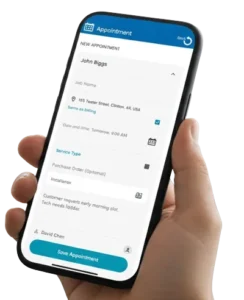
A much better approach is to use a central tool that turns the schedule into a living document. This creates a space for a controlled conversation, where employees can request shift swaps and managers can approve changes with total transparency. Our guide on the best shift planning tools to save you time dives into how the right software can make this process a breeze.
At the end of the day, creating schedules people like isn't about some secret formula. It's about building a system based on predictability, consistency, and respect. When you get that right, you’re not just filling slots—you’re building trust.
Why Communication Is Your Most Important Scheduling Tool
Let's be honest. A schedule taped to the breakroom wall is a monologue. It's a static broadcast that’s probably out of date the second you post it. Most scheduling disasters aren't about the hours themselves—they're about the shaky communication holding it all together.
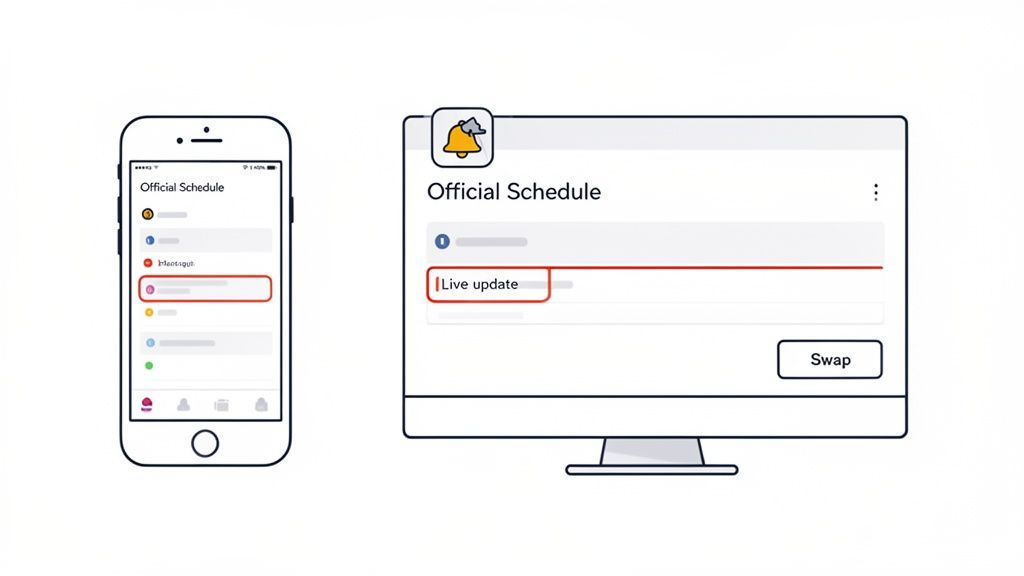
Think about the classic scenarios. What happens when someone calls in sick? What's the actual process for requesting time off? When a schedule change happens, how do you know people really saw it?
This is where spreadsheets and chaotic group texts completely fall apart. They create a messy web of missed messages and pure frustration. One person thinks they’re working Tuesday, another thinks they have it off, and suddenly you have a gap in coverage and two unhappy employees.
From Monologue to Dialogue
A dynamic schedule inside a team app, on the other hand, is a dialogue. It’s a living document that connects directly to the people it affects, turning a top-down command into a two-way conversation.
The goal is to create a single source of truth. A calm, central hub where:
The official schedule lives. Everyone knows exactly where to look for the most current version. No more "which spreadsheet is the right one?"
Swaps are handled transparently. Instead of a messy chain of texts, there's a clear process for offering up a shift and getting it covered, with managers having the final say.
Changes are communicated instantly. When a manager updates the schedule, the right people get a notification. Automatically.
Building a great schedule is only half the battle. If you can’t communicate it clearly and manage changes effectively, all that careful planning goes right out the window.
Creating a Calm Center for Operations
Here’s the thing: your schedule is the heartbeat of your team’s operations. It tells everyone where to be and when. When the communication around it is messy, the entire operation feels messy. People get stressed, managers get frustrated, and costly mistakes happen.
By bringing your schedule and your team communication into the same space, you’re doing more than just sharing information. You’re building a system of trust and clarity. Everyone is working from the same script. You can dive deeper into how this works in our guide to the easiest communication tools for shift workers.
Ultimately, it’s about moving from chaos to calm and from confusion to confidence. It's about making sure your most important operational tool—the schedule—is supported by your most important cultural one: clear communication.
Building Resilient Schedules for an Unpredictable World
Let's be honest, the days of creating a schedule and expecting it to hold for months are long gone. We used to think of a roster as a fixed document, set in stone. But in a world that changes by the minute, that old-school approach just doesn’t cut it anymore. A rigid schedule built for a predictable past will crack the second it meets our unpredictable reality.
The ground is constantly shifting. A recent report from the World Economic Forum projects a 23% churn of jobs by 2027. Think about that—nearly a quarter of all roles are expected to change. Industries that run on shift work, like transportation and supply chain management, are right in the eye of this storm.
This isn’t some abstract problem. It's happening now, making the need for flexible, resilient schedules more critical than ever.
Bridging the Culture Gap
On top of all that, there’s a growing divide happening inside our companies. Many office-based employees now enjoy a level of flexibility from remote or hybrid work that frontline teams can only dream of. This has accidentally created two different employee experiences under the same roof. Your frontline crew is living one reality, while your office team is living another.
A truly resilient schedule is more than just a grid of times; it's a tool for bridging this gap. When your schedule is part of the same app everyone uses for communication—like Pebb—it becomes a unifying thread that pulls everyone together, no matter where they work.
The goal is to build a single, cohesive company culture, not two separate ones. A shared digital space where schedules are transparent and communication flows freely is the best way to level the playing field.
A Schedule Built for Stability
So, how do you actually build a schedule that can handle all this? It starts with a mindset shift. You have to stop seeing the schedule as an administrative task and start treating it as a core piece of your operational strategy.
This means building flexibility in from day one. It means having clear processes for handling last-minute call-outs and being able to communicate those changes to everyone instantly.
Ultimately, it’s about creating a system that gives your team a sense of stability, even when the world feels chaotic. When your people know they can count on a fair, transparent, and well-communicated schedule, they feel valued and secure. That feeling of stability is exactly what keeps your best people from walking out the door. It turns your schedule into your most powerful tool for retention.
Thinking Beyond the Roster
So, we've walked through the nuts and bolts, but let's be honest—the schedule itself is just the starting point. It’s better to think of it as the operating system for your team's day. A great one makes everything hum along smoothly. A bad one introduces static and friction into every single interaction.
The real leap happens when you stop treating scheduling as a weekly chore and start seeing it as a cornerstone of your culture.
From Roster to Culture
Take a step back and ask a few critical questions. How does our schedule impact team communication? What does it do for morale? Does it build trust or break it?
When the schedule lives inside the same app your team uses for daily chats and important updates, it's no longer just a static grid. It transforms into a dynamic part of a calmer, more connected way of working.
In complex field operations, having the right tools is essential for building schedules that can actually bend without breaking. This is where dedicated Field Service Scheduling Software can be a game-changer, helping you adapt to last-minute changes and weave scheduling into your wider operational toolkit. This isn't just about squeezing out more efficiency; it's about creating a system that everyone sees as fair and transparent.
When your schedule is integrated with your team’s daily conversations, it becomes a symbol of trust. It shows you see your people as partners in the operation, not just names filling empty slots.
This shift in perspective is everything. You're no longer just plugging holes in a calendar. You're thoughtfully designing the rhythm of your workplace, building a foundation of predictability and respect that lets your team do their best work.
And isn't that the real goal?
Common Questions About Shift Work Schedules
As soon as teams start thinking about ditching those messy spreadsheets, the same questions always pop up. I’ve heard them from managers in just about every industry, and they almost always circle back to fairness, efficiency, and the hunt for that "perfect" system.
Here are a few of the most common ones we hear, along with some straight answers.
What Is the Best Type of Shift Work Schedule?
Let’s get this out of the way first: there’s no single “best” schedule. Anyone who tells you there is, is probably trying to sell you something. A 24/7 hospital has completely different needs than a coffee shop that closes at 6 p.m.
The smartest approach is to first get a real feel for the trade-offs of common patterns, like fixed versus rotating schedules. Then, and this is the important part, have an open conversation with your team. The goal isn’t to find some magical one-size-fits-all solution, but to land on the right balance between business coverage and personal predictability for your specific crew.
How Can I Make Our Shift Scheduling Fairer?
When you boil it down, fairness in scheduling really comes down to two things: predictability and transparency. It’s that simple.
Start by getting schedules out as far in advance as you possibly can—at least two weeks out is a solid benchmark. Then, make sure you have a clear, simple process for requesting time off and swapping shifts that everyone understands and trusts.
Most importantly, you have to make sure the less desirable shifts are distributed equitably over time. Using a central tool where everyone can see the same information is the fastest way to build that trust and prove you’re serious about being fair.
Why Are Spreadsheets So Bad for Scheduling?
Spreadsheets feel familiar, but they're a terrible way to manage people’s time. They’re static, disconnected from your team, and a constant source of confusion. They just can’t handle real-time changes or send out updates automatically, which is where everything tends to fall apart.
Think about it: when a shift changes, it kicks off a manual chain of texts and emails that almost always leads to someone missing the memo. A modern scheduling tool, on the other hand, turns the schedule into a living document that’s directly connected to your team's communication. It makes sure everyone is always on the same page, minus all the extra work and anxiety.
Ready to build schedules that work for people, not just for spreadsheets? Pebb unifies scheduling, communication, and operations into one simple app, helping you create a calmer, more connected workplace. Learn more and see how Pebb can help your team.