
Restaurant Operations Management A Calm Operator's Guide
A practical guide to restaurant operations management. Learn to manage staff, inventory, and tech to build a calm, profitable, and enduring business.
Dan Robin
Some nights tell you everything you need to know about a restaurant.
Not the easy Tuesday lunch where every regular orders the same thing and the dishwasher shows up early. I mean the ugly nights. The ones where the rail is full, the host stand is backed up, someone in the kitchen is asking where the backup prep went, and a manager is trying to answer three questions at once while pretending none of this is rattling them.
That’s restaurant operations management. Not the textbook version. The actual version. The lived one.
If you run restaurants long enough, you stop thinking of operations as paperwork or checklists. You start seeing it for what it is. A way to protect the room from panic. A way to make sure guests feel cared for even when the building is under pressure. A way to keep your managers from carrying the whole place on their backs.
That Saturday Night Feeling
It’s a little after 8 PM on a Saturday. The printer won’t stop. A server is waiting on a re-fire. Bar tickets are piling up. Table seven wants to know where the drinks are, and table twelve wants a manager because the medium-rare steak came out medium.
Nobody in that moment is thinking, “We need better restaurant operations management.”
But that’s exactly the problem.
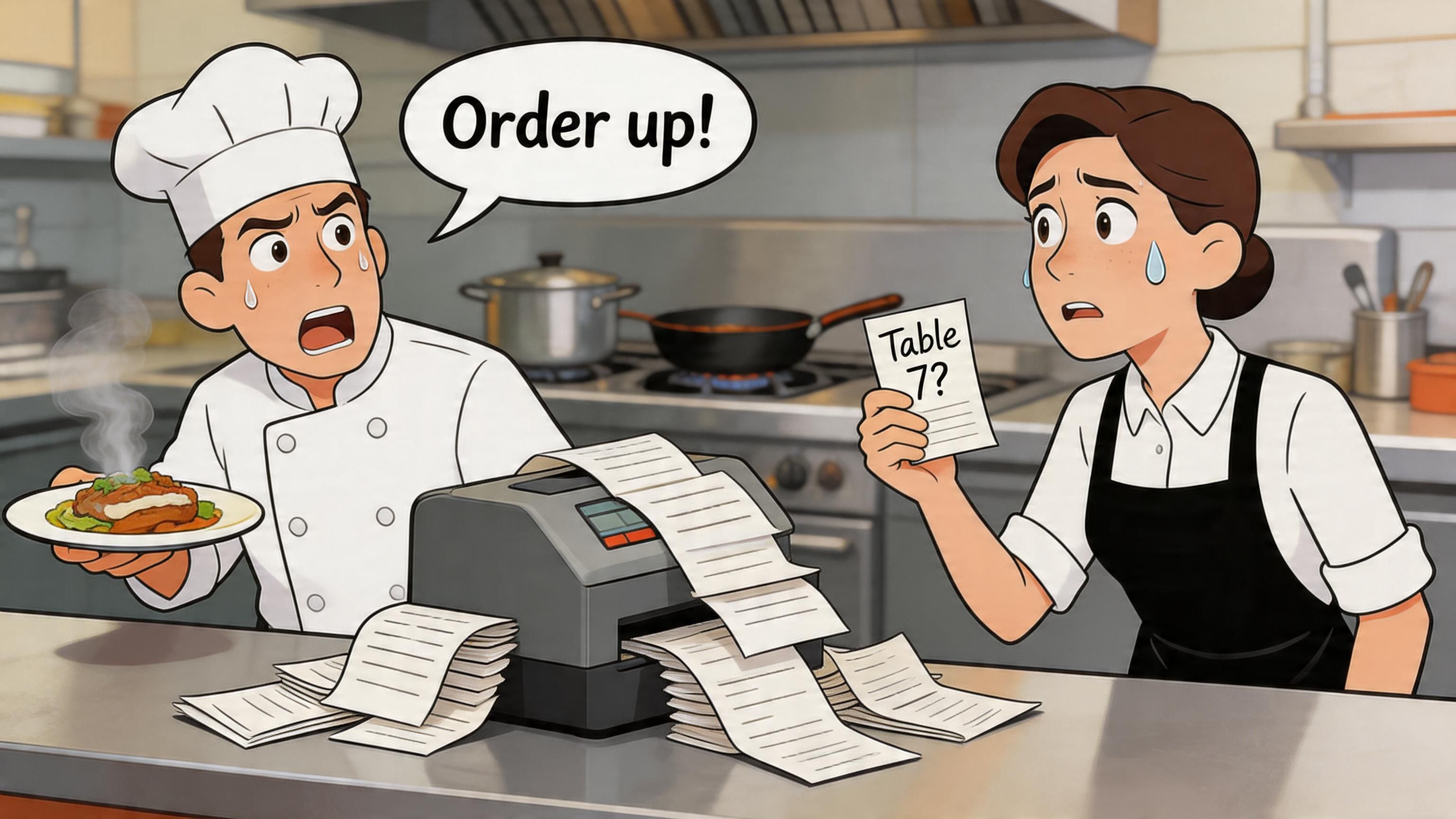
A bad service usually looks sudden. It rarely is. Most rough nights start earlier in the week. A weak handoff. A schedule built from guesswork. A prep list nobody updated. A manager who’s been plugging holes for so long they stopped seeing the pattern. Saturday just exposes what the system already knew.
Chaos is usually delayed information
When a restaurant feels frantic, information is almost always moving too slowly or not moving at all. Front of house doesn’t know the kitchen is out of a key item. The kitchen doesn’t know a large party just got sat. The closing manager never told the opener that a vendor shorted the delivery. So everyone improvises.
Improvisation is expensive.
The worst shift problems are usually communication problems wearing a different costume.
The numbers behind this business are hard enough without self-inflicted wounds. A sobering statistic hangs over the industry. 60% of restaurants fail within the first year and 80% close within five years, and that pattern is tied to basic operational breakdowns like weak cost control, inefficient staffing, and inconsistent service, according to Provi’s restaurant management metrics overview.
Calm is built before service starts
Good operators know the goal isn’t a perfect shift. That doesn’t exist. Glass breaks. Deliveries run late. A line cook calls out. The point is to build a place that can absorb stress without passing it straight to the guest.
That’s what operations is for. It creates enough order that people can do their jobs well. It gives managers room to lead instead of just react. It turns “How are we already in the weeds?” into “We had pressure, but we handled it.”
That kind of calm isn’t soft. It’s disciplined.
The Three Pillars of a Healthy Restaurant
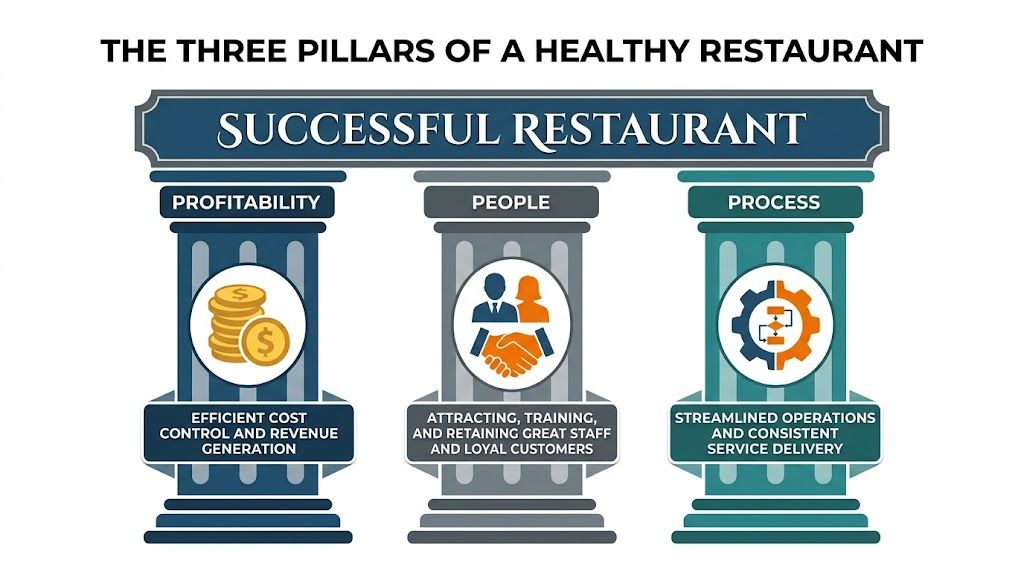
A restaurant isn’t a machine. It’s closer to a three-legged stool. If one leg is shaky, the whole thing wobbles.
Most operators naturally focus on two legs. Front of house and back of house. Fair enough. That’s where service happens and food gets made. But there’s a third leg that now matters just as much. The digital layer. The shared place where the team gets information, sees tasks, tracks changes, and stays aligned.
Front of house sets the emotional tone
Guests don’t experience your org chart. They experience your front of house.
They notice whether the host seems lost. They notice whether a server knows the menu, whether drinks arrive on time, whether someone catches a problem before it turns into an apology. A strong FOH operation doesn’t feel stiff. It feels smooth. People know what to say, who owns what, and when to ask for help.
A weak FOH usually shows up in familiar ways:
Inconsistent greetings: Guests get warmth from one host and indifference from the next.
Muddy table ownership: Servers and runners assume someone else handled the request.
Slow problem recovery: Small mistakes linger because nobody has clear authority to fix them.
The answer isn’t more speeches before service. It’s cleaner structure. Clear sections. Simple side work. Tight pre-shift communication. Fewer assumptions.
Back of house protects the product
The kitchen carries a different kind of pressure. Guests don’t see most of it, but they taste the results.
Strong BOH operations create repeatability. The same plate leaves the pass the same way, regardless of who’s on the station. Prep is organized. Pars are realistic. Recipes aren’t vague memory tests. Ordering isn’t a last-minute scramble. The line can move because the kitchen did the quiet work before the rush.
There’s nothing glamorous about this. It’s discipline.
Practical rule: If your best cook has all the answers in their head, you don’t have a system. You have a dependency.
The digital layer keeps everyone in sync
This is the part too many restaurants still treat like an afterthought.
When communication lives in random texts, sticky notes, missed calls, and five different apps, the operation starts leaking. Shift notes disappear. Policy updates don’t reach part-time staff. A prep change gets sent to one group chat but not another. Managers become human routers for basic information.
That’s not a people problem. That’s design failure.
A healthy digital layer acts like the restaurant’s nervous system. It gives the team one place to find the schedule, one place to see tasks, one place to read updates, one place to check procedures. That matters because restaurant work is mobile, fast, and fragmented by shift.
One simple way to look at it
Pillar | What it owns | What breaks when it’s weak |
|---|---|---|
Front of house | Guest flow, service, hospitality | Delays, awkward service, poor recovery |
Back of house | Food quality, prep, consistency | Waste, ticket friction, bad plates |
Digital layer | Communication, handoffs, visibility | Confusion, rework, manager overload |
A lot of operational pain gets blamed on staffing, attitude, or “the industry being hard.” Sometimes that’s true. Often it’s not. Often the restaurant lacks a shared system that helps decent people work together without friction.
That third pillar is what stops the other two from drifting apart.
What to Measure If You Want to Stay in Business
At 8:15 on a packed Saturday, the board is full, the host is quoting a wait, a line cook is asking where the backup salmon went, and a manager is trying to cover a callout while comping a table that has been waiting too long. In that moment, the numbers that matter are the ones that explain why the night feels hard in the first place.
Good operators track fewer things than struggling ones. They just review them consistently, talk about them clearly, and use them to make better calls with the team. A spreadsheet does not fix confusion. Shared understanding does.
COGS shows whether your kitchen is under control
Start with Cost of Goods Sold, or COGS.
This number puts pressure on the daily habits that make or break a kitchen. Waste. Portion control. Ordering. Receiving. Prep discipline. End-of-night storage. If COGS starts creeping up, the problem is rarely mysterious. Product is getting over-portioned, spilled, spoiled, comped too freely, rung in wrong, or bought badly.
That is why weekly review beats monthly review. By month-end, nobody remembers which station drifted, which vendor changed pricing, or which prep sheet was ignored three weekends in a row.
COGS is also a communication metric. If the chef, GM, and shift leads do not talk openly about pars, yields, and waste, the number gets worse before anyone names the cause.
Labor cost matters, but labor output matters more
Labor is where a lot of owners get nervous and make the wrong cut.
A lower labor percentage can still hide a bad operation. If service slows down, ticket times stretch, managers jump into every gap, and the team leaves cooked, the schedule was cheap on paper and expensive in real life. The better question is whether labor hours matched the work.
Two measures help:
Sales per Labor Hour: Revenue generated for the hours scheduled
Customers Served per Labor Hour: Guest volume handled for the hours scheduled
Used well, these numbers help build smarter schedules by daypart, role, and seasonality. Used poorly, they become a blunt instrument that punishes teams for weather shifts, callouts, and uneven rushes.
If you want a clean baseline for the math, this guide on how to calculate direct labor cost covers the formula. The operational part is harder. You still have to judge when a lean floor is efficient and when it is one bad rush away from collapse.
A restaurant can hit its labor target and still burn out the people holding the shift together.
That trade-off matters because restaurant operations are human first. Managers who spend every service plugging staffing holes stop coaching, stop planning, and stop communicating well. The labor report may look fine while the system underneath it is wearing down.
Prime cost gives you the clearest operating picture
Prime cost combines COGS and labor, which makes it one of the few numbers worth checking every single week without fail.
It matters because these are the two costs that move fast and hurt fast. If prime cost is running high, the fix usually comes from a handful of small corrections done together. Cleaner prep lists. Better ordering. Tighter station assignments. Menu prices that reflect real plate costs. More realistic scheduling around actual volume instead of hope.
No single metric runs a restaurant. Prime cost comes closest because it forces the kitchen and the floor into the same conversation.
A few other numbers catch trouble early
Some metrics do not deserve top billing, but they do deserve attention.
Metric | What it usually reveals |
|---|---|
Table turnover | Whether service flow is clean or tables are stalling somewhere between greet, fire, and closeout |
Employee turnover | Whether people can succeed in your system or are getting worn down by it |
Health and sanitation issues | Whether basic standards are slipping in ways that can become expensive fast |
Table turns need context. Fast is not always good. A dining room can turn tables quickly because service is sharp, or because guests feel rushed.
Employee turnover also needs context. Some turnover is normal. Repeated exits from the same role, the same manager, or the same shift pattern usually point to poor communication, weak training, or burnout upstream.
And sanitation problems should never sit in a separate mental bucket from operations. They are operations. If your receiving, storage, cleaning, and line checks are loose, bigger problems follow. Preventive work like commercial kitchen pest control belongs in the same conversation as food cost and labor because neglect in one area usually shows up in the others.
The point of measurement is simple. Pick numbers that help you ask better questions, then walk the floor and verify the story with your own eyes. If the team is tired, unclear, and constantly improvising, the metric problem is usually a people and communication problem in work clothes.
The Silent Killers of Your Restaurant
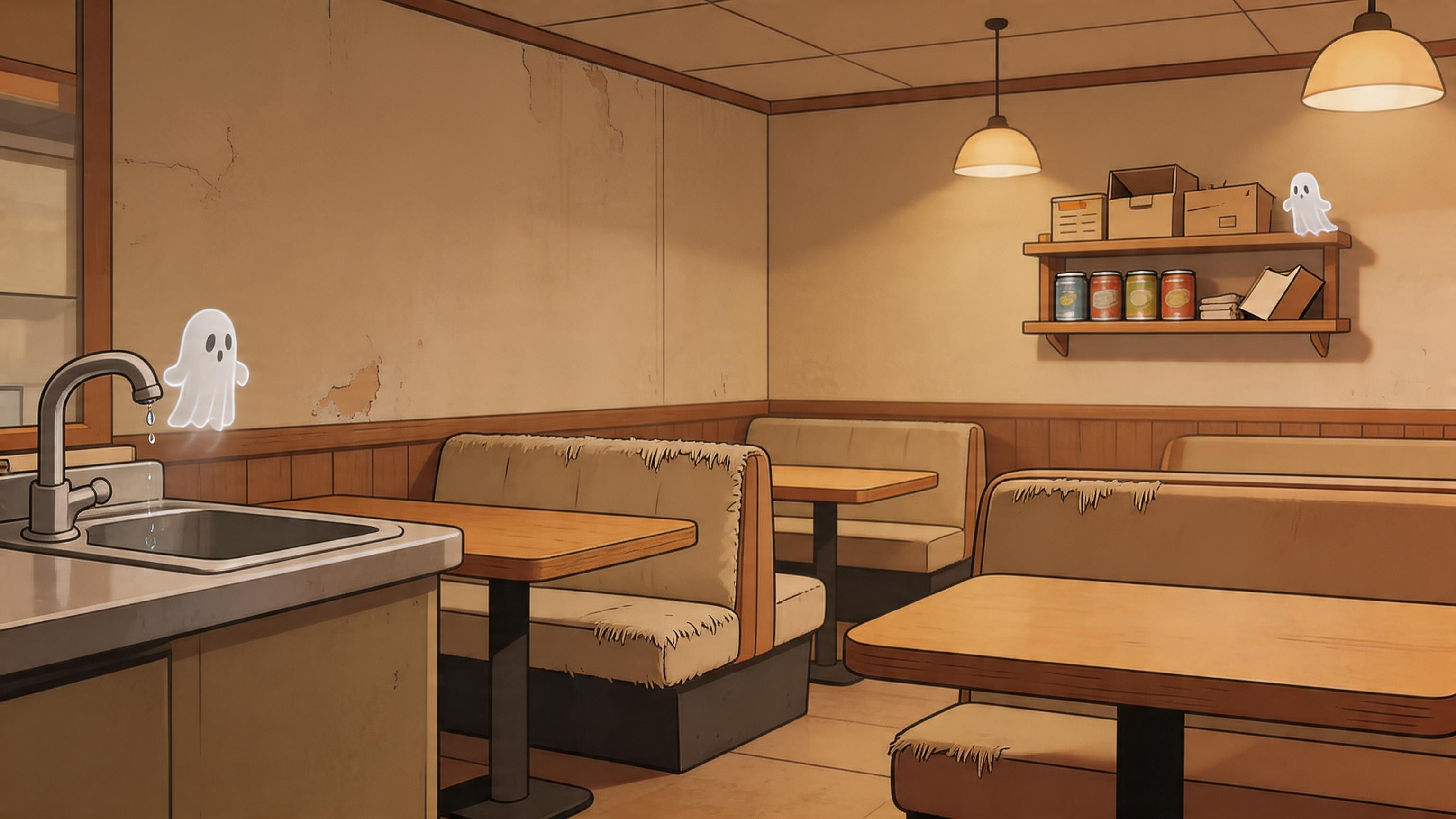
Restaurants rarely die from one dramatic event. Most get worn down.
A little waste here. A little inconsistency there. A manager who hasn’t had a real day off in months. A team that stops trusting handoffs because details keep getting lost. None of that makes headlines. All of it hurts.
Manager burnout is not a side issue
This is the one I wish more owners took seriously.
Manager burnout is a primary operational risk, not a private weakness. In hospitality, manager turnover frequently exceeds 70%, and when that churn starts, it damages scheduling, training, standards, accountability, and morale, as described in Gecko Hospitality’s look at the pressure restaurant managers carry.
A burned-out manager doesn’t just feel tired. They stop thinking ahead. They stop coaching. They stop documenting. They make shorter decisions because they have no bandwidth left for better ones. Then the restaurant starts calling that decline “normal.”
It isn’t normal. It’s expensive.
If your managers spend every shift putting out fires, the building is teaching them to be firefighters instead of leaders.
Turnover poisons consistency
Staff turnover gets talked about as if it’s just part of the trade. To a point, yes. Restaurants are high-churn environments. But many teams passively accept avoidable turnover because the pain shows up in fragments.
One weak opener leaves a rushed setup. One undertrained server creates a rough table touch. One line cook who never learned the station properly starts improvising. Over time, guests feel the instability even if they can’t name it.
The cost isn’t just hiring. It’s repetition. Repeating training. Repeating corrections. Repeating the same preventable mistakes.
A few warning signs show up early:
Handoffs get thinner: Managers stop leaving useful notes because they assume nobody reads them.
Standards get personal: Every shift runs according to who’s on, not according to a shared way of working.
Guest recovery gets uneven: Some complaints are handled gracefully, others get fumbled.
Small neglect becomes real damage
A lot of operators spend their energy on the visible mess and miss the quiet stuff. Deep cleaning slips. A drain issue gets ignored. Deliveries get checked loosely. Dry storage gets cluttered. Pest prevention becomes reactive.
That kind of neglect doesn’t stay hidden for long. It eventually becomes a service problem, a safety problem, or a reputation problem. If you need a practical refresher on prevention basics, this guide to commercial kitchen pest control is a useful place to start.
The same logic applies to inventory waste. Product disappears a little at a time. Over-portioning. Spoilage. Prep nobody used. Misfires nobody logged. It doesn’t feel urgent in the moment, which is why it keeps happening.
Most silent killers share one root
Different symptoms. Same disease.
The root issue in many struggling restaurants isn’t effort. People are trying hard. The issue is that too much lives in people’s heads, too little is clearly shared, and managers are expected to bridge every gap manually.
That setup can survive for a while. It cannot stay healthy.
From Chaos to Calm Building Your Playbook
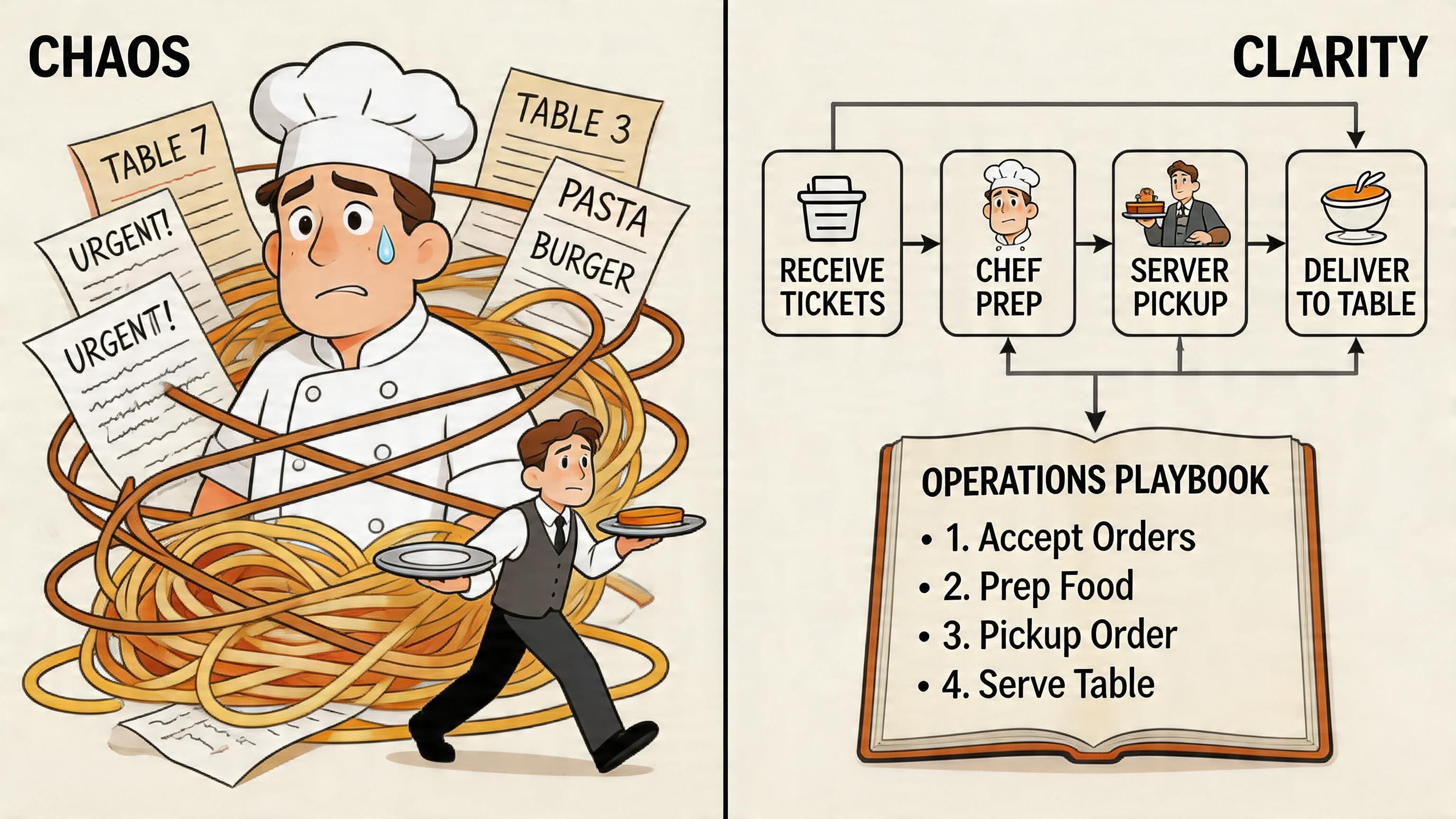
It is 4:45 on a Saturday. One cook is late, the prep list is half-finished, a server is asking about the eighty-sixed dessert, and the opening manager is already answering three questions that should not need a manager. That is not a discipline problem. It is a playbook problem.
You need a working system people can follow under pressure. Short, visible, current, and clear enough that a tired shift lead can use it without translating it for everyone else.
Build for the shift you actually have
Plenty of SOPs fail because they were written in a quiet office for a fully staffed day. Restaurants do not run on those days alone. They run on callouts, late trucks, broken dish machines, and managers who are already carrying too much.
A useful playbook reduces the number of decisions that have to live in one person’s head. That matters for consistency, and it matters for manager well-being. If every answer depends on the same burned-out operator, the system is fragile before service even starts.
The format does not need to be fancy. It needs to answer the questions people ask during a real shift:
Opening checklists: What has to be ready before the first ticket hits
Shift handoff notes: What changed, what is low, what the next manager cannot miss
Side work assignments: Who owns recurring tasks, so they do not become nobody’s job
Closing routines: What gets cleaned, counted, stored, logged, and passed on
If you want a practical model, this policy and procedure manual guide is a solid starting point.
Good playbooks protect attention
Operators often talk about efficiency like it is only a labor issue. It is also a human issue. Confusing prep sheets, outdated station maps, and vague closing duties drain attention fast. Then people get short with each other, mistakes pile up, and the manager becomes the switchboard for the whole building.
Clear process gives some of that attention back.
Restaurant365’s guide to restaurant operations management points out that labor improves when operators build better schedule templates and cleaner workflows, rather than just cutting hours: https://www.restaurant365.com/blog/guide-to-restaurant-operations-management/. That tracks with what happens on the floor. Labor waste usually starts in poor design, weak communication, and preventable rework.
I have seen a restaurant “solve” bad systems by adding another body to the shift. Sometimes you need the extra hands. Sometimes you are paying someone to stand in the gap between two broken routines.
On the floor: The best checklist is the one a tired closing manager can still complete accurately at 12:30 a.m.
Keep the playbook alive
A dead manual creates more confusion than no manual at all. Staff read one version, managers teach another, and new hires learn by rumor. Once that starts, standards become personal again.
Review the playbook on a simple rhythm. Look at the spots where supervisors keep repeating the same reminder. Check guest complaints that show up more than once. Ask what gets missed during handoff. Those patterns tell you where the document is unclear, too long, or out of date.
A healthy playbook usually shares four traits:
Trait | What it looks like in practice |
|---|---|
Short | Staff can use it during a live shift |
Specific | It names the task, the owner, and the standard |
Visible | People know where it lives without asking a manager |
Current | It matches the restaurant as it runs today |
Keep the language plain. “Clean line area” is weak. “Wipe rails, change sanitizer, sweep under lowboy, label leftover mise” gives people something they can do. The same goes for sanitation supplies. If cleaning steps are part of the playbook, staff should know which professional cleaning chemicals are used for which job and where they are stored.
Clarity gives people room to work
Some operators hear “process” and picture a rigid restaurant where nobody can think. In practice, clear process does the opposite. It removes avoidable confusion so the team can use judgment where judgment matters.
When opening is clear, handoffs are consistent, and guest issue steps are easy to find, the room feels calmer. Managers stop carrying every detail alone. Cooks and servers stop guessing. The whole operation gets steadier because information moves cleanly and people are not running on fumes.
That is what a good playbook does. It turns tribal knowledge into shared knowledge, and shared knowledge is what keeps a restaurant from slipping back into chaos.
Choosing the Right Tools for the Job
A cluttered tech stack feels a lot like a cluttered prep station. You can work around it for a while. Then the cracks start costing you time, attention, and patience.
I’ve seen restaurants run scheduling in one app, task lists in another, policy docs in a shared drive nobody opens, and day-to-day communication in group texts that scroll into oblivion. Add delivery tablets and POS alerts to that pile, and now your managers are spending part of every shift hunting for information.
Start with the job, not the feature list
Most software buying goes wrong because operators shop by category instead of by need.
The question isn’t “Do we need another app for communication?” The question is “Where does the team go when they need something?” If the honest answer is “It depends,” then the system is already too messy.
As delivery becomes a bigger part of the business, that mess gets more dangerous. Delivery now accounts for 25% to 30% of revenue in major markets, and weak coordination between online orders and kitchen workflows can push waste up by 15% to 20%, according to Dawnvale’s restaurant operations guide. The fix isn’t more noise. It’s a tighter connection between digital orders, kitchen flow, and team communication.
What good tools actually do
I don’t care much about flashy demos. I care whether a tool reduces handoffs, shortens confusion, and gives the team one shared version of reality.
A useful system should handle a few core jobs well:
Communication: One place for shift updates, manager notes, and urgent changes.
Tasks: Checklists for opening, closing, cleaning, prep, and side work.
Scheduling: Clear shifts, changes, swaps, and time-off handling.
Knowledge: Policies, recipes, procedures, and onboarding materials that people can access from their phones.
This is also true for sanitation workflows. If your cleaning standards live in a binder but your actual team lives on mobile, those standards won’t hold. For operators reviewing products and handling procedures, this roundup on professional cleaning chemicals is useful context because the product choice and the process around it need to match.
Consolidation usually beats cleverness
One platform that does the important jobs clearly is usually better than four specialized tools that don’t talk to each other.
That doesn’t mean every restaurant needs the exact same stack. Some need deeper inventory systems. Some need stronger accounting links. Some are simple enough to stay lean. But almost every operation benefits from having one digital home where the team can communicate and run the basics without bouncing around.
If you’re comparing options, this guide to employee scheduling software is a sensible starting point. And one example in this category is Pebb, which combines team chat, tasks, scheduling, knowledge sharing, file access, and shift-related updates in one mobile-first app. That kind of setup makes sense for restaurants that want fewer disconnected systems and clearer handoffs across shifts.
Good restaurant tech should lower the number of places your team has to check before they can do good work.
A simple test before you buy
Ask three questions.
Question | What you want to hear |
|---|---|
Can hourly staff use it easily on their phones? | Yes, without training turning into a project |
Does it replace other tools instead of adding one more? | Yes, it consolidates core work |
Does it help managers spend more time on the floor? | Yes, less chasing, less admin, more leadership |
If the answer to those questions is fuzzy, keep looking. The point of technology in restaurant operations management is not to impress ownership. It’s to make the day run cleaner for the people doing the work.
The Work Is Never Done and That Is a Good Thing
No restaurant ever arrives.
You can have a clean kitchen, a sharp team, a strong manager bench, and a beautiful Saturday service, and the next week a vendor misses a delivery, a fridge acts up, and two new hires need more support than expected. That’s the business. It moves. It resists perfection.
I find that reassuring.
It means the job isn’t to build a flawless operation. It’s to build a resilient one. A place where people know what matters. A place where information moves clearly. A place where managers can lead without carrying every detail alone. A place where problems still happen, but they don’t spread panic through the building.
The best operators I’ve known treat restaurant operations management like daily craft. They tighten one loose handoff. They simplify one checklist. They remove one recurring point of confusion. Then they do it again next week.
That’s enough. More than enough, really.
If you want to improve your restaurant, don’t start with a grand reinvention. Start smaller. Ask what one thing you can make clearer for your team tomorrow. Then do that. Calm is built that way.
If your restaurant is juggling chat threads, paper checklists, scattered policies, shift changes, and manager handoffs across too many tools, Pebb is worth a look. It gives teams one place for communication, tasks, scheduling, knowledge, and day-to-day coordination, which is often the missing layer in restaurant operations management.
