
Your Post Construction Cleaning Calculator & Field Guide
Ditch the guesswork. Our guide and post construction cleaning calculator help you create accurate bids, avoid common pitfalls, and manage your crew.
Dan Robin

A lot of cleaning bids are lost before the crew even unloads the first vacuum. Not because the cleaner can't do the work. Because the number was a guess dressed up as a quote.
If you're reading this, you probably know the feeling. A contractor wants a fast price. The site isn't fully ready. The dust looks manageable from the doorway. You throw out a number, win the job, and then spend the next two days paying for your optimism.
A good post construction cleaning calculator fixes the better part of that. But the key advantage isn't the calculator itself. It's what the calculator forces you to do. Look closely. Price the work you have. Turn a vague cleanup into labor, sequence, supplies, and a plan your crew can execute without chaos.
The High Price of a Bad Guess
The bad jobs usually start the same way. The superintendent says it's “mostly done.” The painter says touch-ups are minor. The floor guy says they'll protect the surfaces. Then you walk in on day one and find drywall dust in every track, paint specks on glass, stickers on fixtures, and trash tucked behind doors like nobody thought a cleaner would notice.
I've seen bids go sideways not because the cleaner was careless, but because the estimate was built on hope. Hope that the trades were finished. Hope that debris was light. Hope that one pass would do it.
It rarely works that way.
What underbidding actually looks like
An underbid post-construction clean doesn't just hurt the owner. It hits the crew first. They move faster than they should. They skip breaks. They start making hard choices about where to spend time because the budget already ran out. By the end, everyone's frustrated, including the client.
The deeper damage is quieter. You start avoiding the phone call from your team lead. You stop wanting to look at the hours. You tell yourself the next one will make up for it.
It usually doesn't.
Practical rule: If a job feels stressful before it starts, the estimate is often the reason.
The fix isn't magical. It's discipline. A solid calculator gives you a repeatable way to stop pricing jobs from the doorway. It helps you turn site conditions into labor assumptions, and labor assumptions into a bid that has a chance of holding up effectively.
Guesswork is expensive in slow ways
Most cleaners think the loss happens on one bad project. Sometimes it does. More often, it leaks out over a year of slightly wrong bids. Four extra crew hours here. A return trip there. Disposal you forgot to charge. Admin time you never counted. If you haven't built overhead into your pricing, start with this breakdown of how to calculate overhead rate.
That's the shift worth making. A post construction cleaning calculator isn't just about math. It's about calm. It gives you a way to bid work without crossing your fingers, and it gives your crew a fair shot at finishing the job without carrying the whole estimate on their backs.
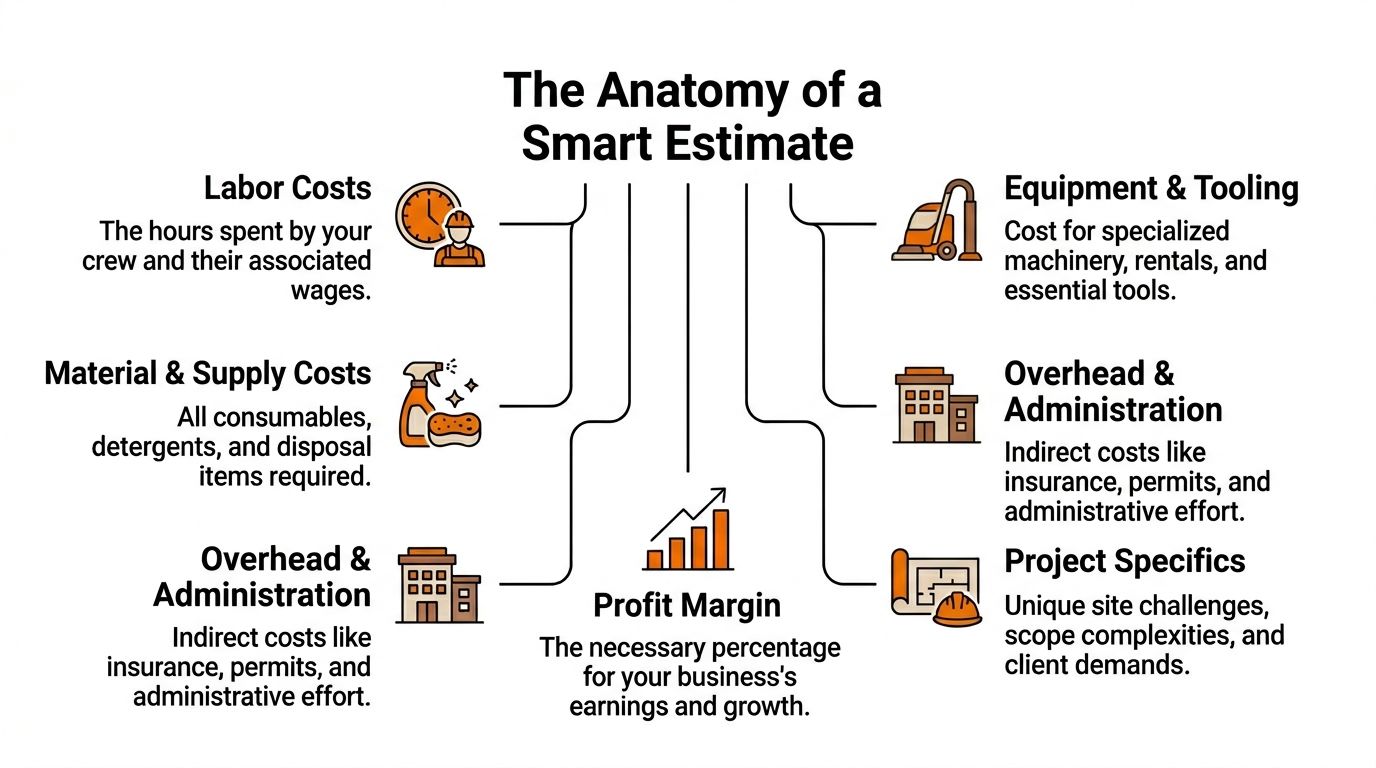
The Anatomy of a Smart Estimate
A common mistake is to fail before the math even starts. The calculator gets blamed, but the underlying problem is usually bad inputs from a rushed walkthrough.
Square footage matters. It just doesn't carry the whole estimate by itself. Smart bids come from separating usable cleaning area from total building area, matching the work to the project phase, and judging the actual condition left behind by the trades.
Cleanable space beats total space
I have seen plenty of bids go sideways because someone priced the shell, the storage rooms, and the unfinished corners the same way they priced finished offices or units. That is how a decent-looking estimate turns into a long day for the crew.
The cleaner's first job is to define what will be touched. Jobber's guide to pricing commercial cleaning jobs makes the same point in plain terms. Accurate pricing starts with the serviceable area, not the full property size. In post-construction work, that distinction matters even more because parts of the building are often still off-limits, incomplete, or not ready for detail cleaning.
Mechanical rooms, unfinished basements, exterior-only sections, locked units, punch-list areas, and spaces still occupied by other trades should be counted differently, or excluded until they are ready.
When I walk a site, the useful question is simple. What exactly are we cleaning today?
The three phases are different labor
Rough clean, final clean, and touch-up clean belong on the estimate as separate scopes. If they get blended together, the price stops reflecting how the job will run in the field.
Connecteam's post-construction cleaning cost calculator overview highlights why purpose-built calculators break these phases apart instead of treating them like standard janitorial work. The labor profile changes from phase to phase, and the crew plan should change with it.
On site, the difference is obvious:
Rough cleaning deals with debris, stickers, packaging, and the heavy dust that slows everything down.
Final cleaning is detail work. Glass, fixtures, edges, ledges, trim, and all the residue the first pass did not solve.
Touch-up cleaning is the return visit after inspections, trades, and foot traffic put fingerprints and dust back where you already worked.
Those are different tasks with different production rates. The estimate should show that clearly, because your crew will feel the difference in the first hour.
Debris level decides the pace
Debris level is where a lot of estimates break apart. A site with light dust cleans fast. A site with drywall powder packed into tracks, adhesive on frames, and paint specks on floors does not.
A good calculator should let you rate the site by condition, then convert that rating into labor. That is the bridge between the number on the screen and the plan your team follows once the doors open.
Heavy debris usually shows up in predictable places. Window tracks. Cabinet tops. Vent covers. Baseboard edges. Floor corners. Protective film left on glass or hardware. None of that looks dramatic from the doorway, but it adds time one small surface at a time.
If you're newer to this type of work, this practical guide to cleaning after construction does a good job showing the level of detail crews run into on finished sites.
Smart estimates include the quiet costs
The visible dirt gets all the attention. Margin usually disappears somewhere less obvious. Crew lead time, supply burn, vac filter replacements, travel, setup, disposal, callbacks, and office time all belong in the bid.
Labor is still the anchor. If that number is soft, everything built on top of it will be soft too. This guide to calculating direct labor cost is useful because it helps tie your estimate to actual wage burden instead of a guessed hourly rate.
A smart estimate answers five field questions in order. What are we cleaning, which phase are we in, how dirty is it, how many labor hours will it take, and what does the crew need to finish without a return trip? Once those answers are solid, the calculator stops being a pricing toy and starts becoming an operating plan.
Putting the Numbers to Work
A calculator should make pricing clearer, not more mysterious. If you need ten tabs and a finance degree to bid a post-construction clean, the tool is getting in your way.
I like a simple structure:
base production rate × cleanable square footage, then adjust for site reality, then add what the job will consume in labor and materials.
That isn't fancy. It's usable.
Start with the pricing lanes
For interior post-construction work, pricing commonly falls between $0.15 and $0.60 per square foot, depending on the level of work. Rough cleaning tends to sit at the lower end, while standard or touch-up work lands higher. Hourly rates typically run $25–$75 per hour, with an average around $40 per hour, and some markets go much higher. In NYC, post-renovation cleaning can reach $70 per hour per cleaner. As for production time, a 1,500 sq ft area may take about four hours, while a 3,000 sq ft space can take a full eight-hour shift (HomeGuide post-construction cleaning rates).
Those numbers aren't your bid. They're your guardrails.
A simple sample estimate
Let's use a practical example. A 2,500 sq ft new build is ready for a final clean. The site has real drywall dust, but not extreme buildup. No one has done a decent rough clean before you arrive.
You could sketch the estimate like this:
Choose your cleanable square footage Use the area you'll clean, not the brochure size.
Pick the phase rate
Final and touch-up work usually deserve a stronger per-square-foot number than rough cleanup because detail work slows production.Adjust for debris reality
If the dust is deeper than it looked in the hallway, you need to account for that in labor or in your pricing factor.Add labor logic
A 2,500 sq ft space sits much closer to the benchmark where larger spaces can require around eight hours of work, depending on crew size and phase complexity, based on the HomeGuide benchmark above.Add materials and disposal Pads, cloths, trash bags, scraper blades, PPE, glass supplies, and any special disposal need to live somewhere in the estimate. Many “calculator” bids frequently fail to include such costs.
A benchmark table you can actually use
Cleaning Phase | Average Cost per Sq. Ft. | Average Hourly Rate per Worker |
|---|---|---|
Rough cleaning | $0.15–$0.40 | $25–$75 |
Final or touch-up cleaning | $0.20–$0.60 | $25–$75 |
This table is intentionally simple. It gives you a usable range without pretending every project behaves the same.
The napkin version of the math
For a quick field estimate, think in layers:
Base area price based on cleanable square footage and phase
Debris adjustment if site conditions are worse than standard
Labor check against how many worker-hours the crew will spend
Supplies and disposal
Margin and overhead
If the square-foot price says one thing and the labor check says another, trust the labor check. Floors and glass don't care what your spreadsheet hoped for.
If your estimate can't be explained in plain English to your crew lead, it's probably too abstract to trust.
Why spreadsheets still matter
I'm not against software. Good software is useful. But a simple spreadsheet still teaches discipline because it forces you to see the moving parts. Square footage. Phase. Labor hours. Materials. Special conditions. It stops you from hiding mistakes inside a glossy interface.
A practical worksheet should include these fields:
Job basics like client, address, phase, and cleanable square footage
Site condition notes covering dust, paint, debris, access, and readiness
Labor plan with workers, hours, and any supervision time
Direct costs for supplies, disposal, rentals, and extras
Final price check so your quote matches your plan
The point of a post construction cleaning calculator isn't to spit out a number fast. It's to produce a number you can defend when the client asks questions and still respect when the job starts on Monday morning.
If your calculator helps you do that, keep it. If it only helps you quote faster, be careful. Fast wrong is still wrong.
Common Traps That Sink Cleaning Bids
Friday at 4:30, a GC calls and wants a number before the weekend. The site walk was rushed, half the lights were off, and two trades were still working. That is exactly when bad assumptions slip into a bid and turn a decent-looking estimate into a money-loser by Tuesday.
Cheap bids rarely come from one missed line item. They come from a chain of soft assumptions. The building looks close enough to finished. Dust seems manageable. Disposal feels minor. The crew should be able to make up time on site.
That kind of estimating gets expensive fast.
A classic mistake is pricing the building, not the work
Plans show one number. The crew cleans another.
A bid falls apart when total square footage gets copied into the calculator without checking what is ready, accessible, and in scope. Unfinished rooms, stacked storage areas, locked sections, punch-list holdbacks, and protected spaces all distort the estimate. Then the crew lead shows up with a price built for the whole shell and a work area that behaves nothing like the plans.
Good estimators mark the cleanable area, note what is excluded, and attach those notes to the job file so the field team sees the same scope the office priced. If you want the estimate to hold up in the field, those scope notes need to travel with the job through your mobile workforce management system for field crews, not stay buried in someone's worksheet.
Debris needs a rule, not a vibe
Debris changes production. Fine dust on finished surfaces is one job. Paint specks on glass, silicone on frames, and boxes left by three trades is another.
Estimators get into trouble when they describe site conditions loosely and price them optimistically. “A little extra dust” can mean repeat vacuuming, hand-detailing edges, scraper work, and a slower final pass to avoid rework. If the calculator gives one neat number but the site condition says otherwise, the site condition wins.
A practical bid ties debris to a specific adjustment. Extra removal. Extra detail time. Extra disposal. Something concrete.
Field note: If your lead tech walks the site and says the crew will need blades, adhesive remover, or a second pass on glass, treat that as a production issue and price it that way.
What leaves the building costs money
Post-construction cleanup includes removal, staging, bagging, hauling, and dump runs. Those tasks chew up labor even before disposal fees show up on an invoice. A quick check against local junk removal pricing helps keep that part of the bid grounded in reality.
I have seen profitable cleaning work turn thin because no one accounted for elevator waits, long pushes to the dumpster, or the extra hour spent breaking down bulky packaging so it could leave the site. None of that is dramatic. All of it hits margin.
Local conditions can wreck a copied pricing model
A rate that works in one market can fail badly in another. Parking, building access, labor availability, disposal rules, union requirements, and after-hours restrictions all change how fast the crew can move and what the job really costs to deliver.
Here are the traps that show up again and again:
Using one labor assumption across every job, even when travel, access, or local wages clearly differ
Blending all phases into one price, which hides where the time will be spent
Leaving equipment out of the bid until the crew asks for ladders, HEPA vacuums, floor protection, or extension poles
Treating touch-ups like free goodwill, even though callbacks pull supervisors and techs off other scheduled work
A calculator can give you a number in seconds. A profitable bid also needs judgment about how the job will run once boots hit the floor. That is the gap that sinks bids. The office sees a price. The field inherits the consequences.
From Estimate to Execution with Your Crew
Friday at 3:30, the superintendent calls and wants the building ready for a Monday walkthrough. The estimate looked fine in the office. Then the crew arrives and finds one working elevator, missing keys for two areas, and another trade still sanding on the third floor. That is how a good bid turns into a bad job.
The handoff from estimate to field plan decides whether the work stays profitable. Labor hours on a calculator are only useful once they become headcount, zone assignments, supply loads, access notes, and a realistic sequence for the crew.
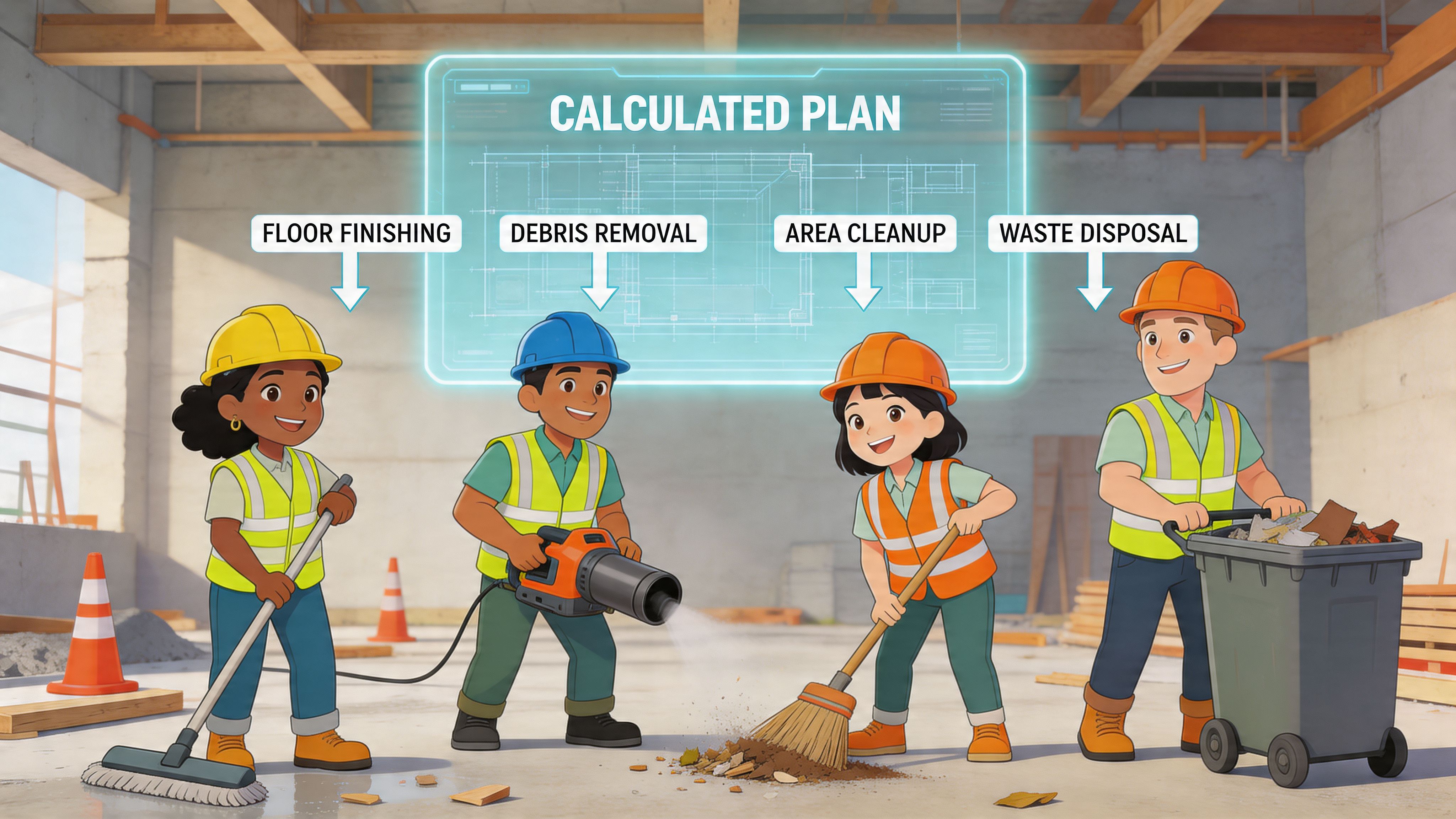
Turn labor hours into a real shift plan
Start with the labor total, then break it into something a supervisor can run.
If the estimate allows one full day for four technicians, schedule one full day for four technicians. Do not cut the crew and hope hustle makes up the difference. Do not stack too many people into tight areas either. Overstaffing creates its own waste. People wait on ladders, crowd each other on glass, and burn paid time walking around one another.
The better approach is simple. Match the plan to the phase, the layout, and the finish level the client expects. Rough clean, final clean, and touch-up each need a different crew shape. A rough pass may favor more hands for debris and dust removal. Final cleaning usually rewards tighter assignments, stronger inspection, and techs who know how to work without re-soiling finished surfaces.
Build the day around site friction
Production rarely falls apart because someone forgot how to wipe a sill. It falls apart on access, timing, and sequence.
Before the shift starts, answer the field questions that affect pace:
Which areas are ready for cleaning today
How the crew gets in and moves through the site
Where debris, vacuums, ladders, and water access are located
Which finishes need special care such as fresh paint, polished floors, or new glass
Who signs off each zone before the team leaves
Then set the cleaning order to protect the work. High dust first. Detailed surfaces next. Floors late. Final glass and touch-ups after traffic drops. Crews move faster when the job has a clear sequence, and you avoid paying twice for the same square footage because someone had to reclean it.
Give the crew a usable job file
A field team needs more than an address and a start time. They need the same thinking that went into the estimate, translated into instructions they can use on-site.
A solid job file includes:
Scope by phase, so no one confuses rough clean tasks with final detail work
Assigned zones, by floor, wing, unit, or common area
Access details, including keys, lockbox codes, parking, loading areas, and elevator rules
Site contacts, with one clear decision-maker for problems
Equipment and supply list, tied to the actual surfaces and height work on the job
Photo notes from the walkthrough, especially for heavy dust, sticker removal, paint specks, or protected finishes
If you run multiple crews, a mobile system helps keep that file in one place. This overview of mobile workforce management solutions shows what to look for when you need scheduling, field communication, and job documentation to stay tied together.
Protect margin during the job, not after it
Crews should know what "done" means before they unload the first vacuum.
That means clear production targets, but it also means permission to flag a bad assumption early. If one area is still active with trades, if debris volume is heavier than the walkthrough showed, or if access is slower than planned, the supervisor needs to raise that the same day. Waiting until payroll closes does nothing for margin.
I like a simple rule. Compare actual progress to estimated progress by midday, not at the end. That gives you time to add labor, resequence the work, or tell the client the site conditions changed the scope.
Use every job to sharpen the next estimate
The companies that bid well long term do one thing consistently. They close the loop between the office and the field.
After the job, compare estimated labor to actual labor. Note where the crew lost time. Save site photos. Record whether the issue was access, debris load, trade overlap, finish level, or weak planning. Then feed that back into the next estimate.
A calculator gets you to a number. A crew plan gets you to a profitable job. The operators who tie those two together are the ones who keep their margins.
A Final Word on Pricing with Confidence
The goal isn't to win every job.
That sounds obvious, but a lot of owners still price like they're trying to collect trophies. They shave the number to keep the client happy, then ask the crew to absorb the difference with speed, stress, and unpaid patience. That's not a pricing strategy. That's borrowing against your team.
A disciplined post construction cleaning calculator helps, but only if you use it properly. It should tell you when a job is worth taking, when the scope is still too muddy to quote cleanly, and when a low number will buy work you shouldn't want.
Confidence is quieter than hustle
Confident pricing doesn't feel flashy. It feels steady. You know your cleanable area. You know the phase. You know the site conditions. You know what labor, supplies, and coordination will cost. Then you name a price that lets the crew do the job properly.
Clients may push back. Some will shop the number. That's normal.
The important thing is that you're no longer bargaining against your own reality.
A fair bid respects everyone involved
A solid estimate respects the client because it sets a clear expectation. It respects the crew because it gives them enough time and support to do the work right. It respects your business because it leaves room for overhead, mistakes, and the plain truth that not every site behaves the way the walkthrough suggested.
A profitable bid is not greed. It's the price of doing the work without chaos.
There's a quiet kind of pride in a well-run post-construction clean. The job starts on time. The crew knows the plan. The walkthrough goes smoothly. The invoice doesn't trigger regret. You go home tired, not rattled.
That's worth building toward.
Your Questions on Post-Construction Cleaning Costs
How should I price union versus non-union labor
Price the labor you have to buy. Don't force a generic rate onto a market with different labor conditions. If union requirements apply, treat them as a real cost input from the start, not as a surprise you hope to “work around” later. The estimate needs to reflect the job's labor reality.
What's a fair profit margin
A fair margin is one that survives the work. I won't give you a canned number because that depends on your market, overhead, crew structure, and risk tolerance. What I will say is this. If your price covers labor and supplies but leaves nothing for supervision, callbacks, admin time, and business health, it isn't profit. It's exposure.
How do you handle rush jobs or after-hours work
Charge more when the schedule creates friction. Rush work compresses planning, limits flexibility, and often leads to extra coordination. After-hours work can add access headaches, supervision needs, and fatigue. If the timing makes the job harder, the price should say so.
What do basic calculators usually miss
Basic calculators often default to rough estimates at around $0.25 per sq ft, but they can miss environmental compliance and hazardous waste disposal. Those hidden costs can increase the project price by up to 42% under stricter 2025-2026 EPA guidelines for materials like paint residues, and disposal fees can range from $50-$200 per ton (Angi on construction site cleaning costs).
That's why a quick number is not enough. If the site includes regulated waste, special disposal, or unusual cleanup conditions, your estimate needs another pass before it becomes a quote.
If your cleaning operation is growing, the hard part usually isn't just pricing jobs. It's getting the whole crew aligned once the work starts. Pebb gives teams one place to coordinate shifts, share job files, manage tasks, store documents, and keep field crews connected without juggling a pile of separate apps. For cleaning businesses that want estimates to turn into clean execution, it's a practical way to keep the office and the crew on the same page.
