
Policy and Procedure Manual: The Guide Your Team Will Actually Use
Discover how a Policy and Procedure Manual can replace a dusty binder with a living, actionable guide that protects your business and empowers your team.
Dan Robin

Let's be honest. When you hear “policy and procedure manual,” you probably picture a thick, dusty binder on a forgotten shelf. It’s the document written by lawyers, for lawyers, that no one on your team ever opens. We’ve all seen it.

We've been looking at this all wrong. That manual isn't supposed to be a defensive shield you only pull out when something goes wrong. It should be the living playbook for how your company actually works. It's the one place a new hire can go to understand their role, a manager can turn to for a fair decision, and a team member can find the confidence to handle a tough situation.
The problem isn't the manual itself. It's that we build them to be forgotten.
Shifting from Relic to Resource
We create dense, unreadable documents and then wonder why staff ignore old intranets. We make them impossible to find and then act surprised when nobody uses them.
The core issue is simple: We build these manuals for auditors and lawyers, not for the people who actually need the information to do their jobs. It’s a fundamental design flaw.
When a document is hard to find and even harder to read, people will find another way. They’ll ask a coworker (who might be wrong), interrupt a manager, or just guess. This creates inconsistency, introduces risk, and quietly erodes trust.
It’s time to fix that.
This is about turning your policy and procedure manual from a relic into your company’s most useful tool. It’s about building a culture of clarity, not just checking a compliance box. Let’s start by digging into why the old model fails and what a better one looks like.
Why Most Manuals Are Failing Your Team
Let's be honest. The traditional policy and procedure manual was built for a different world—a world of cubicles, desktop computers, and a slower pace of work. That world is long gone. For today's fast-moving, often-remote teams, that old model is completely broken.
Imagine a nurse in a hectic hospital ward or a retail employee on Black Friday. They need an answer right now, not five paragraphs of dense corporate-speak buried in a PDF they can't even open on their phone. When information is a pain to find, people fall back on old habits: they guess, ask a colleague who might be just as confused, or interrupt their manager. Productivity gets slowly choked by a thousand tiny inefficiencies.
The Anatomy of a Failed Manual
This isn't just a minor frustration; it cultivates a culture of guesswork. When the official playbook is collecting dust, your team is left to improvise. This leads to inconsistency, unnecessary risks, and a constant, quiet hum of anxiety about whether they're doing things the "right way."
We see the same three problems over and over:
It’s Buried Alive: The manual is hidden in some cryptic folder on a shared drive, impossible to access from the shop floor or a company phone. It's not searchable, not mobile-friendly, and not where people actually work.
It’s Stale and Untrustworthy: The content is a time capsule from last year. It references outdated processes, lists managers who left months ago, and ignores new regulations. No one trusts it.
It’s a One-Way Street: It’s a document that dictates rules. There's no way for an employee to ask a question, flag a procedure that doesn't work, or even confirm they've read a critical safety update.
This broken system pushes teams into risky workarounds. It's no surprise that 60% of governance and risk professionals admit they still rely on spreadsheets for compliance. This old-school approach eats up 56% of their time on risk identification and 52% on monitoring alone. You can dig deeper into how these manual processes create risk by reviewing the latest compliance statistics.
A False Sense of Security
Here’s the tough reality: a manual that nobody uses is worse than having no manual at all. It gives leadership a false sense of security while leaving the team and the business completely exposed. The risks are real, but the guide meant to mitigate them is just sitting there, ignored.
An unread policy is just a suggestion. And suggestions don't hold up in court, prevent workplace accidents, or create a consistent customer experience.
A failing manual is a symptom of a deeper issue—a disconnect between how your business runs and how it documents the way it runs. To fix this, you need a living knowledge system, not a static document. We've written about the best practices for maintaining knowledge bases to keep them relevant. But first, you have to admit the old binder-on-the-shelf approach just doesn't work anymore.
The Hidden Costs of a Bad Manual
A poorly managed policy and procedure manual isn't a minor hassle; it's a quiet, relentless drag on your business. These costs rarely show up on a budget report. Instead, they surface in far more painful ways—wasted time, frustrated employees, and completely avoidable risks.
When we think of business costs, our minds usually jump to the big, scary fines. And for good reason. The regulatory landscape has become a minefield. A recent analysis showed that a whopping 73% of compliance programs now consider policy management their top priority. With GDPR fines hitting $2.3 billion in Europe alone—a 38% jump in just one year—it’s obvious that a solid manual is your first line of defense. You can dig into the numbers in this breakdown of compliance statistics.
But that’s only half the story. The real, everyday costs are operational. They're subtle, they compound, and they hurt.
The Slow Bleed of Operational Drag
Think about the friction caused by unclear procedures. Every time an employee has to stop and ask a manager a basic question, that's a small productivity leak. When a team member messes up a customer return because the policy is buried in an old email, that’s a direct hit to your reputation.
These little moments add up fast. It’s the cost of wasted materials from a botched process, the hours spent correcting mistakes, or the customer you lose forever because of inconsistent service. This isn't just inefficiency; it's creating an environment where people feel uncertain and unsupported.
When the path of least resistance is to guess or interrupt someone, you’re not just losing time. You're systematically building a culture of inconsistency.
This kind of mess is often a symptom of weak internal communication. These knowledge gaps create invisible barriers, making it hard for teams to work together. We've explored this in our guide on breaking down communication silos. A clear, accessible manual is one of the most powerful tools you have to bridge those gaps.
The Human Cost of Confusion
But perhaps the most damaging cost is the toll it takes on your people. Nobody likes feeling confused or constantly worrying they’re about to make a mistake. When your employees can’t find the answers they need, morale plummets.
They feel set up to fail. This leads to disengagement, burnout, and people quitting. And replacing a good employee is expensive—far more expensive than building a clear policy and procedure manual.
Here's how a bad manual directly hurts your team:
Onboarding Failure: New hires are left adrift, leading to a longer ramp-up time and a much higher chance they'll leave.
Perceived Unfairness: When policies are applied inconsistently, it can look like favoritism, destroying trust.
Increased Stress: The mental load of trying to remember unwritten rules adds unnecessary stress to everyone's workday.
Ultimately, a bad manual sends a terrible message: "You're on your own." It tells your team that leadership hasn't bothered to provide the basic tools they need to succeed. Getting your manual right isn't just an admin task. It's a fundamental part of running a healthy business. It shows you respect your team's time and are invested in their success.
How to Build a Manual People Actually Use
Let's be honest. Nobody wakes up excited to write a policy and procedure manual. And even fewer people want to read one. They often feel like defensive documents, crafted by legal teams to cover the company in a worst-case scenario.
But what if we flipped that script?
Instead of starting with compliance checkboxes, what if you started with your people? A great manual isn't built to impress auditors; it's built to empower a new hire on their first day or help a manager through a tricky conversation. It’s a fundamental shift in mindset. You're not writing for the person who created the manual; you're writing for the person who desperately needs the information inside it.
Forget the Jargon, Start with Clarity
The first step is to mercilessly hunt down and eliminate corporate jargon. Your goal is clarity, not complexity. Put yourself in your team's shoes. What does someone actually need to know to do their job well?
This means turning abstract policies into concrete, actionable steps. A vague statement like, "We are committed to a secure workplace," doesn't help anyone. But a procedure that says, "All visitors must sign in at the front desk and wear a visitor's badge," is crystal clear and immediately useful.
A bad manual creates a domino effect of risk. It’s not just one problem; it’s a cascade.
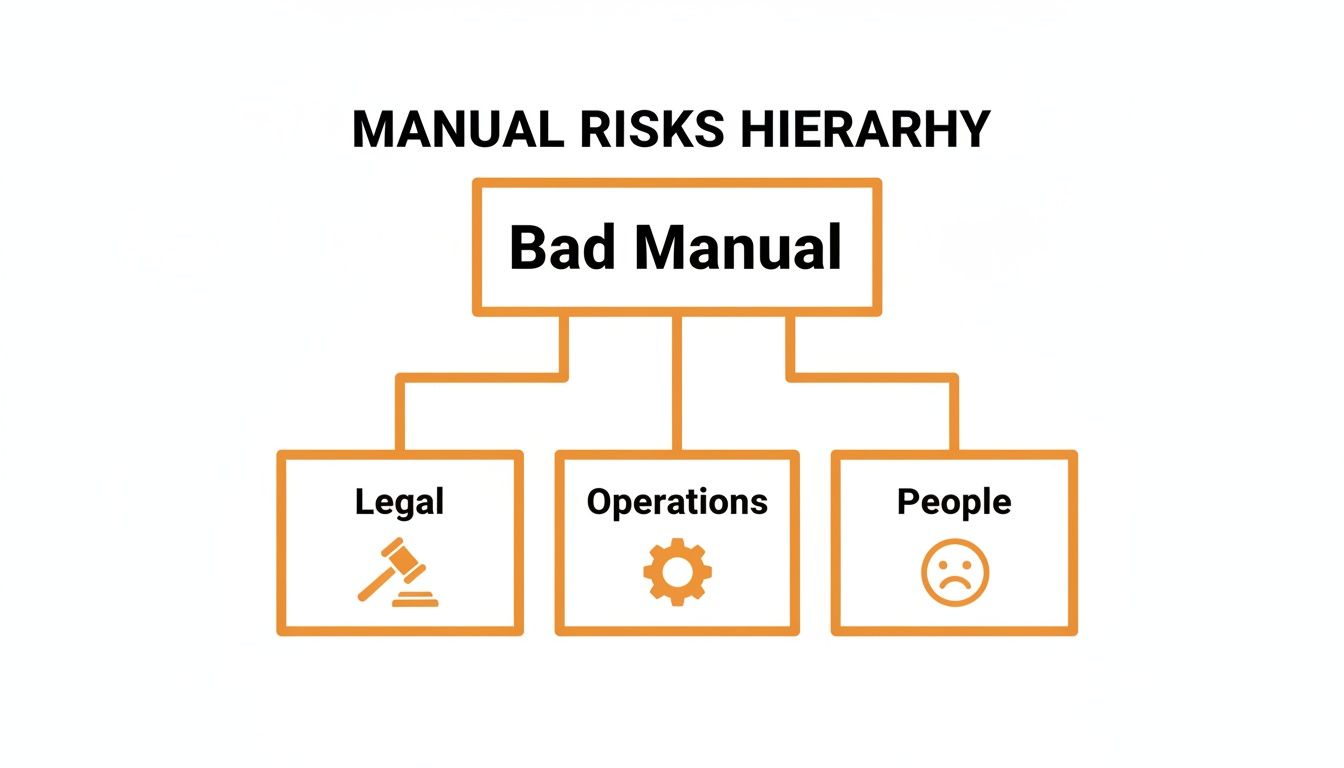
As you can see, a single poorly written manual can quickly spiral into compliance violations, operational mistakes, and a nosedive in team morale.
The Essential Building Blocks
Every company is different, but a useful manual tends to follow a consistent, logical structure. The key is to provide context before diving into the rules.
Here’s a simple framework that works.
A well-structured manual transforms a list of rules into a practical guide. This table breaks down the core sections that provide a solid foundation.
Section | What It Covers | Why It Matters |
|---|---|---|
1. The 'Why' (Mission & Values) | Company mission, vision, and core values. | It sets the tone and gives employees a reason to care about the rules. It's the foundation of your culture. |
2. General Employment Policies | Equal opportunity statements, anti-harassment policies, codes of conduct. | This is where you cover the non-negotiables. A valuable manual provides clear guidance on reporting workplace discrimination effectively. |
3. Workplace & Safety Procedures | Emergency plans, data security protocols, remote work guidelines. | This section covers the physical and digital environment, keeping everyone safe and your operations secure. |
4. Benefits & Compensation | Payroll schedule, time-off policies, overview of health insurance. | Keep it simple and clear. This is information every employee needs and will reference often. |
5. Role-Specific Procedures | Step-by-step processes for daily tasks (e.g., processing a return, submitting an expense report). | This is where the manual becomes truly practical. It turns abstract rules into everyday actions. |
Each section builds on the last, creating a resource that feels less like a rulebook and more like a helpful conversation.
Think of your manual not as a rulebook but as a conversation with your team. It should answer questions before they're even asked, providing a sense of stability and fairness.
The goal isn't to create a massive encyclopedia. It's to build a reliable, living guide that helps your people make smart decisions, feel supported, and understand how their work fits into the bigger picture. When you prioritize clarity, you create a tool that helps, not a binder that hinders.
Turning Your Manual Into a Living Resource
Here’s the thing about a great policy and procedure manual: it’s never finished. If you treat it like a project with a start and end date, it’s already on its way to becoming that dusty binder. The days of the annual review are long gone. That whole approach is just too slow for how we work now.
A truly effective manual is a living resource. It evolves right alongside your business.
This requires a mindset shift. Instead of a static book of rules, we need to treat it like a dynamic knowledge system—one that’s woven directly into daily work.
From Document to Daily Tool
Modern tools make this shift possible. The old way was burying a PDF in a shared drive. The new way is to host your policies in a dedicated, searchable library that’s accessible from anywhere, especially a phone.
Think about the difference this makes. A new retail employee gets a push notification about an updated return policy. A manager assigns a quick task for their team to read and acknowledge a new safety procedure. This isn't just convenience; it’s turning passive information into active engagement.
When your policies live where your team works, the friction disappears. You turn the manual from a defensive document into a practical, operational tool.
Keeping Your Manual Relevant and Alive
Creating a living resource isn't just about using a better tool, though. It's about building a continuous cycle of review, feedback, and improvement. Here’s what that looks like.
Embrace Version Control: Every time a policy is changed, it needs to be tracked. Who made the change? Why? A good system shows a clear history. This is crucial for clarity and accountability.
Use Attestations Wisely: An attestation is just a formal way of having an employee confirm they’ve read and understood something. It’s not about catching people out; it’s about ensuring critical information has been received.
Create Feedback Loops: Your frontline team often knows when a written procedure doesn’t match reality. Create a simple way for them to flag outdated information. This feedback is gold—it helps you close the gap between what the manual says and what people do.
The goal isn't just to publish policies. It’s to start a conversation around them. When people can ask questions and offer feedback, they become participants in the process, not just recipients of rules.
This constant cycle of updates ensures your manual stays accurate and trusted. A robust manual should also include frameworks for critical situations. For example, solid business continuity planning is a set of procedures that must be kept current to protect the business during a crisis.
The Rhythm of a Living Manual
So, how often should you be updating things? Forget a fixed schedule. The rhythm of your business should dictate the pace.
A policy should be reviewed whenever there's a trigger event. This could be a change in regulations, a new piece of equipment, or an incident that reveals a gap in your procedures. For instance, the U.S. government recently updated its policy manual for TN visas, which required companies hiring under that program to change their internal processes. Waiting for an annual review would have been far too late.
By unifying your policies with your daily operations, you transform your policy and procedure manual from a static document into an active, protective, and genuinely useful part of your company's culture.
The Future Is Not a Manual
Let's be honest, the phrase "policy and procedure manual" feels heavy. It brings to mind that dusty binder. That whole model is a relic.
The future isn't a book; it's a living knowledge system that’s part of your company's digital DNA.

This is more than a word game. It’s a complete mindset shift. The goal is no longer just to create a document. It's to deliver the right answer to the right person, right when they need it.
From Static Document to Active Knowledge
Here’s the thing: when your policies live inside the same app where your team is already talking and managing tasks, all the friction just melts away. An employee doesn't have to stop what they're doing and go on a treasure hunt to find an answer. It’s right there.
This isn’t just a nice-to-have. It makes the entire employee experience better. It builds trust by showing you respect their time and are serious about giving them the tools they need to succeed.
The goal is to make looking up a procedure as easy and intuitive as sending a message to a coworker. Anything more complicated is a design failure on our part.
This shift helps build a culture of clarity, not just compliance. When answers are easy to find, people stop guessing. Consistency improves, mistakes go down, and your managers get back hours of their time.
Where Information Meets Action
This isn't some far-off dream. By plugging your policy and procedure manual directly into the operational heartbeat of your company, you change it from a passive reference guide into an active, protective tool.
Think about these real-world scenarios:
A new safety protocol is published, and every person on the warehouse team gets a notification on their phone to read and acknowledge it. Done.
A retail associate is handling a tricky return and can pull up the exact policy in seconds, right there on the sales floor.
A manager onboards a new hire and assigns them a "First Week" knowledge playlist that walks them through all the key procedures.
This is how a modern business should run. The dusty binder had its day. Now, it’s time for something that actually works.
Common Questions About Policy Manuals
Even with a clear plan, it's normal to have a few nagging questions. After years of dealing with dusty binders, the idea of a living, breathing policy and procedure manual can feel like a big leap.
Let’s tackle some of the most common questions we hear.
How Often Should We Update Our Policy Manual?
Honestly? Ditch the "annual review" mindset. A policy manual should be a living document. The real answer is: you update it whenever something important changes.
This could be a new regulation, a shift in business strategy, or an incident that reveals a gap. For example, when USCIS recently updated its TN visa policy manual, companies using that program had to adapt immediately. Waiting a year would have been a massive failure.
The right time to update a policy is the moment you realize it's no longer accurate. A modern system should make that update instant, not a bureaucratic project.
For general sections that don't change often, a quick quarterly check-in is a good rhythm. The key is to use a tool that makes updates painless. With the right tool, you can edit a policy and notify the right people in minutes.
What Is the Difference Between a Policy and a Procedure?
This one's important, but simple.
Think of a policy as the "what" and the "why." It's the high-level rule that reflects your company's values and legal obligations. For example: "We are committed to providing a safe workplace." It’s the guiding principle.
A procedure is the "how." It's the series of specific, step-by-step instructions for carrying out that policy. Using our safety example, the procedure would be: "1. All visitors must sign in at the front desk. 2. Employees must display their ID badges at all times. 3. Report any suspicious activity to your manager."
Your manual needs both. Policies provide direction, but procedures provide the roadmap. Without procedures, policies are just good ideas.
How Do We Get Employees to Actually Read the Manual?
This is the million-dollar question. The answer comes down to three things.
First, you have to make it accessible. If your manual is buried in a shared drive, you’ve already lost. It needs to live where your team already works—ideally in a mobile-first app they use every day.
Second, you have to make it digestible. Use simple language and short sentences. No one wants to read a wall of legalese. Break things down with videos, images, and checklists.
And third, you have to make it active. Don't just publish it and hope for the best. Integrate it into the workflow. Use a tool that lets you assign key policies for review and require an acknowledgment. When the manual is part of the daily conversation, reading it becomes part of the job, not a chore.
What Are the Biggest Risks of an Outdated Manual?
An outdated manual isn't just unhelpful; it's a liability. The primary risk is falling out of compliance with labor laws or safety regulations, which can lead to staggering fines.
Another huge risk is inconsistent application of policies. When managers are working from different versions of the rules, it can lead to claims of favoritism or discrimination. It's a recipe for morale problems.
Finally, an old manual undermines your legal defense. If you end up in court, you'll need to prove you had a clear policy and that you followed it. An outdated, ignored policy and procedure manual makes that defense incredibly weak.
Ready to turn your dusty binder into a living resource that your team actually uses? With Pebb, you can create a searchable knowledge library, assign policies for review, and track acknowledgments—all inside the same app your team uses for communication and operations. See how Pebb can transform your company’s policies.
