
A Calmer Way to Improve Performance Management
Is your annual review process broken? We explore how to build a calmer, more human performance management system that actually helps people grow.
Dan Robin
A "performance management system" sounds cold, doesn't it? It's a phrase that brings to mind spreadsheets, ratings, and a whole lot of corporate process. But what if we took a step back? At its heart, a good system is just a way for people to talk about their work, understand how they’re doing, and figure out where they’re going next. It should feel less like a report card and more like an ongoing conversation.
Let’s Be Honest About Annual Reviews
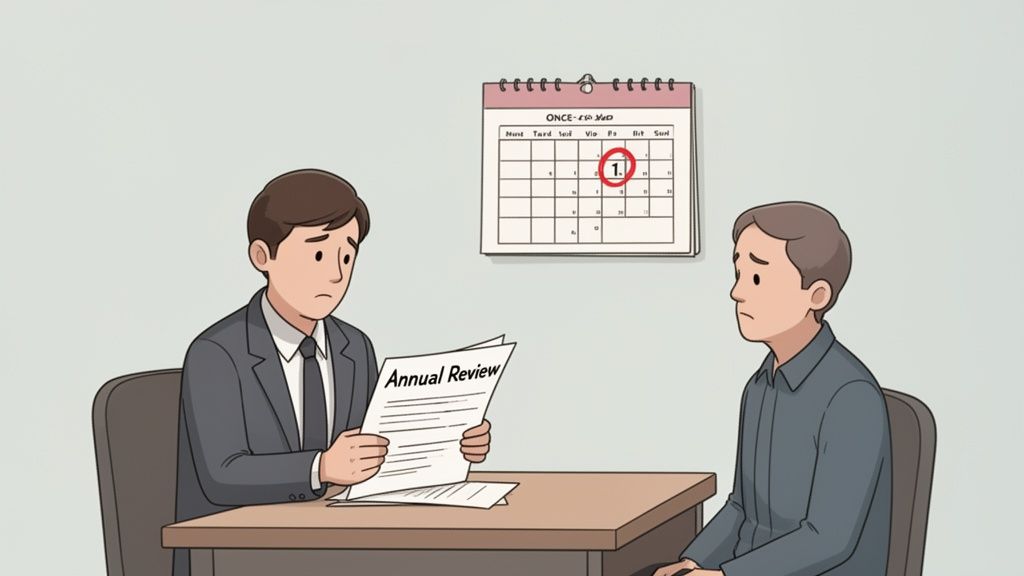
We’ve all been there. That once-a-year meeting where a manager reads from a form about work you did months ago. It feels stiff. Formal. Like something we just have to get through. It rarely feels like a real conversation about what you've accomplished or what you're capable of.
For decades, that was the deal. But performance isn't a single event. It's a journey made up of countless small steps, wins, and stumbles. Trying to sum up an entire year in one hour is like trying to describe a cross-country road trip with a single, blurry photo. It just misses the story.
Why the Old Way Is Broken
Let's just say it: the traditional model is flawed. It's built on old ideas about how work happens and what actually motivates people. It often creates more anxiety than clarity. The system itself is almost designed to feel disconnected from our actual work.
The biggest problem? It treats people like entries on a spreadsheet. It tries to boil down a year of complex, messy, human work into a single number or rating. This completely ignores the context, the effort, and the growth that happens between January and December. By the time you finally have "the talk," the feedback is stale. It's too late to be useful.
The Real Cost of Rigid Systems
Plenty of companies have these systems, but they aren’t helping. A 2024 McKinsey study found that 75% of organizations are failing to build high-performance cultures, even with formal processes in place.
So, what's getting in the way? The top roadblocks cited by nearly 10,000 executives paint a clear picture:
Limited career paths (47%)
Poorly targeted incentives (43%)
Disengaged employees (38%)
Rigid performance-management systems (38%)
That last one is a gut punch. The very tool designed to improve performance is often seen as a major obstacle. You can dig into the findings in the full State of Organizations report.
A modern performance management system should be a supportive guide, not a bureaucratic hurdle. Its real purpose is to build a culture where people feel seen, supported, and connected to the work.
A Calmer, More Human Approach
So, what if we rethought this whole thing? Instead of a yearly judgment day, what if we had an ongoing dialogue? A system that helped managers become better coaches and gave people the clarity they need to do their best work.
This isn't about ditching accountability. It’s about building it in a smarter, more human way. A great performance management system is a tool that connects people, clarifies expectations, and makes feedback a normal part of the day. If you're wondering how to start, our guide on building a better annual performance review template can help you rethink your foundation.
Helping people improve is an act of care. The tools we use should reflect that. It’s time to move away from the anxiety of the annual review and toward something calmer, clearer, and a whole lot more useful.
What Is a Performance Management System Really For?
When you hear “performance management,” what comes to mind? For a lot of us, it’s that dreaded annual review—a high-stakes meeting filled with paperwork and feedback that’s months out of date. But that’s a complete misunderstanding of what a good system should be.
Let’s reframe this. A performance management system isn’t a weapon for HR or a surveillance tool for managers. It’s simply a way to help people understand how they're doing and where they're headed.
Think of it like the navigation on a ship. Its job isn't to punish the crew for being a degree off course. It provides clear, real-time information so everyone can make small, confident adjustments to stay on track and reach the destination together.
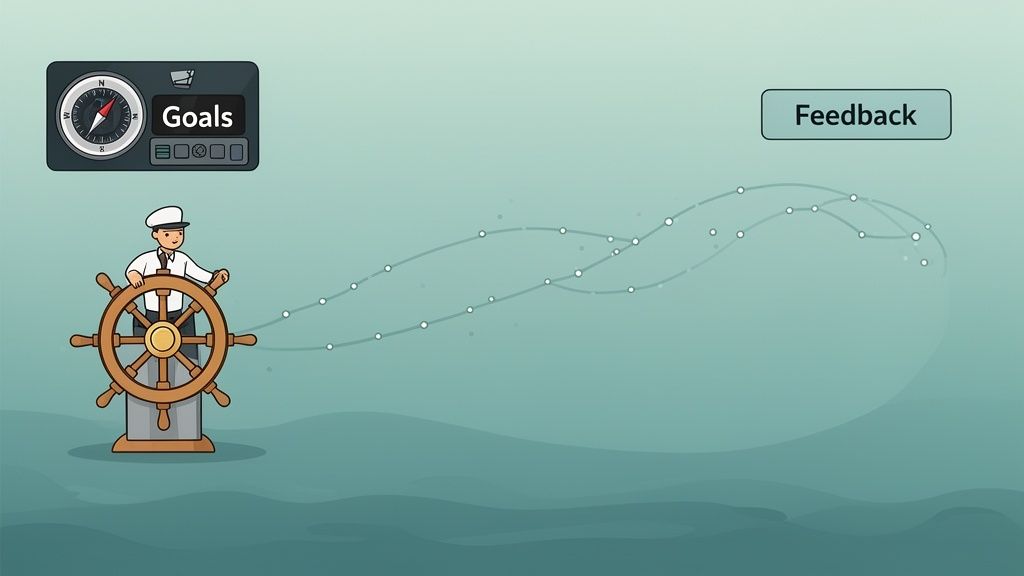
At its heart, a healthy system is about improvement, not judgment. It’s built on a few core ideas that, when done right, feel natural and supportive.
It All Starts with Clear Goals
Without clear goals, performance management is just busywork. If your team doesn't know what they're aiming for, how can you expect them to hit the target? A good system makes goals visible, easy to understand, and connected to the bigger company mission.
This isn’t about setting vague, corporate-speak objectives. It’s about giving people straightforward answers to simple questions:
What does a great job look like in my role?
How does my work help the team?
What should I focus on right now?
When the destination is on the map, people can steer their own ship. They don't need a manager hovering over their shoulder. This kind of alignment prevents what a 2025 U.S. Office of Personnel Management analysis described: a situation where individuals hit their targets, but the company misses its goals entirely.
Feedback That Actually Helps
The next piece is regular, helpful feedback. The annual review is broken because feedback arrives months late in a stressful, high-pressure meeting. It's an autopsy, not a check-up.
A modern performance management system flips that. It makes giving and receiving feedback a low-stakes, everyday activity. It might be a quick "great job" after a tough customer call or a peer sharing kudos for helping out on a project.
A performance management system should be a learning tool, not just a way to check a box. It's a way to focus on the work that matters and show how your team is making a difference.
This continuous conversation builds trust, creating an environment where it's okay to talk about what's not working, ask for help, and celebrate small wins as they happen.
Assessments as a Recap, Not a Reveal
Here’s the thing: if you have clear goals and continuous feedback, formal reviews become exactly what they should be—a simple recap. There are no surprises.
Instead of a nerve-wracking event, the review is a short, reflective conversation that sums up all the check-ins from the past year. It's a moment to look back at the journey, recognize growth, and set a course for the future. To get this right, it helps to know how to build a successful performance management and training program.
When these three parts—goals, feedback, and assessments—work together, they create a powerful rhythm. The system stops being a source of anxiety and becomes an engine for growth, helping everyone do their best work with confidence.
Shifting to Continuous Performance Conversations
The biggest change in performance management today isn’t about software; it’s about mindset. It’s about shifting from a dreaded yearly event to a simple, everyday habit.
Think about it. Work happens in real-time, so why doesn't feedback? Waiting a year to talk about a project, a challenge, or a win is like waiting until a plant is brown and brittle to finally give it water. By that point, the damage is done. The opportunity to learn is gone.
This move toward continuous conversations is about closing that gap. It's about building a culture where quick check-ins are just part of the normal flow of work—not a sign that something is wrong.
From Oversight to Coaching
Let’s be honest, the old model often cast managers as judges. Their job was to watch from a distance, take notes, and deliver a verdict at the end of the year. That creates an awkward distance, turning managers into monitors instead of mentors.
Frequent conversations flip that script. When a manager and an employee talk regularly—even for just five minutes a week—the relationship naturally shifts from oversight to coaching. The focus becomes what’s happening now.
For example, instead of saving a note about a clunky presentation for a review six months later, a manager can offer a tip right after the meeting. "Hey, that was a great point. Next time, maybe try leading with that slide to grab their attention faster." That’s it. It’s small, actionable, and useful.
This approach turns the performance management system into a living dialogue. It builds psychological safety, so people feel comfortable admitting they're stuck or sharing a new idea. This is where understanding the difference between feedforward vs. feedback becomes powerful.
The Proof Is in the Performance
This isn't just a feel-good theory; it has a real impact. When conversations are constant, small issues get solved before they become big problems. Wins get celebrated in the moment, which keeps motivation high.
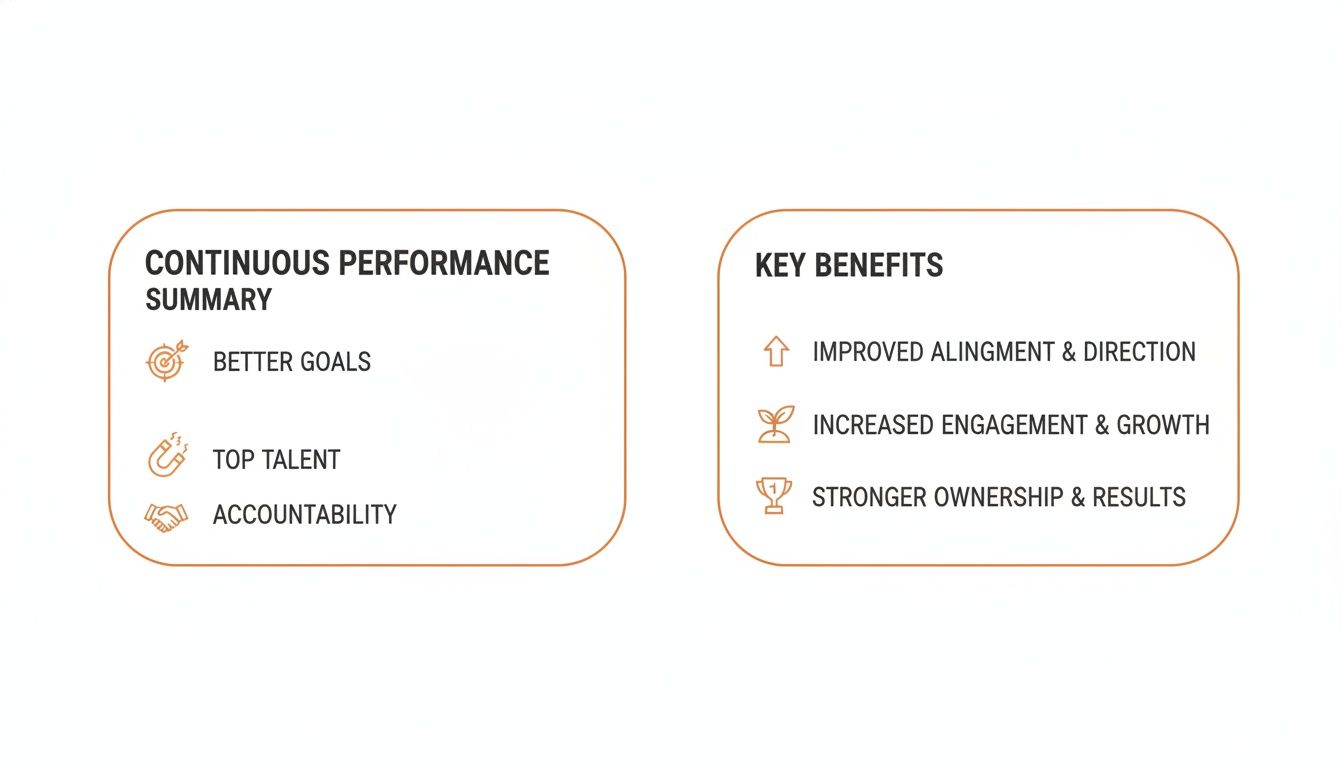
The data backs this up. Organizations that use continuous performance management see much better results. For instance, these companies are 50% more likely to have teams that exceed their financial goals and 42% better at holding employees accountable.
The impact goes beyond hitting targets. It fundamentally changes how a company attracts and keeps its best people.
Companies with continuous systems are 39% better at attracting top talent and a staggering 44% better at retaining their people. It even improves the manager-HR relationship, with managers in these organizations rating their HR teams 50% higher. You can dig into these performance management statistics to see just how powerful this is.
Ultimately, shifting to continuous conversations isn’t about jamming more meetings on the calendar. It’s about weaving better, more human interactions into the workday. It's about treating performance as a journey you're on together.
Choosing the Right Tools Without Adding Noise
Let's be honest: the market for performance management tools is a jungle. It’s crowded with flashy platforms that promise to "fix" performance with complex dashboards and a mountain of features. They look great in a sales demo, but in reality, they just create more work. I've seen it happen too many times—a company spends a fortune on a big, clunky system, only to watch it collect digital dust.
Here's a secret I've learned: the best performance management system is the one your team actually uses. It’s not about finding the tool with the longest feature list. It’s about finding one that fits so naturally into your team's day that they barely notice it’s there.
The goal is to find a tool that sparks conversations, not one that tries to automate them away. The right tool should feel less like new software to learn and more like a helpful guide for how your team already works together.
Simplicity and Integration Are Key
The single biggest mistake I see companies make is buying a standalone performance platform that lives on its own isolated island. Suddenly, everyone has another login to remember. Another app to open. Another system to check. This friction is a deal-breaker, especially for busy frontline teams who aren't chained to a desk.
A much better approach is to find tools that are already part of your team’s daily routine. If your people already use an app for communication, schedules, and company news, that’s where performance management belongs. No new passwords, no extra training sessions.
When the tools are simple and integrated, you’ll see better goal alignment, stronger retention, and clearer accountability.
When looking at your options, it's helpful to compare the old way with a more modern, integrated approach.
Evaluating Performance Management Tools
Consideration | The Old Way (Standalone Systems) | A Better Way (Integrated Apps like Pebb) |
|---|---|---|
Employee Access | Requires a separate login and app, creating a barrier. | Lives inside the app employees already use daily. No friction. |
User Experience | Often complex, built for HR admins, not frontline workers. | Simple, intuitive, and designed for how people actually work. |
Feedback | Relies on formal, scheduled reviews and clunky forms. | Encourages continuous, informal feedback in the flow of work. |
Implementation | Requires long training and change management efforts. | Minimal training needed since it's part of a familiar tool. |
Cost & Value | High cost for a single-purpose tool with low engagement. | Included as part of a platform, driving higher value. |
Thinking through these points can help you avoid the trap of buying a powerful tool that no one wants to use.
What Really Matters in a Tool
Once you cut through the marketing fluff, there are only a few features that truly matter for building a healthy performance culture. You can ignore most of the bloated "enterprise" features that just overcomplicate things.
Focus on these three non-negotiables:
Mobile-First Access: Your tool must work beautifully on a phone. For the nurse on the hospital floor, the retail associate, or the technician in the field, their phone is their office. If they can’t check goals or give feedback from their device, they are completely cut out of the loop.
Simple Ways to Share Feedback: Forget clunky forms and multi-step approvals. A great tool lets you give quick, informal recognition in a public channel or share coaching feedback in a private chat. It should feel as easy as sending a text. For more structured check-ins, a well-designed employee self-evaluation form within the same app keeps everything simple.
Visible Goals and Progress: Everyone, from the CEO to the newest hire, should be able to easily see their goals and how they connect to the company mission. This information shouldn't be buried in a confusing menu. A good system puts goals front and center, giving people a clear "north star" to guide their daily work.
A performance management tool should be for learning, not just for checking a box. It's a way to focus on what matters and show how your team is making a difference.
Anything beyond these core functions tends to add complexity without adding value. Don't get distracted by endless charts or automated "insights." True insight comes from the real, human conversations your tool should be designed to encourage. Find something simple. Find something your people will actually open.
Making Performance Management Work for Everyone
For decades, performance management was built for just one type of employee: the office worker. Most systems were designed for people who sit at a desk, work a 9-to-5, and live in their email. But what about the rest of your team?
What about the nurse hustling through a chaotic hospital wing, the cashier managing a long line of shoppers, or the field technician working solo on a job site? Their work is the heart of the company, yet they're often left out of the performance conversation entirely. The tools we give them just weren't built for their world.
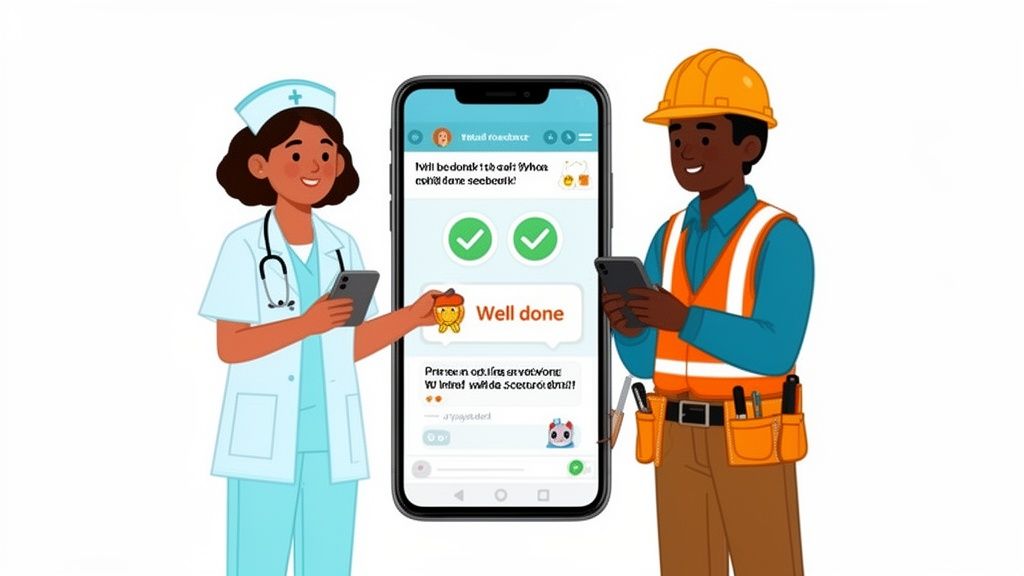
This isn't a minor gap—it's a massive blind spot. A performance management system that only serves half your people isn't a system; it’s a silo. To make performance meaningful for everyone, we have to meet them where they are.
Performance in the Flow of Work
For frontline teams, work doesn't fit into neat, one-hour calendar blocks. It’s dynamic, it's fast-paced, and it almost never happens in front of a computer. Any tool that forces them to log into a clunky desktop portal is dead on arrival.
The only way to connect with them is to bring performance management into their daily routine. It has to be mobile, intuitive, and immediate.
Think about a hospital supervisor after a grueling 12-hour shift. She can send a quick chat to a nurse who handled a tough situation with incredible poise: "You were amazing with that family. Your compassion made a huge difference." That’s real-time feedback that sticks.
Or imagine a warehouse employee on a 15-minute break. He can pull out his phone, open the company app, and see how his team is tracking toward its weekly goal. The information is right there, next to his schedule and team messages—no digging required.
Making Recognition Visible to All
One of the biggest casualties of a disconnected workforce is recognition. When an employee does something amazing on the retail floor or at a remote job site, who sees it? Too often, it's just their direct manager, if anyone. This leaves people feeling invisible.
A modern employee app fixes this by creating a central, public feed for praise and shout-outs.
A store manager in Ohio can celebrate a cashier who got a 5-star customer review.
A teammate in London can thank a driver who went the extra mile on a delivery.
The CEO can share a photo of a new branch and thank the entire launch team.
When recognition is public, it fosters a powerful sense of connection. It reminds everyone, no matter their role, that they're all part of the same team. That's how you build a real culture, not just a corporate process.
Performance isn't a chore; it's a conversation. For frontline teams, that conversation has to happen on their terms, on their device, and in their moment.
Making your performance management system inclusive isn't about finding one tool that fits all. It’s about choosing flexible, mobile-first tools that adapt to how your teams actually work. Once you do that, performance stops being a top-down mandate and becomes a living part of everyone's day.
Making the Change Stick
So you've picked your shiny new performance management system. The easy part is over. Now comes the real work: changing people's habits. This is the quiet, tricky part where most new initiatives fizzle out.
The secret to success isn't a big launch party or mandatory meetings. Real, lasting change happens in the small, day-to-day moments between managers and their teams. It's a slow burn, not a firework display.
It all has to start from a genuine belief that you’re doing this to help your people grow, not to check a box for HR or gather more data. If that core belief isn't authentic, your team will smell it a mile away.
Lead From the Front and Explain the "Why"
Before you get lost in the how, you need to be incredibly clear on the why. Why are we ditching the old annual review? How is this new way going to make our lives better? If you can't answer that in a simple, honest way, you can't expect anyone to get on board.
This change absolutely has to start at the top. When your leaders actively use the tool for public praise or managers make it a non-negotiable part of their weekly check-ins, it sends a powerful signal: "This is how we operate now, and it matters."
Leading by example is what separates a fundamental shift from just another flavor-of-the-month initiative.
The Slow and Steady Path to Adoption
One of the biggest mistakes is expecting everyone to adopt the new system perfectly overnight. It won't happen. Some managers will slip back into their old ways. Some employees will try to ignore it. That’s normal. The key is to be persistent without being pushy.
The goal isn’t a flawless rollout; it’s steady, meaningful progress. Your real job is to coach your managers to become better coaches, one conversation at a time.
Focus on the small wins and celebrate them. Spotlight the manager who started holding consistent check-ins. Give a shout-out to the team that’s constantly recognizing each other’s work. These little stories are contagious; they build momentum and show others what’s possible.
And if you’re wondering if all this effort is worth it, the data says yes. A recent report found that while 91.6% of companies have a formal process, 80.7% now require goals to be documented in a platform. The shift is happening everywhere. You can see the full 2024 performance management findings and see how universal this change has become.
Ultimately, this isn’t about forcing compliance. It’s about building a better way to work, together. You’re not just implementing a performance management system; you’re nurturing a culture of growth. That doesn't happen overnight. It happens one conversation, one piece of feedback, and one small step at a time.
Common Questions About Modern Performance Management
As companies start thinking about ditching old-school annual reviews, a few familiar questions always pop up. Let's tackle the big ones I hear most often.
Won’t Continuous Feedback Take Too Much Time?
That's a fair question, but it frames the problem the wrong way. This isn't about adding more work for managers; it's about changing when and how that work happens.
Think of it this way: instead of hoarding a year's worth of notes for one marathon, two-hour review, you're having dozens of casual, five-minute check-ins. It just becomes a normal part of your weekly rhythm.
This actually saves time. By giving feedback in the moment, you stop small issues from snowballing into big problems that demand hours of meetings later.
How Do You Handle Compensation Without Ratings?
This is the big one. It's probably the #1 concern, and the answer is surprisingly simple: separate performance conversations from pay conversations.
They are two completely different things with totally different goals.
Performance conversations are about growth, coaching, and development. Pay conversations are about budgets and business decisions.
When you put a salary number on the table, the tone shifts. Honesty goes out the window, and the conversation turns into a negotiation. By keeping them separate, you allow feedback to be what it’s supposed to be—a genuine tool to help people improve.
What About Frontline Employees Who Aren't Tech-Savvy?
This concern gets to the heart of why choosing the right tool is so critical. If your performance management system feels like complicated enterprise software, it’s already failed your frontline teams.
A modern platform has to be as intuitive as the social media or messaging apps your employees already use every day. No training manuals, no mandatory seminars.
The technology should feel almost invisible, simply making it easier for people to connect. For teams looking to build a system that works for everyone, exploring Performance Management Best Practices can provide a great blueprint. The goal is a system that meets your people where they are, not one that forces them to learn a new, clunky process.
Pebb is the simple, all-in-one app that brings communication, operations, and performance management together for your entire team. See how we help companies build a stronger culture and keep everyone in sync at https://pebb.io.
