
What Are Compliance Management Systems Really For?
Discover how modern compliance management systems help frontline teams stay safe and engaged. Ditch the spreadsheets and build a culture of compliance.
Dan Robin
Let's be honest, the word 'compliance' can make even the most seasoned manager groan. It brings to mind dusty binders, mandatory training modules that feel like a punishment, and that constant, nagging worry that you’ve missed a critical detail somewhere. A real compliance management system is built to do one thing: replace that chaos with calm. It’s about turning a dreaded, reactive chore into a simple, proactive part of your daily operations.
The Real Cost of ‘Good Enough’ Compliance
For far too long, we’ve relied on a patchwork of spreadsheets, shared folders, and endless email chains to manage compliance. We pieced these systems together because, at a glance, they seemed to work. They felt ‘good enough.’ But that old way of doing things is bleeding businesses dry, and I'm not just talking about the risk of fines.
The true cost is friction. It’s the hours your managers burn chasing down signatures on training forms. It’s the frontline disengagement that happens when you hand an employee a 100-page policy manual that has almost nothing to do with their actual job. This isn't a legal problem; it's a people problem, plain and simple.
The Hidden Drag on Operations
Picture a restaurant chain with dozens of locations. Corporate rolls out a new food safety protocol. With a disconnected, manual system, that crucial update becomes an email that gets buried, a memo that’s lost in the back office, or a poster that never makes it onto the wall. The result is a mess of inconsistent practices, easily avoidable risks, and a huge gap between what headquarters wants and what happens on the floor.
This isn't just a hypothetical. It's the daily reality for operations leaders and HR managers everywhere. They're on the hook for ensuring consistency and safety across teams they may rarely see in person, but they’re stuck using brittle, outdated tools that were never meant for the job.
It's no surprise, then, that the global market for compliance management software is absolutely exploding—it's projected to hit an incredible $106.76 billion by 2030. This isn't just because of new rules. It’s because businesses are finally waking up to the fact that manual methods are a huge liability, especially as data privacy regulations like GDPR bring staggering fines. You can see the full scale of this shift in the compliance market report.
From Liability to Asset
When you start thinking about compliance differently, the solution becomes obvious. The goal isn't just to satisfy an auditor or check a box. The real win is building a smarter, safer, and more efficient organization from the inside out.
Take a look at how a modern approach completely changes the game.
The Old Way Versus The New Way
Area of Operation | Traditional Approach (The Pain) | Modern System (The Gain) |
|---|---|---|
Policy Updates | Email blast with a PDF attachment; no way to track who read it. | Push notification sent to relevant roles; requires a digital sign-off. |
Training | In-person sessions or long videos; manual tracking with spreadsheets. | Bite-sized modules delivered on a phone; automated completion tracking. |
Incident Reporting | Paper forms filled out in the back office, often days after an event. | A quick 30-second report from a mobile device, right on the spot. |
Audits | Frantic search for paper records and email threads across departments. | A central dashboard with all records, reports, and sign-offs in one place. |
The difference is night and day. A modern compliance management system works by meeting your team exactly where they are, delivering the right information in a way that’s impossible to ignore and easy to act on.
It gives you time back. Instead of chasing people down, the system automates reminders and logs everything for you.
It actually engages your team. By making information relevant and easy to access, it helps people understand the "why" behind the rules.
It creates total clarity. Everyone knows exactly where to find the latest procedure, eliminating the old "I didn't know" excuse.
But that’s only scratching the surface. The real magic happens when compliance stops being a mandate pushed from the top down and becomes woven into the daily workflow. It’s about helping a frontline worker flag a safety issue from their phone in under a minute or to quickly confirm a new process right before their shift. This is where ‘good enough’ finally makes way for something genuinely great.
What Is A Compliance Management System?
Let’s be honest, the term "compliance management system" sounds a bit corporate and stuffy. But let’s cut through the jargon. At its core, a compliance management system (or CMS) is really just a tool that helps a business keep its promises—to its customers, its people, and the regulators who oversee it.
Think of it less like a stern auditor with a clipboard and more like a trusty co-pilot who knows the flight plan inside and out, making sure you stay on course.
We’ve all seen what happens without one. That last-minute scramble to find a signed document for an audit. The confusion over which version of the company policy is the actual policy. The collective groan when another mind-numbing training session pops up on the calendar. This is the chaotic reality of trying to manage compliance with a patchwork of spreadsheets, shared drives, and good intentions.
A good CMS simply clears away all that noise. It gives you a single, organized home for everything related to your company's rules and responsibilities.
From Rules on a Page to Actions in the Field
Here’s the thing I’ve seen trip up so many businesses: compliance isn't just about having rules written down somewhere. It's about making sure those rules are understood, followed, and properly documented, especially when your teams are spread across different locations and shifts.
A CMS is what closes that gap. It's a bit like running a professional kitchen:
Recipes (Policies): You need one central cookbook with all your standard operating procedures, available to every single person on the line.
Trained Chefs (Training): You need a reliable way to ensure every cook knows how to prepare each dish correctly and safely.
Handling a Mistake (Incident Management): You need a clear, no-panic process for what to do when a dish gets burnt or an order is wrong.
Quality Checks (Audits): And finally, you need a systematic way to check that every plate leaving the kitchen meets your standards.
A CMS pulls all of this together into a seamless loop. It turns abstract rules into concrete, daily actions that protect your business and your people, so you can stop wrestling with the process and get back to what you do best. The old way of managing this creates a costly drag on your business, hitting your team's time, their morale, and your bottom line.
This chart really drives home the real-world costs of disorganized compliance.
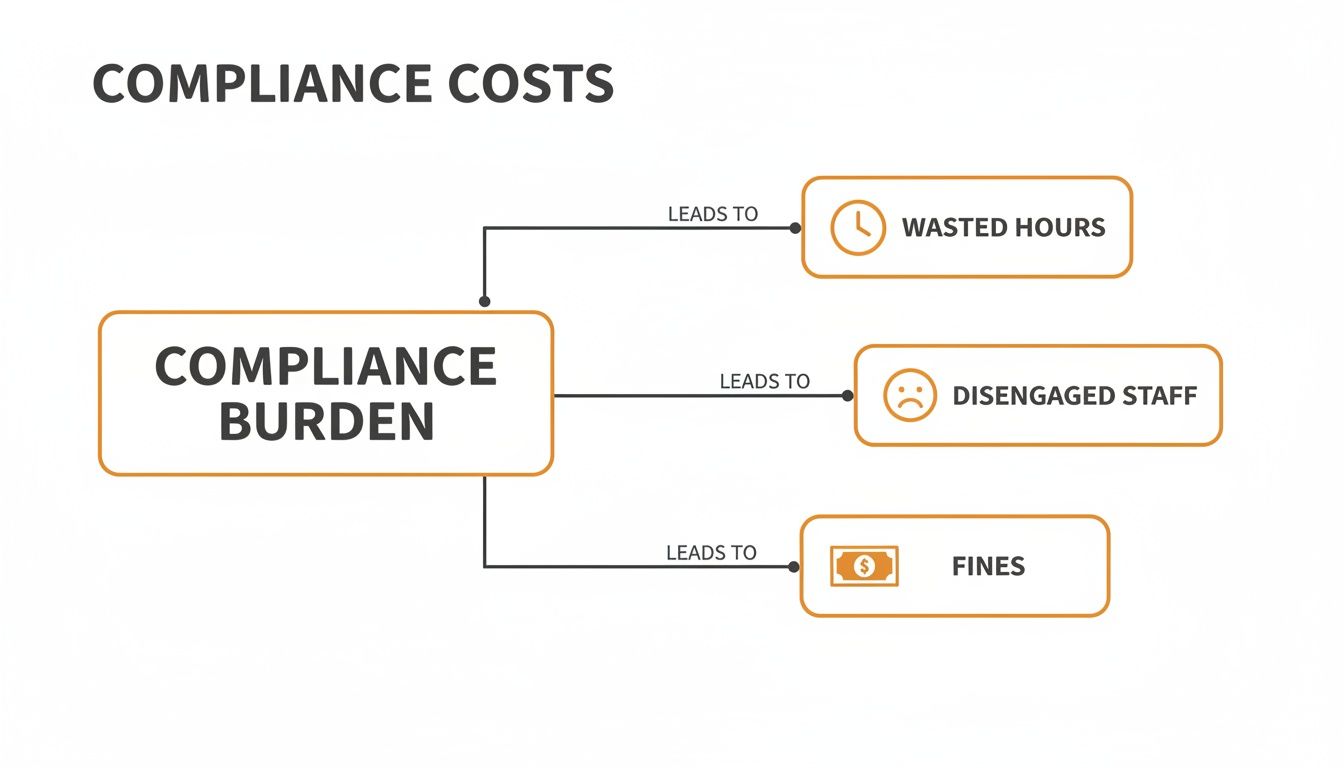
As you can see, the weight of manual compliance doesn’t just waste time; it directly leads to disengaged staff and the constant threat of fines.
A Central Nervous System for Your Business
Think of a proper CMS as the central nervous system for your operations. It senses what’s happening—a new regulation, an internal incident, a policy update—and immediately sends clear signals to the right people, prompting the right actions. This isn't about adding more red tape. It’s about building a smarter, more resilient company where everyone knows exactly what's expected of them.
A CMS provides a single source of truth, which is absolutely crucial. Industry research shows that compliance teams can spend an average of 50 hours on gap analysis for every single new regulatory standard. A centralized system dramatically cuts down that manual grind.
Instead of digging through email chains or shared folders, a manager can see in seconds who has completed their required safety training. When a policy gets updated, the system doesn’t just email it out into the void; it tracks who has read and acknowledged it.
But that’s only half the story. The real magic of a modern CMS is how it feels to the frontline employees using it every day. It’s not just another complicated program they have to learn. It’s a tool that genuinely makes their job easier and safer. When compliance becomes part of the natural workflow, it stops feeling like a chore and starts feeling like common sense.
Why Your Frontline Is Your Greatest Compliance Asset
We tend to picture compliance as something handled in a quiet back office, managed by folks in HR or legal. But if we're being honest, that's not where the real work gets done. Compliance lives and dies on the shop floor, at the patient’s bedside, and on a delivery route. It's built on hundreds of small decisions your frontline employees make every single day.
They're the ones deciding whether to follow that new safety protocol, how to handle an upset customer, or what to do when they spot a potential hazard. They are your living, breathing firewall against risk. The problem is, they’re often the last to get the memo.
Most old-school compliance programs are built with a fatal flaw: they're designed for the boardroom but have to be executed by the frontline. We push rules from the top down and just hope they stick. That whole approach is completely disconnected from how people actually work.
From Mandate to Shared Responsibility
This is where modern compliance management systems change the game. Instead of just being another tool for managers to enforce rules, they become a resource that genuinely helps employees do their jobs better and safer. It’s all about shifting compliance from a top-down mandate into a shared responsibility.
When your system is actually designed for the frontline, you see a real difference. The focus moves away from simply policing behavior and toward building genuine awareness.
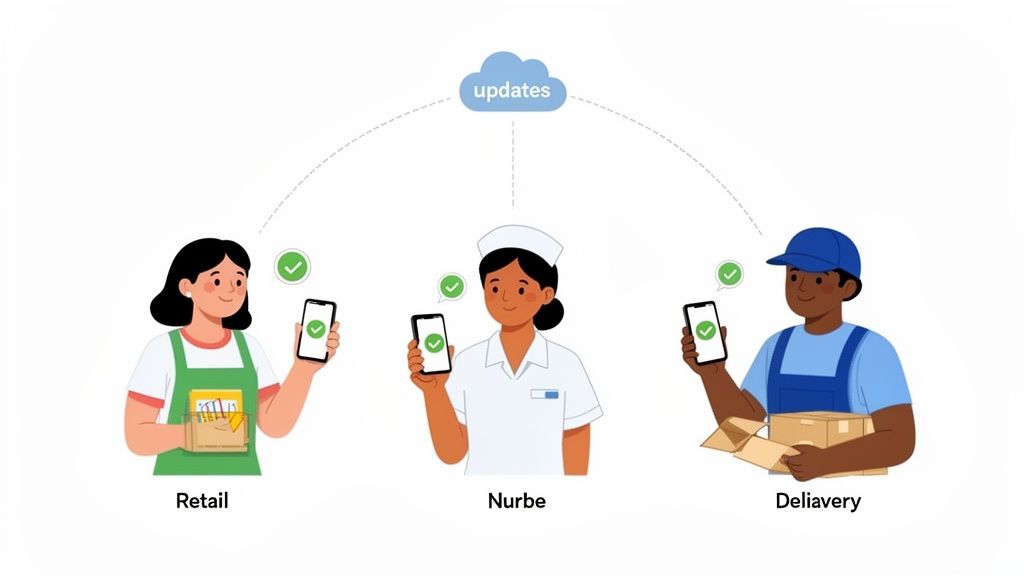
A retail associate gets a push notification with a photo of a recalled product, helping them pull it from shelves before a customer can buy it.
A nurse confirms a new patient handling procedure on their phone moments before they need it, ensuring both safety and consistency.
A warehouse operator reports a spill using a quick mobile form, triggering a cleanup alert in seconds, not hours.
Suddenly, compliance isn’t some abstract concept buried in a manual. It’s timely, practical information that makes a real difference in the flow of work.
Building a Culture of Awareness
The goal here isn't to force your team to memorize a mountain of regulations. It's to build a culture where people feel aware, confident, and equipped to make the right call in the moment. A good system does this by making information incredibly easy to find and digest.
Instead of pulling people off the floor for long, formal training sessions, we need to bring learning directly into their workflow. When compliance info is delivered in small, relevant bites on the devices your team already uses, engagement goes through the roof.
Think about it. A nurse doesn't have time to dig through a 200-page digital binder. But a quick, 30-second video on a new hand-washing technique? That’s something they can actually use. A delivery driver isn’t going to read a long email about vehicle inspection changes, but a simple checklist they can tap through on their phone before starting a route? That gets done.
To truly help your frontline, you have to see them as the core of your compliance strategy, not the final step. A big part of this is incorporating robust employee security awareness training to build that knowledge from the ground up.
This isn't just about having the right policies in place. As you can see with how connected tools improve both employee training and incident reporting for compliance, it's about a fundamental shift in how we view our frontline teams. They aren’t just cogs in a machine; they are your most valuable sensors, your first line of defense, and your single greatest compliance asset. Your system should absolutely treat them that way.
How To Choose The Right System Without The Headache
Shopping for compliance software can feel overwhelming. The market is packed with vendors all promising you the moon. You’ll get bombarded with buzzwords like "AI-powered this" and "blockchain-integrated that" until your head spins. It's exhausting.
So, how do you cut through the noise and find a system that actually fits your company? More importantly, one that your team won't secretly despise?
Here's the honest truth: the answer isn't in a feature-for-feature comparison. Most compliance management systems offer a similar set of core functions. The real differentiator isn't what they do, but how they do it and who they’re designed for.
Start With Principles, Not Features
Instead of asking, “Does it have automated reporting?” try asking more grounded, human questions. Does this tool respect my team’s time? Could a new hire figure it out without a week-long training seminar? Will it make our daily work easier, or is it just another password to forget?
These aren't fluffy, nice-to-have considerations. They are the absolute foundation of a successful rollout. A tool with a thousand bells and whistles is completely useless if your team finds it clunky and avoids it at all costs.
I’ve seen companies spend a fortune on powerful platforms that end up as digital ghost towns. The problem is rarely the software's capability; it's almost always the user experience. If a tool feels like a chore, people will treat it like one.
Focus on these core principles first, and let everything else follow.
Simplicity is everything. The system should just make sense. If you need a consultant to walk you through the basics, that’s a massive red flag.
It must work where your team works. For frontline and distributed teams, that means it has to be mobile-first and incredibly fast on a phone. I’m not talking about a shrunken-down desktop site, but a true, native mobile experience.
It should connect, not isolate. The tool must fit into your current tech world. Can it talk to the communication or HR platforms you already rely on? A system that just creates another data silo is a step in the wrong direction.
Look for Signs of a True Partner
When you're talking to vendors, think of it less like buying software and more like hiring a key partner. A good partner listens. They understand your industry and the unique headaches your frontline staff deal with every day. Are they asking you smart questions about your workflow, or are they just reading from a sales script?
This is especially critical now. New tech is completely changing the game, with AI analytics now able to predict 85% of risks before they even happen and cut audit times by up to 60%. That’s huge when you realize the average cost of a single non-compliance event is a jaw-dropping $14.82 million. As a recent data compliance market report shows, cloud-based deployments and smart analytics are turning compliance from a necessary evil into a real business advantage.
A vendor who gets this won’t just sell you a license; they'll help you prepare for what’s next. They’ll be open about their product roadmap and what they're building for the future.
The Final, Gut-Check Questions
Before you sign on the dotted line, run the system through one final mental test. Imagine two scenarios.
First, picture your busiest, most skeptical employee on a chaotic Tuesday morning. Can they use this tool to report an issue in less than 60 seconds? If the answer is no, keep looking.
Second, think about how the system handles communication. Does it help clarify rules and procedures, or does it just add to the digital noise? The gap between a secure, clear platform and a messy one can create huge risks. We’ve written about the crucial differences between secure messaging and non-compliant platforms before, and it's a distinction you can't afford to ignore.
Ultimately, choosing the right system isn’t about finding the perfect tool. It’s about finding the simplest, most intuitive tool that your people will actually want to use. It's about choosing a system that serves them, not the other way around.
How To Implement A System People Actually Use
Buying a new tool is the easy part. The hard part—the real work—is getting your team to actually embrace it. We’ve all seen expensive software licenses gather digital dust, turning into pricey "shelfware" that nobody ever touches. So, how do you make sure your new system doesn't meet the same fate?
It's all about thoughtful change management. This isn’t about forcing a mandate from the top down; it’s about building genuine momentum from the ground up. It takes empathy, clear communication, and a healthy dose of patience.

Start Small And Find Your Champions
One of the biggest mistakes I see leaders make is trying to do too much, too soon. They plan a massive, company-wide launch with rigid deadlines and mandatory training sessions. This approach almost always backfires, creating friction and immediate resentment.
A much smarter strategy is to start small. Identify a single team—preferably one that’s open to new ideas and has a manager you trust. Pitch it as a pilot program. You’re not rolling out a new system; you’re simply trying something out with a small group to see if it helps them.
The beauty of this approach is threefold:
It lowers the stakes. If the pilot hits a snag, you can pause and make adjustments without disrupting the entire company.
It creates internal champions. When that first team starts seeing results, they become your most powerful advocates. Their genuine excitement is far more convincing than any corporate memo.
It provides priceless feedback. You get to learn what really works (and what doesn't) from the people who are in the trenches using the tool every day.
Frame It As A Tool That Helps
Let’s be honest. When your frontline team hears "new compliance system," their minds often jump to, "Great, another way for corporate to micromanage us." You have to get ahead of that perception right from the start.
The words you choose are incredibly important. Avoid talking about enforcement, oversight, or monitoring. Instead, focus on how this new tool will make their jobs easier, safer, and less complicated.
How you introduce a new system is everything. Instead of saying, “We’re implementing this to ensure policy adherence,” try something like, “We found a tool that gets you the right information instantly, so you never have to guess what the current procedure is.”
The entire conversation should be about what's in it for them. A great compliance management system feels less like a watchful warden and more like a helpful partner. It's the app that gives them a quick answer on their phone, saving them from having to track down a manager or flip through a dusty binder. A huge part of this is ensuring your policies are clear and easy to follow; our guide to creating a great policy and procedure manual can show you how.
Celebrate Early Wins And Gather Honest Feedback
Once your pilot team is up and running, be on the lookout for small victories and celebrate them publicly. Did the system help someone report a safety hazard in record time? Share that story. Did it save a manager hours of tedious paperwork? Highlight that in the next team meeting.
These early wins are what build unstoppable momentum. They demonstrate to the rest of the company that this isn't just another flavor-of-the-month initiative—it's something that delivers real, tangible value.
At the same time, you need to actively seek out honest feedback. Create a safe space where your pilot users can tell you what they love, what they hate, and what they find confusing. Make it clear you want the unvarnished truth. This isn’t just about being nice; it’s about refining the system with real-world input before rolling it out to everyone else. A tool that has been battle-tested and improved by your own people has the best possible chance of success.
Building A Resilient And Aware Organization
For far too long, we’ve seen compliance as a finish line. You scramble to pass the audit, check the box, and breathe a huge sigh of relief. You’re ‘done.’
But thinking that way is a trap. It’s a static approach in a world that never, ever stops moving. Regulations shift, your team turns over, new risks appear out of nowhere, and customer expectations only go up. Treating compliance like a one-and-done event is like trying to navigate a raging river by only looking at a single photograph of it.
Here’s the truth: a good compliance management system isn’t a final answer. It’s a compass. Its real job isn't just to drag you through today's audit, but to help you navigate constant change. The goal isn’t to simply be compliant—it’s to build a resilient, deeply aware organization that can adapt to whatever the future throws at it.
Getting this mindset right is everything. It's the difference between constantly reacting to yesterday's problems and proactively preparing for tomorrow's opportunities.
Beyond Checkboxes To Culture
Real organizational resilience isn't about having a perfect, unblemished record. It’s about having the visibility to spot a problem the moment it happens, the agility to figure out why it happened, and the ability to adjust course on a dime.
It’s about fostering a culture where every single person feels equipped and empowered to make the right call—not just because a rulebook says so, but because they have the context and the tools to do it themselves.
This is exactly why your system's design is so critical. It should be built to create awareness, not just enforce rules. To make sure your system encourages people to lean in, you should integrate actionable compliance training best practices right into the platform. When training and communication are part of the daily workflow, you build good habits and organizational muscle memory.
We’ve seen it time and again. The companies that truly thrive are the ones that treat compliance not as a defensive shield, but as an offensive tool for building a smarter, more dependable operation. They use their compliance system to get better every single day.
So, let’s wrap this up not with a neat summary, but with a question for you to take back to your team: Is your current approach just helping you react to the past, or is it genuinely preparing you to win in the future?
A great compliance management system does the latter. It gives you the insight and agility to build an organization that doesn’t just survive change—it gets stronger because of it. It’s not about finding a final destination; it's about building a better ship for the journey ahead.
Frequently Asked Questions
When we talk with people about moving away from spreadsheets and email chains, a few common questions always come up. It’s natural. Shifting to a modern compliance management system feels like a big step, but it’s usually simpler than you think. Here are some honest answers to the things we hear most often.
We Are A Small Business, Do We Really Need A Formal System?
I hear this one a lot, and my answer is always the same: you probably need it more than anyone. When you don't have a big legal department to fall back on, even small mistakes can become incredibly costly. A good system isn't about adding layers of bureaucracy; it's about saving you from drowning in it.
Think of it this way: instead of spending your own time chasing signatures or wondering if everyone saw the latest policy update, you get an automated expert. It handles the tedious work of distributing policies, tracking training, and keeping records organized, freeing you up to actually run your business. It’s a way to get the same peace of mind as a huge corporation, without the overhead.
How Do We Get Our Frontline Staff To Care About Compliance Training?
You start by respecting their time and their intelligence. The reason most frontline staff hate compliance training is because it’s usually terrible. It pulls them off the floor for an hour to watch boring, generic videos that have little to do with their actual job.
You get them to care by stopping all of that.
Use a modern, mobile-first tool to integrate learning directly into their daily workflow. Send a short, 30-second video on a new procedure. Push out a quick, one-question quiz to reinforce a key safety rule. Post a "did you know?" update right in their team chat. When the training is accessible, relevant, and quick, engagement naturally follows. It stops being a dreaded task and just becomes part of the daily conversation.
What Is The Difference Between A Compliance System And Our HR Platform?
This is a great question, because on the surface, they can seem similar. Your HR platform is typically built around the employee lifecycle—things like hiring, payroll, time off, and performance reviews. Its focus is on the individual employee's relationship with the company.
A compliance management system has a much broader job. Its focus is on managing operational and regulatory risk for the entire organization.
It handles company-wide policies that go far beyond HR, like data security or worksite safety. It tracks specialized, job-specific training and certifications. A good CMS is also where you manage incident reports, like a customer slip-and-fall or a data breach, and it’s the tool you use to prepare for external audits.
While the two systems can and absolutely should connect, they solve different problems. Your HR tool manages your people; your compliance tool protects your entire operation.
Ready to see what a calm, organized, and truly connected workplace feels like? Pebb brings communication, operations, and compliance together in one simple app that your frontline teams will actually love to use. Learn how Pebb can help you build a more aware and resilient organization.
