
The Work of Worthwhile Conflict
Gain practical conflict resolution in teams strategies. Handle disagreements with confidence, build trust, and foster a productive, healthier workplace.
Dan Robin
We’ve all been there. That meeting where the tension is so thick you could cut it with a knife. Two people are talking, but nobody is listening. Or worse, the meeting where nobody talks at all, and the silence is deafening.
Most companies try to stamp out conflict. They see it as a failure, a disruption to a peaceful, productive workplace.
We see it differently. After building teams for years, we’ve learned that the right kind of conflict is a sign of life. It means people care enough to disagree. They have skin in the game. Silence is what’s truly dangerous. Silence is where good ideas go to die, where resentment festers, and where your best people quietly decide to leave.
So, this isn’t a guide about avoiding arguments. It’s a guide on how to have better ones. It’s about turning friction from a destructive force into an engine for clarity and trust.
The Cost of Saying Nothing
Let’s be honest. Conflict is uncomfortable. Our gut reaction is to avoid it. But that avoidance has a steep price.
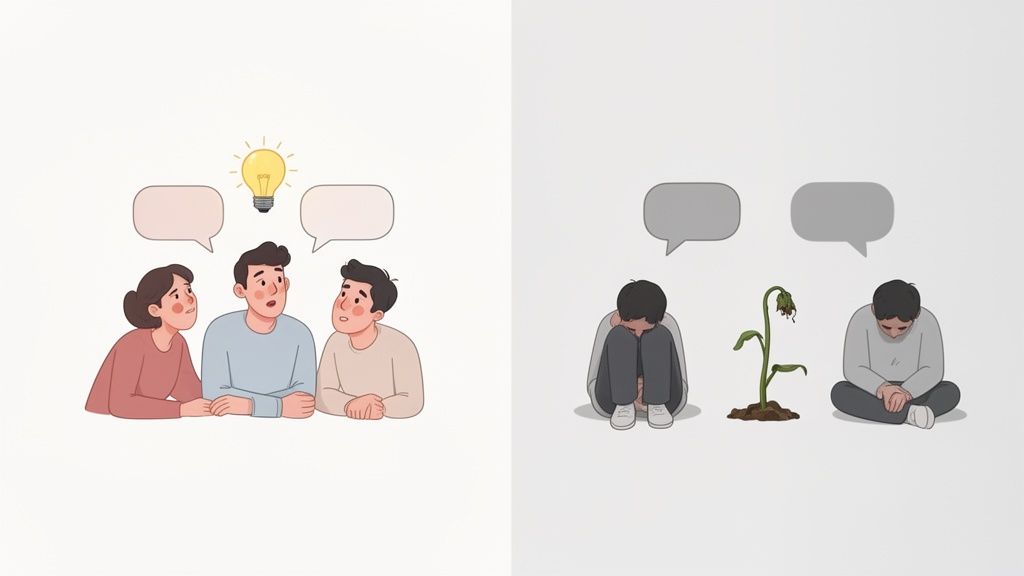
When issues are left to simmer, they don’t just go away. They go underground. They poison trust, kill productivity, and fuel quiet quitting. This is even more true on remote teams, where a small misunderstanding in a Slack message can snowball into a massive divide. This breakdown is almost always a symptom of a weak communication culture, a problem we explore in our guide on the lack of communication in the workplace.
And this isn’t just a fuzzy “culture” issue. It costs real money. A recent study found that workplace conflict costs UK businesses a staggering £28.5 billion a year. That’s nearly $3,600 per employee, every single year, wasted on unresolved arguments and the fallout they create. The numbers behind the staggering cost of workplace conflict are hard to ignore.
Unresolved conflict is a debt. It accrues interest every single day, paid with morale, productivity, and eventually, your best people.
Conflict Isn’t a Bug, It’s a Feature
So, what if we reframed conflict? What if, instead of a fire to be put out, we saw it as a signal? A flashing light on the dashboard, telling us something needs attention.
Here’s the thing. When handled well, conflict is an engine for growth.
It’s where better ideas are forged. When two different viewpoints clash respectfully, the idea that emerges is almost always stronger.
It’s where trust is built. Getting through a tough conversation and coming out the other side proves that your relationships can handle the pressure.
It’s where roles get clear. Disagreements often shine a light on fuzzy boundaries, forcing a team to define who owns what.
Our goal shouldn’t be a workplace free of friction. That’s a fantasy. The goal is a workplace where friction is handled with confidence, not fear. It’s about teaching people how to disagree well. This isn’t a fluffy, feel-good exercise. It's about creating a calm, direct, and honest way to work together.
The rest of this piece will show you how.
A Manager's Guide to Noticing Trouble
The best managers I know have one thing in common: they see trouble coming from a mile away. They don’t wait for the explosion. They notice the tremor. Your job isn’t to be a judge. It’s to be a detective.
Most disputes don’t just erupt. They start with a quiet shift in a team’s energy. That gut feeling you get when something just feels… off. Trust that feeling. It’s your most reliable early-warning system.
Digital Body Language
On modern teams, the first clues are often digital. A once-lively Slack channel that goes silent is a huge red flag. So is a sudden drop-off in emoji reactions or the friendly GIFs that stitch a remote team together.
I’ve learned to watch for a few specific tells:
Public silence, private DMs. You realize big project issues aren’t being discussed in the main channel anymore. You get the sense a lot is happening in private messages. People are avoiding direct, open discussion.
The one-word reply. A teammate who usually writes detailed, thoughtful responses suddenly starts giving curt, one-word answers. “Fine.” “Okay.” “Done.” This isn’t about efficiency. It’s a wall going up.
Sudden isolation. Two people who used to collaborate seamlessly are now working in total silos. They stop tagging each other for feedback. They don’t peer-review work anymore.
These aren’t quirks. They’re the digital equivalent of someone turning their back and crossing their arms. They are symptoms. And they’re worth investigating.
How to Ask Without Accusing
Once you sense something’s wrong, it’s time to gather context. But how you ask is everything. Your goal is to gently open a door for conversation, not to back someone into a corner. Asking, “What’s your problem with Sarah?” is a guaranteed way to make them shut down.
I’ve found it’s always better to start one-on-one. A private chat or a quick, informal call. Approach it with curiosity, not accusation.
Your job isn’t to solve the problem in this first chat. It's simply to understand what the problem is.
Try asking soft, open-ended questions focused on the work, not the person:
“Hey, the project channel has been a bit quiet. How are you feeling about the way work is flowing?”
“I wanted to see how you're doing with the new design sprint. Is there anything getting in my way that I can help with?”
“You and Alex usually work so closely on these. Is there any support you need from me to make that collaboration a bit smoother?”
These questions give people a safe way to share what’s on their mind without feeling like they’re “tattling.”
Diagnosing the Problem
As you listen, you’re trying to diagnose the type of conflict. Not all disagreements are the same, and telling them apart is a managerial superpower. The diagnosis tells you what to do next.
Most conflicts fall into one of three buckets:
A Simple Misunderstanding: This is the most common and easiest to fix. Someone misread the tone of an email. Two people have different information. It’s about clarifying communication.
A Flawed Process: The conflict isn’t about the people. It’s about a broken system they’re stuck in. Roles aren’t clear. Handoffs are messy. This is about fixing the workflow, not the people.
A Deeper Personality Clash: This is the trickiest. Two people whose work styles or values just don’t align. The goal isn’t to pick a winner, but to help them find a professional way to coexist.
Knowing the source of the conflict is everything. You can’t fix a process problem with a heart-to-heart, and you can’t fix a personality clash with a new project plan. This early detective work is what lets you act with a clear head.
How to Mediate a Disagreement
So, you’ve done your homework. There’s a real issue. Now for the part that makes most managers sweat: sitting two people down to talk it out.
I get it. Playing mediator can feel like walking a tightrope. But it’s a skill you can learn. The secret isn’t having all the answers. It’s creating a safe space for an honest conversation.
Your job isn’t to declare a winner. Think of yourself as a facilitator. Your only goal is to guide the conversation toward understanding and keep it on track.
Set the Rules Before You Start
Before anyone even sits down, set a few ground rules. This isn't about being stuffy. It’s about establishing a baseline of respect so the conversation doesn't immediately go off the rails.
I often start by saying something like this:
“Thanks for being here. My only goal is to help you both understand where the other is coming from. To make sure we have a good chat, let’s agree on two things: we’ll let each other finish without interrupting, and we’ll focus on the problem, not the person. Sound fair?”
This simple opening frames your role as neutral, sets a non-confrontational tone, and gets their buy-in from the start.
The Art of Listening
So much conflict escalates because people feel unheard. When you can make someone feel truly seen, you defuse a ton of tension right away. To do this, you have to improve active listening skills so you can validate each person’s side.
Here’s a simple, powerful structure I've used countless times:
Let Person A share their side. Ask them to describe the situation from their point of view. Let them speak without interruption.
Summarize what you heard. Before Person B jumps in, paraphrase what Person A said. “So, if I'm hearing you right, you’re frustrated because project handoffs are late, which forces you to rush. Is that right?” This proves you’re listening.
Now, turn to Person B. “Thank you for listening. Now I’d like to hear your perspective.”
Repeat the process. Let Person B share their side, and then summarize their points back to them just as you did for Person A.
This feels methodical, but it works. It slows the conversation down and forces each person to actually process what the other is saying, rather than just planning their rebuttal.
This simple flow chart illustrates the key steps to follow when you first spot signs of conflict.
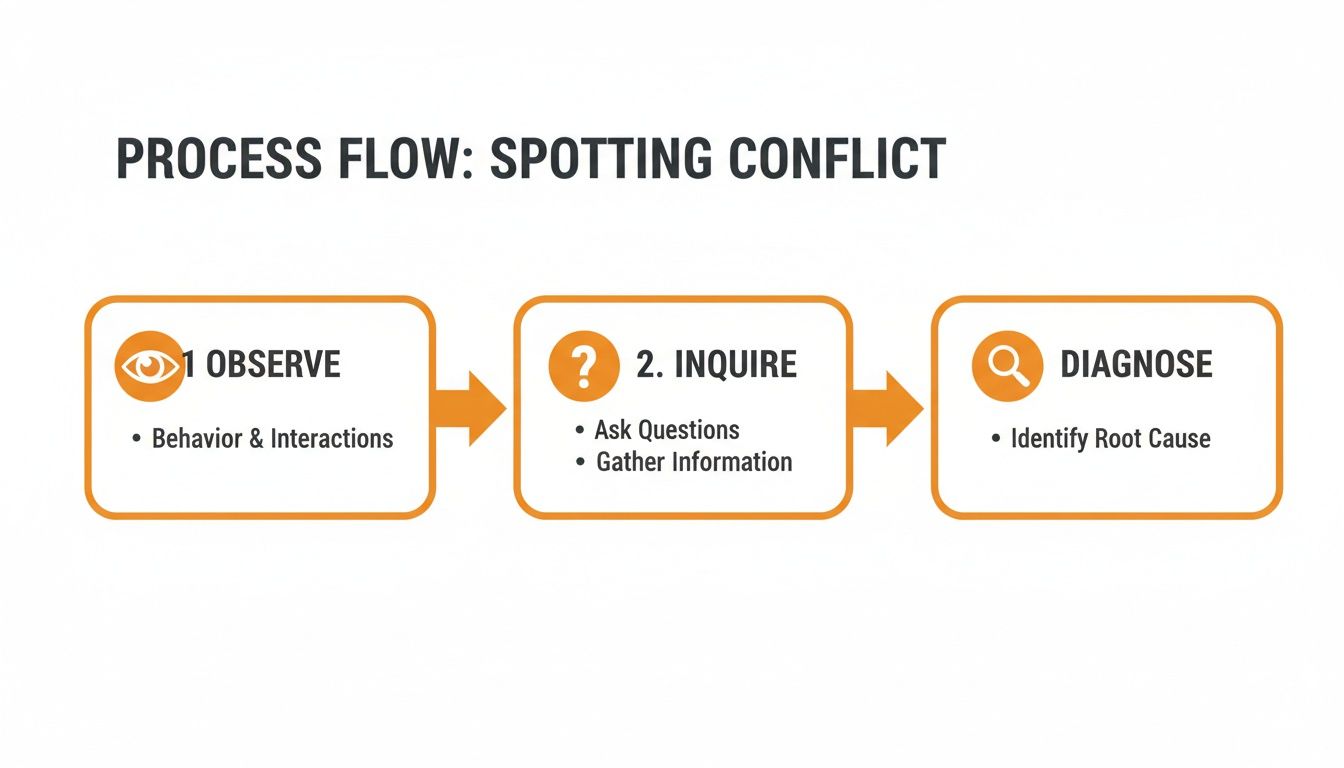
As you can see, your job starts before the meeting. You need to Observe the behavior, Inquire privately to gather context, and Diagnose the root cause before you can effectively mediate.
From Blame to Impact
The biggest roadblock in any conflict is the blame game. “You always...” or “You never...” are conversational landmines. They immediately put the other person on the defensive. Your job is to gently coach them toward more productive language.
When someone says, “You always ignore my messages,” you can help them reframe it.
This shift moves the focus from an accusation (“You are the problem”) to an impact (“This action caused this feeling”), opening the door for empathy instead of defensiveness.
Instead of This (Ineffective) | Try This (Effective) | Why It Works |
|---|---|---|
"You never listen to my ideas." | "I feel unheard when my ideas aren't acknowledged in meetings." | It focuses on the speaker's feeling ("I feel") instead of an accusation. |
"You're always late with your part." | "When the deadline is missed, it impacts my ability to get my work done on time." | It connects the action to a business impact, removing personal blame. |
"Why are you being so difficult?" | "Help me understand your concerns about this approach." | It's a genuine invitation to talk, not a judgment of character. |
Helping your team learn to communicate this way is one of the most valuable supervisor communication skills you can develop.
Get a Commitment
Once you’ve guided them to a place of understanding, the final step is to agree on what comes next. A vague “we’ll try to do better” is a recipe for failure. You need concrete commitments.
Ask them directly: “What is one thing you can each commit to doing differently, starting tomorrow?”
Get specific. Then, write it down. A simple follow-up email summarizing the agreement is perfect.
For example:
Alex commits to: Acknowledging project messages with a quick emoji or “Got it” by end of day, so Ben knows it’s been seen.
Ben commits to: Bundling non-urgent questions into a single message in the afternoon.
This creates shared accountability. It turns a difficult conversation into a productive starting point for a healthier way of working together.
The Real Work Is Follow-Through
That feeling of relief after a good mediation is great, isn’t it? The tension breaks. It feels like you’ve solved the problem.
But I’ve learned this the hard way: that conversation is the starting line, not the finish.
Resolutions don’t fail because the agreement was bad. They fall apart in the quiet days that follow, when there's no follow-through. Old habits are stubborn. Without a clear path forward, teams almost always slide back into the same ruts.
The success of conflict resolution in teams isn’t measured by the quality of the agreement. It’s measured by the change in behavior that follows.
A handshake is a promise. The real work is making sure that promise holds up when deadlines are looming and stress is high.
The Gentle Check-In
Your role now shifts from mediator to a supportive coach. The trick is to check in without making people feel like they’re under a microscope. Heavy-handed oversight only breeds new resentment.
I prefer light-touch, informal check-ins. About a week later, I’ll send a quick, private message to each person individually. Something like:
“Hey, just wanted to check in. How have things felt this past week?”
“Thinking about our chat last week. Anything I can do to help?”
The framing is important. It’s not, “Are you following the rules?” It’s a quiet signal that you're still invested in their success. It shows this wasn't a one-off HR task.
Plan for Setbacks
Let’s be realistic. Progress isn’t a straight line. There will be bumps. Someone will forget a commitment. An old, sarcastic tone might slip out. Expect it. In fact, plan for it.
The worst thing you can do is treat a small setback as a total failure. When you normalize the process of repair, you show your team you’re invested in long-term health, not a quick fix. When a slip-up happens, I frame it as a learning opportunity.
“Okay, that didn’t go as planned. What can we learn from it? What made it hard to stick to our agreement in that moment?” This approach transforms a mistake into data, taking blame out of the equation.
Build Better Systems
Ultimately, your job is to make the right way of interacting the easy way. This means looking beyond the two individuals and examining the systems they work in. The conflict was a symptom. Now it’s time to treat the cause.
Was the conflict over missed deadlines? Maybe it's time to build a clearer handoff process in your project management tool.
Did it stem from communication breakdowns? Perhaps you can establish a team norm, like using an emoji to acknowledge all important messages.
This is how you turn a single mediation into a permanent upgrade for your whole team. By building supportive systems, you’re no longer relying on individual willpower. You’re changing the environment to make collaboration smoother.
The goal isn't just to resolve this one conflict. It's to make your team more resilient for the next one. And trust me, there will always be a next one.
Build a Culture That Doesn't Need a Referee
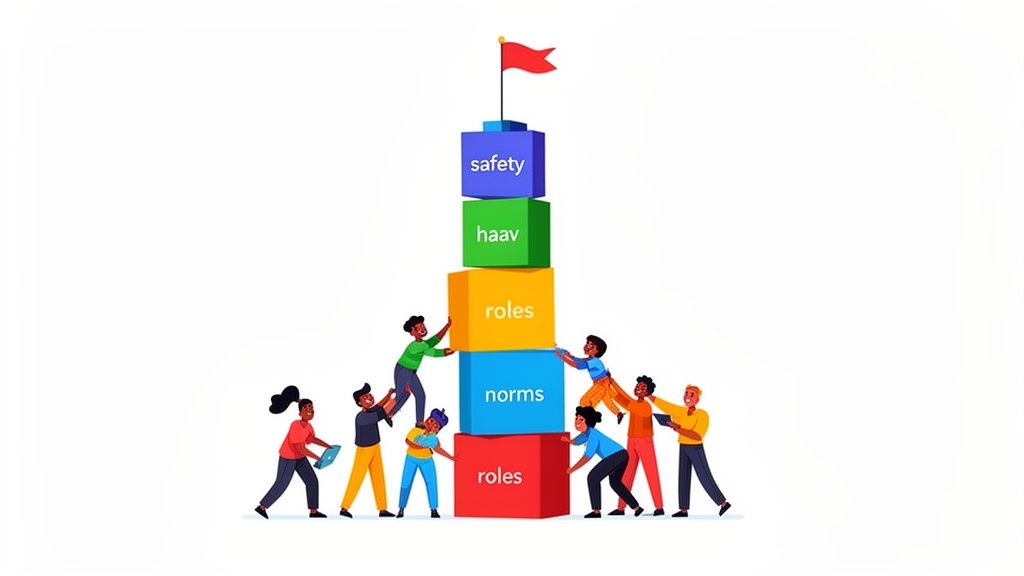
So far, we’ve talked about what to do when conflict happens. That’s the reactive part. The firefighting. But the real win is needing to play the referee less and less.
The best approach to conflict resolution isn’t about becoming a better firefighter. It’s about building a house that’s less likely to catch fire in the first place.
This means shifting your mindset from reaction to prevention. It’s about creating a culture where healthy disagreement is normal, even productive. A place where friction leads to innovation, not frustration.
The Foundation of a Resilient Team
I’ve seen this work in a handful of great companies, and they all have three things in common. They don’t just put these on a poster; they weave them into how they operate every day.
Psychological Safety: This is the bedrock. It’s the shared belief that you can speak your mind, ask a “dumb” question, or challenge an idea without being punished. Without it, you get silence and resentment.
Clear Communication Norms: How do we give feedback here? What’s the right channel for an urgent question? When everyone understands the rules of engagement, you get fewer accidental collisions. You can start by establishing essential ground rules at meetings.
Well-Defined Roles: So much conflict grows from ambiguity. When people aren't sure who owns what, you get turf wars and dropped balls. Clear roles are like good fences—they make for good neighbors.
Principles Into Practice
Principles are nice, but they don't mean a thing until they change how your team works. One of the most powerful ways to make this real is a Team Charter.
This isn't some dusty document you file away. It's a living agreement, created by the team, that spells out how they’ll work together.
A good charter might say things like:
On Feedback: “We give feedback directly and kindly, within 24 hours. We focus on the behavior, not the person.”
In Meetings: “We challenge ideas freely but commit fully once a decision is made. Everyone is expected to contribute.”
For Communication: “Urgent issues get a call. Project updates go in the project channel. Everything else can wait.”
When the team builds these rules together, they aren’t just following a mandate. They're holding themselves and each other accountable. It becomes their culture.
Leaders Go First
Here’s the catch. None of this works if leaders don’t model the behavior. If you avoid tough conversations, so will your team. If you get defensive when someone gives you feedback, you've just taught everyone to keep their opinions to themselves. You set the tone. Always.
This is why investing in these skills is an operational strategy, not a perk. The data agrees. One survey found that 95% of employees who got conflict resolution training said it helped them. Even better, 85% of those workers said they could navigate conflict without taking it personally.
Conflict is a feature of great teams, not a bug. Your job isn’t to eliminate it. It’s to build the trust, skills, and systems that turn it into a source of strength.
Ultimately, this is about building trust. It’s the highest-leverage investment you can make in your people. We have a whole guide on how to build trust in teams if you want to dig deeper.
This work is never easy and it’s never “done.” But the payoff is a team that’s not just productive but resilient, innovative, and genuinely connected. A team that isn't afraid to argue its way to a better answer. What could be more valuable than that?
Your Toughest Questions, Answered
We've helped managers untangle workplace issues for years. We’ve heard it all. Here are the most common questions we get, with our honest, practical answers.
What if one person refuses to participate in mediation?
This is a tough one. First, pull that person aside for a private chat. It’s easy to assume they're just being difficult, but often, the refusal comes from a place of fear. They might worry it will be unfair, that they’ll get blamed, or that it’s just a waste of time. Your job is to listen—really listen—to their concerns. Reassure them that the goal isn't to assign blame but simply to get on the same page.
But what if they still refuse? Honestly, at that point, the issue is no longer about the original conflict. It’s a performance problem. Collaborating with colleagues is a fundamental part of the job. Refusing to even try to resolve a team issue is a roadblock to their responsibilities, and you need to treat it as such.
How do you handle conflict between a manager and their direct report?
This is a minefield. The power imbalance is the elephant in the room and the single biggest barrier to an honest conversation. The direct report has to feel 100% safe to speak up without fearing it will haunt them in their next performance review.
Because of this, the manager involved should never be the one mediating. This is non-negotiable. You must bring in a neutral third party. An HR business partner is a good choice, or a trusted senior leader from another department. The mediator's role is to steer the conversation toward observable behaviors, not titles or hierarchy. The key is to separate the power dynamic from the actual problem.
What’s the difference between healthy debate and destructive conflict?
This is simpler than most people think. The difference isn't about how loud people get. It’s about where the attacks are aimed.
Healthy debate attacks the problem. Destructive conflict attacks the person.
Healthy debate is about the “what.” It’s focused on ideas, strategies, and processes. People might be passionate, but there's an undercurrent of respect and a shared goal to find the best answer. It’s driven by curiosity.
Destructive conflict is about the “who.” It gets personal. You'll hear character attacks, sweeping generalizations like “you always do this,” and a steady emotional escalation. It’s not about finding a solution; it’s about winning the argument. As soon as the conversation shifts from the work to the person, you’ve crossed into dangerous territory.
The silence after a blow-up can be just as damaging. Research shows that a staggering 47% of employees who run into a dispute just "let it go" and do nothing. You can see more in these workplace conflict statistics from boterview.com. This isn't a sign of resilience; it's a symptom of a deeper issue. It tells you people don't trust the process, or worse, they don't trust leadership to handle it fairly.
At Pebb, we believe great teams are built on clear, direct communication—especially when things get tough. Our platform is designed to support exactly that, giving you dedicated spaces and tools to keep everyone aligned and tackle issues head-on. By bringing chat, tasks, and company news into one place, Pebb helps you build a culture where problems are solved, not swept under the rug. See how we can transform your team's communication at https://pebb.io.
