
Your annual performance review template is broken. Here’s a better way.
Ditch the broken yearly review and try the annual performance review template to spark real conversations and improve performance.
Dan Robin
Let’s be honest. The annual performance review is a ritual most of us dread. It’s that one stiff, awkward meeting where a year’s worth of work gets squeezed into a generic form. It often feels like an administrative chore, not a real conversation about growth. We’ve been there. We’ve filled out those forms and walked away feeling like the whole exercise missed the point.
The real problem isn’t the meeting itself. It’s the philosophy behind it.
Why the Old Way Doesn't Work Anymore
Trying to guide someone’s career with a single yearly check-in is like trying to drive across the country by looking at the map only once. It just doesn’t work for modern teams. A McKinsey study found that 80% of managers are unhappy with their performance systems. We know the feeling.
The annual review often becomes a dumping ground for a year’s worth of pent-up feedback. That’s rarely fair or productive. Real growth happens in small, consistent conversations, not a single, high-stakes meeting.
This model is especially broken for dynamic frontline workers. Imagine a retail associate or a healthcare aide who needs feedback in the moment, not a report card 12 months later. The cycle is just too slow.
Shifting the Mindset, Not Just the Form
We quickly realized that finding a better template for the same old process was a fool’s errand. We had to change our thinking first. We had to move from a top-down evaluation to a collaborative, ongoing dialogue about progress.
This meant rethinking the purpose of the review itself.
From backward-looking to forward-looking: The conversation should be less about rating the past and more about creating a path for the future.
From a monologue to a dialogue: It needs to be a two-way street where people feel heard, not just judged.
From an event to a process: The formal review should be a summary of continuous feedback, with zero surprises. You can see more on why old engagement models fall short in our guide on digital vs. traditional employee engagement.
Before you can fix the template, you have to fix the thinking. That’s why we ditched the old model.
I realized that a single, perfect annual performance review template wasn't the answer. That's the kind of thinking that got us into this mess.
Instead, I decided to build a simple, focused toolkit. It’s a small collection of documents designed to do one thing: spark and sustain genuine conversations about work, progress, and growth. This isn't about creating a paper trail; it's about building a shared understanding.
The old way was a predictable march toward a year-end judgment. This infographic paints a pretty clear picture: a flat, disconnected, and backward-looking exercise.
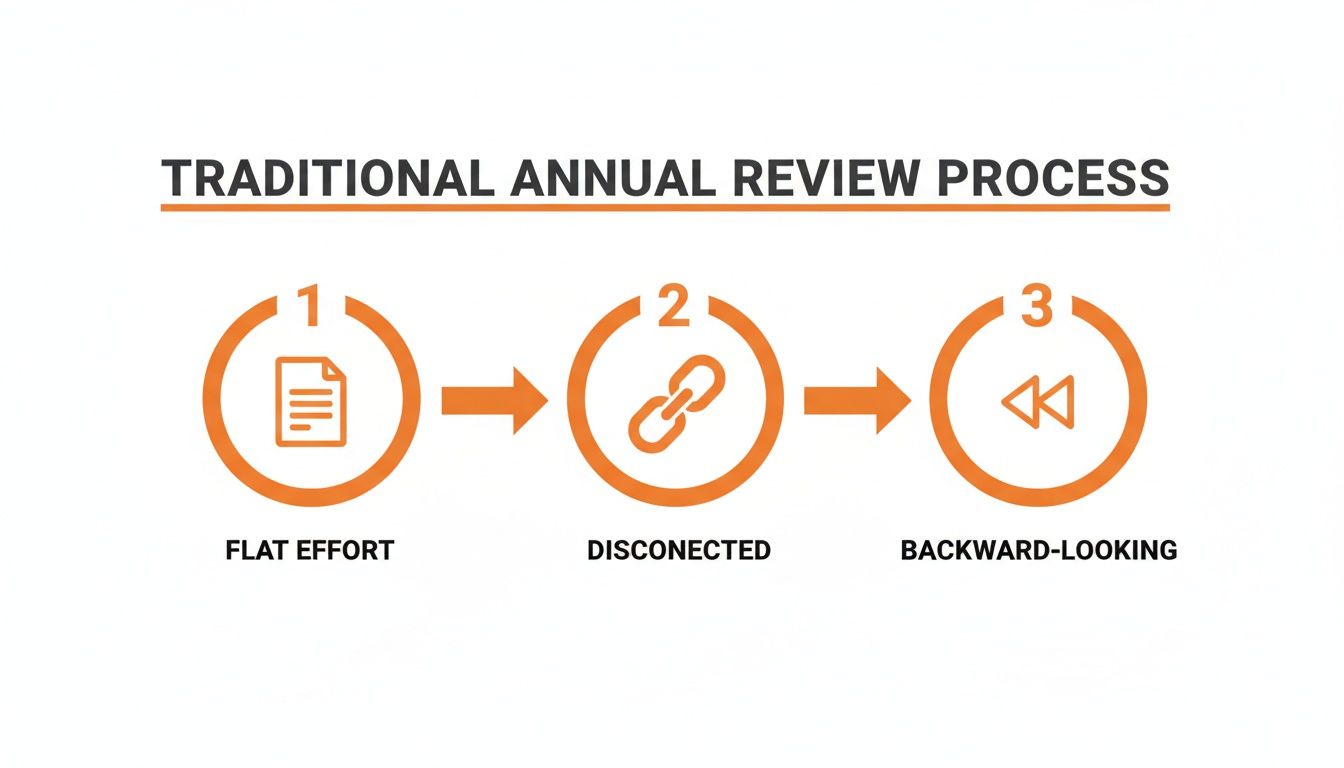
It’s easy to see why these reviews so often fail to inspire anyone. The process itself is the problem.
The Three Core Documents
Our toolkit is intentionally simple. It boils down to three core pieces, each with a clear purpose. Think of them less as forms and more as conversation guides.
The Manager’s Prep Doc: A private space for managers to gather their thoughts. It prompts them to reflect on contributions, challenges, and opportunities before the meeting, using concrete examples.
The Employee Self-Reflection: This is the heart of the process. A set of open-ended questions for the employee to answer, focusing on their own view of their wins, what they've learned, and where they want to go.
The Team Calibration Sheet: A simple tool for leaders to use together. It helps ensure managers across teams apply expectations fairly, preventing the "tough grader" vs. "easy grader" problem.
Let’s be honest, the move away from the classic annual review isn’t just a trend; it's a fundamental change in how great companies think. Back in 2016, a whopping 82% of companies were still clinging to traditional annual reviews. By 2019, that number had dropped to just 54%.
Why the shift? Companies that embrace continuous feedback see huge benefits, like 40% higher employee engagement and a 26% boost in performance. The data speaks for itself.
Shifting From Evaluation To Dialogue
The real magic here isn't in the documents, but in the mindset shift they encourage. We've crafted each prompt to move the conversation away from a top-down evaluation and toward a shared exploration of what’s working and what’s next.
For example, instead of asking a manager to "Rate communication skills from 1-5," we prompt them with, "Share an example where their communication had a big positive impact on a project." This small change moves the focus from a subjective rating to a specific behavior. It's about evidence, not just opinion.
The goal is to make the formal review a summary of a conversation that has been happening all year long, not the start of a new one. There should be zero surprises.
This approach isn’t just for office teams. The simplicity of these documents makes them incredibly adaptable for frontline and hybrid environments, where time is short and feedback needs to be direct.
The table below breaks down how each component contributes to a more modern approach.
Core Components of a Modern Review Toolkit
Template Component | Primary Goal | Who Completes It | When to Use It |
|---|---|---|---|
Manager Prep Doc | Gather specific, evidence-based feedback and prepare for a constructive conversation. | Manager | 1-2 weeks before the review meeting. |
Employee Self-Reflection | Empower employees to reflect on their own performance, wins, and development goals. | Employee | 1-2 weeks before the review meeting. |
Team Calibration Sheet | Ensure fairness and consistency in performance ratings across different teams and managers. | Leadership/HR | After managers complete prep docs, but before final ratings are shared. |
Ultimately, a modern performance review process should do more than just rate people—it should help you build high-performing teams.
These tools are not rigid, one-size-fits-all documents. Treat them as a starting point—a framework for having honest, forward-looking conversations that actually help people, and the business, get better. The point is the dialogue, not the document.
Turning Templates Into Meaningful Conversations
I used to think a well-designed annual performance review template was the secret. I was wrong. A great template is just the starting point; it's worthless without a great conversation to back it up. The paper doesn't inspire growth. People do.
The real work starts when you sit down with someone and turn that document into a genuine human check-in, not a judgment day. It’s a skill, and like any other, it takes practice.
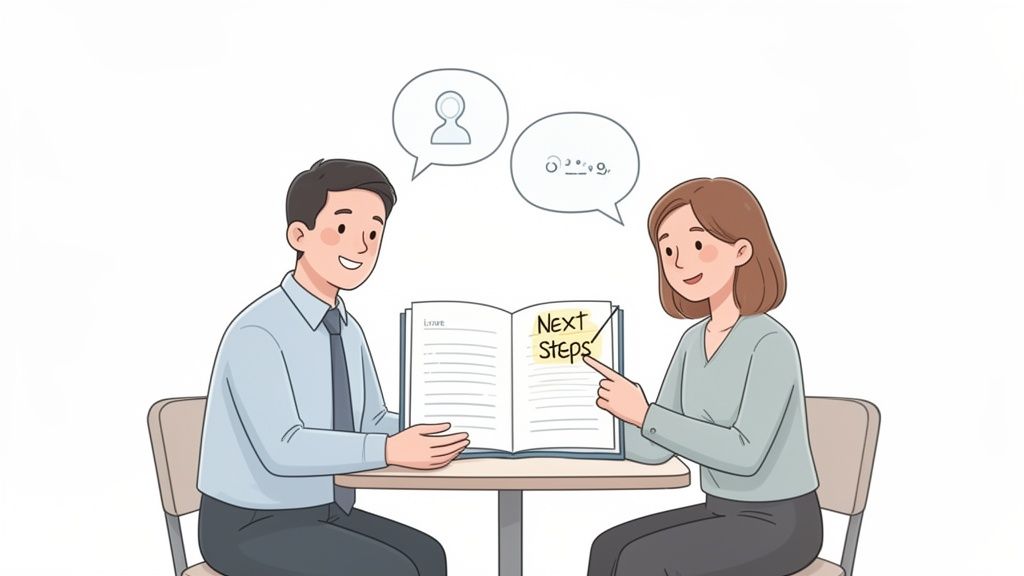
This is where so many managers stumble. They treat the template like a script, reading off points and ticking boxes. But the goal isn't to get through the form. It’s to connect, understand, and build a path forward together. The best managers I know listen far more than they talk.
Setting the Stage for an Honest Talk
The first five minutes of a review can make or break the entire thing. Dive straight into critiques, and you’ll trigger a defensive response. That’s just human nature. Instead, start with ease.
I’ve found a simple opener works wonders: “Thanks for meeting. I’ve really been looking forward to this. Before we dive in, how are you feeling about the past year?”
This one question shifts the dynamic. It signals this is a two-way street, not a lecture. It invites the employee to share their perspective first, which is incredibly powerful.
Here are a few other conversation starters I’ve used:
"Looking back at your self-reflection, what’s the one accomplishment you’re most proud of? Tell me about that."
"What was the most challenging part of the last six months, and what did you learn from it?"
"If you could change one thing about your role to make it more impactful, what would it be?"
The key is genuine curiosity. Ask questions you don't already know the answer to.
Navigating Tricky Feedback with Care
Let’s be honest: delivering constructive feedback is tough. The temptation is to either soften the message until it's meaningless or deliver it so bluntly it feels like an attack. Neither works.
I've found the best way is with specific, observable examples. Vague feedback like, “You need to be more proactive,” is useless. It’s not actionable.
Instead, ground it in a real scenario: “On the Q3 launch, I noticed you waited for tasks to be assigned rather than jumping in to find what was next. What was your perspective on that? I’d love to brainstorm how we can get you more involved in planning.”
This approach does three things: it anchors the feedback to a specific event, it invites their perspective instead of making an accusation, and it frames the solution as a collaborative effort. It’s about solving a problem together, not pointing out a flaw.
This is especially true on the frontline. A retail manager can’t wait for a formal review to address a recurring issue. Feedback needs to happen closer to the moment, but the principle is the same: be specific, be curious, and focus on the future.
From Template to Reality: A Filled-Out Example
Let’s imagine a manager, Sarah, reviewing a team member, Alex. He’s a talented developer who delivers great code but struggles with collaborating across teams.
Here’s a snapshot of Sarah’s prep notes:
Manager's Filled Example
What is one thing Alex does exceptionally well? Alex’s code is consistently clean, well-documented, and nearly bug-free. The refactoring on the billing module in Q4 was a huge win and cut technical debt by 15%. His technical skill is top-tier.
Where is the biggest opportunity for Alex’s growth? Cross-team collaboration. During the Phoenix project, the marketing team had trouble getting timely updates, which delayed their launch by three days. He tends to work in a silo.
Open-ended question to ask: "How can we make it easier for you to share progress with non-technical teams earlier in the process?"
During the conversation, Sarah kicks things off with praise for the billing module. She then transitions carefully: “I want to talk about Project Phoenix. From my side, it seemed like there was a disconnect with the marketing team. Can you walk me through your experience?”
This opens the door for Alex to share his side—perhaps he felt marketing’s requests were unclear. By understanding his perspective, Sarah can move from feedback to problem-solving. The conversation isn’t about blame; it’s about making the next project run smoother for everyone.
This is the real purpose of an annual performance review template: to be a catalyst for a conversation that builds trust and lights a clear path forward. Without that, it’s just paper.
Keeping Reviews Fair and Consistent
Let’s get real. Fairness is everything. The second an employee feels the process is biased, you've lost their trust. It’s a sting that can poison the well for months.
We’ve all seen it. One manager is a tough grader, while another hands out top marks to everyone. An employee on a high-visibility project gets all the glory, while the person doing critical, behind-the-scenes work is overlooked. This inconsistency is a trust-killer.
The goal isn't to turn managers into robots. It's about giving them a shared language for what "good" and "great" actually look like. Without that, you're not evaluating performance—you're just collecting opinions. And opinions are riddled with bias.
From Gut Feel to Clear Rubrics
The first step away from subjectivity is to stop focusing solely on output. How people achieve their goals often matters just as much. This is where a simple rubric is a game-changer.
Instead of a generic "teamwork" score, your rubric could define what that means in practice:
Needs Improvement: Tends to work in a silo; rarely offers help or shares information proactively.
Meets Expectations: Collaborates effectively on assigned projects; shares information when asked.
Exceeds Expectations: Actively seeks opportunities to help others; proactively shares knowledge and elevates the entire team.
This simple structure strips out ambiguity. It forces a manager to ground their feedback in specific examples, not just a gut feeling that someone isn't a "team player." Suddenly, everyone is speaking the same language.
The Power of Calibration
Even with a great rubric, individual bias can still sneak in. That's where the Team Calibration Sheet becomes your best friend. This isn't about forcing a bell curve or hitting a quota. It's simply a structured conversation for your leaders.
Before final reviews are shared, managers get together to discuss their initial ratings. One manager might present their case for a top performer. Another leader might ask, "That's impressive, but how does that compare to what Jane did on the Q3 project? She also exceeded her goals and mentored two new hires."
This dialogue is the core of calibration. It’s a peer-review system for managers. It gently forces them to justify their decisions, check their assumptions, and align on what "great" looks like across the company.
This helps smooth out the natural variations between managers and protects your team from the "luck of the draw" of who their boss is. A consistent review process is also crucial for helping you identify high potential employees.
Essential Legal Guardrails
Alright, let's talk documentation. It sounds cold, but it's a non-negotiable part of a fair process. Good documentation isn't about building a case against someone; it's about creating an honest record of the conversations you're already having.
Think of it this way: the notes in your annual performance review template should be a summary, not a surprise. Throughout the year, you should keep simple, dated notes on significant events—both wins and challenges. This doesn’t have to be a nightmare; a private document with bullet points is often enough.
Here are a few simple rules we live by:
Be Factual and Specific: Instead of "John has a bad attitude," write "On May 15, during the team meeting, John interrupted a colleague three times."
Focus on Behavior, Not Personality: Document what the person did, not your interpretation of their character.
Keep it Consistent: Document for everyone, not just struggling employees. This helps you avoid any appearance of targeting. For more ideas, check out our guide on how to avoid bias in remote team evaluations.
This practice protects the company, of course. But more importantly, it ensures the feedback you deliver is fair, grounded in reality, and genuinely helpful.
Adapting Reviews for Frontline and Hybrid Teams
A review process built for a 9-to-5 office job will completely miss the mark for a warehouse crew or a retail team. We learned this the hard way. Their work is different, their environment is different, and what they need from feedback is different.
You can't hand a tablet with a multi-page form to a nurse at the end of a 12-hour shift and expect thoughtful self-reflection. It’s not realistic. The annual performance review template has to adapt to their reality, not the other way around.
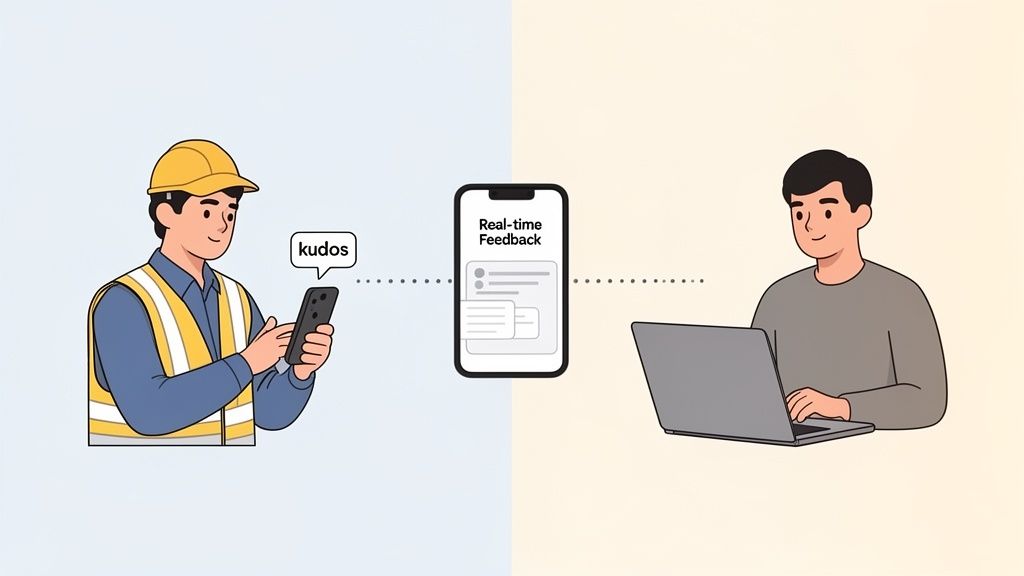
Often, the traditional process feels completely disconnected from the actual work. The numbers back this up: only 26% of employees feel positive about performance management, and a huge 58% think it could be way better. To fix this, 75% of organizations are looking to bring AI into the mix. One firm saw a 12.9% jump in call center performance using AI-generated reviews, while machine learning assessments have delivered 20-30% higher accuracy for frontline supervisors. This shift is fueling a market that's expected to more than double by 2032. You can dive deeper in our article on improving internal communication for frontline workers.
For Frontline Teams: Go Mobile and In-The-Moment
For frontline teams, the secret is making feedback a small, frequent part of their daily flow. The annual review should simply summarize ongoing conversations, not a once-a-year surprise.
Capture real-time kudos. Use a simple, mobile tool where a manager can send a quick shout-out for a job well done right from the floor. This builds a bank of positive examples to pull from later.
Focus on observable behaviors. Tweak your template to focus on tangible actions. For a barista, this could be "Greets every customer with a smile" or "Keeps workspace clean during peak hours."
Keep it short and simple. The self-reflection might just be three questions they can answer on their phone in five minutes. The manager's prep should be just as direct.
The goal is to weave feedback into the work itself. It should feel less like a chore and more like a natural part of getting the job done right.
For Hybrid Teams: Focus On Equity
Hybrid work brings a new challenge: proximity bias. It's that natural tendency to favor the people we see more often. If you’re not careful, your remote employees can easily fall through the cracks, getting less frequent and lower-quality feedback.
The challenge with hybrid reviews isn't the template; it's making sure the inputs for that template are gathered fairly for everyone. A great review process is blind to location.
To fight this, you have to be deliberate.
Prioritize written communication. Encourage managers to document feedback for everyone, not just remote folks. This creates a consistent trail of check-ins for the entire team.
Use asynchronous tools. Lean on tools that allow for feedback on your own time. This is a massive benefit for people in different time zones, letting them reflect on their own schedule.
Measure impact, not visibility. Your annual performance review template should zero in on outcomes, not on who was seen in the office. Frame questions around results: "What was the measurable impact of your work on Project X?"
Whether your team is on the factory floor or spread across three continents, the principle is the same. The process has to serve the people doing the work, not the other way around.
Burning Questions About Modern Performance Reviews
When I talk with leaders about ditching the old annual review, the same questions always pop up. It's a big change, and it's normal to be skeptical. Let's tackle the questions I hear most, with straight-up answers.
So, How Often Should We Actually Do Reviews?
The "review" should be an ongoing conversation, not a single event. My recommendation is a meaningful, structured check-in twice a year.
But—and this is a big but—that's supported by lighter, informal chats quarterly or even monthly. This approach transforms the formal review into a simple summary of a dialogue that’s been happening all year. No surprises.
For frontline teams, the rhythm needs to be even quicker. Think weekly huddles or quick end-of-shift check-ins. These act as micro-reviews, making feedback immediate and relevant.
What Are the Biggest Mistakes Managers Keep Making?
The single biggest blunder is blindsiding an employee. I can't stress this enough. Feedback—good and bad—should be shared in the moment. The formal review meeting should never contain new information. It's a recap, not an ambush.
Another classic pitfall is the manager monologue. A great review is a two-way conversation where the manager listens at least as much as they talk. Lastly, focusing only on the past without building a plan for the future is a huge missed opportunity.
How Do We Know if Our New Process is Working?
Forget completion rates. That’s just ticking a box. Instead, look at your employee engagement surveys. Are people saying the feedback they get is fair, helpful, and helps them grow?
The ultimate measure of success is simple: Are your managers and employees having more frequent, more honest, and more helpful conversations about performance? If the answer is yes, you're on the right track.
Also, keep an eye on regrettable turnover. Are your top performers sticking around? Their decision to stay is one of the most powerful indicators you have.
Can This Really Work for a Small Business Without an HR Department?
Absolutely. In fact, it’s often easier for small businesses to adopt this more human approach. Our annual performance review template toolkit is designed to be straightforward and doesn't depend on fancy software.
The whole thing is about the quality of the conversations. That comes down to commitment from leaders, not the size of your HR team. A founder or a single manager can use this framework to build a strong feedback culture from the start. It’s about principles, not headcount.
Ready to transform your team's conversations? Pebb unifies communication, operations, and engagement into one simple app, making it easy to build a culture of continuous feedback for both frontline and office teams. See how it works at pebb.io.
