
Labor Law in Oklahoma: A Plain-English Guide
Navigate labor law in Oklahoma with confidence. Our guide for HR and managers covers wages, breaks, hiring, firing, and compliance in plain English.
Dan Robin
A supervisor in Oklahoma gets a text at 8:12 p.m. An employee quit mid-shift and wants to know when the last paycheck will hit. The supervisor guesses, sends back a casual answer, and moves on.
That's how labor problems usually start. Not with a courtroom. With a quick message, a rushed answer, and a manager who thinks they're being helpful.
Most labor law in Oklahoma works like that. It doesn't show up as a dramatic legal event. It shows up in payroll timing, schedule edits, a minor's shift that runs too late, or a handbook clause copied from another state that has no business being there. The expensive mistakes aren't usually bold. They're ordinary.
I've seen businesses spend serious time worrying about the wrong things while ignoring the daily habits that create risk. A clean policy on paper won't save you if managers apply it three different ways across three locations. A lawyer-reviewed offer letter won't help much if it still includes a non-compete clause that doesn't belong in Oklahoma.
What helps is a calmer approach. Know the rules that matter. Build them into daily operations. Make it easy for managers to answer the common questions correctly the first time.
It Starts with a Simple Question
A lot of Oklahoma compliance work begins with one plain employee question: “When do I get my last check?”
If the manager answers from memory, there's a decent chance they'll get it wrong. In Oklahoma, final wages for employees who resign or are terminated must be paid by the next regular payday, as summarized in Rippling's Oklahoma labor law overview. That sounds simple, but only if your payroll process is disciplined enough to handle off-cycle exits without confusion.
The real problem isn't the law
The law is often the easy part. The hard part is making sure the answer given on Tuesday night matches what payroll does on Friday morning.
That gap shows up everywhere in labor law in Oklahoma. A shift lead promises flexibility on break timing. A store manager lets a minor stay late because the closing crew is short. An owner copies a hiring template from Texas or Missouri and slips in a restriction that doesn't fit Oklahoma law at all. None of these choices feel dramatic in the moment.
Then they become records.
Practical rule: If a manager answers employee questions about pay, scheduling, or departure terms without a written playbook, the business is guessing.
Most employers don't need a giant legal binder. They need a short set of operating rules managers can apply. What is the deadline for final pay? Who approves schedule changes for minors? When should payroll be notified? What promises should managers never make on the fly?
The questions repeat
The same issues tend to come up again and again:
Final pay timing: Managers need one approved answer, not a personal interpretation.
Hours and scheduling: Frontline teams need clear guardrails before a small exception turns into a pattern.
Hiring documents: Templates borrowed from other states often create avoidable Oklahoma problems.
Leave and time off questions: If employees ask, managers should know whether the issue is company policy, state law, or federal law.
That's the frame I'd use for this topic. Not “How do we memorize labor law?” but “How do we stop ordinary moments from turning into preventable mistakes?”
Understanding Oklahoma's Legal Foundation
A supervisor in Tulsa tells an employee, “That's just our policy,” and assumes the answer is enough. If the policy conflicts with Oklahoma law or leaves out a federal requirement, that casual answer can turn into a wage claim, a bad termination dispute, or a document problem that is expensive to fix later.
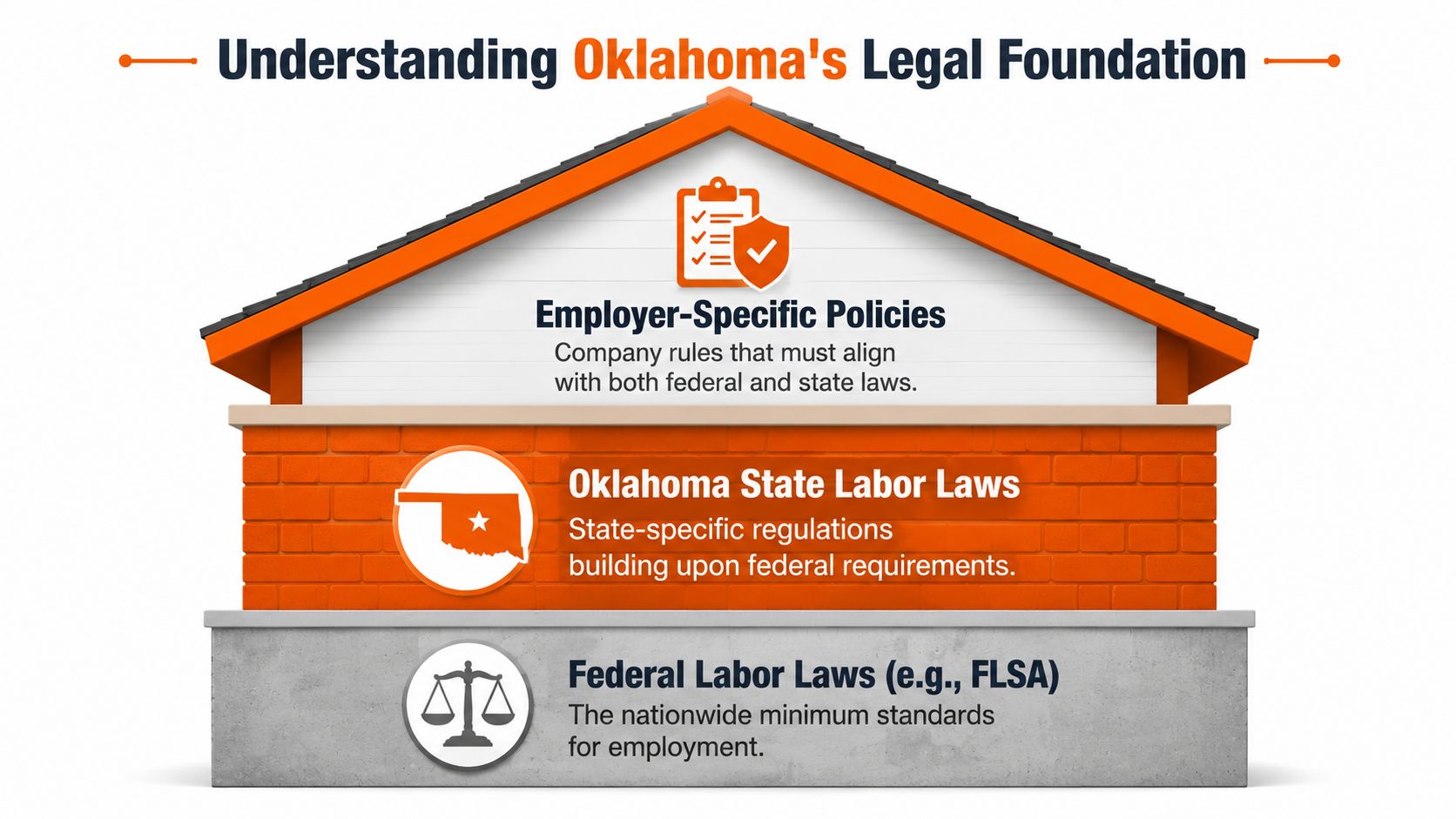
Labor law in Oklahoma is layered. Federal law sets the baseline for many workplace rules. Oklahoma adds state-specific requirements in areas such as wage payment, child labor enforcement, and restrictions on employment agreements. Your own policies sit on top of both. If managers do not know which layer controls the issue in front of them, they start improvising.
Federal law sets the baseline
For day-to-day operations, this matters because Oklahoma employers do not manage one single rulebook. They manage overlapping rule sets. Federal law often controls the broad standards for wage and hour, discrimination, and leave. Oklahoma law fills in state-specific obligations and enforcement points, largely through Title 40 of the Oklahoma Statutes and the Oklahoma Department of Labor.
Managers need that translated into operating practice. A handbook statement is not enough. The scheduling lead needs to know when a state rule applies, payroll needs to know which pay issue follows Oklahoma timing requirements, and HR needs to know when a federal law preempts a homemade policy. If benefits administration is part of your compliance process, keep a plain-English guide to federal ERISA law in the mix too, because benefits questions often follow a different federal framework than frontline managers expect.
Oklahoma law changes how you write and enforce policy
Oklahoma has its own employer logic. That shows up quickly in two places managers and owners routinely mishandle: right-to-work rules and the state's narrow approach to non-compete agreements.
The practical takeaway is straightforward. Do not borrow hiring documents, restrictive covenant language, or manager scripts from another state and assume they travel well. I have seen businesses create problems by reusing templates that sounded polished but did not fit Oklahoma's rules. The legal issue is one problem. The operations problem is bigger. Frontline managers start enforcing terms that should never have been in the packet.
Policy is where compliance succeeds or fails
Company policy should convert legal requirements into repeatable actions. Who can approve an exception. What payroll needs in writing. Which promises managers cannot make during hiring, discipline, or separation. If those instructions are missing, compliance depends on memory and personality.
Two policy failures show up again and again:
Policy problem | What it looks like in practice |
|---|---|
It copies another state | The document uses terms that do not fit Oklahoma requirements or includes restrictions the business cannot realistically enforce |
It stays too abstract | The rule exists on paper, but supervisors do not know what to say, what to document, or when to escalate the issue |
That is the legal foundation managers need. Not a theory lesson. A working map that tells frontline teams which rules control, what choices they are allowed to make, and when they need HR or legal review before they answer the employee standing in front of them.
The Rules for Wages Overtime and Breaks
A shift supervisor lets a team member clock out at 5:00, then asks for “one quick favor” before they leave. Another manager sends schedule changes by text after hours and expects replies right away. Payroll closes on time. The legal problem starts earlier, on the floor, when managers treat working time like a judgment call instead of a tracked business process.
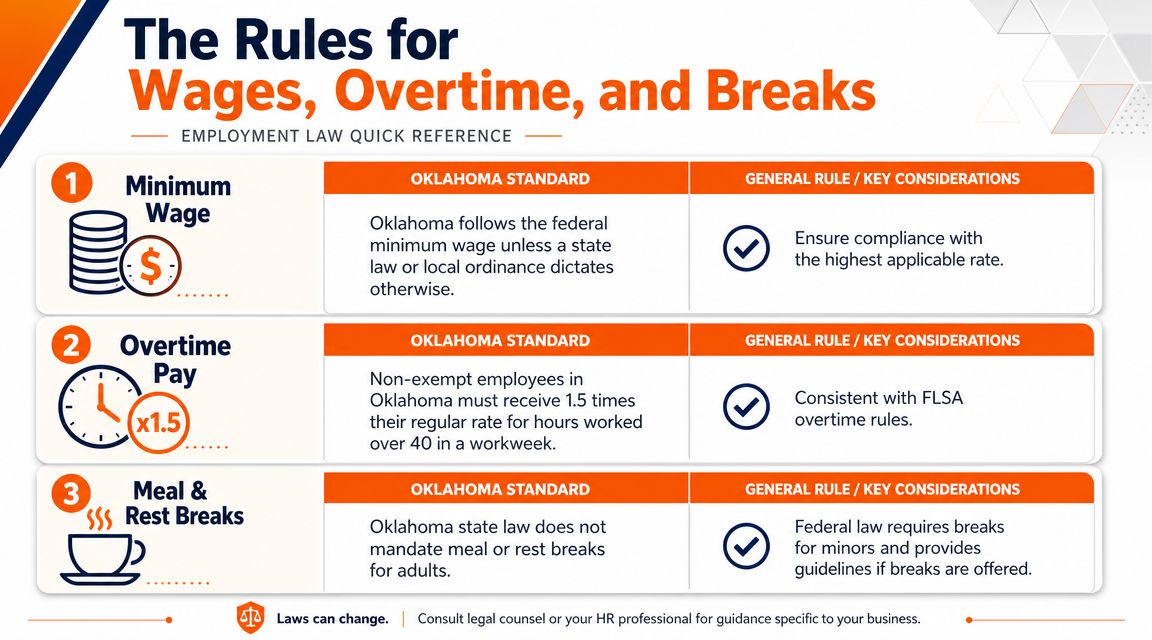
Three questions drive most day-to-day issues. Does this employee qualify for overtime? What counts as paid time? What break rules are we promising and enforcing? In Oklahoma, clean answers depend less on a handbook paragraph and more on whether supervisors schedule, record, and approve time consistently.
Overtime is usually won or lost in timekeeping
Oklahoma employers generally follow federal overtime rules under the Fair Labor Standards Act. For managers, the primary risk is rarely the formula itself. Instead, it is off-the-clock work, missed edits, auto-deducted meals that were not taken, and “helpful” schedule changes that never make it into payroll.
That is why overtime compliance has to be built into daily operations. Train supervisors that work starts when the work starts, not when the punch lands. Require employees to report missed meal periods and after-hours work. Review exception reports every pay period. If you operate in multiple states, do not copy a stricter state rule into Oklahoma or assume a looser Oklahoma practice will travel elsewhere. This comparison of how overtime is calculated in California shows how fast multistate payroll assumptions can go sideways.
A practical control I recommend is simple. Any manager who can change a schedule should also be responsible for confirming the time record matches what happened.
Breaks need an enforceable policy, not good intentions
Oklahoma does not impose a broad adult meal-and-rest-break rule across all workplaces. That surprises managers who have worked in other states and assume break timing is legally standardized everywhere.
For many employers, the bigger compliance issue is self-inflicted. The handbook promises rest breaks, meal periods, or paid break windows. Staffing levels, production goals, and supervisor habits make those promises hard to keep. Once that happens, the problem is no longer theoretical. It turns into inconsistent treatment, wage disputes, and credibility issues when employees compare notes.
Break policies hold up better when they answer operational questions clearly:
Who is responsible for releasing employees for breaks
What employees should do if a meal period is interrupted or skipped
Whether short breaks are paid under company policy
How missed breaks get reported before payroll closes
When a supervisor must escalate a recurring coverage problem
Vague language causes expensive confusion. “Breaks when business permits” is not useful guidance for a shift lead trying to cover a lunch rush with two people out.
Voting leave and final pay are manager training issues
Two Oklahoma requirements belong in supervisor training and payroll checklists because timing matters.
State law requires Oklahoma employers to provide eligible employees with paid time off to vote in certain circumstances, and terminated employees must receive final wages by the next regular payday under the Oklahoma Department of Labor's wage guidance. Those sound straightforward. They still get mishandled when a frontline manager denies time off informally or when separation paperwork reaches payroll late.
The fix is operational. Give managers a script for voting-leave requests. Build a separation checklist that triggers final-pay review the same day the termination decision is made. Do not leave either issue to email chains and memory.
Child labor rules depend on scheduling discipline
Child labor compliance breaks down fast in businesses that rely on shift swaps, callout coverage, and informal role changes. A minor gets asked to stay late. A supervisor moves someone to a different task without checking whether that job is restricted. Hours are reviewed after the week closes instead of before the schedule is posted.
Those are process failures.
Oklahoma child labor rules require closer control over hours, time of day, and job assignments for younger workers. In practice, that means scheduling software, job codes, and approval workflows should do some of the compliance work for your managers. If you still track minor restrictions with notes in a paper file or a manager's memory, you are depending on luck.
Common frontline mistake | Better operating habit |
|---|---|
A supervisor keeps a minor late to cover a callout | Set age-based scheduling limits in the scheduling process and require approval for exceptions |
A manager assigns a younger worker to a restricted task | Match age rules to job codes before the employee is placed on the floor |
Weekly hour limits are checked after payroll | Review total scheduled hours before the schedule is published |
Retail, hospitality, food service, and other shift-based employers feel these issues first because the pace is fast and exceptions happen daily. That is exactly why wage-and-hour compliance cannot live only in HR. Frontline teams need rules they can apply during the shift, in the timekeeping system, and at the moment a manager is tempted to make “just this once” an operating practice.
Navigating At-Will Employment and Non-Competes
Employers love the phrase at-will employment because it sounds clean. It isn't. It's useful, but it's not magic.
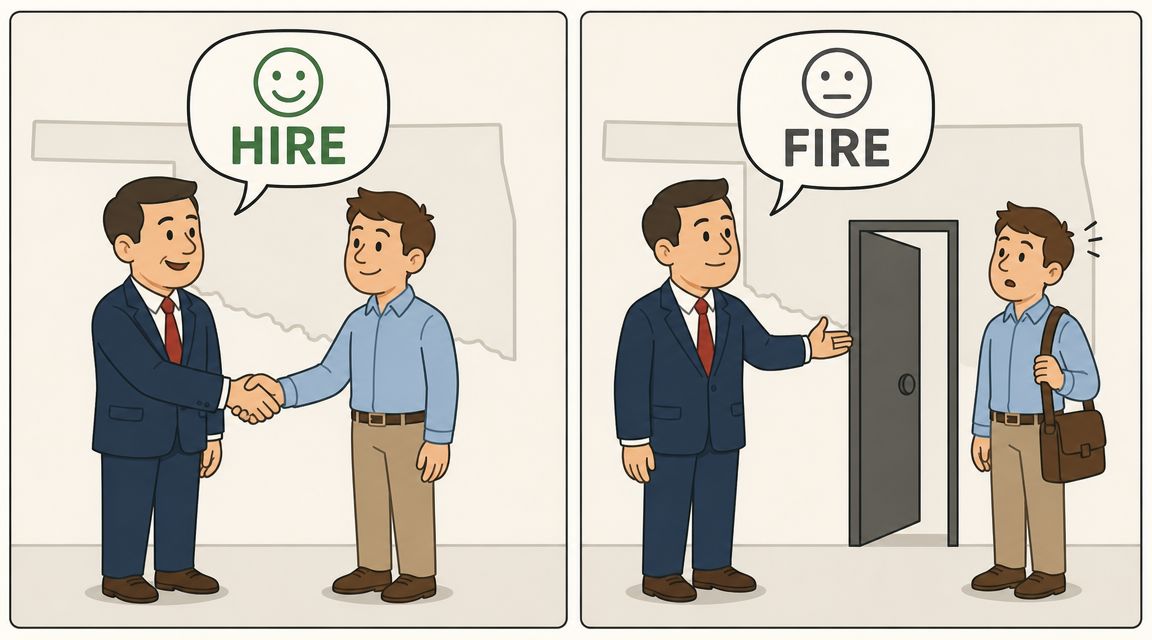
At-will employment generally means the employment relationship can end at any time for a legal reason. The phrase that matters is “legal reason.” If a manager thinks at-will means “I can fire someone however I want, whenever I want, with no process,” that business is already drifting toward preventable trouble.
At-will is not a substitute for discipline
Smart employers still document performance, investigate complaints, and make termination decisions with some consistency. Not because every exit demands a legal memo. Because inconsistency is what makes ordinary decisions look suspect later.
I usually tell managers to think less about their right to terminate and more about the story their records tell. If the file shows shifting reasons, skipped steps, or a sudden termination after a complaint, “at-will” won't make that story look better.
A sensible termination process usually includes:
A clear reason: One that is job-related and can be explained without drama
Basic documentation: Enough to show the decision wasn't random
A review step: Someone outside the immediate chain should sanity-check the call
A clean handoff: Payroll, access removal, property return, and final pay timing should all be coordinated
That last point matters more than people think. The legal event and the operational event happen at the same time. If they aren't connected, you create avoidable confusion.
Oklahoma's non-compete ban changes the playbook
Oklahoma stands apart. Many employers still rely on old templates loaded with restrictive language that won't hold up.
Paylocity's Oklahoma law guide notes that Oklahoma is one of the few states that completely bans non-compete agreements, with a very limited exception for the sale of a business. For everyday employers, that means you should stop trying to protect the company with clauses that are dead on arrival.
If your default hiring packet still includes a broad non-compete in Oklahoma, you're not being protective. You're being careless.
What works better than a bad non-compete
The practical question isn't “Can we stop people from leaving?” You usually can't. The better question is “What legitimate interests can we protect lawfully?”
The same Paylocity summary points to compliant alternatives such as confidentiality clauses and customer non-solicitation agreements. Those tools still need careful drafting, but they're grounded in a real Oklahoma reality instead of wishful thinking.
Here's the operational version:
Weak approach | Better approach |
|---|---|
Use a blanket non-compete for every employee | Use role-specific confidentiality language tied to actual sensitive information |
Paste the same restriction into contractor and employee agreements | Review worker classification and agreement type before adding restrictions |
Hope a scary clause deters departures | Protect data access, customer relationships, training materials, and offboarding steps |
If your workforce includes contractors, the risk picture changes again. This plain-English guidance on employment liability for contractors is useful because businesses often assume contractor status solves people-risk issues when it often just changes the form of the risk.
The best Oklahoma employers I've seen don't obsess over trapping talent. They tighten confidentiality, limit unnecessary data access, clean up offboarding, and compete by being a place people want to stay.
The Essential Paperwork Trail
Records aren't glamorous. They are what save you when memory fails.
Most labor law in Oklahoma problems get harder once the business has to reconstruct what happened from texts, hallway conversations, and payroll corrections. Good documentation doesn't make a bad decision good, but it does make a fair decision easier to prove and a routine audit much less painful.
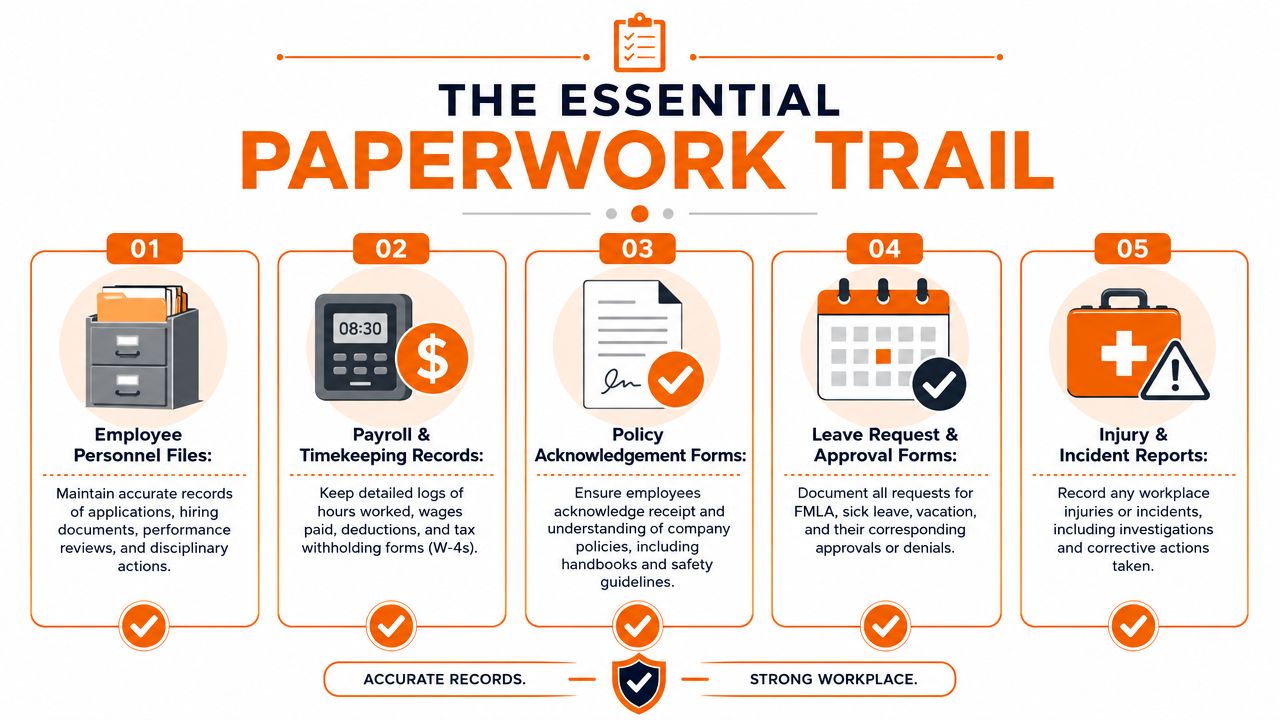
Keep records that answer real questions
If an employee disputes pay, you need hours worked, wage records, and any adjustments. If a manager says an employee received a warning, there should be some record of that warning. If a policy matters, you should be able to show the employee received it.
That doesn't require fancy software by itself. It requires consistency. Store documents in one place. Use version control for policies. Make sure payroll records, personnel records, leave records, and incident reports aren't scattered across inboxes and desktops.
For employers that need a cleaner system, this guide to HR document management is a useful way to think about organization before compliance slips into chaos.
What should be easy to find
A practical file structure should make these records easy to pull:
Personnel records: Application materials, offer documents, job changes, performance notes, and disciplinary records
Payroll and timekeeping: Hours worked, wages paid, deductions, and related forms
Policy acknowledgments: Signed proof that employees received the handbook or updated policies
Leave and scheduling records: Requests, approvals, denials, and schedule changes that matter
Safety and incident records: Injury reports, witness notes, and follow-up actions
Your records should let an outside reviewer understand what happened without asking three people to explain it from memory.
Handbooks and posters deserve a reset
A lot of handbooks become junk drawers. They contain outdated policies, leftover language from another state, and rules no manager follows. If you operate in food service or hospitality, a practical restaurant employee handbook guide is a strong example of how to write something people can use, not just sign.
Poster compliance matters too. Employers should confirm that required state and federal notices are posted in a place employees can see. Break rooms, common areas, and onboarding spaces work better than a back office wall no one visits. The exact poster set depends on your setup, but the discipline is the point: use official sources, replace outdated postings, and make one person responsible for checking them.
Paperwork gets mocked because people confuse it with bureaucracy. Done right, it's just evidence that your business knows what it said, what it paid, and what it asked managers to do.
From Policy Manual to Daily Operations
Here, most compliance programs either become real or stay decorative.
A handbook can be perfectly written and still fail in practice. The failure usually comes from friction. Employees can't find the policy. Supervisors don't know which version is current. HR updates a rule, but the night shift never hears about it. Then leadership acts surprised when one location follows the new process and another keeps doing what it did last year.
Compliance needs a delivery system
Frontline operations run on access, timing, and repetition. If a policy lives in a PDF buried in someone's email, it won't shape behavior. If a process depends on managers remembering details from a training session months ago, it will break under pressure.
That's why I prefer boring, dependable systems over heroic management. Put current policies in one searchable place. Make acknowledgments simple. Tie schedule rules to the scheduling workflow. Make performance notes part of normal supervision, not a special event reserved for terminations.
A useful starting point is a practical guide to building a policy and procedure manual. The big idea is simple: policy should live where work happens.
What operational compliance looks like
It usually looks less dramatic than people expect.
One location uses a standard manager checklist when someone resigns. Another requires child labor review before schedules publish. A district manager can see whether policy acknowledgments are complete without chasing paper forms. Supervisors log coaching conversations while the details are fresh, not months later when HR asks for backup.
That kind of system does three things at once:
It reduces improvisation. Managers stop making policy on the fly.
It improves consistency. Different locations handle the same issue in roughly the same way.
It creates usable records. If a dispute comes up, the history exists.
Tools should remove excuses
I'm not impressed by software that adds another layer of admin work. I am impressed by tools that make the right action easier than the wrong one.
The best compliance tool is the one a tired manager can still use correctly at the end of a long shift.
If a mobile team can read the latest policy from a phone, acknowledge it, message a question, and complete basic documentation in the same place, compliance gets closer to daily reality. If timekeeping, scheduling, and policy updates all live in disconnected systems, leaders spend half their time reconciling avoidable messes.
That's the shift worth making. Don't build a compliance program that depends on perfect memory and endless follow-up. Build one that fits the way your teams work.
Staying Compliant Is About People Not Paperwork
A lot of employers frame compliance as a defensive exercise. Avoid complaints. Avoid claims. Avoid trouble. That mindset is too small.
The better reason to care about labor law in Oklahoma is that clear rules make work feel fair. Employees know when they'll be paid. Managers know what they can and can't promise. Younger workers aren't scheduled in ways that put the company in a bad spot. Hiring documents match the state you operate in. None of that is flashy. All of it builds trust.
The companies that struggle most usually don't have a knowledge problem. They have a consistency problem. They say one thing in the handbook, another thing in orientation, and a third thing on the floor. Employees notice. So do regulators, auditors, and plaintiff-side lawyers.
You don't need to become a labor lawyer to run a sound workplace. You need a few things done well, every time: accurate pay practices, lawful agreements, clean records, visible policies, and managers who know when to stop guessing. That's manageable.
And it changes the tone of the business. People spend less energy decoding the rules and more energy doing their jobs.
If you want a simpler way to turn policies, updates, scheduling, acknowledgments, and frontline communication into one daily system, take a look at Pebb. It gives teams a single place to share policy updates, organize documents, message across shifts and locations, and keep the operational side of compliance from slipping through the cracks.
