
How Do You Calculate Overtime in California? 2026 Guide
Confused by CA overtime? Our 2026 guide explains how do you calculate overtime in california, covering daily/weekly rules, rates, & recordkeeping. Get started!
Dan Robin
Most overtime problems in California don't start with bad intent. They start with a manager who thinks they already know the rule.
An employee stays late a few days, picks up a weekend shift, maybe earns a bonus that week, and payroll runs like always. Nobody thinks there's a problem because the weekly total doesn't look dramatic. Then someone asks a simple question: what was this employee's regular rate of pay that week, and did you compare daily overtime to weekly overtime the right way?
That's where the confidence usually cracks.
I've seen this over and over. Frontline managers are trying to cover shifts. HR is trying to keep payroll moving. Finance wants clean numbers. Everyone assumes overtime is mostly about hours over 40. In California, that assumption is where the mess begins.
The Overtime Mistake Almost Everyone Makes
The most common California overtime mistake isn't bad math. It's using the wrong mental model.
A supervisor sees an employee work a long Tuesday, a normal Wednesday, and a short Friday. Total hours for the week don't look too high, so the supervisor assumes payroll can just check whether the person crossed 40 hours. That logic works in a lot of places. It doesn't work well here.
California overtime is built around the workday as much as the workweek. That means a single ugly shift can create overtime even when the weekly total looks harmless. Add a bonus, a different pay rate for part of the week, or sloppy time edits, and a payroll run that seemed fine turns into a compliance problem.
The second mistake is operational. Companies treat timekeeping like an admin task instead of a wage-and-hour control. If supervisors are texting schedule changes, employees are clocking in late on paper, and payroll is rebuilding hours from memory, you're inviting errors. That's why even basic habits like clean punch data matter. A simple, consistent staff clock-in and out process does more for overtime compliance than another policy memo.
Why smart teams still get this wrong
Most payroll mistakes happen in good-faith environments. The team cares. The manager is trying. The payroll clerk follows the same steps they used last pay period.
The problem is that California doesn't forgive casual assumptions. If you don't define the workday clearly, if you miss daily overtime, or if you ignore pay that should be folded into the regular rate, the paycheck can be wrong even when nobody meant to underpay anyone.
Practical rule: If a manager says, "They didn't hit 40, so there's no overtime," I already know where to start looking.
The real risk isn't just the calculation
The hard part isn't one paycheck. It's repetition.
Once a bad setup gets into your schedule habits, your timekeeping process, or your payroll template, the same error persists. Every location follows the same shortcut. Every supervisor inherits the same misunderstanding. Then fixing one employee's pay turns into auditing months of records.
That’s why "how do you calculate overtime in california" isn't really just a math question. It's a systems question. If your process depends on somebody remembering every exception by hand, the process is broken.
The Two Pillars of California Overtime
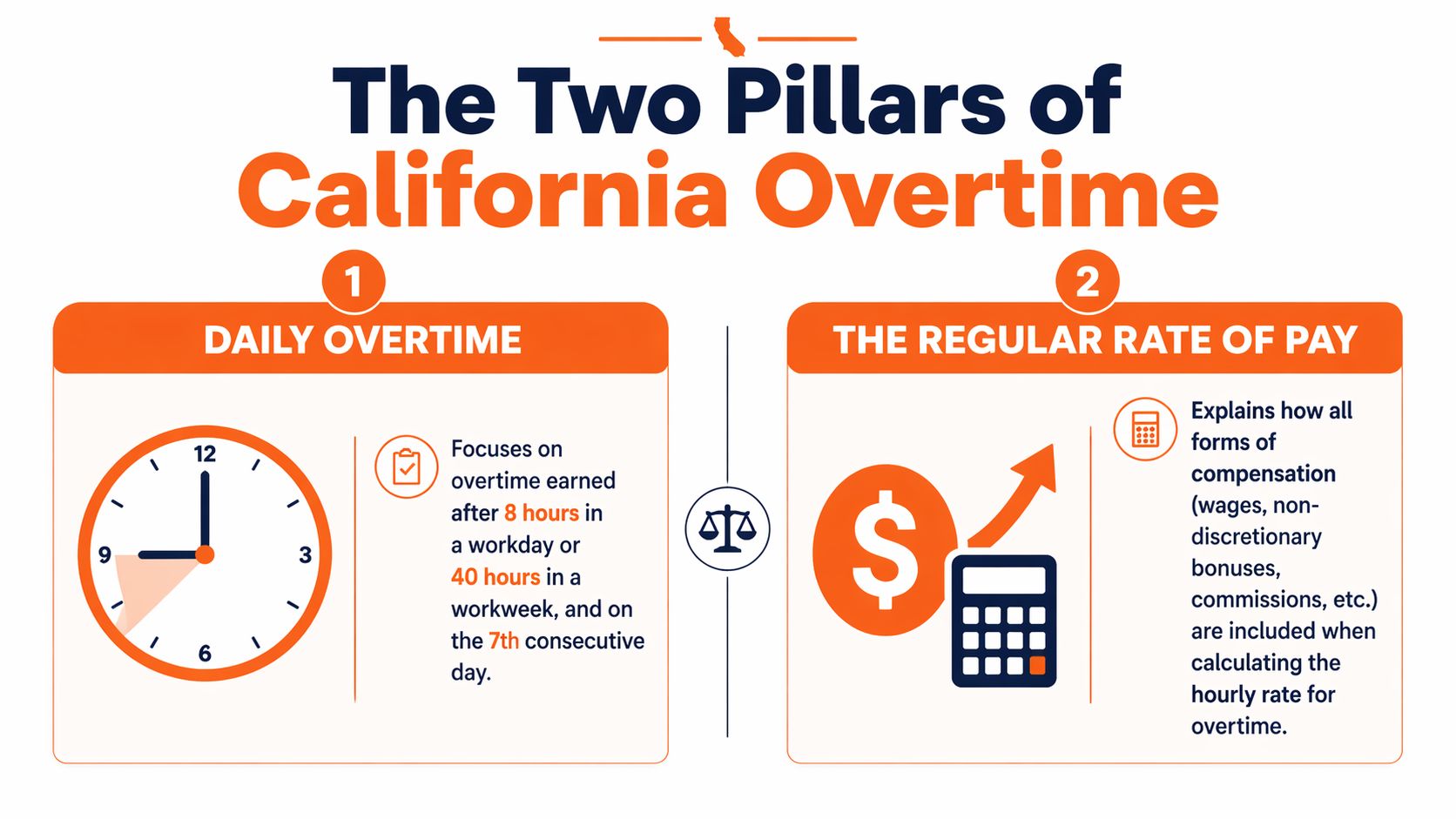
California overtime breaks down into two separate decisions. First, identify which hours qualify for overtime under the daily and weekly rules. Second, calculate the correct regular rate for that week so those hours are paid correctly.
Miss either step and payroll can be wrong even when total hours look reasonable on paper.
Daily overtime comes first
Frontline managers usually spot overtime by looking at the weekly total. In California, that shortcut causes trouble fast. The state requires employers to check daily overtime first, then weekly overtime, with double time in longer-day situations and on parts of the seventh consecutive day, as outlined by the California Department of Industrial Relations overtime rules.
A shorter shift later in the week does not erase a long shift earlier in the week. If someone works 11 hours on Tuesday and 5 on Wednesday, Tuesday still created overtime.
That is where schedule changes, missed meal coverage, and last-minute call-ins create headaches. The manager is trying to fill a shift. HR and payroll inherit the consequences.
The regular rate is where manual payroll breaks down
The second pillar is the rate itself. Overtime is based on the employee's regular rate of pay, and that number is not always the posted hourly wage.
If the employee worked at two different rates in the same week, earned a production bonus, picked up a shift differential, or received another non-discretionary payment tied to work, the regular rate may need to be recalculated before overtime is paid correctly. The Labor Commissioner addresses these regular-rate rules in this California overtime pay overview.
This is one of the biggest friction points I see in practice. Managers approve hours. Payroll exports the week. Then somebody realizes the employee spent part of the week in one role at one rate and part in another. If the team is still rebuilding that in a spreadsheet or from a manual overtime timesheet in Excel, errors are not a rare exception. They are built into the process.
What this looks like in practice
Use this quick check:
Question | What payroll needs to confirm |
|---|---|
Did overtime happen? | Review the workday, workweek, and whether a seventh consecutive day rule applies |
What rate applies? | Use the regular rate for that week, not just the employee's posted base wage |
Could the rate change? | Yes. Multiple rates, shift premiums, commissions, and non-discretionary bonuses can change it |
The practical problem is not the formula by itself. The practical problem is that the formula depends on clean inputs from scheduling, timekeeping, and pay data.
Salaried non-exempt employees still earn overtime
Salary creates confusion for supervisors who equate it with exemption. California does not. A salaried employee can still be non-exempt and still be owed overtime.
In that case, payroll has to convert the salary to an hourly equivalent before calculating the premium. If that employee also receives bonuses or other non-discretionary compensation, the regular rate analysis can get more complicated than managers expect.
What works in the real world
The cleanest process is to separate the work into two checkpoints. First, confirm the overtime-triggering hours under California's daily and weekly rules. Second, confirm whether anything in that week changes the regular rate.
Teams that handle this well do not leave those decisions to memory. They use timekeeping and payroll systems that flag long days, track multiple rates automatically, and pull bonus data into the same calculation. That is how you reduce the manual error that so many overtime guides treat like a fact of life.
Your First Calculation Daily and Weekly Overtime
A frontline supervisor approves four long shifts, sees only 43 hours on the weekly total, and tells payroll to pay 3 hours of overtime. That shortcut is how a simple timecard turns into a correction, an employee complaint, or both.
California overtime starts with the day, not just the week. The employer's defined workday and workweek control the calculation, and daily overtime can easily produce more premium hours than the over-40 rule. As noted earlier, California requires employers to compare the applicable results instead of stacking daily and weekly overtime on top of each other.
A simple week that still causes mistakes
Use this schedule:
Monday: 10 hours
Tuesday: 10 hours
Wednesday: 10 hours
Thursday: 13 hours
Friday: 0 hours
Saturday: 0 hours
Sunday: 0 hours
Total hours worked: 43.
A manager looking only at the weekly total sees 3 overtime hours. In California, that answer is incomplete.
Step one, count the daily overtime
Start with each workday on its own.
Monday: 2 overtime hours
Tuesday: 2 overtime hours
Wednesday: 2 overtime hours
Thursday: 4 overtime hours at 1.5x, plus 1 hour at double time
That produces 10 premium hours under the daily rules. Of those, 9 hours are overtime at 1.5x and 1 hour is double time.
This is the point managers miss under schedule pressure. They remember "over 40 in a week" because it is easy to spot on a summary report. California requires a day-by-day review first.
Step two, compare the weekly result
Now check the weekly rule.
The employee worked 43 total hours, so weekly overtime would be 3 hours over 40.
Here is the comparison:
Method | Result |
|---|---|
Daily calculation | 9 overtime hours at 1.5x, plus 1 double-time hour |
Weekly calculation | 3 overtime hours at 1.5x |
For this timecard, the daily calculation drives the payment because it produces the greater overtime result.
The practical headache is not the math. It is the workflow. If supervisors edit punches late, if overnight hours fall into the wrong workday, or if payroll reviews only the weekly total, the wrong answer can look reasonable. Teams still relying on spreadsheets should at least standardize inputs. A clean timesheet template in Excel is better than a handwritten log, but manual review still leaves too much room for missed long days and duplicate fixes.
Review California overtime in this order: workday, daily overtime, weekly overtime, then the correct pay rate.
Step three, apply the rate correctly
If the employee worked at one hourly rate and earned no extra non-discretionary compensation that week, apply that regular rate to the overtime hours and the double-time hour.
Even in a "simple" week, payroll teams get tripped up here. They may identify the right overtime hours but apply the wrong multiplier. Or they pay all premium hours at 1.5x and miss the double-time hour over 12 in a day.
Where the process usually breaks
In practice, four mistakes show up over and over:
The workday is unclear. That creates problems with overnight shifts, split shifts, and punch corrections.
Payroll starts with the weekly total. That misses daily overtime on compressed or uneven schedules.
The team uses the schedule instead of actual hours worked. Overtime is based on the time worked.
Supervisors treat a single-rate week as low risk. One bad punch, one missed premium hour, or one late correction can still create an underpayment.
The cleanest process is boring on purpose. Timekeeping should flag shifts over 8 and 12 hours automatically. Payroll should review exceptions, not rebuild the week by hand. That is how HR teams reduce the manual error that so many California overtime guides treat as unavoidable.
Handling Bonuses Multiple Rates and Salaried Staff
A frontline manager approves time for a week that looks ordinary at first glance. One employee covered two roles at different rates, another hit a production bonus, and a salaried coordinator stayed late three nights in a row. Payroll closes the week using the default setup, then HR spends the next pay cycle fixing underpaid overtime.
That is the week California overtime gets expensive.
The hard cases are usually the same three. Mixed hourly rates, non-discretionary bonuses or commissions, and salaried employees who are still non-exempt. The legal rule behind all three is simple enough. The regular rate has to be right before the overtime premium can be right. The operational problem is that many teams still treat these items as side calculations instead of part of the same weekly pay calculation.
Multiple pay rates usually require a weighted regular rate
If an employee works at two or more hourly rates in the same workweek, payroll usually needs a weighted average regular rate. The clean method is to total straight-time earnings from all rates, then divide by total hours worked.
For example, if someone works 20 hours at $20 and 20 hours at $30, straight-time earnings are $1,000 for 40 hours. The regular rate is $25.
That sounds straightforward. The trouble starts when supervisors tell payroll to use the employee's home department rate, the last rate worked, or the highest rate worked. Those shortcuts create underpayments and overpayments, and both are a problem. California Labor Code section 515(d) addresses how overtime is calculated for nonexempt salaried employees and points back to the regular rate framework that drives these calculations across pay methods. See the statute text here: California Labor Code section 515.
A mixed-rate week breaks weak workflows fast
The formula is not the hard part. The handoff is.
Managers approve hours in one system. Payroll maps earnings codes in another. If the extra shift gets coded to the wrong department or premium work gets paid at the wrong base rate, the weighted average is wrong before anyone even starts the overtime calculation.
Use this sequence every time:
Add straight-time earnings from each rate worked that week
Add all hours worked in the week
Divide earnings by hours to get the regular rate
Apply the overtime premium to that regular rate
This is one of the clearest cases for automation. Good time and attendance software for complex payroll rules can pass the right earnings codes and hours into payroll without forcing HR to rebuild the week by hand.
Bonuses and commissions change the regular rate
If the bonus is non-discretionary, it usually belongs in the regular rate. That includes promised attendance bonuses, production incentives, shift-based incentives, and many commission arrangements.
The U.S. Department of Labor explains the rule clearly in its guidance on fact sheet #56A covering bonuses under the Fair Labor Standards Act. Federal guidance is not the whole California analysis, but on regular-rate treatment of non-discretionary bonuses, it is a reliable starting point and lines up with the payroll issue employers keep missing.
Here is the practical failure point. The bonus often gets entered after payroll has already calculated overtime. Finance sees it as separate compensation. California overtime does not.
If a non-discretionary bonus covers a single workweek, recalculate the regular rate for that week and pay any additional overtime due. If the bonus covers multiple weeks, allocate it back across the period it covers and recalculate the overtime premium accordingly. The payroll setup matters as much as the legal rule. A bonus code marked incorrectly can produce bad overtime for months.
Pay item | Common payroll mistake | Better handling |
|---|---|---|
Flat attendance or production bonus | Paid after the fact with no overtime adjustment | Include it in the regular rate and recalculate overtime |
Commission | Treated as separate incentive pay only | Allocate it correctly and include it in the regular rate |
Shift incentive tied to objective criteria | Excluded because it is called a premium | Review whether it is non-discretionary compensation that affects the regular rate |
Salaried does not mean exempt
This point still trips up experienced managers. A salary is a pay method. Exempt status is a legal classification.
If the employee is salaried and non-exempt, overtime still applies. The Division of Labor Standards Enforcement manual discusses regular rate principles and overtime enforcement positions in detail, including issues that affect salaried non-exempt employees. The manual is here: DLSE Enforcement Policies and Interpretations Manual.
In practice, payroll needs an hourly equivalent before it can calculate overtime correctly. Then the same premium rules apply to the overtime hours. The common breakdown is not the math. It is the assumption that salaried non-exempt employees do not need precise time records because they receive a fixed paycheck anyway.
That assumption creates ugly audits. If you are tightening this process before a wage-and-hour review, this checklist for audit is a useful operational prompt for finding weak spots in timekeeping, pay codes, and approval workflows.
The practical lesson
These cases expose the same operational flaw. The company built payroll for a simple hourly week, then kept adding exceptions around it.
The fix is to treat regular-rate inputs as controlled data, not payroll trivia. Rate changes, bonuses, commissions, salary conversions, and time edits all need clear rules and clean system mapping. Otherwise, managers keep approving labor in real time while HR and payroll clean up the consequences after the pay run.
That is the avoidable part. The math is not what usually hurts employers. The bad setup does.
Beyond the Math Recordkeeping and Staying Compliant
You can calculate overtime perfectly and still lose the argument if your records are weak.
This is the part managers often resist because it feels administrative. It isn't. In California, recordkeeping is part of wage compliance. If time records are vague, edited casually, or reconstructed after the fact, you don't just have a paperwork problem. You have a credibility problem.
Unauthorized overtime still has to be paid
This rule surprises managers every year. Under California's suffer or permit doctrine, employers have to pay for overtime hours they knew or should have known about, even if the work wasn't approved in advance. The California Labor Commissioner's overtime FAQ makes that plain in its guidance on unauthorized overtime and payment obligations.
You can discipline an employee for breaking policy. You cannot refuse to pay them for time worked.
That changes how smart operators think about overtime control. You don't control labor costs by pretending unauthorized work didn't happen. You control labor costs by making work visible sooner.
If employees are answering messages after clock-out, finishing paperwork at home, or starting prep work before the shift, the legal question isn't whether you approved it. The question is whether you knew or should have known.
Good records beat heroic explanations
When a company has trouble, I almost never hear, "We had no policy." I hear, "We had a policy, but the records don't line up."
Good overtime control usually comes down to a few boring disciplines:
Defined workdays and workweeks: Set them clearly and keep them consistent
Employee-verified punches: Let employees confirm the time record that payroll will use
Tight edit controls: Every manual change should be traceable
Supervisor training: Managers need to know what counts as work, not just what counts as a scheduled shift
If you're trying to tighten that process, a practical checklist for audit helps surface the weak spots before someone else does.
Why old habits keep failing
Rounding is one of those habits that sounds harmless until it isn't. So is letting supervisors "clean up" punches in bulk at the end of the week. So is relying on handwritten notes when shifts change in real time.
A lot of businesses still act like time and attendance is a back-office task. It isn't. It's an operations control. If you're reviewing systems, it's worth looking at what modern time and attendance software does well: clean punch capture, location-aware records, approval trails, and fewer informal workarounds.
Compliance is mostly process design
The companies that stay out of trouble don't usually have genius payroll teams. They have fewer loose ends.
Their managers know not to text work instructions off the clock without a plan for time capture. Their payroll staff understands which earnings codes affect the regular rate. Their records tell a coherent story. That's what compliance looks like in real life.
Answering Your Toughest Overtime Questions
Payroll closes at 10 a.m. Then a manager mentions a night shift that ran past midnight, a weekend make-up shift, and a bonus that hit the same pay period. That is usually when California overtime stops looking simple.
The hard questions are rarely about a clean 9-to-5 week. They show up in hospitals, warehouses, restaurants, field teams, and sales groups where schedules change fast and pay does not come from one hourly rate alone. For HR and frontline managers, the friction is predictable. The problem is that many teams still handle it with texts, memory, and spreadsheet patches.
What if a shift crosses midnight
Start with the employer's defined workday. Daily overtime is tied to that line, not to the date on the calendar.
CalChamber's overview of California overtime laws and overnight shifts explains why this trips people up. A single overnight shift can be split across two workdays, and that split changes whether daily overtime is triggered at all.
Supervisors get burned. They approve "one shift" while payroll has to process two workdays. If nobody can state the workday start time without checking three different systems, fix that before the next overnight schedule posts.
How does the seventh consecutive day rule really work
Managers miss this rule because they focus on total hours and ignore the pattern of work inside the workweek.
The California Department of Industrial Relations explains the rule directly in its overtime FAQ. If a nonexempt employee works all seven days in a workweek, the first 8 hours on the seventh day are paid at 1.5 times the regular rate, and hours over 8 on that day are paid at 2 times the regular rate.
The key lesson from these hard cases is straightforward. A week can create seventh-day overtime even when a manager does not view the schedule as "heavy." What matters is seven consecutive days in the defined workweek. That is why schedule changes late in the week need review, not just approval.
How do commissions affect overtime
They change the regular rate. Once that happens, the overtime number often needs a second look.
This is a common disconnect between operations and payroll. Sales leaders treat commissions as a compensation issue. Payroll treats overtime as a time issue. California ties them together, so the week has to be recalculated with all required earnings included in the regular rate.
The same problem shows up with nondiscretionary bonuses. If attendance, production, shift completion, or safety bonuses are in play, do not assume the base hourly rate tells the whole story. Modern payroll systems can handle that recalculation cleanly, but only if the bonus codes and effective dates are set up correctly.
What about split shifts, swing shifts, or multiple rates in one week
These cases create more errors than many basic overtime guides admit.
An employee works receiving in the morning, covers a driver route in the afternoon at a different rate, then returns for an evening inventory count. The manager sees coverage. Payroll sees multiple rates, a long day, and a regular-rate calculation that cannot be guessed.
Split and swing schedules also create trouble when they cross the workday boundary. A modest weekly total does not protect the employer from daily overtime exposure. If employees move between jobs, locations, or pay rates, timekeeping and payroll need to capture each segment accurately. Otherwise, someone ends up rebuilding the week by hand after the checks are out.
Does holiday work automatically mean overtime in California
No. Holiday hours do not trigger overtime by themselves under California law.
Holiday time can still create overtime if it pushes the employee over a daily or weekly threshold, and company policy or a collective bargaining agreement may promise extra pay on top of that. Those are separate questions. For a clean breakdown, this guide on holiday overtime pay in California is a useful reference.
This is another place where handbook language causes avoidable cleanup. If policy says "holiday premium" without defining how it interacts with overtime, payroll is left sorting out whether the extra pay is contractual, discretionary, or part of the regular-rate analysis.
What's the safest way to handle gray areas
Use a short review path before payroll finalizes the week:
Confirm the defined workday and workweek.
Map actual hours worked, including cross-midnight segments.
Check for daily overtime, weekly overtime, and any seventh-day trigger.
Identify bonuses, commissions, and any week with multiple hourly rates.
Make sure the records support the result, including edits and approvals.
That last step decides a lot of wage disputes. A correct calculation is harder to defend if the time edits are vague, the manager approval came late, or the bonus was entered under the wrong earnings code.
When should HR step in instead of leaving it to payroll
Early, usually before the schedule is worked.
If managers are swapping employees across roles with different rates, promising attendance incentives, adjusting punches after side conversations, or treating salaried nonexempt staff as if overtime can be handled informally, HR should not wait for payroll to sort it out. By then, the week is already messy.
The companies that handle California overtime well do not rely on heroic cleanup. They build cleaner inputs. Defined workdays, accurate job-rate coding, bonus rules that feed payroll properly, and manager approvals that leave an audit trail. That cuts down the manual error that many overtime writeups treat as unavoidable.
If you're tired of managing overtime through scattered chats, edited spreadsheets, and disconnected tools, Pebb is worth a look. It brings scheduling, clock-ins, team communication, tasks, and policy access into one place, which is exactly what frontline teams need when overtime mistakes start upstream, not in payroll alone.
