
Your Team Isn't Unmotivated. They're Unclear.
Tired of motivation fads? This practical, human-first guide shows how to motivate team for real results. Written for honest leaders.
Dan Robin
Let’s be honest. Trying to “motivate” a team with pizza parties, gift cards, or rah-rah speeches is a waste of time. I’ve tried it. I’ve seen it fail. The problem isn’t a lack of perks. It’s a lack of clarity, trust, and autonomy.
Motivation isn’t something you inject into people. It’s what happens naturally when they feel seen, trusted, and in control of their work. Build that environment, and you can stop trying to force it.
What's Really Draining Your Team's Energy
We’ve all seen it. A new project kicks off, the energy is high, and then… a slow fade. The daily grind sets in, the spark is gone, and you start wondering if you hired the right people.
Here’s the thing I’ve learned: that’s almost never the real problem.
The issue is usually a fundamental disconnect. Motivation isn't a switch you can flip. It’s the natural output of a healthy work environment. When that environment is polluted by ambiguity or mistrust, no perk in the world will fix it.
The Quiet Killers of Team Morale
Before you can build anything, you have to find out what’s tearing it down. These are the quiet problems that creep in and wreck morale before you even notice.
It usually starts with ambiguity—no one’s sure what success looks like. That leads to a feeling of disconnect from the work. That’s when managers often overcorrect and start micromanaging, which only makes things worse.
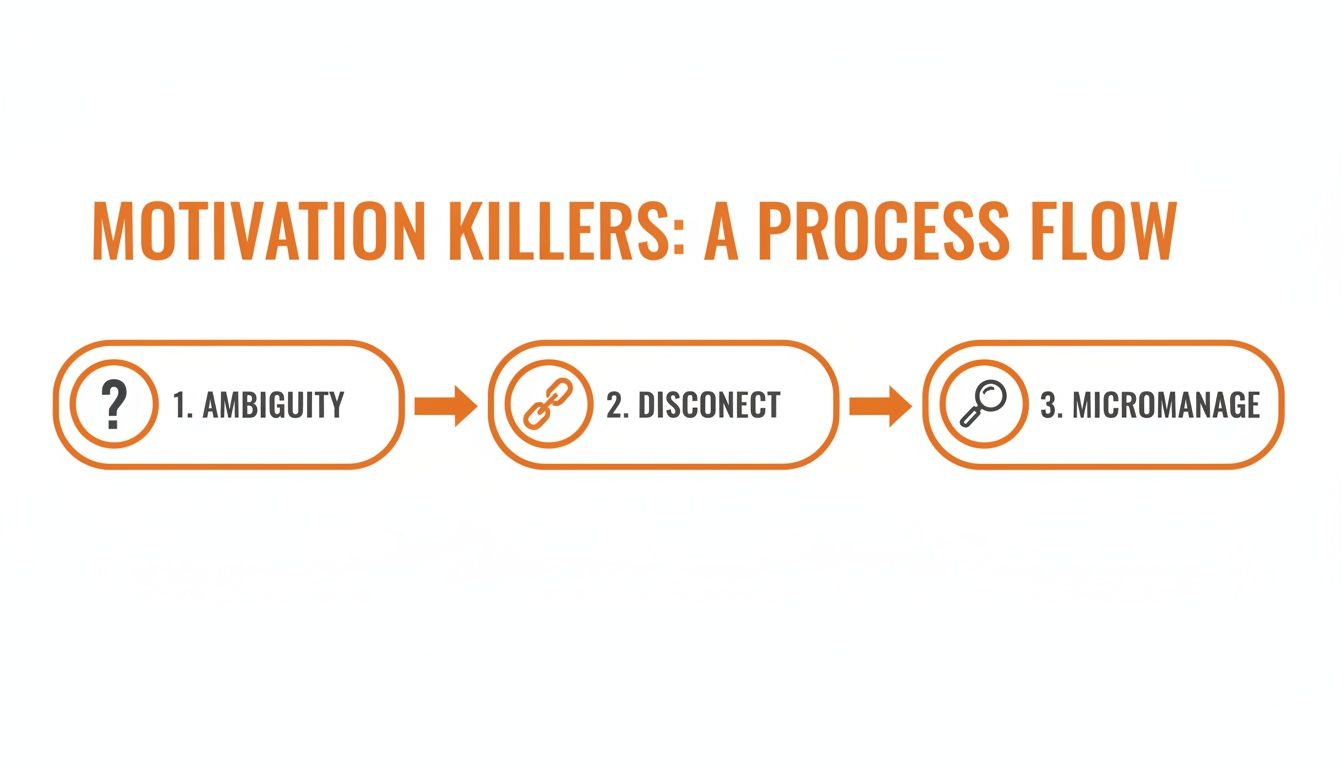
When people don't get the "why" behind their work, or feel like they’re constantly being watched, their drive just evaporates. Why pour your heart into something when your effort feels pointless or untrusted?
This all comes back to leadership. Research consistently shows that managers account for a staggering 70% of the variance in team engagement. Your mission statement can be perfect, but if your frontline leaders aren't actively building trust, motivation will always be on life support.
Motivation isn't a transaction. It's a relationship. It's built on seeing people as people, not resources. Solve for trust and clarity, and the drive to do good work will follow.
Another huge drain is simple overload. When your best people are buried in administrative tasks, they have no energy left for the work that matters. If that sounds familiar, it might be time to Hire LatAm Virtual Assistants to take on those non-core duties, freeing up your team to focus on what they do best.
Stop "Solving" for Motivation. Start Building It.
This isn't another checklist of motivational hacks. It’s about a fundamental shift in how you lead. We’re going to stop treating motivation like a problem to be solved and start seeing it as the outcome of a healthy team dynamic. That means building better habits and improving your own frontline leadership skills.
Ahead, I’ll walk you through how to create an environment where motivation flourishes. We'll cover practical ways to bring clarity to daily work, build real connection, and give your team the ownership they crave.
It's about getting back to basics. It's about being human. And it works.
Build Clarity and Purpose Into Every Day
Motivation dies in the dark. I’ve seen it countless times. A team kicks off a project with plenty of energy, but without a clear goal—a real sense of why their work matters—that drive just fizzles out. It’s like asking someone to run a marathon without telling them where the finish line is.
People don’t just want a to-do list; they want a mission. Our job as leaders isn't to be cheerleaders. It’s to be the ones who light the path. We have to bring clarity and purpose into the day-to-day grind. When you connect the small tasks to the bigger picture, you're not just giving instructions. You're building a shared purpose. That’s how you motivate a team.

Translate Strategy into Daily Missions
Let’s be real. Corporate goals like “increase Q3 efficiency” mean nothing to the person on the floor. It’s jargon. It doesn’t connect to their actual work. The magic happens when you translate those lofty objectives into tangible, daily missions.
Think about an operations manager in a warehouse. Instead of just barking orders, they could use a central hub like Pebb to post a clear priority for the day: “Our goal today is to process all incoming shipments from Supplier X by 4 PM to avoid weekend backlog.”
That one sentence is incredibly powerful. It sets a specific, measurable target. It gives a clear deadline. And it explains the "why"—to avoid a weekend backlog, which no one wants.
Suddenly, the job isn't just "moving boxes." It's a team mission with a clear finish line. That small shift in communication changes everything.
Give Your Team the "Why"
Most people aren't just motivated by a paycheck. They're driven by purpose. This isn't just a fluffy idea. As Daniel Pink wrote in Drive, a sense of purpose is a cornerstone of intrinsic motivation. People want to feel like their work matters. It’s our job to connect the dots for them.
And this is only getting more important. A 2024 Gallup poll found that younger employees especially need this connection—with 86% of Gen Z and 89% of millennials citing purpose as essential for job satisfaction.
Instead of just telling your team what to do, get in the habit of always explaining why it matters. This simple shift turns a checklist into a contribution. That’s one of the most powerful motivators you have.
For example, imagine a hospital unit manager overseeing day and night shifts. It’s easy for those two groups to feel disconnected. The manager could use a simple news feed to share updates: “Incredible work, night shift, on stabilizing the patient in Room 204. Day shift, our focus is now on their recovery plan. Dr. Evans' notes are attached.”
This isn’t just a handoff; it’s a story. It celebrates a win, sets the next goal, and shows exactly how each shift's work builds on the other's. It makes the purpose real.
Use Simple Scripts for Clear Communication
Clarity doesn't come from long-winded memos. It comes from direct, human language. Whether your team is remote or side-by-side, your communication has to cut through the noise.
Here are a few simple scripts I’ve seen work wonders:
To start the day: "Today, our main focus is ____ because it helps us ____. Let's nail that."
To share an update: "Quick heads up: we're shifting focus from X to Y. The reason is ____, and here’s what it means for you."
To connect to the big picture: "I know this task can feel repetitive, but it's critical for our goal to ____. Your work here makes a huge difference."
They aren't fancy. But they’re clear, honest, and respect your team’s time. They provide the context people crave and show you're thinking about the "why" as much as the "what."
At the end of the day, building clarity is about making the goal obvious and the path achievable. When people can see the finish line and understand why it’s important to cross it, they’ll find their own motivation to run.
Create Rituals of Connection and Recognition
Let’s be honest. People don’t work for companies. They work for other people. A paycheck is essential, but it’s not what inspires someone to dig deep when a project goes sideways.
Feeling like your work is seen and valued by the people you’re in the trenches with? That’s what does it. Real motivation comes from simple, consistent rituals that make people feel appreciated.
Ditch the "Employee of the Month" Award
We’ve been taught that recognition is a formal, top-down event—that dusty 'Employee of the Month' plaque in a forgotten hallway. That model is broken. It’s especially useless for frontline and distributed teams who already feel disconnected.
Waiting a month, let alone a year, to acknowledge great work is a surefire way to make your best people feel invisible. The most powerful recognition doesn't come from a manager once a quarter. It comes from peers, in the moment.
The data backs this up. One study found that 69% of employees work harder when they feel their efforts are recognized. And recognized employees show a 20% jump in performance. If you’re interested, you can explore the full employee motivation statistics and see how strong the link is.
The most powerful motivators aren’t expensive. They're simple, human gestures that say, “I see what you did, and it mattered.” That kind of recognition costs nothing but a moment of your time.
Make Recognition Specific, Public, and Instant
A generic "good job" is empty. It's forgettable. For praise to land, it needs to connect a specific action to a positive outcome. This shows you’re actually paying attention.
Here’s what that looks like.
What you might say: "Thanks for your hard work this week."
What you should say: "Huge thank you to Maria for staying late last night to fix that inventory system glitch. Because of her, we got all of today's orders out on time. That was a huge save."
See the difference? The second one tells a story. It highlights a specific action, explains the business impact, and publicly celebrates the person. Now everyone on the team sees what great work looks like.
Upgrade Your Recognition Toolkit
Old-school recognition methods were designed for a world where everyone worked in the same building. They fall flat today. A simple communication platform can change the game.
Here's how you can transform your approach:
| Recognition Tactics Before and After a Unified Platform |
| :--- | :--- | :--- |
| Traditional Method (Low Impact) | Modern Method (High Impact) | Why It Works Better |
| The annual award or a dusty plaque. | A dedicated "Wins" channel where anyone can give instant shout-outs. | Recognition is immediate, public, and peer-driven. It feels more authentic. |
| A private "thank you" email. | A quick, personal voice note sent from a manager's phone through a team app. | The human voice carries a warmth and sincerity that text can't match. |
| Generic gift cards at the end of the quarter. | Team members award points to each other, redeemable for personal rewards. | This empowers everyone to recognize good work and ties appreciation to daily contributions. |
Modern tools aren't about replacing human connection; they're about amplifying it. Instead of another email, try sending a quick voice note. A simple, 15-second message saying, “Hey, just wanted to say thank you for how you handled that customer complaint. You were amazing,” can make someone’s entire day.
These small rituals build a culture where people feel valued. They show that you see the person, not just their output. If you're looking for more ways to build this into your team's DNA, check out our guide on creating impactful employee recognition program ideas your team will actually care about.
Motivating a team isn't about grand gestures. It’s about cultivating respect and appreciation, one small shout-out at a time.
Give Your Team Control With Autonomy and Tools
The fastest way to kill someone’s initiative is to micromanage them. Stand over their shoulder, question every decision, demand to be looped in on every detail. I guarantee their motivation will die in days.
I learned this the hard way. Early in my career, I thought being a good manager meant having all the answers and keeping a tight grip on everything. What I was actually doing was signaling to my team that I didn't trust them. It was a disaster.
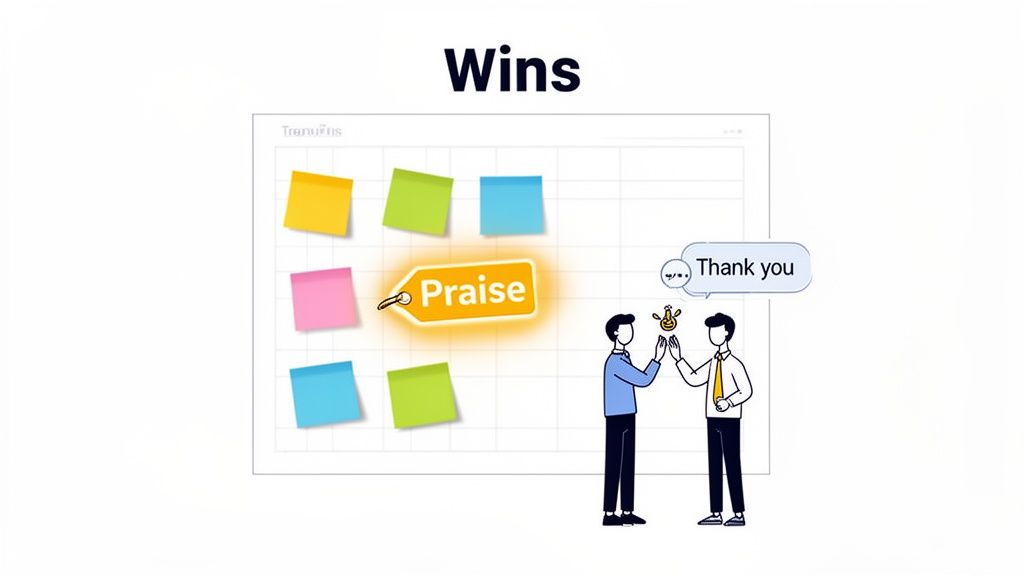
Real motivation doesn't come from being told what to do. It comes from a sense of ownership. And you can't have ownership without control. It's one of the three core psychological needs identified by Self-Determination Theory: autonomy. People are wired to want control over their actions.
The Line Between Delegation and Abdication
Giving your team autonomy doesn't mean throwing a task over the wall and hoping for the best. That's not delegation; it's abdication. True autonomy is about giving people both the freedom to act and the resources they need to act wisely.
It’s about trust, but it’s also about providing the right tools. When you equip your team to solve problems on their own, you're not just making your life easier. You're building their confidence and competence. Those are powerful internal motivators.
Think about a new retail employee on a busy Saturday. A customer has a tricky return, and the employee doesn't know the policy.
Scenario A (No Autonomy): The employee has to find a manager, who is busy. The customer gets frustrated. The employee feels incompetent.
Scenario B (Autonomy with Tools): The employee pulls out their phone, opens the company’s knowledge library in an app like Pebb, and finds the return policy in seconds. They handle the situation, the customer is happy, and the employee feels capable.
The difference is a simple tool that removes friction. That’s how you build a motivated, self-sufficient team.
Equip Them to Be Problem Solvers
One of the biggest drags on motivation is feeling helpless. When an employee constantly has to ask for permission or information, it reinforces powerlessness. Your job is to remove those barriers.
Here are a few practical ways to do this:
Build a Central Knowledge Library: Create one place for all essential information—policies, procedures, training guides. When someone has a question, their first instinct should be to check the library, not interrupt a manager.
Use Smart Scheduling Tools: For hourly teams, shift scheduling is a constant source of friction. Using a tool that lets team members easily view schedules and swap shifts on their own gives them control and reduces headaches for managers.
Create Clear Task Workflows: When you assign a task, make sure all necessary context, files, and deadlines are attached. This stops the endless back-and-forth and lets people get to work.
Giving someone autonomy is the ultimate sign of trust. It tells them, "I believe in your judgment and your ability to figure this out." That belief is often the very thing people need to rise to the occasion.
Let's be honest. This can feel scary at first. You're giving up control, and you might worry that people will make mistakes. They will. But that’s part of the process.
The key is to create an environment where mistakes are learning opportunities, not reasons to revoke trust. It’s about being a safety net, not a puppeteer. When your team knows you have their back, they’ll have the courage to take initiative. And that's where true, lasting motivation is born. It’s not about cheering louder; it's about getting out of the way.
Know If It’s Working: Measure and Close the Loop
So you’ve been trying new ways to motivate your team—setting clearer goals, giving public shout-outs, offering more autonomy. That’s great. But how do you know if it’s working?
If you're not paying attention, you're just guessing. It's time to stop guessing and start listening.
I don't mean sending out those dreaded annual engagement surveys that everyone hates. I’m talking about creating a real-time feedback loop, where you use simple data and real conversation to take your team's pulse.
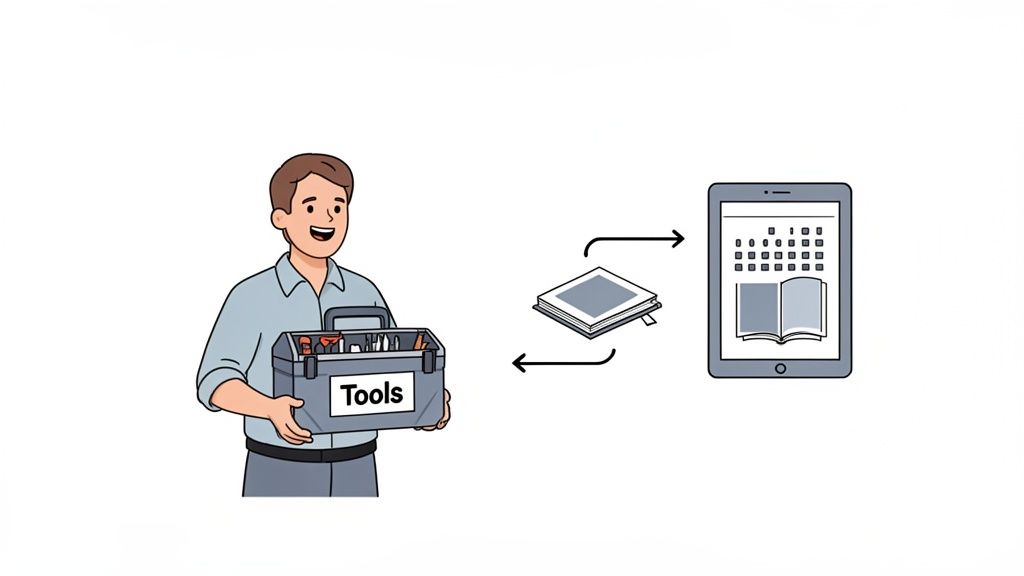
This isn’t about big-brother-style tracking. It’s about understanding their world so you can clear out the things getting in their way.
Let Data Point You in the Right Direction
Before you even start a conversation, you can learn a lot just by observing. The right data gives you clues about where morale is high and where it might be dipping. You don't need a complicated dashboard—just curiosity.
For instance, inside a tool like Pebb, you can look at simple signals:
Which posts get the most love? If a post celebrating a team win gets tons of likes and comments, that’s a strong signal that public recognition is landing well.
Has a team channel gone silent? A sudden drop-off in communication can be a red flag for confusion or a dip in morale.
Who are the natural helpers? See who consistently jumps in to answer questions. These are your informal leaders, the glue holding the team together.
This data doesn't give you the whole picture, but it tells you where to start looking. It points you toward the conversations that matter.
Ditch "How Are You?" for Questions That Work
Here’s the thing: pairing that data with simple one-on-one check-ins is where the magic happens. But you have to ask the right questions. "How are you?" almost always gets a polite, but useless, "Fine, thanks."
To understand what’s really on their minds, you need to dig deeper.
A framework I find helpful comes from motivational interviewing, called OARS. It’s a simple way to structure conversations to encourage honest sharing.
Open-ended questions: Start with questions that can’t be answered with a "yes" or "no." Instead of "Are you happy with the project?" try, "What's one thing that's energizing you about this project?"
Affirmations: Genuinely acknowledge their effort. "I really appreciate how you handled that tricky customer call. You’re excellent at staying calm under pressure."
Reflections: Show you’re listening by paraphrasing what you hear. "So it sounds like you’re feeling a bit stuck on the reporting part."
Summaries: Tie it all together. "To recap, you're excited about the new design but concerned about the tight deadline. Is that right?"
This isn’t a script to follow word-for-word; it's a mindset. It shifts the conversation from a transaction to a dialogue.
Your job isn’t to solve every problem. It’s to listen so well that they feel heard, which often empowers them to find their own solutions. That sense of agency is a powerful motivator.
By closing this feedback loop—using data to spot issues and conversations to understand them—you show your team you’re serious. You prove that their experience at work matters. If you’re curious about more modern ways to measure employee engagement, it’s worth exploring.
Ultimately, this cycle of listening, learning, and adjusting builds trust. And when your team trusts that you’re invested in making their work life better, their motivation will start to take care of itself.
Answering the Tough Questions About Team Motivation
Even with the best intentions, you're going to hit roadblocks. That’s just management. Learning how to keep a team fired up isn't a one-time task—it's an ongoing conversation.
Over the years, a few questions have come up again and again from managers trying to get this right. Here’s my take on them, no fluff.
How Do I Motivate an Employee Who Seems Completely Checked Out?
Let’s get one thing straight: you can’t make someone be motivated. It's not a switch you can flip. What you can do is create an environment where they might choose to re-engage.
The only place to start is with a private, honest chat. Don't walk in with a list of their shortcomings. That just puts people on the defensive. Lead with curiosity.
I've found that opening with something like, "I've noticed you seem less engaged lately, and I just wanted to check in. Is everything okay?" can work wonders. More often than not, the problem is something you can help with. It could be muddy expectations, a frustrating roadblock, or a dynamic with a coworker.
Sometimes, the truth is that the role isn't the right fit anymore. That's okay. By approaching it like a human first, you open the door for a real solution, not just a temporary patch. Motivation is a two-way street. It starts with showing you care enough to ask.
What’s the Real Difference Between Motivation and Happiness?
This is a fantastic question because they are not the same thing. Think of it this way: happiness is an emotion. Motivation is the engine.
A happy employee might love the free snacks, but that surface-level contentment won't fuel them through a tough project. Motivation runs deeper. It’s tied to purpose, autonomy, and a sense of getting better at something that matters.
As a leader, your goal isn't to be a cruise director, manufacturing constant happiness. Your job is to foster deep, intrinsic motivation by providing clarity, trust, and opportunities for growth.
The best part? A motivated team that feels a true sense of accomplishment is almost always a happy team. Happiness becomes a byproduct of doing meaningful work, not the goal itself.
How Can I Motivate My Team When We Have a Tiny Budget?
This is the reality for most managers. But here's a secret: once people’s basic financial needs are met, money quickly falls down the list of what actually drives them.
In fact, some of the most powerful motivators are completely free.
Recognition is king. A specific, public "thank you" in a team meeting can be far more impactful than a tiny bonus. It provides social proof and shows everyone what success looks like.
Autonomy is a close second. Can you give your team more control over how they work? Can you trust them with their own schedules? Showing you trust them is a massive motivator.
Invest in their growth. This doesn't have to cost a cent. Offering mentorship, handing over a challenging new responsibility, or letting someone lead a small project are incredible ways to show you're invested in their future.
Focusing on these intrinsic rewards builds a resilient culture that doesn’t depend on the next round of raises. Many of the characteristics of a good coach are exactly what's needed to inspire a team in these situations.
Motivating a team isn't about pulling a lever or writing a check. It’s about creating a place where people feel trusted, valued, and connected to a mission they believe in. Get that right, and you’ll find that motivation isn't something you have to manufacture. It's already there, waiting for you to unlock it.
Ready to build a place where your team can feel seen, heard, and motivated every day? Pebb unifies communication, operations, and engagement into one simple app for your entire team. See how it works at https://pebb.io.
