
Why Teamwork Is Overrated (And What to Do Instead)
Discover why is teamwork important. Learn the ROI of collaboration and get a practical blueprint for building it, even for distributed & frontline teams.
Dan Robin
We need to talk about "teamwork." It's a word that conjures up images of cheesy office posters, awkward trust falls, and corporate jargon that means nothing. For years, we’ve been told it’s the secret sauce.
But here’s the thing: maybe the problem isn't that we're bad at teamwork. Maybe the problem is teamwork itself—or at least, our broken idea of it.
Teamwork Isn't What You Think It Is
I’ve seen it countless times. A busy restaurant on a Saturday night. The kitchen is swamped, servers are running in circles, and the host is trying to seat new guests at tables that haven’t been cleared. Everyone is working hard. But nobody is working together.
That’s not a team problem; it’s a system failure. It's what happens when we confuse effort with alignment.
For too long, we've treated teamwork as a soft skill—a fuzzy, nice-to-have quality that should magically appear when you put good people in the same room. We got it wrong. Real collaboration isn't about liking your coworkers or grabbing a beer after a shift. It's about being perfectly in sync, even when you're miles apart.
Redefining Collaboration As A System
The best teams I've ever been part of operated less like a family and more like a well-oiled machine. That isn't cold or impersonal. It’s actually the highest form of respect. It respects everyone’s time and talent by making work clear, calm, and coordinated.
This practical definition of teamwork stands on a few simple pillars:
Shared Context: Everyone has the exact same information. No guessing games.
Clear Signals: Communication is direct and purposeful. You know where to find answers and how to ask for help without adding to the noise.
Reliable Handoffs: When a task moves from one person to another, the transfer is seamless. Nothing gets lost.
To get this, you have to understand the difference between team and group. A group is just a collection of individuals. A team is a connected unit, moving in the same direction toward a shared goal.
Let’s be blunt: a group of people working in the same building is not a team. A team works in sync because they have a system that connects them, not because they share a breakroom.
For any business with frontline or distributed workers, this distinction changes everything. Your retail associates or warehouse crew can’t just rely on being near each other. They need a system.
Why Is Teamwork Important? The Numbers Don't Lie
So, why does this structured approach matter so much? It's not just about a calmer workplace; it's about real, measurable outcomes. When you move from a disconnected group to an aligned team, the impact is undeniable.
Let's look at the data.
The Real Impact of Effective Teamwork
Metric | Improvement |
|---|---|
Productivity | Well-connected teams see a 20-25% increase in productivity. |
Employee Retention | Companies with engaged employees have 59% lower turnover. |
Safety | Highly engaged teams experience 70% fewer safety incidents. |
Customer Experience | Businesses with great teamwork see a 10% boost in customer ratings. |
The evidence is clear. Building a better system isn't a "feel-good" initiative—it’s a strategy for a more resilient, profitable, and safer business. It’s not about spirit; it’s about structure. Get the structure right, and the spirit will follow.
The Hard Numbers Behind Great Collaboration
For years, we've talked about teamwork as a "soft skill." That view misses the point. Great collaboration isn't just a feeling. It's a financial engine that shows up in your profit margins, productivity reports, and retention rates.
Let's be honest: in business, what gets measured gets managed. We haven't always put hard numbers on teamwork, so it gets pushed aside. It’s time to change that. Investing in a better work system isn't an expense; it's one of the highest-return investments you can make.
The results are crystal clear when you get this right.
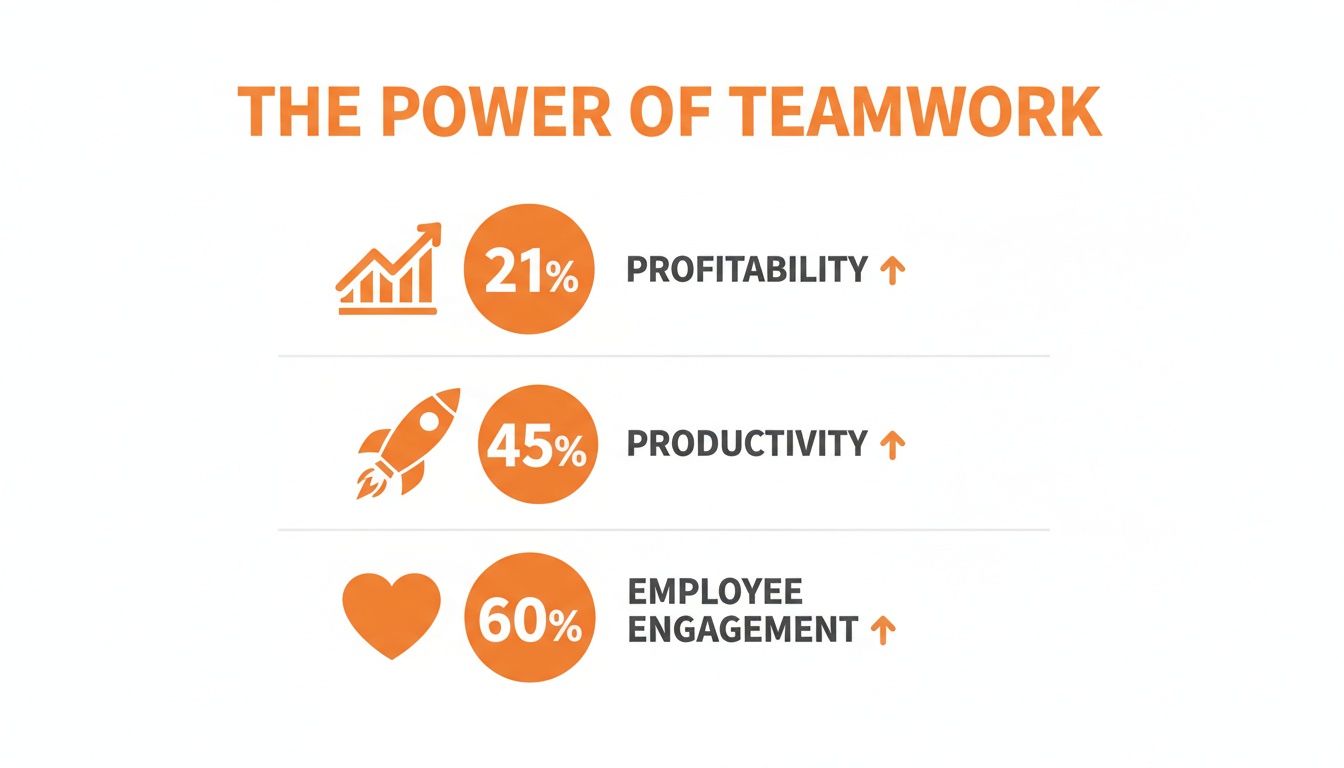
These numbers aren't luck. They’re the result of creating an environment where people can simply and easily work together.
The ROI of a Connected Team
So, why is this such a big deal financially? Because a disconnected team is actively costing you money. A deep-dive analysis by Gallup found that business units with the most engaged employees—a direct outcome of strong teamwork—are 23% more profitable.
That’s not a small bump. It’s often the difference between hitting your targets and missing them completely. The benefits ripple out, with these teams also achieving:
18% higher sales productivity
10% higher customer loyalty
When your people are in sync, your customers feel it.
But that’s only half the story. Other studies on workplace collaboration show that when employees work together well, they don't just feel better—they perform better. They produce 73% better work and are 60% more innovative. For an operations manager in a fast-paced field, that translates into very real efficiency gains.
Productivity Is a Team Sport
The link between teamwork and productivity is undeniable. It's not about forcing people to work longer hours; it's about removing the friction that slows them down. Organizations with truly connected employees see productivity shoot up by 20-25%.
Think about that on the front line. A warehouse associate instantly confirms an order with someone on a different shift. A nurse gets a critical update without chasing a colleague down the hall. Work gets done faster, with fewer mistakes.
A Stanford study drives this home. It found that people prompted to work collaboratively stuck with a task 64% longer than those working alone. They also felt more engaged, less tired, and had a higher success rate.
That sustained effort is what you're after. It’s the product of shared momentum, something that can't exist when people are working in silos. It’s no surprise that companies that intentionally build this collaborative muscle see a 39% surge in productivity.
This is why having a single, unified platform is so crucial. When communication, tasks, and knowledge all live in one place, you stop wasting time. You create a direct line to higher output. If you're wondering how to track these improvements, our guide on how to measure the ROI of internal communication offers a good starting point.
Ignoring the mechanics of how your teams work is a strategic mistake. With a global engagement crisis where only 21% of employees feel truly engaged, the cost of doing nothing is enormous. Good collaboration isn't a perk; it's a pillar of a healthy business. The numbers don't lie.
Where Teamwork Breaks Down in the Real World
We’ve seen the data. The ROI is clear. So why does the day-to-day reality on the shop floor or behind the front desk so often feel like chaos?
It’s almost never because people don't want to collaborate. The real issue is that the systems they’re forced to use are fundamentally broken.
Teamwork doesn't just magically appear. It crumbles when the right environment isn't there to hold it up. The breakdown starts small—a missed message here, a delayed task there—but it snowballs.
The Anatomy of a Breakdown
When we talk with ops managers, we hear the same painful stories. These aren't unique failures; they're universal symptoms of a disconnected workplace.
Information gets stuck in silos. The marketing team lives in one app, the warehouse crew uses another, and critical updates are buried in emails no one reads. This isn’t a people problem—it’s a pipeline problem.
Then you have the communication gap between shifts. The morning crew clocks out, but the crucial context about a tricky customer or a broken machine never makes it to the evening team. The next shift walks in blind, wasting time putting out fires they didn't start.
This chaos is a direct result of a fragmented tech stack. Your average employee juggles a half-dozen apps just to get through the day. It’s exhausting, inefficient, and the perfect recipe for critical details to fall through the cracks.
This isn’t just an annoyance; it’s a direct hit to performance. A staggering 86% of employees and executives point to a lack of collaboration or poor communication as the primary reason for workplace failures. You can explore the wider impact of workplace collaboration. The message is clear: tool overload is sabotaging your team's success.
The Human Cost of Disconnected Work
When the system fails, your people pay the price. They spend hours every week just trying to track down information. Projects stall, not from a lack of effort, but because of crossed wires. It’s no wonder that 97% of employees believe a lack of team alignment directly torpedoes the outcome of their work.
Think about what that looks like on the ground:
Wasted Time: An estimated 64% of workers lose three or more hours every week simply because collaboration is broken. That adds up.
Stalled Projects: When teams can't sync up, deadlines get pushed, and great ideas die on the vine.
Burned-Out Employees: Nothing drains motivation faster than fighting the system just to do your job. Eventually, your best people get tired of the friction and leave.
This isn't about pointing fingers. It's about diagnosing the real issue. The problem isn't lazy employees or bad managers. It’s the failure to give your team a single, unified place where work can flow smoothly. The answer isn’t another productivity hack or a new messaging app. It’s about creating a true operational hub—a digital home where everyone is finally on the same page.
A Blueprint For A Truly Collaborative Culture
So, we’ve seen the hard numbers and picked apart the common ways work goes wrong. What do we actually do about it?
Most advice you’ll find is a tired list of trust falls and communication workshops. Let's be real—that’s just scratching the surface. You can't fix a systemic problem with a quick fix. You need a better blueprint.
The foundation of great teamwork isn't more meetings or another chat app. It's a simple idea: a single source of truth. One central, calm, organized place where all your communication, operations, and knowledge can live.
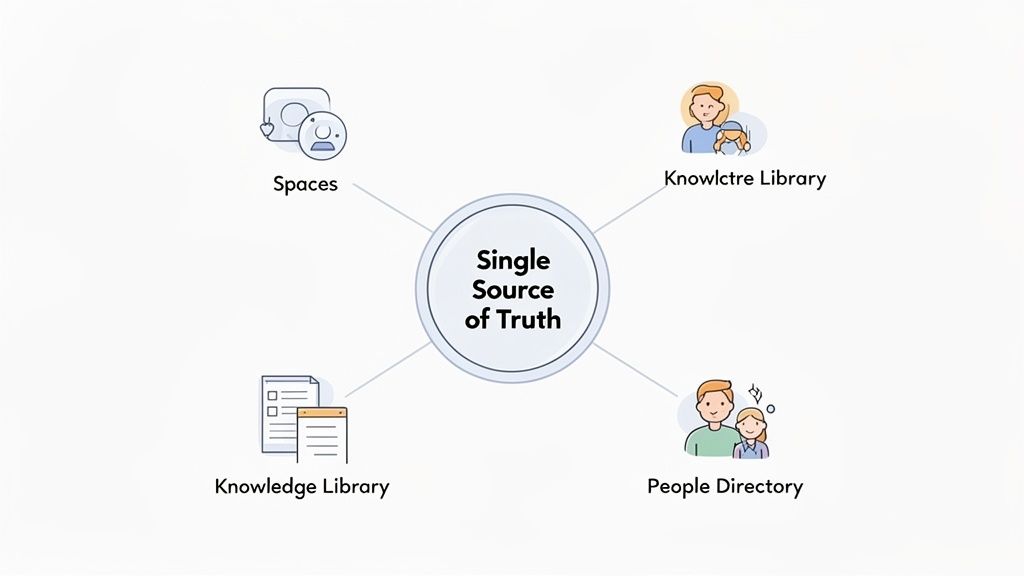
This isn’t about adding another tool. It’s about being more intentional. It’s about building a digital home for your company that ends the information chaos.
Tame the Noise with Dedicated Spaces
First, turn down the volume. The modern workplace is a constant storm of notifications. It’s nearly impossible to focus.
This is where dedicated Spaces come in. Instead of a single, noisy chat, you create distinct, organized areas for each team, project, or location. One Space for the warehouse, another for the marketing team, and one for the new product launch.
Each Space becomes a self-contained hub for that group’s work. Inside, they find:
Focused Conversations: The chat stays on-topic.
Clear Tasks: Everyone can see what needs to be done and who’s on it. No more dropped balls.
Key Files: All the documents for that team live right alongside their conversations and tasks.
The goal is pure focus. By giving each team their own digital room, you cut down on the constant context-switching that kills productivity.
Build Lasting Knowledge in a Central Library
Think about how much time is wasted hunting for information. “Where’s the latest return policy?” “What’s the Wi-Fi password?” These little questions add up.
This knowledge drain happens because crucial information is scattered everywhere. A Knowledge Library puts a stop to this by creating one official home for all your important documents and procedures.
A central library isn't just a digital filing cabinet. It's how you build institutional memory. When a key person leaves, their expertise doesn't walk out the door with them.
When onboarding guides and company policies are all in one searchable place, you help people find their own answers. This builds autonomy and frees up managers from being a bottleneck. This is foundational, and you can explore more on how to build trust in teams in our guide.
Connect Your People, Not Just Their Job Titles
At the end of the day, great work is built on human connection. But in a company with multiple locations or different shifts, it can be hard to even know who’s who.
A searchable People Directory changes that. It puts a face to a name and gives you context beyond a job title. You can finally see who works in which department, what their skills are, and a little about their interests.
It sounds simple, but the impact is huge. When a retail associate in one store can easily get advice from a product specialist in another, you dissolve the invisible walls between teams. You build a network that spans locations and shifts.
Building a collaborative culture isn't about some grand initiative. It’s about putting simple, smart structures in place that make working together the easiest way to get things done.
Putting Great Teamwork Into Practice
Theories are great on paper. But the true test happens on a rainy Tuesday morning when everything is going sideways. What does it actually feel like to go from chaos to calm collaboration?
It’s not about grand gestures. It’s about small, consistent actions, supported by the right tools, that make working together feel effortless. The goal is to make the right way to work the easiest way.
Let’s see what this looks like.
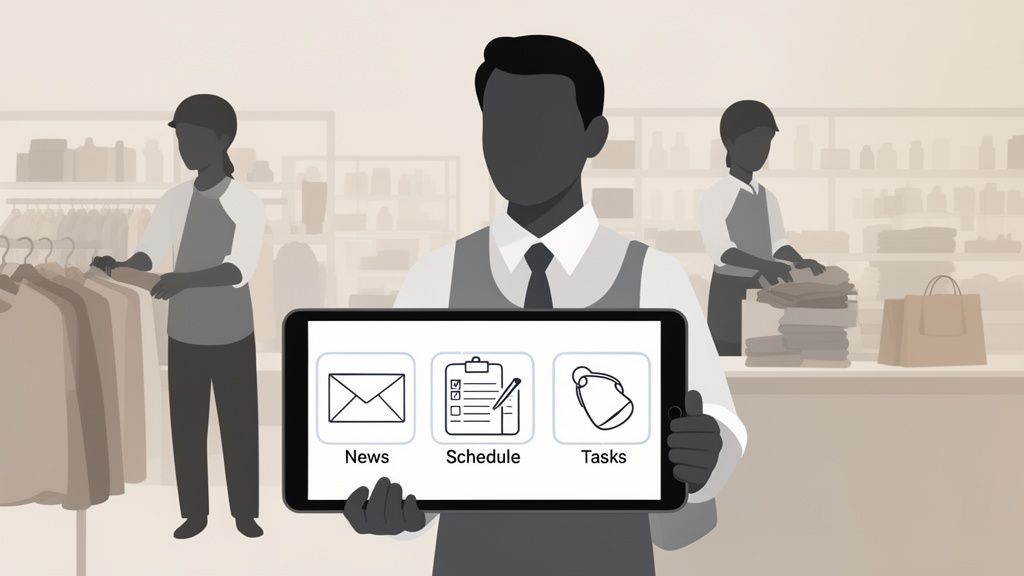
When everyone has instant access to news, schedules, and tasks in one spot, the dynamic changes. This single source of truth cuts through the noise and keeps everyone aligned.
A Manager's Morning Solved
Meet Sarah, a retail store manager. Her morning used to be a frantic scramble. She’d dig through her inbox, squint at a paper schedule, and try to decipher handwritten notes. A stressful, scattered way to start the day.
Now, her morning is completely different.
She grabs her coffee, opens a single app on her phone, and sees the latest company news. No more inbox archaeology. Next, she taps into her team’s dedicated ‘Space’ for the store. A couple of PTO requests are waiting; she approves them instantly.
Before her team even clocks in, she assigns a few key tasks for the morning crew—restock aisle 5, set up the new promo display. When they arrive, their instructions are waiting, clear and impossible to miss. No more verbal instructions lost in the shuffle.
This isn't a fantasy. This is what happens when you solve the real-world headaches of communication with a unified system. It's calmer, more organized, and just plain practical.
This shift from chaos to clarity isn't just for retail. Imagine a charge nurse using a dedicated Space to manage shift handoffs, ensuring no critical patient detail is missed. Or a warehouse supervisor using in-app voice calls to solve a shipping snag with a driver. The principle is the same: one central place for everything. If you're looking for more ways to build this flow, our guide on how to improve team collaboration offers actionable steps.
Making Work Flow Naturally
The real magic is how these tools work together. It’s not just having a chat feature; it’s about that chat living right alongside your team’s task list and shared files.
Think about a hotel team prepping for an event:
The Plan: The manager drops the final run-of-show document into the “Conference Weekend” Space. Everyone from the front desk to catering has it.
The Conversation: The head of catering asks a question in the chat. The manager replies. That answer is now visible to the whole team, preventing the same question from being asked 10 more times.
The Action: The manager creates tasks for the setup crew with clear deadlines. As tasks get checked off, everyone sees the progress in real-time.
This is just a smarter way to work. Features like file sharing and task assignments become natural parts of the conversation. And because it's all in one place, leaders can see what's working without micromanaging. Exploring some team building activities for remote workers can also help strengthen these bonds.
The goal is to get to a point where a manager—like Sarah—reads this and thinks, “Yes, that’s exactly what my team needs.” It’s not about adding more software. It’s about finding a calmer, more organized way to work together.
The Quieter, More Productive Way to Work
We’ve covered a lot of ground—what real teamwork looks like, why it's critical, and how it falls apart. But if there’s one idea to take away, it’s this: the best teamwork is often quiet.
It’s not the loud, frantic energy of a packed meeting or a chat channel that’s constantly pinging. True, high-performing teamwork is more like a low hum. It's the sound of a team so in sync that the work just flows. Handoffs are seamless, information is where it needs to be, and people are free to focus on their actual tasks—not the work of finding the work. That’s where real productivity lives.
Let’s be honest, most of us have been chasing productivity all wrong. We download another app, try some new "hack," and cram in more communication, hoping something clicks. We're just treating the symptoms.
The real solution is far simpler. It’s about creating an environment where working together is the path of least resistance. Where work feels intentional, not chaotic.
So, the next time you think about improving teamwork, don't just ask, "How can we get everyone to talk more?" Instead, ask, "How can we build a system that helps them achieve more, with less noise?" That's what the future of work really looks like.
Your Teamwork Questions, Answered
Over the years, we've heard just about every question there is about teamwork. It seems simple, but the reality can be messy. Here are my answers to a few common ones.
How Can We Improve Teamwork with Frontline and Office Staff?
This is a classic dilemma. When you have people working in different places and on different schedules, it’s easy for two separate cultures to emerge. The office team and the frontline crew can feel like they're in different worlds.
The answer isn't forced happy hours. The secret is a single source of truth.
Both your frontline and office staff need one central hub where they can find company news, get important documents, and talk to one another. When everyone uses the same platform and sees the same information, you dissolve that "us vs. them" mindset. A warehouse worker should be able to ask a quick question and get an answer from someone in finance without navigating a maze of emails. That’s how you know it’s working.
What’s the First Step to Fixing Poor Collaboration?
You can't fix a problem you can't see clearly. Your first step should be to conduct a communication audit. Don't let the name scare you—it's just taking stock of how your team actually communicates.
Ask yourself and your people a few simple questions:
How many different apps are we juggling just to talk to each other?
Where does crucial information fall through the cracks most often?
How do new employees get up to speed?
You're looking for the pain points: too many tools, confusing workflows, and trapped information. This audit gives you a map of the breakdowns so you know where to start.
How Do We Measure the ROI of Improving Teamwork?
The big one. How do you prove that investing in better teamwork is worth it? You stop guessing and start tracking the numbers that already drive your business.
You don't have to guess at the financial impact of good teamwork. It shows up in clear, measurable ways in your operations, finance, and HR reports.
Instead of relying on feelings, look at the hard data. Keep an eye on metrics like:
Employee turnover: Are your best people staying longer?
Project completion times: Are you shipping projects faster with fewer headaches?
Customer satisfaction scores: Are happier, more connected teams creating happier customers?
These aren't soft numbers; they're direct indicators of your company's health. When you see these metrics moving in the right direction, you'll have all the proof you need that teamwork isn't just a culture initiative—it's a business strategy.
Ready to build a calmer, more productive workplace? With Pebb, you can unite your entire team, from the front line to the back office, in one simple, modern app. Start building better teamwork today.
