
How to Measure Employee Engagement Without Guessing
Tired of meaningless metrics? Learn how to measure employee engagement with human-centered methods that reveal what's truly happening with your team.
Dan Robin
Let’s be honest. The way most companies measure employee engagement is broken. It’s a corporate ritual, disconnected from the day-to-day reality of work. We’re told engagement is the pulse of the company, but we’re checking it once a year with a clunky, 50-question survey.
That isn't a pulse. It's an autopsy.
True engagement isn't a score you chase. It’s the texture of daily work. It’s the quiet confidence your people have in their teams, their managers, and the mission. It’s visible in what they say, and more importantly, in what they do.
The Problem with Annual Engagement Surveys
We’ve all been there. The email lands, demanding we fill out the annual survey. We spend an hour clicking through questions, trying to remember how we felt six months ago. A month later, leadership presents a PowerPoint deck with a single, aggregate number. And then… nothing.
The real issue? That number doesn’t tell a story. It’s a single, static snapshot.
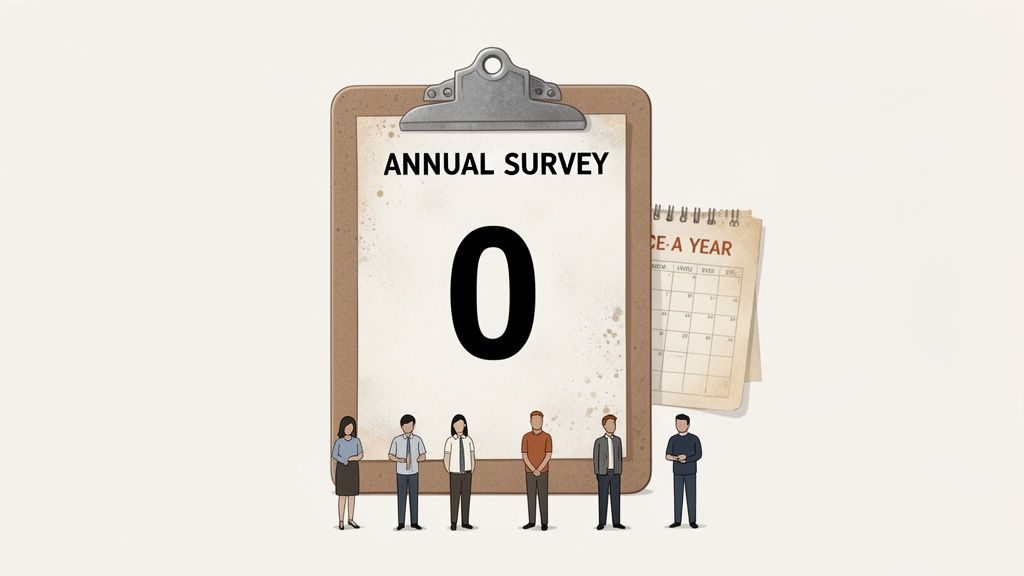
The results are often skewed by whatever happened that particular week, or a general reluctance to be completely honest. Asking someone to recall their feelings from last quarter is like trying to remember what you had for lunch last Tuesday. The memory is fuzzy, and the data is weak.
This old-school approach creates a massive delay between feedback and action. By the time the numbers are crunched, the issues have either snowballed or been forgotten. It’s an exercise in looking backward instead of clearing the path forward.
The Real Cost of a Bad Snapshot
The stakes are higher than just a disappointing report card. When we fail to get a true read on engagement, we miss the quiet signs of trouble. Good people quit, and no one knows the real reason. Brilliant ideas are never voiced. Everyday friction builds up and grinds productivity to a halt—especially for frontline and distributed teams, who are often the most disconnected.
This isn’t just a hunch. According to Gallup's 2023 report, global employee engagement is hovering at a dismal 23%. This widespread disconnect costs the global economy a staggering $8.8 trillion in lost productivity. For frontline industries, the consequences are even more stark, with significantly higher absenteeism and safety incidents.
Those aren't just abstract figures. They represent real people and real business impact. Shifts left uncovered, orders unfulfilled, customers left waiting. They expose the huge gap between what an annual survey reports and what’s actually happening on the ground.
Moving Beyond the Score
So, what’s the alternative? It starts with a shift in mindset. We have to stop treating engagement as a score to be managed and start seeing it as an ongoing conversation.
This means moving away from the once-a-year event toward a continuous, lightweight process. It means pairing what people say in quick, simple polls with what they do in their day-to-day work. Let’s be clear: this isn't about surveillance. It's about understanding the health of the systems your teams use to communicate and collaborate.
The goal is to get a living, breathing picture of your team’s experience. Because once you can see the real story, you can finally start to change it.
What Does an Engaged Team Actually Look Like?
Before you can measure engagement, you have to know what it looks like in the wild. This is where so many companies stumble. They get fixated on a number without stopping to ask a fundamental question: what does a highly engaged team at our company really do?
Think about it. Is it a warehouse crew that proactively flags safety issues? A hospital staff that coordinates flawlessly between shifts? Or a remote team where people genuinely connect on things that aren't just work?
Engagement isn't one-size-fits-all. It's tangible, specific, and looks different everywhere. Your first job isn’t to pick a tool; it’s to paint a clear picture of what success looks like for you.
Start with a Real-World Goal
Forget about chasing a higher score on a dashboard. Instead, focus on a real problem you want to solve.
I once worked with a retail chain hemorrhaging new hires. Their engagement goal wasn't some vague notion of "happiness." It was to figure out if new employees felt supported during their make-or-break first 90 days. That’s a meaningful, measurable goal tied directly to the bottom line.
Your goal could be:
Improving communication: Are critical updates actually reaching everyone, especially folks on the front line?
Reducing friction: Can people find the information and colleagues they need without getting tangled in bureaucracy?
Boosting collaboration: Do people feel comfortable reaching across departments to solve problems together?
Once you have a goal, you can start hunting for the right signals. A core piece of this puzzle is ensuring a strong sense of mental wellbeing at work, because it’s the foundation for everything else. When people feel psychologically safe, they bring their best selves to work.
Look at What People Say vs. What They Do
I find it helps to split engagement metrics into two simple buckets: what people say and what people do. You need both to see the complete picture.
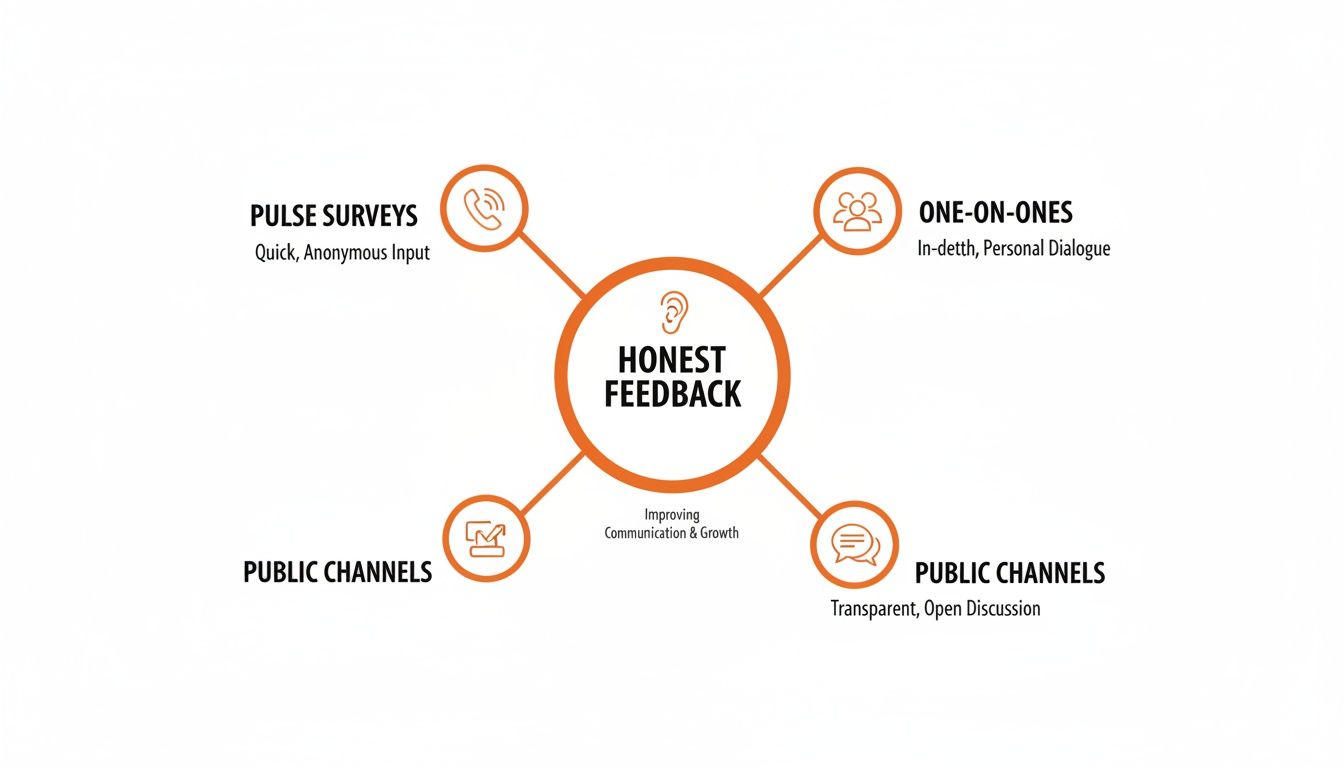
What people say is about context. This is your qualitative data—the feelings, perceptions, and ideas you can only get by asking. You can get this from pulse surveys, one-on-ones, or by gauging the mood in team chat channels.
But here’s the thing: what people say is only half the story. The other half, often more telling, is what they do.
Actions are the clearest signal of engagement. An employee might tick a box saying they feel connected, but their behavior—do they actively jump into team discussions or offer to help a new teammate?—tells you what’s really going on.
This is where behavioral data becomes your best friend. These are the digital breadcrumbs people leave behind in the tools they use every day. This isn’t about micromanaging. It’s about understanding the collective rhythm of the organization. Are teams sharing knowledge? Are managers responding to questions promptly? Are people actually using those resources you spent so much time creating?
Combining these two views is where the magic happens. A low pulse survey score on "feeling informed" is interesting. But when you see that data alongside a behavioral metric showing only 30% of your frontline staff viewed the latest policy update? Now you have a real, actionable insight. You have a story. That is how you measure employee engagement in a way that actually works.
How to Get Honest Feedback From Your Team
We’ve all seen it. The big meeting ends, the leader asks, “Any questions?” and is met with silence. The moment everyone leaves, the real conversations start in the hallway or over Slack.
People have plenty to say. The problem is they often don’t feel comfortable, safe, or that it’s worth their time to speak up.
The secret isn’t a more complex feedback system. It's about creating small, consistent, and easy moments for people to tell you what’s on their minds. The goal is to make sharing feedback feel as natural as sending a quick text.
Make It Effortless with Pulse Surveys
Remember that 50-question annual survey? By question 27, you were probably just clicking through to get it over with. That’s not a recipe for honesty; it’s a recipe for burnout.
This is where pulse surveys change the game.
These are short, frequent check-ins—sometimes just one or two questions—that your team can answer in less than 30 seconds. Instead of an easily ignored email, picture a simple question popping up right inside the app they use for work every day. A quick tap, and they’re done.
Because the ask is so small, participation goes up. And because you’re asking frequently, you get a continuous stream of relevant insights instead of one giant, outdated report. This is a lifesaver for frontline teams who aren't chained to a desk. They can answer a quick question on their phone during a break, feeling heard without it disrupting their day.
A simple question like, “Do you have the tools you need to do your job well this week?” can tell you more than a 20-minute survey ever could. It’s specific, timely, and you can actually do something about the answers.
The Power of a Good Conversation
Surveys spot trends, but nothing beats a real conversation. The best way to understand what's really going on with team morale is to listen. This is where well-structured one-on-ones are invaluable.
But let’s be real—most one-on-ones turn into status updates. A great one-on-one should be a dedicated space for the employee, not the manager. It’s your chance to ask open-ended questions that get a real dialogue going.
Here are a few questions I’ve found work wonders:
"What's one thing we could change that would make your job better?"
"Is anything blocking you right now that I can help with?"
"What part of your work has given you the most energy lately?"
The magic, though, is in the follow-up. When someone shares a problem and sees you genuinely try to fix it, you build an incredible amount of trust. That trust is the currency of honest feedback. If you want to go deeper on this, you might be interested in how to make employees feel seen without yet another survey.
Reading Between the Lines
Not all feedback comes from a direct question. Sometimes, the most powerful insights come from observing the natural flow of work.
How are people talking to each other in public channels? What's the general tone? Are people having lively discussions, or is it just a feed of one-way announcements from leadership?
Looking at the sentiment in public channels isn't about playing Big Brother. It’s about taking the temperature of the culture. If a big announcement is met with a flood of confused questions, that’s a clear sign the message didn’t land. If you notice one team is consistently silent, that’s a flag worth looking into.
This isn't corporate surveillance; it’s just good organizational awareness. By weaving these lightweight, human-focused methods together, you stop “measuring engagement” as a formal process and start having an ongoing conversation. You build a culture where feedback is just a normal part of how you work—not a dreaded annual event.
Using Behavioral Data to See the Full Picture
Surveys and one-on-ones give you one side of the story—what people are thinking and feeling. But what they do? That’s where you find the unvarnished truth.
Actions reveal what’s really happening, especially when no one is being asked a direct question. This is why one of the most powerful ways to measure employee engagement is to observe how work gets done in your digital workspace.
Let's be crystal clear: this isn't about playing Big Brother. Nobody wants that. It’s about looking at the health of your company’s nervous system—how information flows, where collaboration is humming, and where communication is breaking down.
Think of it like being a city planner. You wouldn't monitor individual cars to see if you have traffic problems. You'd look at the flow of traffic on major highways and check for bottlenecks. We’re doing the same thing, but for our digital workplace.
From Vague Feelings to Concrete Signals
So, what does this actually look like? It means moving beyond subjective survey scores and looking for tangible signals in your digital tools. These are the small, everyday actions that, when viewed together, paint a vivid picture.
This is where you combine direct feedback from sources like pulse surveys with the observational data from your company’s communication channels.
You can start by asking some straightforward questions about your team’s digital habits:
Knowledge Sharing: Are new folks constantly asking the same questions, or are they finding answers in your knowledge base? High usage among new hires is a great sign your onboarding works.
Communication Flow: What’s the response rate to important announcements? If a critical update gets an 85% acknowledgment within 24 hours, that’s a healthy signal. If it's closer to 20%, you’ve got a communication breakdown.
Cross-Team Collaboration: Are people talking to colleagues outside their immediate team? Seeing conversations between, say, marketing and operations, points to a connected culture, not a siloed one.
Manager Involvement: Are managers actively participating in their team chats, answering questions, and giving recognition? A visible, responsive leader is a huge driver of engagement.
These aren't fuzzy scores. They're concrete signals. And honestly, they’re often far more telling than asking someone to rate their “sense of belonging” on a scale of one to five. If you want to dig deeper, you can learn more about getting started with workforce analytics in our guide.
Spotting Trends in Your Digital Workspace
Once you start looking for these digital signals, you’ll begin to see patterns. You’re no longer just collecting data points; you're spotting trends that tell a story.
Maybe you notice one retail location consistently has higher participation in team discussions and lower staff turnover. That’s probably not a coincidence. It’s a correlation worth digging into.
Tools like Pebb are built to bring these patterns to the surface without getting lost in the weeds of individual messages. You can quickly see which teams are most active or which posts get the most interaction, helping you understand what really resonates.
Here's the key: this isn't about judging teams as "good" or "bad." A quiet team isn’t necessarily a disengaged one. They might be a heads-down engineering squad that communicates differently from a lively sales team. The goal is to establish a baseline for each group and then watch for significant changes.
A sudden drop-off in a normally chatty team’s activity could be an early warning sign of burnout. A spike in activity around a new project shows genuine excitement. These are the kinds of subtle insights a survey will almost always miss.
By combining what people say with what they do, you finally get the full story. You stop guessing about engagement and start seeing it for what it is: a dynamic, living system. And once you can see that system clearly, you can start making it better.
Turning Your Data into Meaningful Action
Collecting data is the easy part. A dashboard full of colorful charts might look impressive, but on its own, it’s just noise. The real work begins when you step back and weave those numbers and comments into a coherent story.
This is where you connect what people say with what they do.
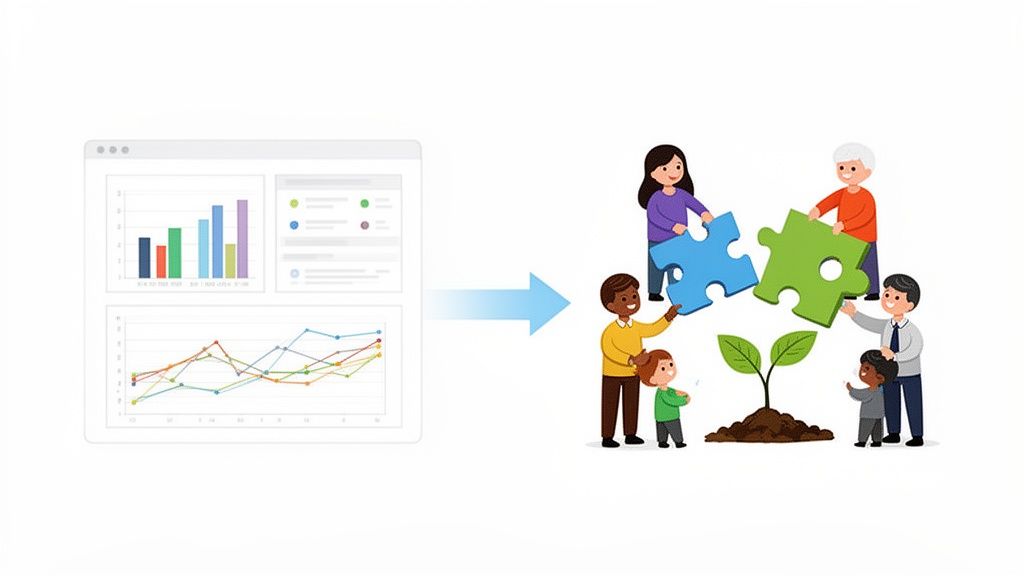
Imagine a pulse survey shows a low score on “feeling connected to the company’s mission.” That’s a decent start. But when you pair that with data showing only 15% of your team watched the latest all-hands recording, you suddenly have a powerful insight.
The problem isn't a lack of mission; it's a breakdown in how you're communicating it. And that’s a problem you can solve.
The Only Benchmark That Truly Matters
It’s tempting to compare your engagement scores to some industry average. We see it all the time. But let’s be honest: comparing your company in Ohio to a tech firm in Singapore is an exercise in vanity. It tells you very little about your own unique challenges.
The only benchmark that truly matters is your own past performance. Is communication improving month over month? Is cross-team collaboration trending up or down?
Your goal is to get better than you were yesterday. That’s it.
From Insights to Conversation
Once you’ve uncovered an insight, the worst thing you can do is keep it locked away in a report. The whole point of this work is to start a conversation, not to deliver a verdict.
Share your findings. And not just with the executive team. Share them transparently with the managers and teams they directly affect. Frame it not as a problem to be fixed, but as an observation to be explored together.
A great way to approach this is with an observation and an open-ended question:
"We noticed messages sent on Friday afternoons get much lower engagement than those sent on Tuesday mornings. What do you all think is going on there?"
"The sentiment in our team chat was overwhelmingly positive after the new shift-swapping feature launched. What about it is working so well for you?"
This simple shift turns managers and employees into partners in finding a solution. You’re not handing down a mandate; you’re inviting them to co-create an improvement. They are, after all, the experts on their own experience. After analyzing your data, it's crucial to implement actionable strategies to boost engagement and build a thriving workplace.
This entire process—observe, interpret, share, and discuss—isn’t a one-time project. It’s a continuous loop. It’s about making small, iterative improvements that add up over time. It’s how you stop chasing a score and start building a genuinely better place to work.
Common Questions About Measuring Engagement
We've covered a lot of ground on what it means to measure employee engagement in a more human, practical way. But I know moving from theory to practice always unearths a few more questions.
Let’s dig into some of the most common ones.
How Often Should We Be Measuring This Stuff?
First, let's agree to ditch the annual survey. It's a relic. Engagement is a living, breathing thing, and your measurement rhythm should reflect that.
The real answer depends on the cadence of your teams. For a fast-paced retail crew, a quick, single-question pulse survey each week might be perfect. For a project-based office team, a bi-weekly check-in could hit the sweet spot. The goal is to create a continuous, low-effort conversation, not an event everyone dreads.
Behavioral data is a different beast. You should be able to glance at this in near real-time. Think of it like checking the weather—you’re looking for patterns and shifts, not analyzing every cloud. The whole process should feel light and helpful, never like spying.
What’s the Real Difference Between Engagement and Satisfaction?
This one is critical. People use these terms interchangeably, but they are worlds apart.
Satisfaction is transactional. It’s about being content with the basics—pay, benefits, the quality of the desk chair. It answers the question, "Is this job good enough for now?" A satisfied employee might be fine clocking in and out, but they aren’t bringing their best ideas to the table.
Engagement is about emotional commitment. It’s the connection an employee feels to the company’s mission and their willingness to invest discretionary effort. An engaged employee is the one who helps a swamped colleague, suggests a smarter way to do something, or stays a few extra minutes to get a project over the line—not because they have to, but because they care.
We focus on engagement because that’s the fuel for growth. It’s what builds a resilient, innovative culture.
I once worked with a company where everyone was "satisfied." The pay was good, the hours were fair. But the business was stagnant. The spark was missing. True engagement is the difference between a team that just works and a team that wins.
How on Earth Do We Measure Engagement for Our Frontline Workers?
This is where traditional methods completely miss the mark. You can’t email a long survey to a warehouse worker or a barista and expect a thoughtful response. It's not part of their workflow.
The key is to meet them where they are. This means using mobile-first tools that fit naturally into their day.
One-Tap Surveys: Send a quick pulse question directly to their phone through an app they already use for schedules or communication. A single tap to respond takes two seconds.
Look at Relevant Behavioral Data: Focus on signals that matter in their roles. Are they acknowledging shift changes promptly? Are they accessing new training materials? Are they using team chat to coordinate handoffs?
For frontline teams, engagement often boils down to feeling connected, heard, and supported. You measure that by looking at how easily information flows and how quickly questions get answered. It’s about making connection an easy part of the job, not another task on the to-do list.
Is It Possible to Cause "Survey Fatigue"?
Oh, absolutely. And it’s one of the biggest reasons engagement efforts fall flat.
Survey fatigue happens for two main reasons: you ask too many questions too often, and—this is the big one—people see zero action taken as a result of their feedback. It quickly teaches them that their voice doesn't matter, so why bother?
The solution is to be incredibly intentional.
Keep it short. I'm serious. One to three questions, max. Show you respect their time.
Close the loop. This is the most important part. Share the high-level findings and, crucially, explain what you’re doing about it.
When people see that their input leads to a real improvement, they stay invested. It's not about the quantity of your measurements; it's about the quality of the conversation it starts.
Turning these insights into action is where the real work—and the real reward—begins. If you're tired of guessing and want to see what a unified platform for communication and engagement actually looks like, Pebb brings everything together in one simple app. See how you can connect your team and get a real-time pulse on your organization’s health.
