10 Task Prioritization Techniques to Stop Guessing and Start Doing
Stop drowning in tasks. Learn 10 proven task prioritization techniques to bring calm and focus to your team's work, from the Eisenhower Matrix to RICE.
Dan Robin
It’s the universal truth of work: the list is always longer than the day. For years, we’ve watched teams—in offices, warehouses, hospitals, and retail stores—drown in a sea of ‘urgent’ tasks. Everyone’s busy, but is anyone actually making progress on what matters? The problem isn’t a lack of effort; it’s a lack of clarity.
We’ve all been told to just work harder, to multitask, to hustle. It’s terrible advice. The real fix isn’t about doing more, it’s about doing the right things in the right order. This isn't about finding a magical 'productivity hack' or filling out one of the best productivity planners without a system. It’s about adopting a shared framework.
At Pebb, we've spent years observing how the calmest, most effective teams operate. They don’t guess what’s important. They have a language for it. Here’s the thing: mastering a few simple task prioritization techniques is the difference between constant chaos and confident progress.
So let's stop reacting and start choosing. We're going to walk you through 10 battle-tested methods that actually work, especially for teams spread across different shifts and locations. No theory, just practical steps to help your team decide what to do next.
1. Eisenhower Matrix (Urgent vs. Important)
We’ve all been there. A dozen things clamor for our attention, and everything feels like a top priority. It’s easy to get caught in a cycle of just reacting to the loudest alarm. The Eisenhower Matrix cuts through the noise with a simple, powerful question: is this task urgent, important, both, or neither? Made famous by President Eisenhower and later Stephen Covey, it’s one of the most effective task prioritization techniques because it forces clarity.
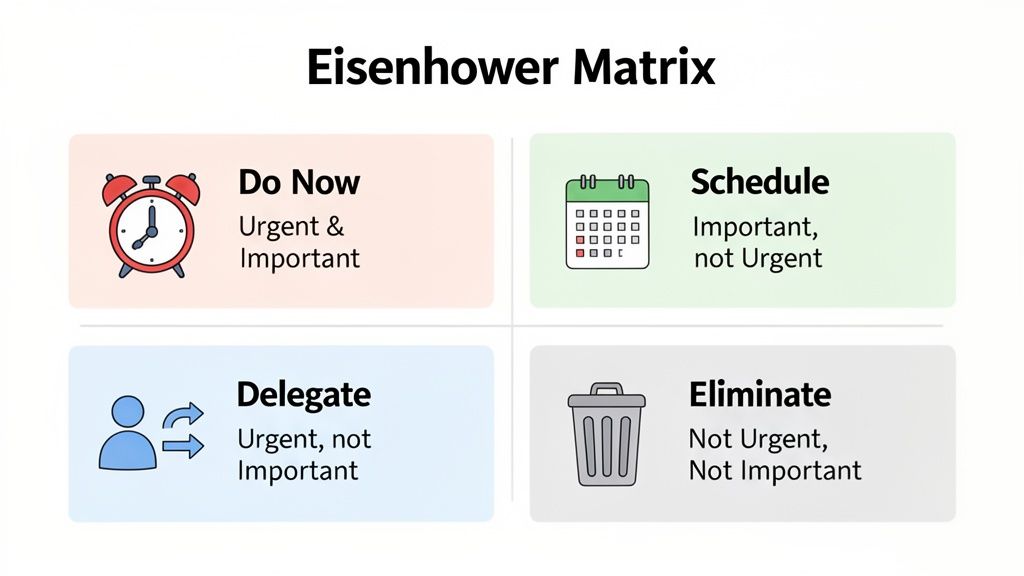
The magic lies in its four quadrants:
Do (Urgent & Important): Crises and deadlines. A retail manager handling a customer emergency or a warehouse team dealing with a critical inventory shortage. This is work you can't ignore.
Schedule (Important, Not Urgent): Strategic work. This is where real growth happens. Think staff training, process improvements, or planning next month’s schedule.
Delegate (Urgent, Not Important): Interruptions that feel pressing but don't require your skills.
Eliminate (Not Urgent, Not Important): Time-wasters that can be dropped.
The real challenge is protecting Quadrant 2. It’s the work that gets pushed aside for Quadrant 1 fires. A practical way to implement this is to use a shared tool to tag every new request by its quadrant. This gives your entire team, from the front desk to the back office, immediate clarity. We recommend blocking out calendar time specifically for Quadrant 2 activities—it’s the only way to ensure they get done.
2. ABCDE Method (Priority Ranking)
Sometimes, the most complex problem needs the simplest answer. When your team faces a long list of tasks and needs to know what to tackle first, a clear, direct ranking system is invaluable. The ABCDE Method is one of the most effective task prioritization techniques for this very reason. It trades complex quadrants for a straightforward alphabetical ranking. Developed by Brian Tracy, it brings immediate clarity to any to-do list, which is especially powerful in fast-paced frontline environments.
The method assigns a letter to each task based on its consequence:
A (Must-Do): Absolutely critical tasks with serious consequences if not completed. A hospital shift leader would label urgent patient care as an 'A' task.
B (Should-Do): Important tasks, but with milder consequences if delayed. Think of a retail team restocking shelves after a delivery.
C (Nice-to-Do): Tasks that would be good to get to but have no negative impact if left undone, like reorganizing a promotional display.
D (Delegate): Tasks that someone else can and should do. A restaurant manager might delegate calls to a delivery vendor.
E (Eliminate): Non-essential tasks that can be dropped, like organizing outdated supplies that are about to be discarded.
The golden rule is to never work on a 'B' task when an 'A' task is unfinished. The key to making this work is discipline. We recommend training supervisors to use a task management software to assign these labels daily at the start of a shift. By posting the day's 'A' and 'B' priorities in a shared space, everyone on the team knows exactly where to focus their energy from the moment they clock in.
3. MoSCoW Method (Must, Should, Could, Won't)
When a new project kicks off, the list of requests can feel endless. Everyone has a “must-have,” and it’s tough to separate what's truly essential from what’s just a nice idea. The MoSCoW method is one of the most practical task prioritization techniques for bringing clarity to group projects. Developed for software development, it moves the conversation from "what do we want?" to "what do we actually need to succeed?".
The framework gets its name from four simple categories:
Must Have: Non-negotiable requirements. For a new store opening, this means having staff hired and registers operational. The project fails without these.
Should Have: Important but not vital for launch. These are high-value items that can wait if necessary, like completing advanced staff certifications.
Could Have: Desirable, small-effort additions. Think of these as bonuses if time and resources permit, such as creating a special local marketing campaign.
Won't Have: Items explicitly ruled out for the current project. This is crucial for managing expectations, like deciding you won't build a custom ordering app for the launch.
The real benefit comes from getting everyone on the same page. We recommend using a shared space to host these MoSCoW discussions with your teams. Documenting your 'Won't' list is just as important as your 'Must' list; it gives you a clear 'no' to reference when stakeholders ask for more. Review these priorities quarterly. Business needs can shift quickly.
4. RICE Scoring (Reach, Impact, Confidence, Effort)
When you're trying to compare wildly different projects—a new training program versus a software update—gut feelings don't cut it. How do you decide which one delivers more value? The RICE scoring model, first popularized by the team at Intercom, is one of the best quantitative task prioritization techniques because it gives you a concrete formula to weigh your options. It removes the emotion and forces you to think critically about four key factors.
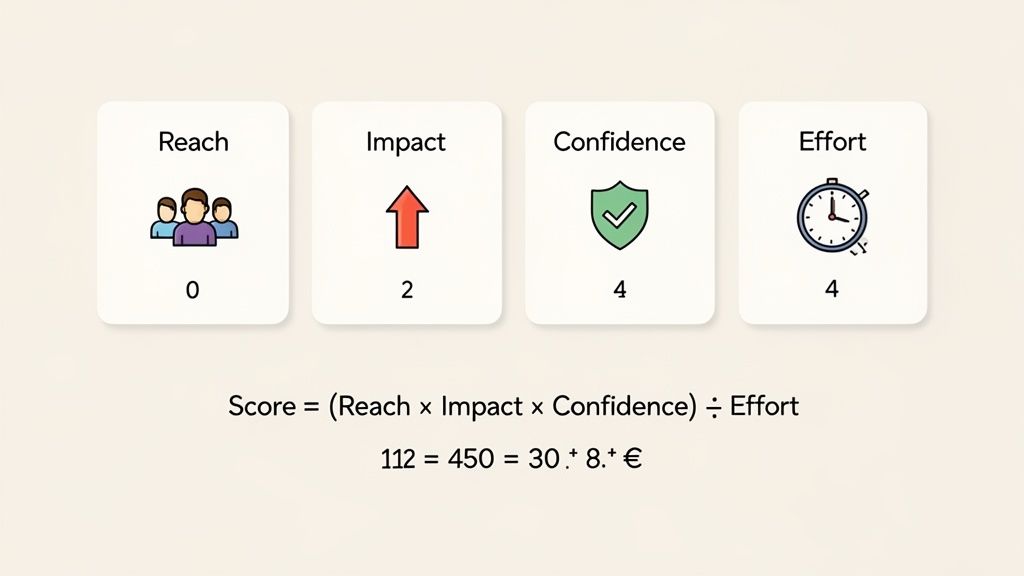
The score is calculated with a simple formula: (Reach × Impact × Confidence) ÷ Effort. Here’s what each part means:
Reach: How many people will this project affect in a specific period? Think employees, customers, or users.
Impact: How much will this project affect each person? A 1-10 scale works well.
Confidence: How certain are you about your estimates? This is expressed as a percentage.
Effort: How many person-hours or resources will this project require?
The power here is objectivity. A project might have massive reach but low impact, while another has a smaller reach but transforms the workflow for that group. For example, a new scheduling feature might score a 78.75, while a company-wide training update scores 148.75, making it the clear priority. We recommend using real data for your "Reach" estimate instead of just guessing. By sharing the final RICE scores, you show your teams the "why" behind every big decision, building trust and alignment.
5. Kano Model (Customer Satisfaction Analysis)
Not all tasks are created equal, especially when it comes to how your customers (or employees) perceive them. The Kano Model, developed by quality management expert Noriaki Kano, is a brilliant task prioritization technique because it helps you see your work through your users’ eyes. It moves beyond a simple "important/unimportant" scale and instead asks: how will this work impact satisfaction?
The model sorts features and tasks into three main categories:
Basic Needs: These are the absolute must-haves. If they’re missing, people are dissatisfied. For a healthcare setting, this means secure communication is non-negotiable. It doesn’t win you points, but its absence creates huge problems.
Performance Needs: With these features, more is better. Faster chat loading speeds in an employee app or mobile shift access for retail staff directly increase user satisfaction. The better they perform, the happier the user.
Delighters: These are the unexpected, delightful surprises that create loyal fans. Think AI-suggested responses in a chat tool or predictive scheduling recommendations for managers. Users don't expect them, but they love them when they discover them.
The key is to ensure all your Basic Needs are met before pouring resources into Performance or Delighters. We recommend surveying your teams quarterly to map features to these categories. Use this analysis to create a clear roadmap that balances stability with exciting new capabilities.
6. Timeboxing & Time Blocking
If you’ve ever felt a day slip away reacting to constant pings and interruptions, you’re not alone. The problem often isn’t the work itself, but how we approach our schedule. Timeboxing and its cousin, time blocking, are powerful task prioritization techniques that shift your mindset from "work until it's done" to "work on this for a fixed amount of time." Made popular by Cal Newport in his book Deep Work, this method enforces discipline and protects your focus.
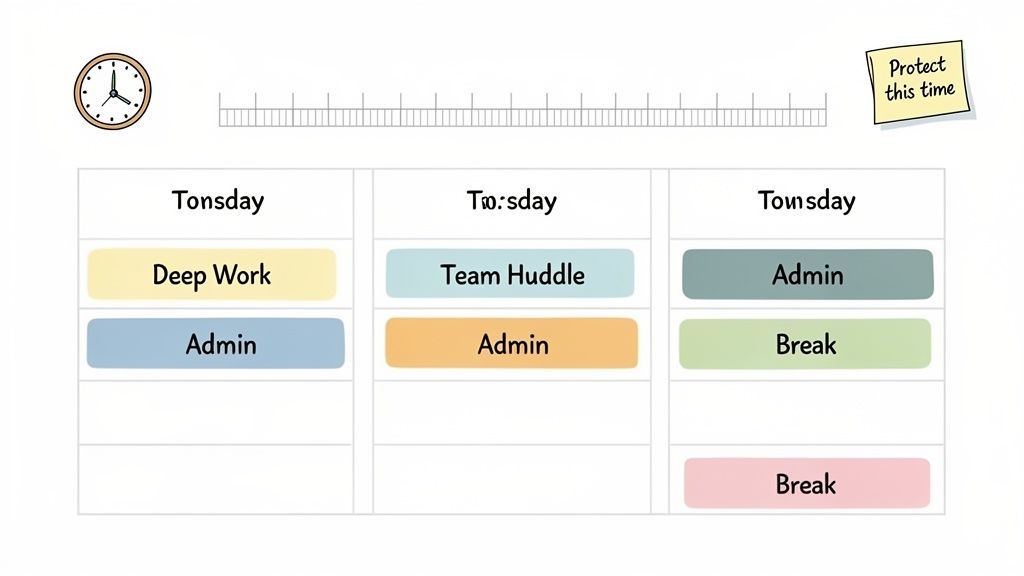
The idea is to assign every minute of your workday a job. Instead of a to-do list, you have a concrete schedule:
Time Blocking: You assign blocks of time to categories of work. For an operations manager, this could be 8-9am for strategic planning (undisturbed), 9-12pm for handling team issues, and 1-3pm for site visits.
Timeboxing: This is a bit stricter, setting a fixed time limit for a single task. For example, "I will spend exactly 45 minutes on the weekly report and then stop." This prevents perfectionism and keeps things moving.
This is a game-changer for leaders who are constantly pulled in multiple directions. It ensures all areas of responsibility get attention. You can use your calendar to schedule your blocks and set your status to "focused" to signal to your team that you're in deep work. Building an effective schedule is a huge part of this, and there are many tools that can help with online employee scheduling. Start your week by reviewing your blocks and communicating your schedule to your team. It creates predictability for everyone.
7. Dependency Mapping & Critical Path
For complex projects like a new store opening or a major system rollout, tasks don't exist in a vacuum. A delay in one area can cause a domino effect, derailing the entire timeline. Dependency Mapping and the Critical Path method are essential task prioritization techniques for seeing how tasks are connected and identifying the single sequence of activities that dictates the project's total duration.
The goal is to visualize the "must-happen-first" order of operations:
Identify Dependencies: Recognize which tasks can't start until others are finished. You can’t train staff until you’ve hired them, and you can’t receive inventory until the location is secured.
Map the Critical Path: This is the longest chain of dependent tasks. A delay to any task on this path directly delays the project's completion date.
Find Slack: Tasks not on the critical path have "slack," meaning they can be delayed slightly without impacting the final deadline.
The power here is focus. It tells your team exactly which handful of tasks will make or break the timeline. For instance, when rolling out a new platform in a hospital, the critical path might be IT setup → platform configuration → pilot unit training. Communicating this path gives everyone clarity on why certain tasks get top priority. Building buffer time into critical path items protects your timeline from cascading delays. To learn more, explore our guide on how to manage workflow dependencies across teams.
8. Purpose-Driven Prioritization (Impact on Goals)
It’s easy to get lost in the weeds of daily tasks, putting out fires and responding to every request. Before you know it, a week has gone by, and you haven't moved the needle on what really matters. Purpose-Driven Prioritization is a powerful technique because it anchors every action back to the big picture. It moves beyond generic labels like "urgent" and asks a more meaningful question: "Does this task directly support our strategic goals?"
Popularized by frameworks like OKRs (Objectives and Key Results), this method is ideal for aligning teams, especially those spread across different locations. Instead of just working hard, everyone is working smart on the same mission. The idea is to define a few critical organizational goals and use them as the primary filter for all incoming work.
Goal: Reduce Labor Costs. A retail manager prioritizes optimizing staff schedules over exploring new convenience features.
Goal: Improve Patient Care Coordination. A healthcare team gives higher priority to new communication tools over minor cosmetic UI updates.
Goal: Enable a Stronger Frontline Culture. An HR leader focuses on culture initiatives first, ahead of routine bug fixes or feature requests.
To make this work, start by establishing 3-5 clear strategic goals for the year. Constantly reinforce these objectives in your team communications. When new tasks come in, tag them with the specific goal they support. This gives supervisors a clear way to explain why certain work takes precedence. It also builds strategic discipline by giving you a clear, objective reason to say "no" to work that doesn't align with the company's direction.
9. Energy-Based Prioritization
Not all hours in the workday are created equal. This is one of the most honest task prioritization techniques because it acknowledges a simple human truth: our energy and focus ebb and flow. Instead of treating team members like machines with constant output, this method prioritizes work based on the team’s actual capacity. It's about matching the right task with the right mindset at the right time.
This human-centered approach moves beyond just deadlines and importance. It asks a different set of questions: When is my team sharpest? Who is best suited for this task right now? What work can be done effectively during a low-energy afternoon lull?
High-Energy Tasks: Complex, creative, or physically demanding work. Schedule these during peak productivity windows. For a restaurant, this is the morning crew handling intricate prep. For a warehouse, it's getting all physical receiving done before lunch.
Low-Energy Tasks: Routine, administrative, or less demanding work. These are perfect for energy dips. Think a hospital unit scheduling documentation for the end of a long shift or a retail team handling simple restocking in the late afternoon.
The key is to treat your team’s energy as a valuable, finite resource. Talk with your people to understand their rhythms. For instance, high-focus work can be assigned during a specific time block when you know your team is at its best. This isn’t about micromanaging; it’s about setting your people up for success by respecting their natural rhythms.
10. Value vs. Effort Matrix
When your resources are tight and every minute counts, you need to know where your effort will make the biggest impact. The Value vs. Effort Matrix is one of the most practical task prioritization techniques for exactly this scenario. It cuts straight to the point by asking you to plot tasks on a simple grid: how much value will this bring, and how hard is it to do? This approach, common in agile and lean frameworks, helps resource-constrained teams get the maximum return on their work.
The framework divides tasks into four clear categories:
Quick Wins (High Value, Low Effort): Do these first. For a retail team, this could be responding to urgent customer messages or fixing broken links on your product page. They deliver immediate value and build momentum.
Major Projects (High Value, High Effort): Plan these carefully. This is where big strategic goals live, like redesigning your scheduling system or implementing a new platform like Pebb.
Fill-ins (Low Value, Low Effort): Fit these in when you have downtime. Think organizing digital files or making minor documentation updates.
Time Sinks (Low Value, High Effort): Avoid these entirely. This includes things like excessive meeting prep for low-stakes updates or chasing perfection on already-completed work.
The goal is to focus the bulk of your energy on Quick Wins and Major Projects. We recommend creating a simple grid to show your team’s priorities and help them understand why certain tasks come first. Use it to push back on time-sink requests by saying, “That falls into our Time Sinks quadrant; let’s find a higher-value approach.” This simple visual tool gives everyone permission to focus on what truly moves the needle.
Top 10 Task Prioritization Techniques — Quick Comparison
Method | 🔄 Implementation Complexity | ⚡ Resource requirements & Efficiency | ⭐ Expected outcomes | 📊 Ideal use cases | 💡 Key advantages / tips |
|---|---|---|---|---|---|
Eisenhower Matrix (Urgent/Important) | Low — intuitive four-quadrant system | Minimal tools; fast to apply | Focused work; fewer reactive interruptions | Frontline teams, high-interruption environments | Simple to teach; review weekly; block time for Quadrant 2 |
ABCDE Method (Priority Ranking) | Very low — label-based ranking | Minimal; very quick for shifts | Immediate clarity on critical tasks | Shift-based ops, fast-paced supervisors | Limit A tasks to ~20%; use color labels for handovers |
MoSCoW Method (Must/Should/Could/Won't) | Medium — needs stakeholder alignment | Moderate planning effort; useful for scope decisions | Clear scope, reduced scope creep | Cross-functional projects, multi-location initiatives | Document "Won't"; hold facilitation sessions; review quarterly |
RICE Scoring (Reach/Impact/Confidence/Effort) | High — quantitative scoring & calibration | High data and estimation effort; slower process | Objective comparability across initiatives | Enterprise programs; analytics-driven prioritization | Standardize rubric; share scores; pilot low-confidence items |
Kano Model (Customer Satisfaction Analysis) | Medium — requires customer research | Moderate (surveys/interviews); research time | Better customer-aligned feature decisions | Product-led orgs; prioritizing features by delight vs need | Survey users regularly; ensure basics are reliable first |
Time Boxing & Time Blocking | Low–Medium — discipline required | Low tooling (calendar); boosts focus and throughput | Improved time management; less perfectionism | Supervisors, managers juggling interruptions | Protect blocks, add buffers, review planned vs actual |
Dependency Mapping & Critical Path | High — detailed mapping of dependencies | High upfront effort; ongoing maintenance | Realistic timelines; fewer downstream delays | Complex rollouts, store openings, system rollouts | Map with all stakeholders; identify top 2–3 critical tasks |
Purpose-Driven Prioritization (Impact on Goals) | Medium — needs clear strategy communication | Moderate; relies on goal-setting & tagging | Strong alignment to strategy; higher motivation | Distributed teams aligning toward shared goals | Define 3–5 goals; tag tasks to goals; say no to off-strategy work |
Energy/Capacity-Based Prioritization | Medium — requires knowledge of team capacity | Moderate scheduling effort; adaptive efficiency gains | Reduced burnout; higher completion and morale | Shift work, frontline teams with varying capacity | Survey peak times; schedule cognitive tasks at peaks; rotate load |
Value vs. Effort Matrix (2×2) | Low — simple visual quadrant | Low effort; fast ROI-focused decisions | Quick wins identified; waste reduced | Resource-constrained teams, fast decision-making | Revisit estimates monthly; prioritize quick wins for momentum |
It's a Conversation, Not a Science
We’ve just walked through ten distinct task prioritization techniques. If you’re feeling a bit overwhelmed, take a breath. The goal isn’t to master all ten by next Tuesday.
Let’s be honest. Any one of these frameworks is better than the default method, which is often “loudest person in the room” or “most recent email.” The point isn’t to find the single, perfect system that will solve all your problems forever. That system doesn’t exist.
Instead, think of these techniques as a shared language. They are tools for starting a conversation with your team about what truly matters. Clarity is the real product here. When a frontline retail associate understands why restocking a key item (Value vs. Effort) is more important than a minor tidying task, they can make smart decisions without needing a manager’s approval for every little thing. When an office team uses the MoSCoW method for a project, everyone leaves the meeting knowing exactly what the “Must Haves” are. That's the goal.
The most effective teams we've seen don’t marry one method. They date them. They might use a simple ABCDE list for daily check-ins but pull out Dependency Mapping for a complex, multi-stage project. They experiment, they talk, and they adapt.
So, here’s your next step: pick one. Just one. Choose the one that seems most applicable to a problem you're facing right now. Try it for a week with your team. Then, talk about it. Did it help? Did it make things clearer or just more complicated? Did it reduce the feeling of being overwhelmed? The right system is simply the one that helps your team end the day feeling a sense of accomplishment, not just exhaustion.
Remember that getting organized is only one piece of the puzzle. Truly effective work requires a mind that's rested and ready. There's a direct link between productivity and sleep, and ignoring it means you’re fighting with one hand tied behind your back. Master your priorities, but also protect your rest. The combination is what truly creates sustainable performance. Great task prioritization isn't about perfectly managed lists; it's about well-led people who feel confident, clear, and capable of making a real difference.
The best techniques are useless if they live in a spreadsheet nobody sees. Pebb brings these conversations into your team's daily workflow, making priorities visible, actionable, and easy to track from the front line to the back office. See how you can put these ideas into practice by checking out Pebb.
