
How to Decrease Employee Turnover (Without Just Throwing Money at It)
Discover how to decrease employee turnover with practical strategies that go beyond perks. Learn to fix the real reasons your best people are leaving in 2026.
Dan Robin
Let’s get one thing straight. People rarely leave a job just for more money. They leave because of a thousand little papercuts. They leave because of chaotic schedules, managers who are nowhere to be found, and the quiet, creeping feeling that they’re just a replaceable part. If you want to stop your best people from walking out the door, you have to fix the work itself.
Why Your Best People Are Quietly Leaving
We’ve all seen it. A company with great pay and shiny perks that still has a revolving door. Why? Because no amount of free lunch can fix a broken daily experience.
This problem is sharpest for your frontline teams—the people actually running your business. The cashiers, nurses, drivers, and warehouse crews. They aren't just cogs in a machine; they’re the face of your company. And they’re burning out.
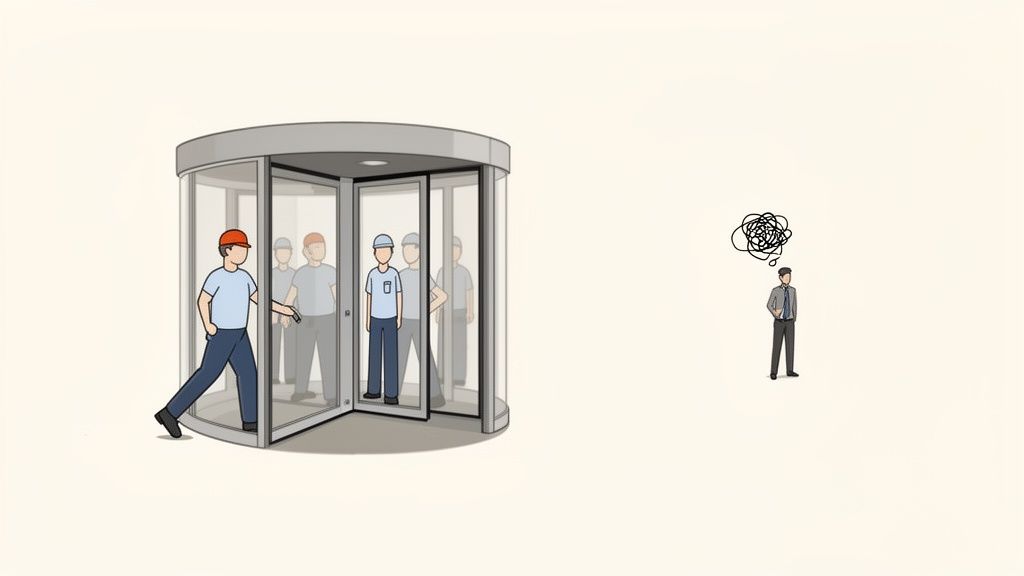
They leave because of small frustrations that pile up until they become unbearable. The schedule that changes with no warning. The manager who only shows up to point out what’s wrong. The feeling that their ideas and complaints disappear into a black hole.
This isn’t just a morale problem. It’s a massive, hidden cost. Every time a good person leaves, you lose their experience, their customer knowledge, and the stability they brought to the team. The ripple effects are huge.
The Real Cost of the Revolving Door
We tend to underestimate how much turnover actually costs, especially in industries that rely on a large frontline workforce. The constant churn of hiring and training isn’t just an HR headache; it’s a direct hit to your bottom line.
The True Cost of Turnover Across Key Industries
Take a look at the average turnover rates and what it costs to replace a single employee in these sectors.
Industry | Average Total Turnover Rate (2025) | Average Cost Per Employee Lost |
|---|---|---|
Retail | 26.7% | $12,500 |
Hospitality | 31.2% | $7,800 |
Healthcare | 22.5% | $52,350 |
Warehousing | 43.0% | $9,750 |
For a mid-sized company, these numbers add up to millions of dollars a year spent on recruiting, training, and lost productivity.
But that's only half the story. The real damage is to your culture. When good people leave, the ones who stay start to wonder why they’re still there. Morale drops. The team gets stretched thin, picking up the slack and burning out even faster. Unmanaged stress is a silent killer of retention; learning how to prevent burnout at work is a critical piece of the puzzle.
The "quiet quitting" you hear about isn't some new fad. It's the sound of people checking out long before they hand in their notice. It's what happens when they feel ignored.
The usual fixes—the annual survey, the pizza party, the suggestion box—miss the point entirely. They’re like putting a bandage on a compound fracture. They might look like you’re doing something, but they don’t fix the broken bone underneath.
To actually decrease employee turnover, you have to stop treating it as an HR problem and start seeing it as an operational one. It’s about how work gets done. It’s about communication, clarity, and connection.
Before we get into solutions, we have to sit with that diagnosis. Your best people aren't leaving for one big reason. They're leaving because of a hundred small ones. Our job is to find those papercuts and start healing them.
Make Your Managers the Reason People Stay
We’ve all heard the line: “People don’t leave companies, they leave managers.” We nod because we know it’s true. But what do we do about it? We promote our best individual contributors into management, give them a pat on the back, and hope for the best.
That’s a recipe for disaster.
A manager who can’t build a fair schedule, offer a single piece of meaningful recognition, or communicate a simple update is a walking turnover machine. They create chaos. And chaos drives good people away. It’s not that they’re bad people; it’s that we’ve given them bad tools.
Expecting a manager to build a great team culture with spreadsheets, messy group texts, and a bulletin board is like asking a chef to cook a five-star meal with a pocketknife and a campfire. It’s messy, inconsistent, and exhausting for everyone involved. You can’t reduce turnover by burying your managers in administrative work.
The answer is to give them one simple, central place to do the work that actually matters.
From Administrative Nightmare to Culture Champion
From what I’ve seen, the best managers aren't HR experts or motivational speakers. They're just incredibly organized and consistent. They make work feel fair, predictable, and human.
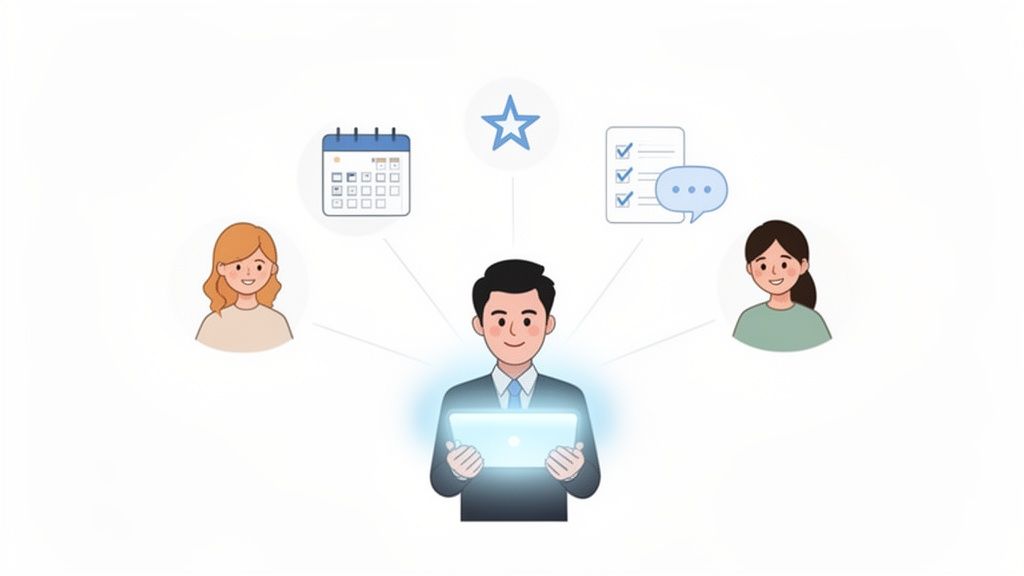
Imagine if your managers could see everything they needed in one spot. A clear team schedule to handle shift swaps in a few taps. A simple way to assign the day’s tasks and see what’s getting done. A direct line to every employee to send an urgent update or a public shout-out that the whole team actually sees.
This isn’t about micromanagement. It’s about removing the friction that turns good managers into frustrated ones. When a manager spends their day fighting logistics, they have no energy left for the people part of their job.
When you simplify a manager's daily grind, you give them the space to actually lead. They can finally focus on coaching, listening, and spotting burnout before it becomes a two-week notice.
The data agrees. A bad relationship with a manager is the root cause of about 50% of voluntary turnover. A 2024 report from Gallagher found that 66% of HR leaders are focused on retention. The companies actually moving the needle are the ones investing in better tools for their frontline leaders, often seeing retention improve by 20-30%. You can read the full report on turnover trends for the details.
Give Your Managers the Right Tools for the Job
The right tool doesn’t just help manage tasks; it changes behavior. We built Pebb with this exact idea in mind. When you put everything a manager needs into one intuitive app, you help them shift from being a bottleneck to being a true culture builder.
Here’s what that looks like in the real world:
A retail manager uses the news feed to celebrate an employee who handled a tough customer with grace. The whole team sees it and feels a shared sense of pride.
A hospital supervisor notices an engagement dip in the team analytics. They pull a quiet nurse aside to check in, heading off potential burnout.
A warehouse lead uses a team space to share safety updates and ask for feedback, making every employee feel heard.
These are small, consistent actions that make people feel seen and valued. This is what great frontline leadership is all about, and it’s why good supervisor communication skills are essential.
The path to lower turnover runs straight through your managers. But you can't just tell them to "be better." You have to give them the tools that make "better" the easiest way to work. When you do that, they stop being the reason people leave and become the reason they stay.
Turning Onboarding from Chaos to Connection
We’ve all seen the new hire's first day. It’s less of a warm welcome and more of a frantic scavenger hunt. Where’s my schedule? Who do I ask about payroll? What’s the Wi-Fi password? They get a stack of papers, a vague gesture toward a dusty binder, and are left to fend for themselves.
This isn't just sloppy; it sends a clear message: “You’re on your own.”
That chaos sets a terrible tone. It tells a new employee they aren't important enough for a thoughtful welcome. It’s a huge, unforced error. Why would anyone stick around a place that can't even get day one right?
That first week is your single best chance to make someone feel like they belong. It’s not about swag or grand gestures. It’s about two simple things: clarity and connection. It’s making sure they know what’s expected and who to turn to for help.
From Paperwork to Purpose
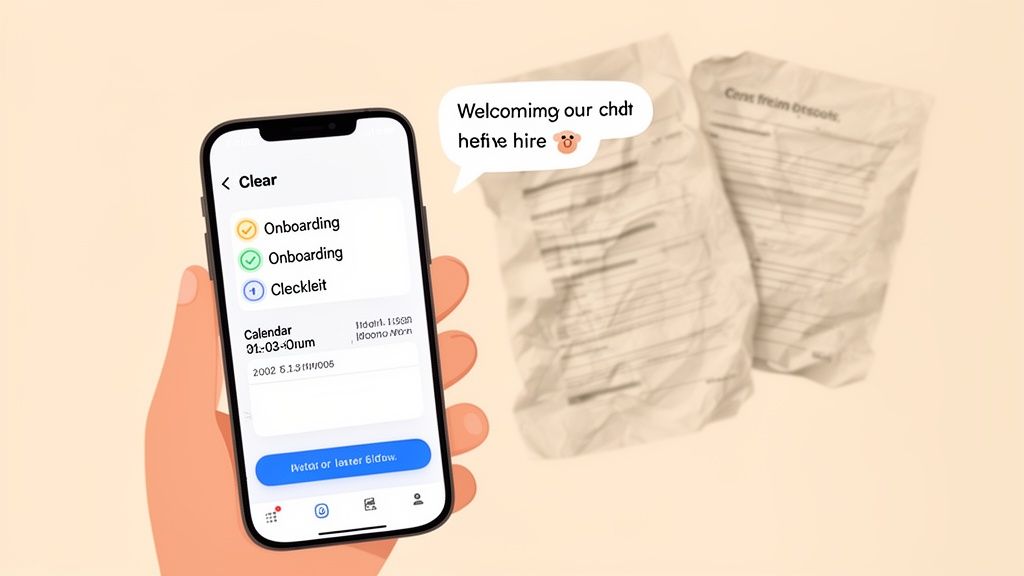
The fix isn’t a thicker binder. It’s putting everything a new hire needs in the one place they’re guaranteed to have it: their phone. When you centralize all that information, you swap confusion for confidence.
Imagine a new employee opening an app on their first day and finding:
Their schedule for the first two weeks. No more guessing games.
A welcome video from the CEO. A simple message that connects them to the mission.
A digital library of key documents. The handbook, safety guides, and benefits info, all a tap away.
A clear checklist of onboarding tasks. They can see their progress and know exactly what to do next.
This is just modern, thoughtful operations. You're showing them, not just telling them, that you respect their time and are invested in their success. When you organize their experience, you prove you're an organized company. That’s a place people want to work. To get this right, use our guide to build a new employee onboarding checklist that covers everything.
The goal of onboarding isn't to get paperwork signed. It's to prove to your new hire that they made the right choice.
Making Connections That Stick
But information is only half the battle. The other, more important half is human connection. People stay at jobs where they have friends. Your onboarding process should be designed to spark those relationships.
A dedicated space for new hires—like a group chat or a private channel—can be a game-changer. It gives them a safe place to ask the “silly” questions they might be too shy to ask a manager. They can share stories, find a lunch buddy, and realize they’re all in the same boat. It’s an instant peer support system.
Combine that with your main company news feed, and you put cultural integration on the fast track. A new hire can immediately see public praise for a job well done, get updates on company milestones, and see photos from the last team event. They’re not just learning about the culture; they’re experiencing it.
This has nothing to do with forced fun. It’s about creating an environment where real relationships can form. When a new hire feels connected to their coworkers, their commitment deepens. They start to see a future with you.
A chaotic onboarding process reveals a lack of care. Fixing it sends a powerful signal that you’re building a place where people are seen, supported, and set up to win. And that is the foundation for keeping your best people around for good.
Building a Culture That Reaches Beyond HQ
Let's be clear: real culture has nothing to do with ping-pong tables or free kombucha. Those things only matter if you work at headquarters. For most of your people in stores, hospitals, or warehouses, the corporate office is a world away. Their culture is what they experience on their shift, in their location, with their immediate team.
When we talk about culture for a distributed workforce, what we're really talking about is connection.
It’s the feeling of being part of something bigger than your daily tasks. It’s knowing who to call when you're stuck and celebrating a win with your teammates. It’s trusting that the people leading the company have your back.
Without that glue, work feels transactional. People feel like cogs in a machine—replaceable and disconnected. That’s a breeding ground for turnover.
Putting a Face to a Name
It’s hard to feel connected to people you don’t know. For an employee in a satellite store, the rest of the company might as well be on another planet. A simple, searchable people directory changes this overnight.
Suddenly, they can put a face to the name of the regional manager they’ve only seen in emails. They can find the right person in payroll without jumping through hoops. It sounds simple, but making people findable makes the entire organization feel more human. It says, "We're all on the same team here."
A directory isn't just a list of names. It’s a map that helps people see where they fit. It's the first step in breaking down the silos that naturally form when teams are spread out.
Creating Space for Real Camaraderie
Work isn't just about work. The friendships and inside jokes we build with colleagues are what get us through tough days. But you can't force these moments with top-down "fun" initiatives. You have to create the space for them to happen on their own.
This is where dedicated channels or "Spaces" for shared interests are so powerful. A space for pet lovers to share photos. Another for bookworms. One for parents to swap tips. These virtual gathering spots let people connect as people, not just as employees. It’s where a nurse on the night shift can bond with a logistics coordinator from another state over a shared love of hiking.
These small interactions build genuine camaraderie that spills over into the workday. When people have real relationships at work, they’re far more likely to stick around. Our guide on how to create a culture of belonging digs deeper into this.
Culture isn't a program you roll out. It's the sum of a thousand small interactions that make people feel seen, heard, and connected.
Making Leadership Visible and Human
For most frontline employees, leadership is an abstract concept. Who are these people making decisions that affect their daily lives? When communication only flows from the top down, it breeds distrust.
The antidote is transparent, regular updates from leaders. A quick video message from the CEO, a post celebrating a milestone, or an open Q&A in the company news feed makes leaders feel real. For inspiration, it's worth seeing what some of the top remote companies do to keep their teams aligned.
This isn’t about sharing polished corporate fluff. It’s about being honest about challenges, celebrating real wins, and connecting daily work back to the company’s mission. When an employee understands why their work matters, their job suddenly has meaning.
That feeling of shared purpose is what makes people want to stay. It’s what transforms a job into a career and a workplace into a community.
Your Practical Playbook for Reducing Turnover
Let’s get tactical. All the talk about culture is meaningless until you translate it into changes people can feel. This is a no-fluff playbook for making changes that actually lower your turnover numbers.
We're moving past the guesswork. It's time for measurable actions that directly address why people leave.
Start With the Highest-Impact Moves
When everything feels urgent, it's easy to get overwhelmed. The trick is to focus on a few things that have an outsized impact on your frontline teams. Don't try to boil the ocean.
Start here:
Simplify Scheduling: A chaotic schedule is a top reason good people quit. Make schedules predictable, transparent, and easy to manage from a phone.
Create Clear Career Paths: People need to see a future. Map out exactly what it takes to get from a frontline role to a team lead or manager.
Implement Consistent Recognition: Don't leave appreciation to chance. Build a simple, public way for managers and peers to celebrate good work.
These aren't one-off projects. They're new habits for your organization. The goal is to weave them into your daily operations. For example, a simple task tool can be used to assign onboarding checklists, ensuring every new hire gets a consistent, warm welcome.
This is a simple flow for building connection and culture, all from one place.
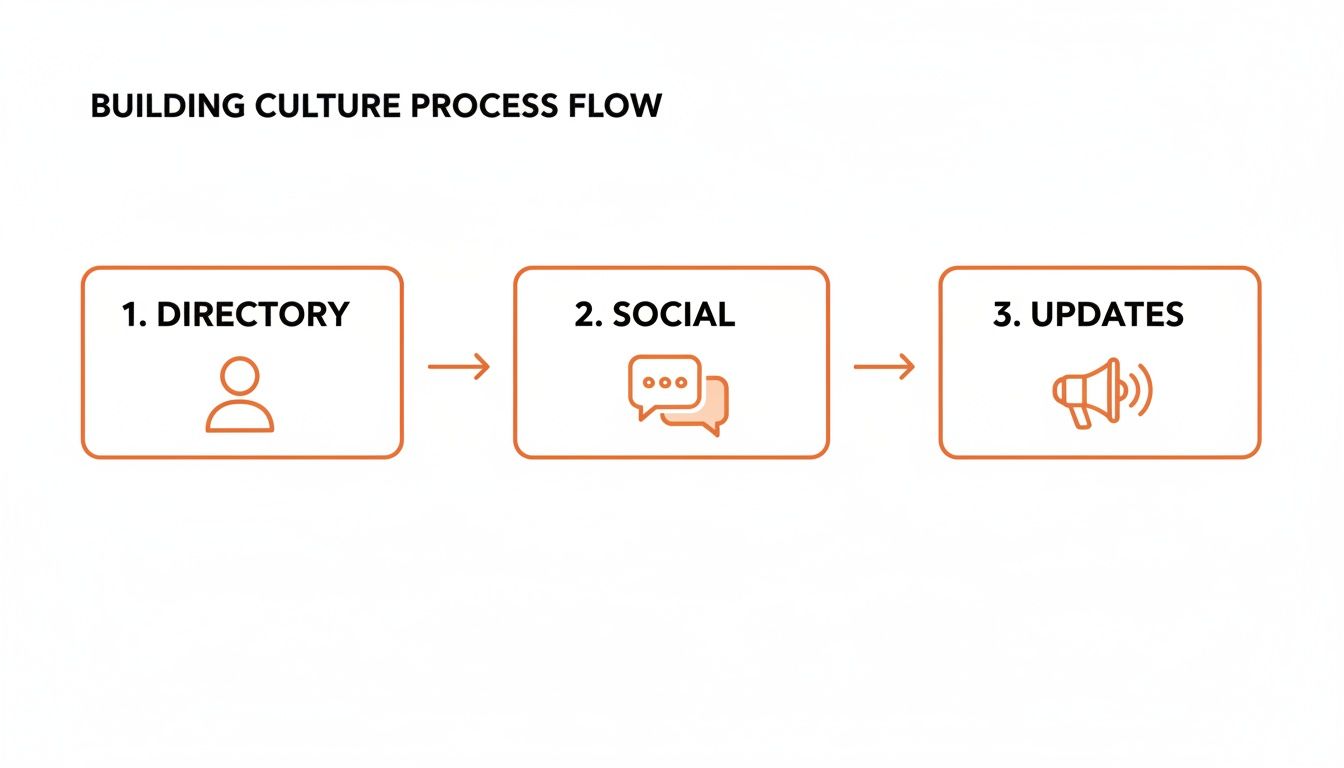
The image above shows how a simple directory, social spaces, and regular updates can work together to build a truly connected culture.
Use One Tool to Make It Stick
Want to know why most plans fail? Complexity. If your recognition program is in one system, schedules are in another, and updates are lost in email, you've already lost. The secret is to bring it all together.
Miscommunication is a massive driver of early exits, especially in demanding fields. Hospitals saw an average turnover of 20.7% in 2025, and for specialized roles, the replacement cost can be 200-400% of their salary. A staggering 54% of exits in the first six months are fueled by poor communication. By centralizing operations into one app, you can fix this. A digital knowledge library can house all your policies, while engagement analytics help supervisors spot problems early. I’ve seen managers bring turnover down by 15-25% just by getting everyone on the same page. You can read more about industry-specific turnover challenges at Achievers.com.
The right tool doesn't just solve a problem; it changes behavior. It makes the right way of doing things the easiest way.
A unified app makes your playbook real. You can use a news feed for public shout-outs. You can build dedicated spaces where teams connect. And you can track engagement analytics to see if what you're doing is actually working.
Measure, Learn, and Repeat
Finally, you have to track your progress. Don't just glance at your quarterly turnover rate and hope for the best. Monitor the leading indicators. Are more people reading company updates? Are they interacting in team channels? Is the feedback you're getting becoming more positive?
These are the early signals that tell you if you're on the right track. They give you the data you need to double down on what’s working and rethink what isn’t. Reducing employee turnover isn't a one-time project; it’s a continuous cycle of listening, adjusting, and improving the daily reality of your team. The playbook is simple, but the commitment to it is what separates the companies people leave from the ones they fight to stay with.
Got Questions About Employee Turnover? We've Got Answers.
We’ve covered a lot of ground. But a problem this big always leaves a few questions. Let's tackle some of the most common ones we hear from leaders who are serious about making a change.
What's the Single Biggest Mistake Companies Make?
Easy. They treat the symptoms, not the disease.
It’s tempting to throw money at the problem—a retention bonus, an across-the-board raise. That might stop the bleeding for a minute, but it does nothing to fix the underlying cause.
If the schedule is a mess, your manager is MIA, and you have no idea what’s going on, a little extra cash won't make you stay. It just makes a bad job a slightly-better-paying bad job. It doesn’t fix the frustrations that had you polishing your resume in the first place.
The real fix is deeper. It’s about getting the fundamentals right. Do your people have the tools and information they need to do their jobs? Do they feel like part of a team? Is their manager in their corner? That's the stuff that makes people want to work for you.
How Long Does It Really Take to See a Difference?
You can spot early signs of progress quickly, but seeing the turnover number drop takes patience. This is a marathon, not a sprint.
Within the first 90 days of bringing everything into one place with a tool like Pebb, you’ll see engagement metrics move. You'll notice more people reading company updates. Team channels will get livelier. The feedback you get might feel more constructive.
These early shifts are your green shoots. They're proof that you're on the right track.
But a real, sustained drop in your turnover rate? That usually takes 6 to 12 months. Lasting change needs time to build on itself. As you keep more people past that critical first year, and as your new way of communicating becomes the norm, the flywheel starts to pick up speed. Consistency is everything.
How Does This Apply to a Non-Desk Workforce?
This is the million-dollar question. The truth is, these strategies are most powerful for your non-desk teams. For too long, frontline workers have been an afterthought, left behind by technology and forced to rely on breakroom bulletin boards or messy group texts.
The key is simple: meet them where they are. And that’s on their phones. A mobile-first platform isn't a nice-to-have; it's a non-negotiable.
When you put everything an employee needs into one simple app, you’re finally giving them the same connection and access that your corporate teams have always had.
Schedules & Tasks: They can see their shifts and daily duties without tracking someone down.
Company News: They see big announcements at the same time as everyone else, not three days later.
Team Chat: They can connect with their coworkers, ask for help, and build the relationships that make work enjoyable.
This isn’t just about efficiency. It’s about dignity. It closes the gap between the front line and headquarters and makes every employee feel like they’re part of the same team. That’s how you stop just talking about reducing turnover and actually start doing it.
Fixing turnover isn't about one magic solution. It’s about making a hundred small, meaningful improvements to how your teams work, communicate, and connect every single day. Pebb is designed to bring all of those improvements together in one simple, unified app.
See how Pebb can help you build a workplace people won't want to leave.
