
Your New Employee Onboarding Checklist Is Broken. Here's How We Fixed Ours.
Ditch the chaos. Here's a proven, human-centered new employee onboarding checklist to help new hires feel welcome, prepared, and ready to contribute.
Dan Robin
We’ve all been there. The first day at a new job. Awkwardly searching for the coffee machine, drowning in a firehose of names and acronyms. A good first week feels like a warm welcome. A bad one feels like being dropped into the deep end without a life vest. For years, we treated onboarding as a mountain of paperwork—a box to be checked. We learned the hard way that the first few days don't just set an employee's initial productivity; they set the tone for their entire journey with us. They decide whether someone feels like a teammate or just another headcount.
So we threw out the old, sterile checklist and built something more human. This isn't just a list of tasks. It’s our philosophy on how to welcome people well, broken down into a practical new employee onboarding checklist you can actually use. It covers everything from the pre-boarding handshake and first-day welcomes to setting clear 30-60-90 day goals and getting them the right training for their role.
We’ll share how we manage this for everyone, whether they're working a frontline shift or sitting in the main office. The goal is simple: set your people up for success from the moment they say 'yes', not just the day they show up.
1. Pre-Boarding: The Welcome Before the Welcome
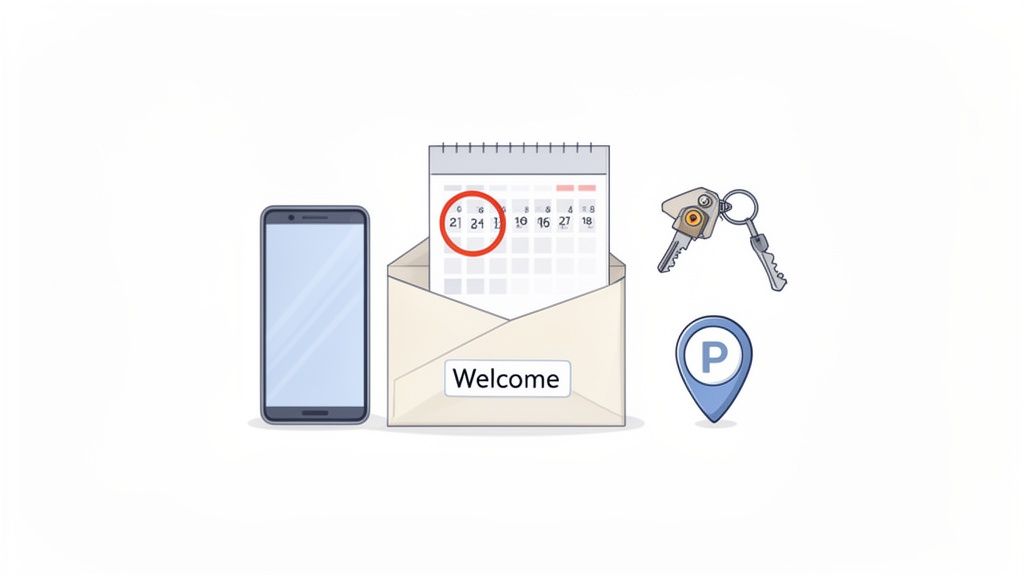
The time between a candidate signing an offer and their first day is often a dead zone. This silence breeds anxiety and makes a new hire feel like an afterthought. We decided to transform this gap into a genuine welcome. It’s our first chance to show them we’re organized, excited, and ready for them. This isn't just about paperwork; it's the first real taste of your company culture and a critical part of a successful new employee onboarding checklist.
This initial touchpoint sets the tone. It replaces first-day jitters with anticipation and shows you have your act together.
Why this matters
Let's be honest, the traditional first day is a chaotic scramble for logins and information. Pre-boarding eliminates that. By sending access credentials and key documents ahead of time, day one becomes about connection, not configuration. This simple step helps them feel productive and integrated immediately. A great pre-boarding experience says, "We've been expecting you, and we're thrilled you're here." A bad one says, "Oh right, you start today."
How we do it with Pebb
We designed Pebb to make this step seamless and personal. Instead of juggling a dozen emails, we create a single, welcoming experience.
Create a Pre-Boarding Space: We set up a dedicated "Welcome New Hires" Space in Pebb. We stock it with our employee handbook, a quick video from the CEO, team photos, and an FAQ about the first week.
Use a Single Invite Link: We send one link that grants the new hire access to the Pebb app and their dedicated Space. No more "check your spam for five different emails" confusion.
Automate Key Information: We use Pebb's Tasks to automatically send a welcome message a week before their start date. It includes first-day logistics, parking info, the dress code, and a clear point of contact for any questions. This small detail provides immense peace of mind.
2. Paperwork: Get It Over With, Fast
Nobody gets excited about paperwork. But getting it done efficiently is a non-negotiable part of any new employee onboarding checklist. This covers everything from W-4s and I-9s to benefits enrollment. Handled poorly, it’s a frustrating mountain of forms that makes your company seem disorganized. Handled well, it’s a smooth, almost invisible process that builds trust from the start.
This isn’t just about legal compliance; it’s about establishing the official employment relationship with clarity. A streamlined process shows your new hire that you value their time.
Why this matters
Dragging out paperwork delays payroll, benefits, and system access, causing unnecessary stress. Digitizing this step turns a tedious task into a quick win. For our remote teammates, a solid remote onboarding process starts here, ensuring they feel connected from day one. This approach eliminates the first-day "form-filling" scramble and lets everyone focus on more important things. A seamless paperwork experience communicates competence and respect. A messy one creates immediate friction.
How we do it with Pebb
We built Pebb to eliminate the administrative headache of HR docs, especially for our distributed teams. Everything is in one secure, mobile-friendly place.
Centralize All Forms: We use Pebb's Knowledge Library for a "New Hire Paperwork" folder. We upload fillable PDFs for tax forms, direct deposit, and benefits, along with our employee handbook for a digital signature.
Track Completion with Tasks: We create a "Paperwork Completion" Task for each new hire, attaching all required documents with a due date before their first day. We can both track what’s been submitted and what’s outstanding.
Automate Reminders: We set up automated notifications in Pebb to gently nudge new hires about incomplete forms. This avoids awkward follow-ups and ensures everything is done on time.
3. System Access: The Keys to the Kingdom
Nothing kills first-day momentum faster than a new hire staring at a locked screen. Assigning system access isn't just an IT task; it’s a foundational step in our new employee onboarding checklist that signals readiness and respect for their time. Getting this right means they can start contributing from day one instead of spending hours chasing logins.
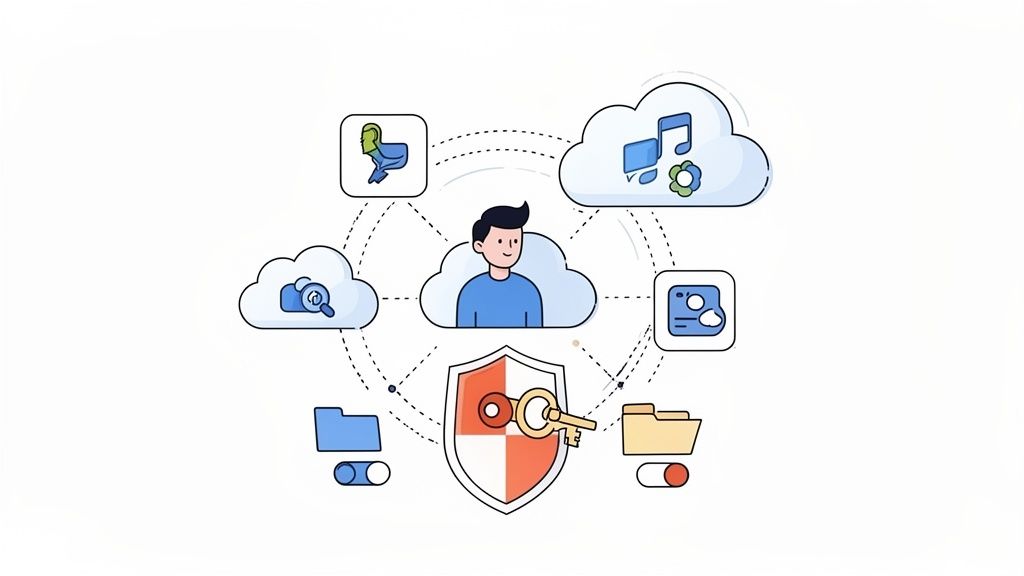
This is about more than an email account. It’s about providing secure, role-appropriate access to everything from Slack and Asana to our payroll system. Done well, it’s a seamless operation. Done poorly, it’s a security risk and a productivity bottleneck.
Why this matters
Let's be honest. Manual access provisioning is slow and error-prone. A new marketing coordinator gets admin-level database access, or a manager can't approve timesheets. These mistakes create security holes and frustration. By automating access based on roles, we ensure everyone has exactly what they need, and nothing they don’t. Proper access on day one says, "You are a trusted part of this team." A frantic search for passwords says, "We weren't quite ready for you."
How we do it with Pebb
We built Pebb with role-based permissions at its core to eliminate this chaos. Instead of manually adding people to dozens of channels, we automate access.
Create Role-Based Access Templates: We define roles in Pebb (e.g., "Store Associate," "Regional Manager"). Each role has specific permissions and automatic access to relevant Spaces, like "Shift Schedules" or "Benefits Information."
Automate Space Assignments: When we add a new employee and assign a role, Pebb automatically adds them to the correct Spaces. A new technician instantly gets access to the HIPAA Compliance Space, while a new barista is added to the "Daily Specials" channel.
Use Tasks for IT Coordination: We create an automated Task in our onboarding flow that notifies IT to provision software licenses and SSO credentials. We can track its completion in Pebb, ensuring nothing falls through the cracks.
4. Introductions: Making a Job a Community
A new hire’s first day shouldn't be a lonely island of paperwork. Real integration begins when they meet the people they'll be working with. Facilitating introductions transforms a job into a community. This is a cornerstone of our new employee onboarding checklist because it lays the foundation for collaboration and trust.
This step moves onboarding from a logistical process to a human one. It’s how you show a new employee they aren't just a number, but a member of a team. It clarifies who to ask for help and begins building the relationships that drive real work.
Why this matters
Leaving introductions to chance is a recipe for isolation, especially in remote or shift-based work. Deliberately building connections accelerates a new hire's ability to navigate the organization and feel comfortable contributing. A checklist can get someone set up, but only people can make someone feel like they belong.
How we do it with Pebb
We built Pebb to make these connections easy and natural, whether our team is in an office or working on the front lines.
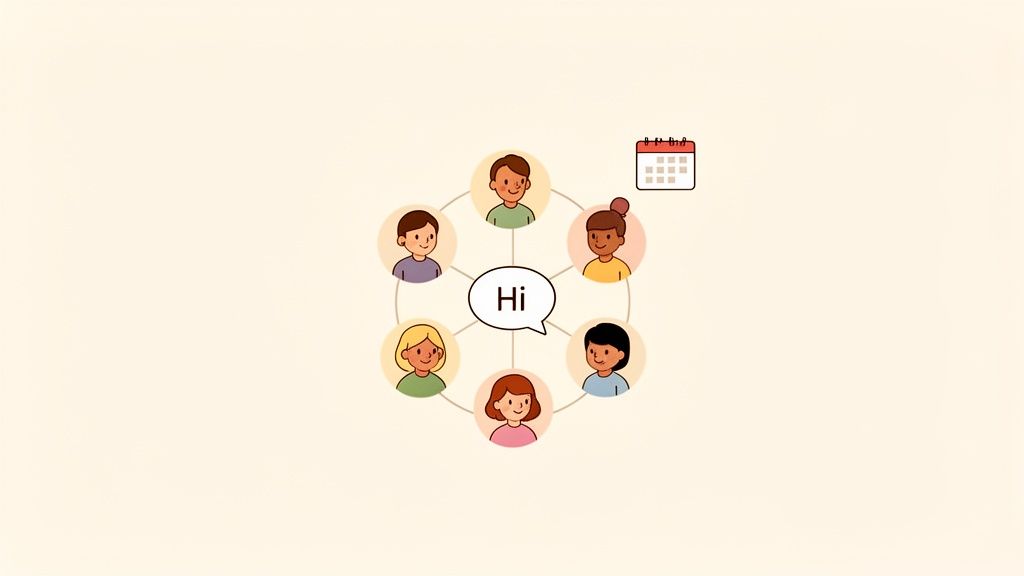
Create a Team Welcome Space: We set up a dedicated "Welcome [New Hire Name]!" channel. The team lead posts a welcome message and encourages everyone to introduce themselves with a fun fact.
Assign a Peer Buddy: We use Pebb's Tasks to assign a peer buddy to the new hire. The buddy gets a sub-task to schedule a 30-minute coffee chat (virtual or in-person) within the first week.
Leverage the People Directory: We encourage new hires to explore the team through Pebb’s People Directory. Rich profiles with photos and roles help them put faces to names and understand who does what.
5. Job Training: Show, Don't Just Tell
Once the welcome is over, the real work begins. A new hire’s confidence depends on how well they are trained for their specific role. Generic, one-size-fits-all training doesn't cut it. They leave people feeling unprepared. This is where tailored, practical training becomes an essential part of your new employee onboarding checklist.
This step is about moving from theory to practice. It’s showing your new hire exactly how to succeed in their role, with the tools your team actually uses. It replaces ambiguity with competence.
Why this matters
Nothing is more frustrating for a new hire than not knowing how to do their job. Effective, role-specific training closes this gap quickly. For instance, top restaurant chains use mobile-first training videos to ensure every employee understands service excellence. This targeted approach accelerates proficiency and ensures consistency. Great training says, "Here's exactly what you need to know to be great." Poor training says, "Figure it out as you go."
How we do it with Pebb
We built Pebb to be the central hub for our team, making it the perfect place to deliver and track structured training.
Create a Centralized Training Hub: We use Pebb's Knowledge Library to build a single source of truth for training materials. We upload procedure docs, safety protocols, and how-to videos, organized by role.
Assign and Track Training Tasks: We create a "New Hire Training" Task list in Pebb. We break training into small steps, like "Watch the 'Point of Sale System' video" or "Complete the Safety quiz." This lets us track progress.
Reinforce with Practice: We pair digital training with real-world application. Pebb helps us assign a mentor to shadow the new hire and provide feedback. You can learn more about how to structure these materials by exploring knowledge libraries for employee onboarding.
6. Goals: A Map for the First 90 Days
Walking into a new role without clear goals is like starting a road trip without a map. You’re moving, but you have no idea if you’re heading in the right direction. Setting explicit goals for the first 30, 60, and 90 days provides the clarity new hires crave. It’s a foundational part of our new employee onboarding checklist that turns ambiguity into focused action.
This process removes guesswork. It defines what success looks like and provides a framework for meaningful conversations about progress. It’s the difference between hoping for a good outcome and engineering one.
Why this matters
Let's be honest, nothing is more demotivating than working hard for a month only to find out you were focusing on the wrong things. Setting clear goals prevents this. By defining expectations upfront, you help your new employee contribute meaningfully and build confidence quickly. When a new hire knows what's expected of them, they can spend their energy doing great work, not deciphering their role.
How we do it with Pebb
We built Pebb to make goal-setting a transparent, trackable process, not a one-time document that gets lost in an inbox.
Create Role-Specific Goal Templates: We use our Knowledge Library to build 30/60/90-day goal templates for different roles. When a new hire starts, we instantly share the relevant guide.
Assign and Track Key Milestones: We convert each major goal into a trackable task within Pebb. We can assign due dates for 30, 60, and 90-day check-ins and monitor completion in the app.
Document Progress in a Shared Space: We set up a private Space for the new hire and their manager to document check-in notes, share feedback, and update goal progress. This creates a single source of truth.
7. Culture: Sharing the "Why"
A new hire can have all the right skills, but if they don’t understand the “why” behind their work, they’ll never be truly engaged. Culture isn't just about free snacks; it’s the unspoken rules of how your team operates, makes decisions, and treats one another. A proper orientation into your company’s culture and mission is the most crucial step in turning a new employee into a true teammate.
This part of our new employee onboarding checklist moves beyond the "what" of the job to the "why" that fuels it. It helps new hires understand the company’s north star, giving them the context to make better decisions.
Why this matters
When culture is an afterthought, new hires feel disconnected. They see values on a poster but can't connect them to their daily work. Companies famous for their culture don't just talk about their mission; they embed it into everything. This makes culture tangible. An employee who understands the mission doesn't just do their job; they understand how their job moves the entire company forward.
How we do it with Pebb
We built Pebb to be the living home for our company culture. It ensures culture is a daily experience, not a one-time presentation.
Create a Dedicated Culture Space: We set up an "Our Mission & Values" Space in Pebb. We fill it with videos from leadership, posts from teammates sharing how they live the values, and customer stories that show our mission in action.
Use the Newsfeed for Culture Stories: Pebb’s newsfeed is perfect for reinforcing culture. We share photos from events, celebrate wins that exemplify a core value, and post updates on our social mission.
Connect Roles to the Bigger Picture: We use Pebb's Tasks to create a simple assignment for managers: "Schedule a 30-minute chat to explain how [New Hire]'s role contributes to our company mission." This simple prompt ensures every new employee sees their impact.
8. Workspace & Tools: The Physical Handshake
Nothing says "we weren't ready for you" like a new hire arriving to an empty desk. Setting up a workspace and tools is more than an IT task; it’s a powerful, tangible welcome. Getting this right is a fundamental part of our new employee onboarding checklist, ensuring our new teammate can be productive from their very first hour.
This step is your company's physical handshake. A fully prepared workspace communicates competence and respect. It eliminates the frustrating scramble for a laptop, replacing it with a smooth transition.
Why this matters
Let's be honest, making a new employee wait for their equipment is a classic onboarding failure. They sit idle, feeling awkward, while you scramble behind the scenes. This has a huge impact on their first impression. Remote-first companies have mastered this by shipping a complete "office in a box" to new hires' homes before day one. This thoughtful preparation makes them feel equipped from the start. A prepared workspace shows you’ve invested in their success before they’ve even logged in.
How we do it with Pebb
We built Pebb to turn this logistical headache into a streamlined process. We can manage provisioning for every role without letting anything fall through the cracks.
Create Role-Specific Checklists: We use Pebb's Tasks to build detailed equipment checklists for each role. A retail cashier needs a register login; a developer needs a high-spec laptop. We assign tasks directly to IT and Ops with clear deadlines.
Track Provisioning Status: The assigned Pebb Task provides a single source of truth for tracking equipment orders and setup confirmation. Everyone involved can see the status at a glance.
Build a "Day 1 Setup" Guide: We stock our Knowledge Library with simple, step-by-step guides for setting up equipment. This helps new hires get started independently and reduces the burden on IT.
9. Check-Ins: The 30-60-90 Day Conversation
The first 90 days are a delicate dance. New hires are navigating a new culture and learning new processes, often without a map. Leaving them alone is a recipe for disengagement. A structured 30-60-90 day check-in plan transforms this uncertainty into a supportive journey, making it an essential part of our new employee onboarding checklist.
This framework provides dedicated moments to pause and reflect. It moves feedback from an ambiguous, year-end event to a continuous conversation. It shows you're invested in their long-term success.
Why this matters
Silence from a manager can feel like a negative review. Without structured feedback, new hires often assume the worst. Research from Gallup shows that regular manager check-ins can improve employee engagement by a factor of nearly three. These touchpoints are your early warning system for potential issues and your best tool for building confidence. A 30-60-90 day plan says, "Your growth matters, and we're in this together." A lack of one says, "Good luck, see you at your annual review."
How we do it with Pebb
We built Pebb to turn these critical check-ins into meaningful, documented conversations.
Schedule and Automate: We use Pebb's Tasks to automatically schedule 30, 60, and 90-day check-ins for every new hire and their manager. We attach a standard agenda so everyone can come prepared.
Document and Track: During the meeting, we document discussion points and action items directly in a Pebb Task or Note. We assign follow-up items to create accountability.
Facilitate Ongoing Dialogue: We use a private Pebb Chat between the manager and new hire to share quick updates and ask questions between formal check-ins. This keeps the feedback loop open.
10. The Handbook: Your Single Source of Truth
An employee handbook is more than a compliance document; it’s a single source of truth that sets clear expectations. Without it, your team is left guessing about everything from benefits to the remote work policy. Providing this upfront is a cornerstone of our new employee onboarding checklist, replacing ambiguity with clarity.
This step communicates that you have established, fair processes. It’s the official guide that helps them understand their rights and responsibilities, preventing future headaches for everyone.
Why this matters
Nothing creates more friction than inconsistent enforcement of unwritten rules. A well-crafted handbook eliminates this. It isn't just about avoiding legal trouble; it’s about building a culture of trust and fairness from day one. A great handbook tells a new hire, "Here's how we all agree to work together." A missing one says, "Good luck figuring it out on your own."
How we do it with Pebb
We built Pebb’s Knowledge Library to transform our handbook from a dusty PDF into a living resource.
Centralize Your Policies: We use the Knowledge Library to create a single home for our employee handbook, code of conduct, time-off policies, and benefits guides. We organize them with clear categories so information is always a search away.
Require Digital Acknowledgment: We assign the handbook as a Task in Pebb and require a digital acknowledgment to confirm the new hire has read and understood the policies. This creates an automatic audit trail.
Make It Digestible: We break complex topics into smaller articles. If you're looking for guidance, here's how to create an employee handbook that people will actually read.
New Employee Onboarding: 10-Point Comparison
Onboarding Step | 🔄 Implementation Complexity | ⚡ Resource Requirements | ⭐ Expected Effectiveness | 💡 Ideal Use Cases | 📊 Key Advantages |
|---|---|---|---|---|---|
Pre-Boarding: Send Welcome Communications & Access Credentials | Low–Medium — automation + HR/IT coordination 🔄 | Low — templates, secure delivery channel, HR time ⚡ | High ⭐⭐⭐ | Remote hires, high-volume hires, tech roles | Reduces first‑day anxiety; enables immediate tool access |
Complete HR Paperwork & Compliance Documentation | Medium — legal variation and verification 🔄 | Moderate — HR/legal, e-signature, secure storage ⚡ | High ⭐⭐⭐ | All hires, regulated industries, payroll onboarding | Ensures legal compliance; prevents payroll/benefits delays |
Assign & Activate System Access & User Permissions | Medium–High — RBAC and integrations 🔄 | High — IT, identity tools, role templates, SSO ⚡ | High ⭐⭐⭐ | Roles with sensitive data, enterprise apps, remote work | Least‑privilege security; faster ramp and fewer access tickets |
Conduct Department & Team Introductions | Low–Medium — scheduling and coordination 🔄 | Low — manager time, communication/video tools ⚡ | High ⭐⭐⭐ | Distributed teams, culture-first orgs, buddy programs | Accelerates relationship building and belonging |
Provide Role-Specific Job Training & Competency Development | High — content creation and ongoing maintenance 🔄 | High — L&D resources, content production, trainers ⚡ | High ⭐⭐⭐ | Complex roles, safety‑critical, frontline/mobile workers | Consistent skills, faster productivity, fewer errors |
Set Clear Goals, Expectations & Performance Metrics | Medium — manager expertise required 🔄 | Low–Moderate — templates, manager time, tracking tools ⚡ | High ⭐⭐⭐ | Performance‑driven roles, sales, knowledge work | Clarity of success; objective performance measurement |
Provide Company Culture, Values & Mission Orientation | Medium — ongoing reinforcement needed 🔄 | Moderate — leadership inputs, comms, content channels ⚡ | Medium–High ⭐⭐⭐ | Employer branding, retention focus, distributed teams | Aligns behaviors; improves engagement and retention |
Set Up Workspace, Equipment & Tools Provisioning | Medium–High — cross‑dept logistics 🔄 | High — IT/ops, inventory, shipping, facilities ⚡ | High ⭐⭐⭐ | Onsite, hybrid, and remote employees | Ensures day‑one productivity; reduces tech support issues |
Schedule Regular Check‑Ins & Progress Reviews (30/60/90 Days) | Low–Medium — calendaring + structured agendas 🔄 | Low — manager time, templates, documentation tools ⚡ | High ⭐⭐⭐ | New hires needing coaching, performance monitoring | Catches issues early; supports development and retention |
Create & Distribute Employee Handbook & Policy Documentation | Medium — legal review and localization 🔄 | Moderate — HR/legal, publishing, translation, platform ⚡ | Medium–High ⭐⭐⭐ | Compliance‑heavy orgs, distributed workforces | Consistent policy understanding; reduces HR inquiries |
(Bonus) Use Pebb Knowledge Library & Spaces (integrated across steps) | Medium — platform setup and content curation 🔄 | Moderate — content, admin time, training ⚡ | High ⭐⭐⭐ | Organizations using Pebb for centralized onboarding | Centralizes resources; enables mobile access and tracking |
Assign Mentors/Buddies & Peer Support Programs | Low — pairing and coordination 🔄 | Low — volunteer mentors, scheduling tools ⚡ | High ⭐⭐⭐ | New hires in complex or shift‑based roles | Speeds social integration; provides on‑the‑job help |
More Than a Checklist, It's a Welcome Mat
We’ve just walked through a comprehensive new employee onboarding checklist. We covered everything from pre-boarding to the 90-day review. If you follow this guide, you’ll have a structured process. You’ll be organized. Your new hires will know what to expect.
But let’s be honest. No checklist can guarantee a perfect onboarding experience. A checklist, on its own, is just a list of tasks. It’s sterile. It lacks a pulse.
What a thoughtful process can do, however, is show people you care. It’s a tangible demonstration that you’ve anticipated their arrival, that you respect their time, and that you are invested in their success. When you hand someone their laptop and it’s already configured, you’re not just checking a box. You’re saying, “We were ready for you.” When their first-day schedule includes a team lunch, you’re not just managing time. You’re saying, “You belong here.”
The Real Goal: Building Trust, Not Ticking Boxes
The true value of a great new employee onboarding checklist isn't just efficiency. The real goal is to build a foundation of psychological safety and trust. You are turning a transactional process—hiring someone—into a relational one. You’re replacing the cold anxiety of starting a new job with the warmth of a genuine welcome.
Think about it from their perspective. A clear, human-centric plan acts as their anchor in a sea of newness. It gives them the confidence to ask questions and the clarity to start contributing sooner. To truly make new employees feel welcomed and set up for long-term success, it’s beneficial to explore comprehensive methods. You can learn more about employee onboarding best practices that focus on boosting retention and productivity.
Ultimately, this isn't about perfectly executing every item. It’s about the intention behind it. It's about laying out a welcome mat that says, "We're so glad you're here, and we’re going to help you succeed."
The checklist is your blueprint. The real work starts the moment they step inside. So, what’s one small thing you could change tomorrow to make your welcome feel a little more human?
Tired of juggling spreadsheets, email chains, and disconnected apps to onboard your team? Pebb brings your entire onboarding checklist to life in one unified employee app. You can assign tasks, share knowledge, schedule check-ins, and connect your new hires with their team from day one, all in a single, intuitive place. See how a calmer, more connected onboarding process works with Pebb.
