
Supervisor Communication Skills Training That Actually Works
Discover proven methods in supervisor communication skills training to boost feedback, listening, and team performance. Start building a lasting program today.
Dan Robin
Most supervisor communication training is a waste of time. Let's just say it. We send managers to a workshop, they get a free lunch, and by Monday morning, nothing has changed. It’s a checkbox. And it fails because we misunderstand what communication is on the front lines. It’s not a soft skill. It's an operational tool, as vital as any machine on your floor.
Why We Keep Getting Supervisor Training Wrong
We’ve all seen it. The mandatory session that promises to turn managers into master communicators. They get a shiny certificate, but a week later, it’s back to crossed wires, operational hiccups, and disengaged teams.
So why doesn’t it stick? Because the training is completely disconnected from the reality of the job.
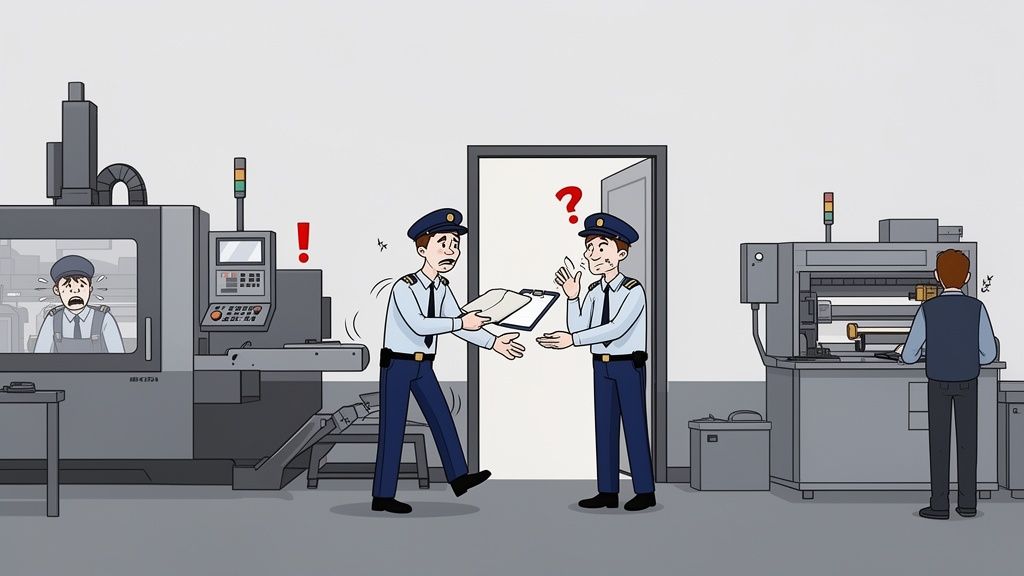
Here’s the thing. On a bustling warehouse floor or during a frantic hospital shift change, communication is the work. It’s the invisible infrastructure holding everything together. It’s what prevents costly mistakes, keeps people safe, and makes sure customers get what they paid for. Treating it like an optional extra is where everything falls apart.
The Real Cost of the Communication Gap
Think about how most supervisors get their jobs. They were probably the best technician, the most efficient nurse, or the top salesperson. We promote them for being great at their craft and then throw them into managing people with zero training on how to actually lead.
This creates a massive—and frankly, dangerous—skills gap.
The numbers are pretty stark. A shocking 91% of employees feel their managers miss the mark on communication. Meanwhile, only 28% of first-time managers ever get formal training before they start leading. To top it off, a 2024 McKinsey study found that 69% of managers are actively uncomfortable talking with their employees.
This isn’t about morale or hurt feelings. It’s about operational integrity. When a supervisor fumbles a new safety procedure or avoids a crucial performance conversation, the entire business feels the fallout.
It's Time to Get Real
The problem is that most training is too academic. It’s packed with abstract theories and personality tests that mean nothing in the day-to-day grind. A supervisor on a loud manufacturing floor doesn’t need a lecture on psychological models; they need to know how to give clear, direct feedback over the roar of machinery.
Modern internal communication best practices make it obvious: communication isn’t just talking. It’s about building reliable systems for clarity and feedback that work in the real world.
So, how do we fix this? We stop treating communication like a one-off event and start developing it as a core competency. This isn’t about making supervisors “nicer.” It’s about giving them practical, no-nonsense tools to run their teams effectively. This guide will show you how.
Build Training Around What Actually Happens
Forget the abstract theories. The only training that sticks is built on the practical, repeatable skills your leaders need every single day. The stuff that happens on the floor, not in a textbook.
It’s time to move beyond buzzwords and focus on the real work.
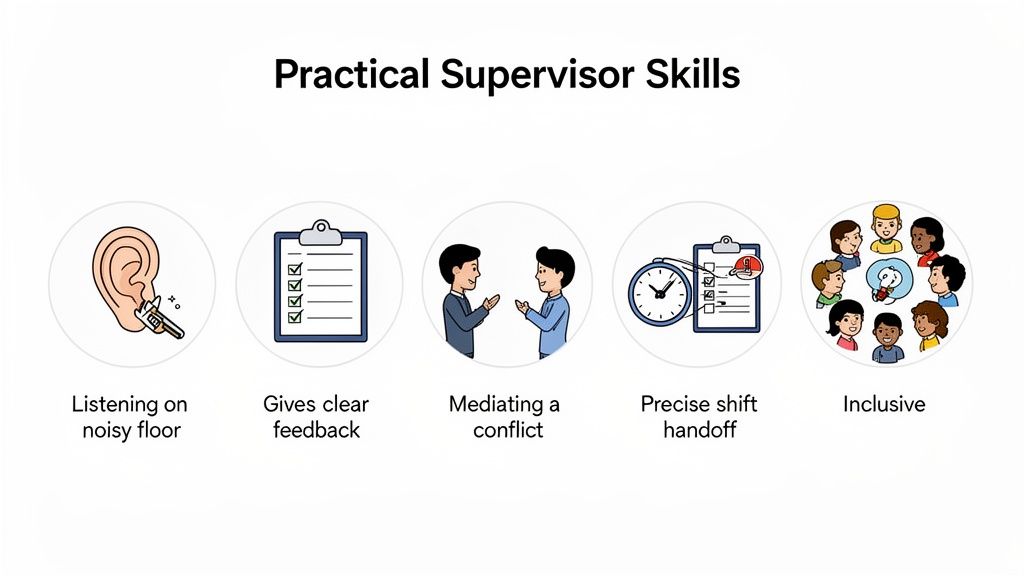
From what I’ve seen, the most successful programs are built around five core skills. These aren’t just topics; they are critical operational functions. When they’re done well, the entire business runs smoother.
1. Listening to Understand, Not Just to Respond
This sounds simple. It’s not. Most people listen while just waiting for their turn to talk. A great supervisor listens to hear what isn't being said.
On a noisy factory floor, this skill is everything. It’s noticing the hesitation in a team member’s voice when they say, “Yeah, I got it.” It’s picking up on body language that screams they’re overwhelmed, even when they insist they’re fine.
Your training needs to give supervisors better questions—open-ended ones that can’t be shut down with a simple "yes" or "no." Instead of asking, “Is the machine running okay?” they should be asking, “What are you noticing about the machine today?” That small shift opens the door to real information.
2. Giving Feedback That Actually Helps
Let’s be honest: the "feedback sandwich"—squeezing criticism between two compliments—is condescending. Everyone sees it coming, and it erodes trust.
Good feedback is a tool for growth. It has to be direct, specific, and focused on behavior, not personality. Instead of, “You’re being careless,” a well-trained supervisor says, “I noticed on the last three orders, the packing slips were missing. Let’s walk through the process together to see where the disconnect is.”
The goal isn’t to point out flaws; it’s to clarify expectations and provide a path forward. When feedback is a normal part of the workflow, it builds people up.
This skill takes practice. A lot of it.
3. Handling Difficult Conversations with Confidence
Nobody enjoys conflict. But supervisors spend about 25% of their time dealing with it, so they can't afford to be unprepared. Avoiding tough conversations only lets small problems fester into big ones.
Your supervisor communication skills training must give them a practical framework for these moments. This isn't about winning an argument; it's about de-escalating tension and finding a way forward. It means staying calm, sticking to the facts, and focusing on a shared goal.
For example, when mediating a dispute, the objective isn't to decide who was right. It's to get them to agree on how they'll work together productively tomorrow. This skill alone can dramatically cut down on HR calls.
4. Nailing the Shift Handoff
For any business that runs around the clock, the shift handoff is one of the most critical—and vulnerable—points of communication. It's where crucial information gets dropped, leading to delays, safety incidents, and frustrated teams.
A solid handoff is more than a quick chat; it’s a structured, repeatable process. Training should focus on creating a simple, standard checklist. What must be passed on? What’s in progress? Are there any issues the next shift needs to watch for? This is purely tactical. It’s about building a reliable system that ensures nothing falls through the cracks.
5. Fostering Inclusive Communication
At its core, great communication makes every person feel seen, heard, and respected. This isn't about being politically correct; it’s about creating an environment where the best ideas can surface from anyone.
This looks like a supervisor who actively solicits input from quieter team members. It means they use clear, simple language everyone can understand. It means they stop interruptions, ensuring everyone gets a chance to contribute.
When people feel safe enough to speak up—to ask a question or point out a mistake—your whole operation gets smarter and safer. Building this foundation is arguably the most important job a supervisor has.
Making the Training Stick
If your training program lives and dies in a PowerPoint deck, it’s already dead. Adults—especially busy supervisors—learn by doing, not by listening. Lasting change doesn’t come from a lecture; it comes from practice.
This is where so many programs fall flat. We spend weeks on the content but no time thinking about how our leaders will actually use it. The goal isn't to download information. It's to build new habits.
To get there, we have to turn the training from a classroom event into a practice field—a safe place to try, fail, and get better without real-world consequences.
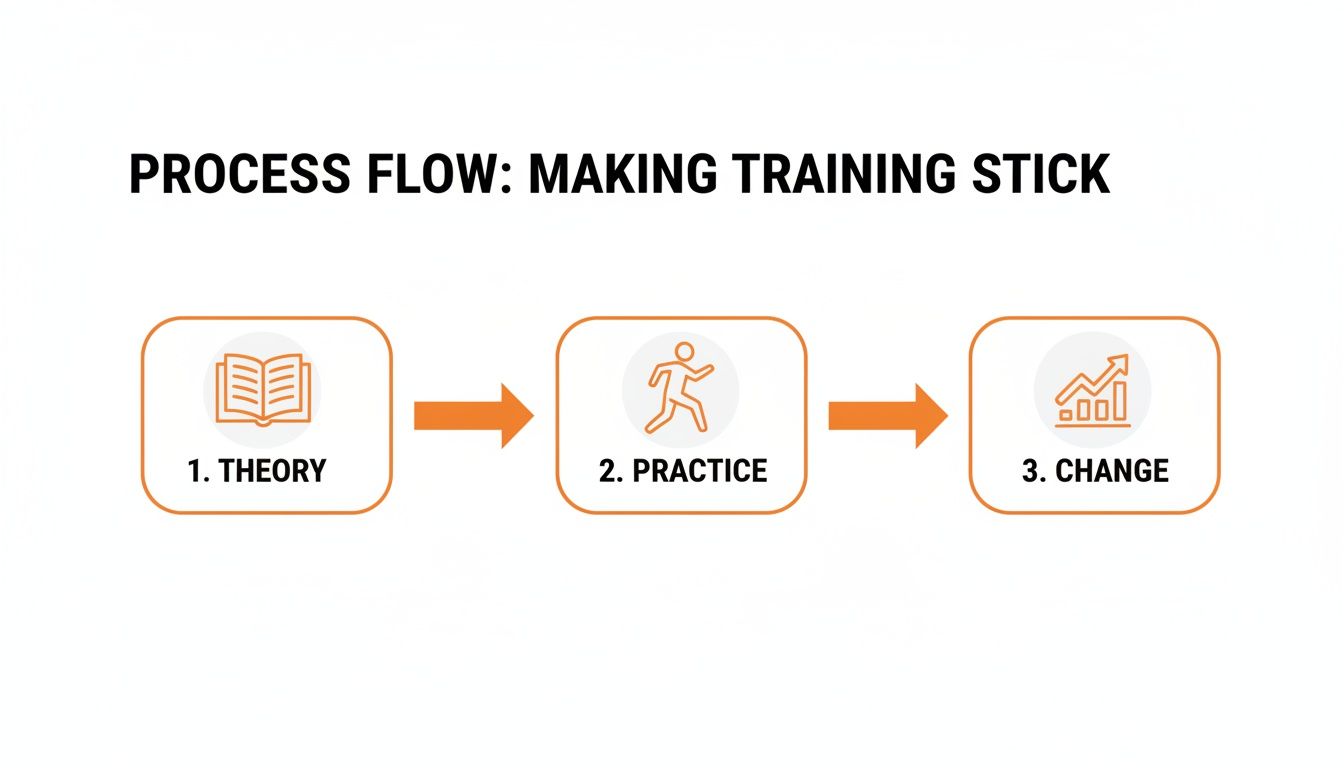
Theory is just the starting line. The real transformation happens when supervisors apply these skills on the job and see the results for themselves.
From Theory to Action with Realistic Scenarios
In my experience, the most effective way to bridge the gap between knowing and doing is through realistic, scenario-based practice. I’m not talking about cheesy role-playing. I mean carefully designed simulations that mirror the exact challenges your supervisors face.
You wouldn't let someone fly a plane after just reading the manual. Why do we expect a supervisor to handle a sensitive performance review after just watching a video?
The key is to make the scenarios specific and real.
For retail: Forget the generic "angry customer." Make it about a customer trying to return a final-sale item during the holiday rush, with a long line forming.
For healthcare: Don't just practice "giving feedback." Have them navigate a tough conversation with a clinically excellent but frequently late nurse who is showing signs of burnout.
For a warehouse: Create a simulation where they have to address a safety violation with a veteran employee who thinks the rules don't apply to them.
The power of these simulations is that they lower the stakes. A supervisor can stumble, try a different approach, and get immediate feedback in a safe environment. That way, they're ready when a high-stakes conversation happens for real.
Using Technology for Practice
Live practice sessions are gold, but they aren't always practical. This is where asynchronous tools can be a game-changer. They allow for practice on a flexible schedule, respecting the chaotic reality of a supervisor's day.
One of the simplest methods is video-based practice. Here’s how it works:
The Prompt: Send a short, written scenario. Something like: "Alex has missed his production target for the third week in a row. He’s a good employee but seems distracted. Record a 2-minute video of how you would start this conversation."
The Recording: Supervisors use their phones to record themselves. The goal isn’t perfection; it’s just to try.
The Peer Review: They share their video in a private group with a few peers. Using a simple rubric, they give each other constructive notes.
This simple loop forces active recall, provides a chance for self-reflection (it’s amazing what you notice when you watch yourself!), and builds a community of practice. It’s a low-cost, high-impact way to make practice a regular habit. This is what real supervisor communication skills training looks like. Messy, iterative, and deeply practical.
How to Reach Every Supervisor
For any company with people working different shifts or in different places, consistency is a nightmare. How do you give the night-shift supervisor in a remote warehouse the same quality training as the manager at HQ? The old model of a mandatory, in-person workshop just doesn’t cut it.
A modern, blended approach isn't a nice-to-have; it's a necessity. It’s about respecting supervisors' time and meeting them where they actually work—which is definitely not behind a desk.
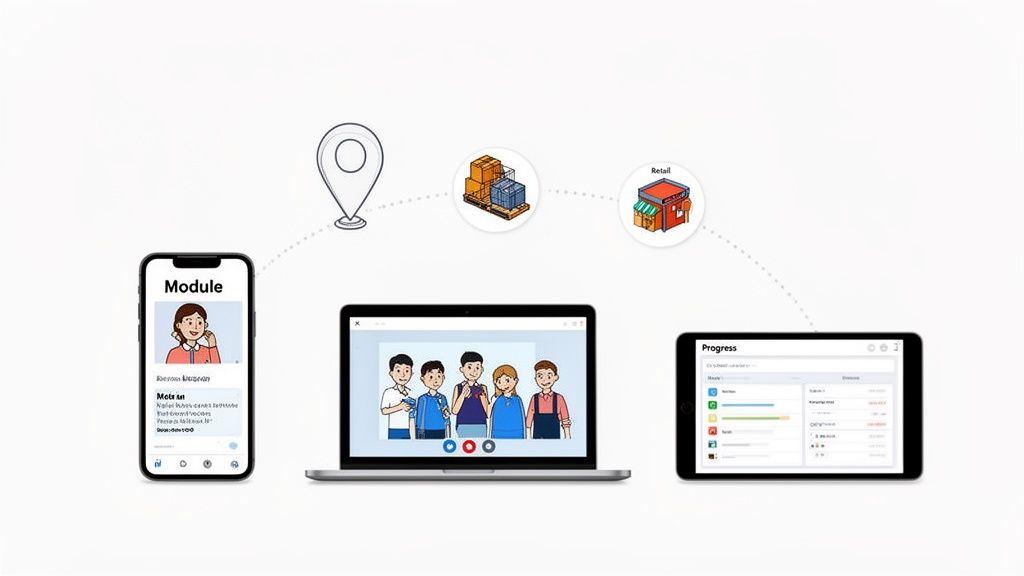
The shift toward hybrid training has made this so much more feasible. In fact, 72% of organizations now offer some form of hybrid training, a huge leap from just 34% in 2020. This finally allows us to deliver consistent supervisor communication skills training across every location and shift.
Start with Mobile-First Microlearning
Your supervisors are busy. Asking them to block off four hours for a live session is a huge ask. A better way is to deliver foundational concepts through mobile-first microlearning.
Think short, sharp lessons—five to ten minutes, max—that they can knock out on their phones during a quiet moment. They introduce one core idea at a time, like a simple model for active listening. The key is to push this content where your teams already are. If they use a specific app for work, the training needs to live there. This simple step removes friction and makes learning feel like a natural part of the job.
Use Live Sessions for Practice, Not Lectures
Once supervisors have the concepts down, bring them together for live sessions. But here's the pivot: these sessions are not for lecturing. They are for practice, discussion, and learning from each other.
Because everyone has covered the basics, you can jump straight into the good stuff: scenario breakouts, fishbowl discussions, or a Q&A with a senior leader who can share their own war stories. These live sessions can be shorter—maybe 60 to 90 minutes—but they deliver so much more value. They become a space to apply theory and build a true community of practice.
Create a Central Hub for Everything
A blended approach only works if it’s organized. You need a single platform to be the home for your entire program. This is the connective tissue holding it all together. This hub should deploy content, track progress, and foster peer learning through a dedicated chat channel or forum where supervisors can ask questions and share wins.
We’ve seen this work wonders. When supervisors have one place to go for everything, engagement goes up. The training stops feeling like a scattered series of tasks and starts feeling like a cohesive program.
For managers who aren't communication pros, a central resource is vital. We put together a guide on internal comms for non-comms people, which offers a great playbook for leaders looking to sharpen their skills. At the end of the day, this model isn't about chasing tech trends. It’s about being more respectful of our leaders' time and more focused on building skills that actually stick.
Measuring What Actually Matters
Most training programs are measured by things that don’t tell you if anything worked. Completion rates and "smile sheets" are vanity metrics. They tell you if people showed up, not if a single behavior changed.
To justify the investment in supervisor communication skills training, you have to connect it to business outcomes. The real proof isn’t in a certificate; it’s in the numbers that move the needle.
Going Beyond the Smile Sheets
Sure, use pre- and post-training assessments. They’re a solid start. But that’s just the first chapter.
The magic happens when you connect the skills your supervisors are learning to the operational metrics on the shop floor. Ask better questions. For instance, after your supervisors complete the module on shift handoffs, are you seeing a measurable drop in safety incidents on the third shift? Now that's a metric the C-suite understands.
Tying Training to Tangible KPIs
The whole point is to draw a clear line from your training to real-world results. Dig into the data you’re probably already tracking.
Employee Turnover: Is attrition dropping on a team after their supervisor went through the feedback module? Showing a small improvement here is a massive win.
Safety Incidents: In any hands-on setting, this is huge. Better communication—clearer instructions, a culture where people feel safe to speak up—directly translates to fewer accidents.
Productivity Metrics: Are teams hitting their targets more consistently? Is there less rework? Effective communication cuts down on the confusion that kills productivity.
The goal is to shift the conversation from "training is a cost" to "training is an investment." When you can say, "We invested $X and saw a 15% reduction in safety incidents," you've won.
The Goldmine in Your Engagement Surveys
Don't forget your regular employee surveys. They are a treasure trove. Before you launch the program, pull a baseline of scores for questions related to manager communication.
Keep an eye on statements like:
"My supervisor provides me with helpful feedback."
"I feel comfortable raising concerns with my manager."
"I feel respected and heard by my supervisor."
Track these scores over the next six to twelve months. A steady climb is one of the strongest indicators that your supervisors are putting their new skills into practice. You can find excellent guidance on metrics for tracking communication effectiveness to help build your strategy.
This isn't just about proving ROI; it’s about understanding what’s truly moving the needle. It's essential to rigorously learn how to measure training effectiveness. When you pair solid training with smart measurement, you create a powerful feedback loop that builds a stronger, more connected organization.
Communication Is a Practice, Not a Project
Here’s the biggest mistake I see: companies treat communication training like a one-and-done event. They run a workshop, check the box, and wonder why nothing has changed six months later.
You can't undo years of ingrained habits in a single afternoon. It doesn't work that way.
Real change happens with continuous reinforcement. The initial training? That's just the starting line. The real work begins the moment your supervisors walk back onto the floor and have to put those new skills to the test under pressure.
From an Event to an Ecosystem
You need to build a supportive ecosystem around your leaders. The goal isn’t to create perfect communicators overnight. It’s about giving good people the tools and confidence to lead better, one conversation at a time.
This means providing resources that live on long after the training ends.
Post-Training Coaching: Brief, regular check-ins with a coach or senior leader can help supervisors troubleshoot challenges as they happen.
Peer Support Groups: Carve out a space—a Slack channel, a monthly coffee—where supervisors can share what’s working and learn from each other.
A Resource Library: Give them an easy-to-access digital library with short videos, checklists, and conversation starters they can pull up on their phones right before a tough talk.
The point is to make learning a continuous loop, not a destination. It reframes the whole effort from a mandatory project to a shared practice of getting better, together.
It's a long game, but it's the only one worth playing. By weaving these threads together, you begin to truly make communication part of your culture. This is how you build a resilient, connected, and effective leadership team.
A Few Common Questions
When leaders get serious about building a program, a few questions always pop up. Let's tackle them.
How Long Should Our Training Program Be?
Whatever you do, avoid the one-day workshop. Real change doesn't happen in an 8-hour sprint. The best programs unfold over several weeks.
I've seen the most success with a blended approach: a series of short, self-paced digital lessons (10-15 minutes each) paired with live practice sessions (60-90 minutes) held weekly or bi-weekly. This respects your supervisors' schedules and gives them time to digest and apply the material on the job.
How Do We Get Buy-In From Senior Leadership?
You have to speak their language. Stop talking about "soft skills" and start talking about "operational efficiency," "risk reduction," and "bottom-line impact."
Dig into your own data. Show them how poor communication contributes to problems they already care about—like higher turnover, more safety incidents, or a drop in productivity.
When you frame your training as a direct solution to those expensive problems, the conversation changes. Come to the table with a clear plan to track measurable KPIs, and you'll find they're much more willing to listen.
How Do We Adapt Training For Different Work Environments?
The core principles of good communication—listening, clarity, respect—are universal. The secret is to customize the scenarios.
The what (the skill) stays the same, but the how (the application) has to feel real.
For retail: Role-play de-escalating an angry customer.
For manufacturing: Practice giving safety-critical instructions.
For office-based supervisors: Focus on giving effective project feedback.
The more the practice mirrors their actual job, the more the skills will stick.
Ready to unify your teams and weave great communication into the fabric of your operations? Pebb brings chat, operations, and engagement into one simple app for your entire workforce. Learn how Pebb can help you build a more connected company.
