
How many work days are there in a year?
Struggling with how many work days per year to plan for? We break down the real number and explore what it actually means for your team’s productivity.
Dan Robin
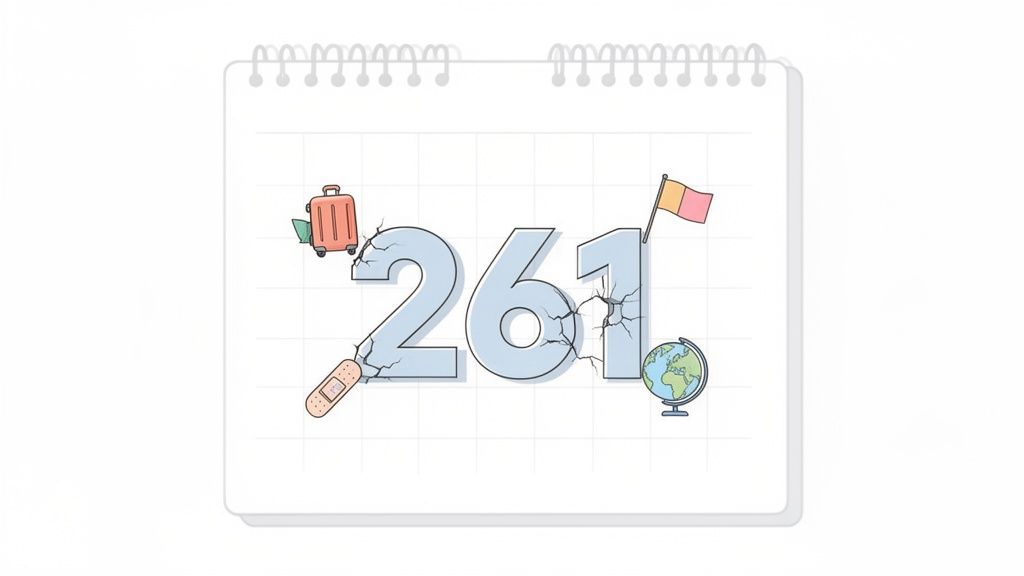
How many work days are in a year? You’ll hear a number like 261 thrown around for 2026. On paper, it looks neat and tidy. But if you’ve ever run a team, you know that number is a fantasy—a clean starting point before the beautiful mess of reality takes over.
I’ve been there. You plug that number into a spreadsheet to map out a project. You build deadlines around it. You make promises based on it. Then, life happens.
That 261 is a theoretical maximum. It’s what you get before you account for the human parts of running a business:
Public Holidays: A moving target that changes by country and state.
Paid Time Off (PTO): Every well-deserved vacation and personal day.
Sick Leave: You can’t plan for it, but you can count on it.
Local Customs: Think of unique regional holidays or those beloved summer Fridays.
So, where does that number even come from?
The math for 2026 is simple. You take 52 weeks and multiply by 5 workdays (that’s 260), then add one extra day because January 1st lands on a Thursday. But that’s only half the story. The real challenge isn’t finding the starting number; it's landing on one you can actually use for planning.
This is why so many project plans fall apart. The gap between the theoretical 261 days and the actual days your team is available is where deadlines slip and budgets break. Getting this right is especially crucial for managing benefits. If you want to go deeper, our guide on how to calculate PTO accrual is a great place to start.
This isn't just about doing math. It's for every manager who wants to plan with confidence, moving beyond generic numbers to build schedules that reflect the real world.
Calculating Your Team's Actual Work Days
So you’ve got that 261-day answer. It’s a fine starting point, but it isn’t your number. Relying on it is like checking the average global temperature to decide if you need a jacket today. It’s data, but not useful data.
Let’s build a number that actually reflects your team’s reality. The good news is, the math is just subtraction. You start with the total days in the year and begin carving out all the days people don't work.
(Total Days in Year) – (Weekend Days) – (Public Holidays) – (Average PTO Taken) = Your Actual Work Days
Think of this less as a rigid formula and more as a way of telling your company’s story. Each number you subtract reflects how you operate, where your team is based, and the kind of work-life balance you support.
Start with Your Schedule
First, let's get the obvious non-working days out of the way: weekends. If your team works a standard 5-day week, you’ll immediately subtract 104 days (52 weeks x 2 weekend days). But what if you're on a 4-day workweek? Suddenly, you’re subtracting 156 days. Right away, you see how much your schedule changes the entire equation.
Don't forget little curveballs like a leap year—2024 and 2028, for example—which adds an extra day to your starting total. It seems small, but these things add up. This is the first step toward a work day count with real meaning.
Account for Time Off
This is where the calculation gets personal. Public holidays and paid time off (PTO) depend entirely on your company's location and policies. The 11 federal holidays in the US are different from bank holidays in the UK. A team in Canada will have its own unique calendar.
Then you have PTO. The average American takes about 17 days off a year, but what’s the average at your company? If you need a hand with that, our guide on how to calculate vacation time can help you find a more precise figure for your team.
Knowing your team's actual work days is also essential for smart financial planning. For instance, knowing how to calculate labor cost percentage gives you a much clearer picture of your spending. When you subtract these real-world days off, you're not just crunching numbers—you're acknowledging that time away from work is both necessary and valuable.
A Global Snapshot of the Work Year
If you’ve ever managed a team spread across different countries, you know the feeling. A normal Tuesday for you is a national holiday for a teammate one time zone over. What you thought was a full week of productivity now has a hole in it.
This isn’t a minor hiccup; it’s a peek into how different cultures approach the work year. The simple question, "How many work days are in a year?" opens up a fascinating story about global work-life balance.
In the United States, the starting number is around 250 work days before a single day of PTO is taken. If you’re based there, that probably feels standard. Maybe even universal.
But that’s just one country’s story.
Different Countries, Different Rhythms
For a teammate in the United Kingdom, the number is already a bit lower thanks to more bank holidays. In Germany, the math changes completely. With more public holidays and a generous vacation minimum, a German employee's starting point is closer to 225 days. That’s weeks of difference, baked right into the culture and laws.
This visual shows the basic idea. You take the total days in a month, subtract the weekends, and you’re left with the pool of days available for work, holidays, and time off.
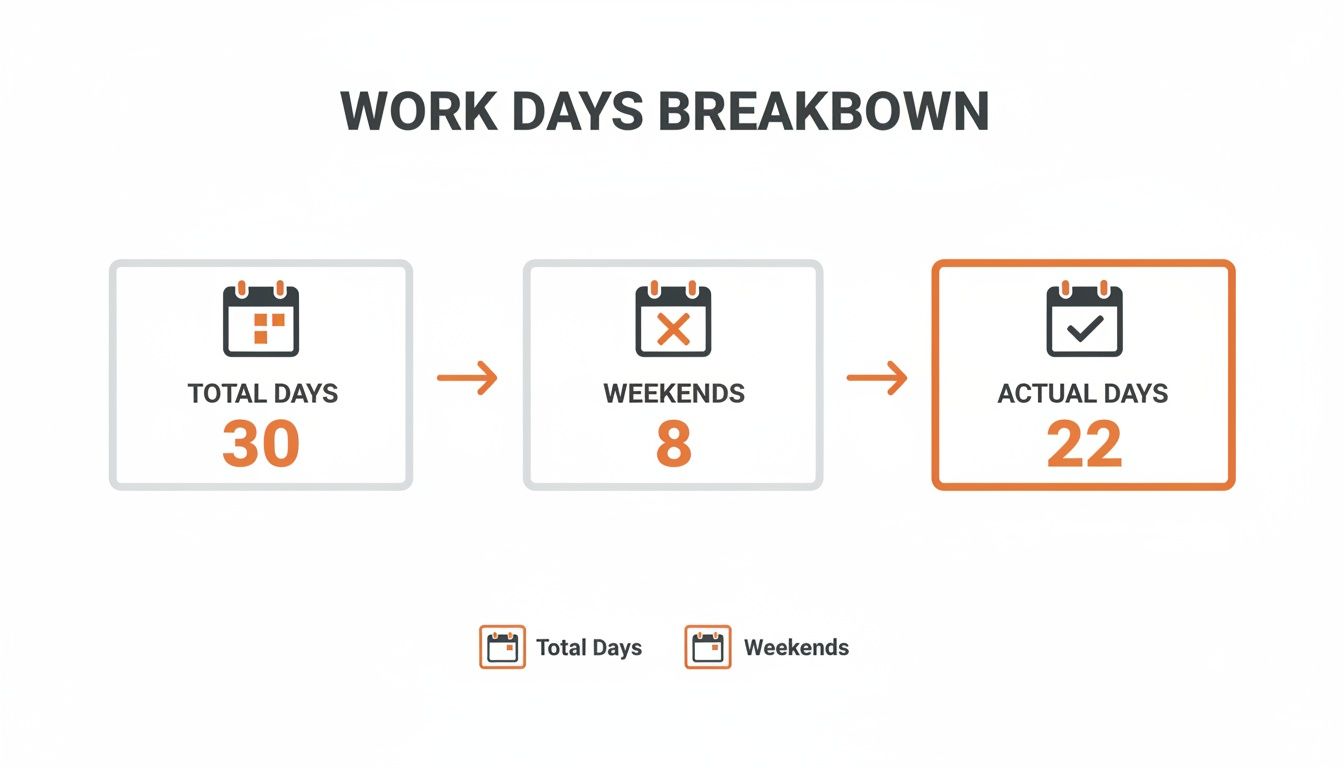
It’s this simple subtraction that reveals just how differently the world works.
The picture gets even clearer when you look at total hours worked. Most developed nations average between 220-250 days worked annually. But while that might translate to 1,800 hours in the US, places like Germany and the Netherlands are closer to 1,300-1,450 hours a year. They get there with shorter workweeks and more time off. You can explore the full data on how work hours vary by country if you're curious.
Understanding these differences isn't about judging which country has it 'right.' It's about empathy. It's about recognizing that your team doesn't operate on a single, universal clock.
Building a Fairer Schedule
So, what does this mean for your distributed team? It means you can't build a project plan based on one country's calendar and expect it to hold up. It means a deadline that feels perfectly reasonable in one region might be a monumental ask for someone else.
Ignoring these variations doesn't just lead to missed deadlines; it quietly sends a message that you’re not invested in fairness. Real collaboration begins when we acknowledge and respect these different rhythms. It's about ditching the one-size-fits-all schedule and building one with a global perspective from the start.
The Difference Between Days Worked and Productive Days
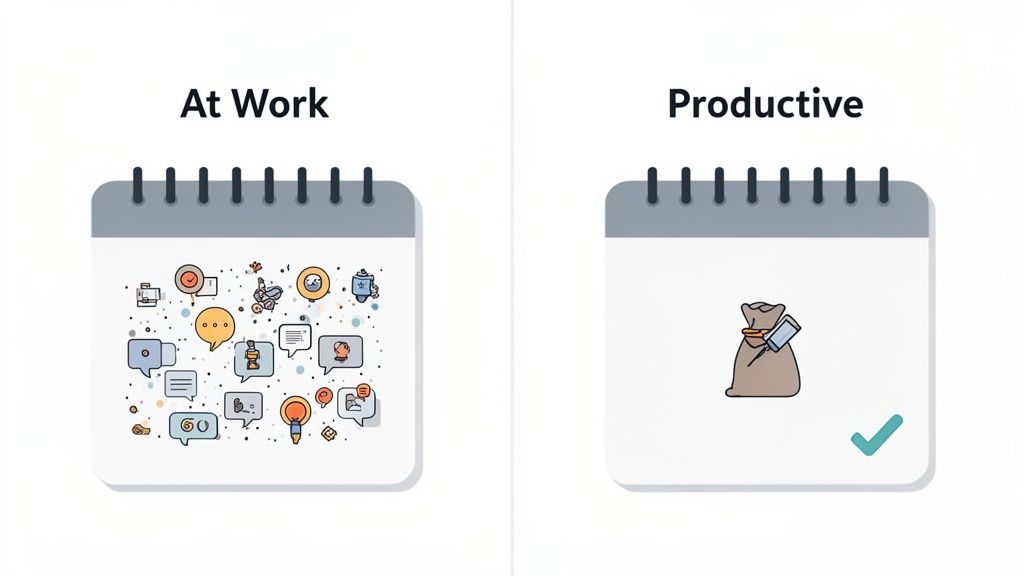
We've run the numbers. We know how many days we're supposed to be working. But let’s be honest. Just because someone is logged on doesn't mean they're getting anything meaningful done.
There’s a huge difference between a “day worked” and a “productive day.” We see it constantly. An employee’s calendar is blocked for eight solid hours, but their actual day is a chaotic mess of back-to-back meetings, endless Slack notifications, and the mental gymnastics of juggling ten different tasks.
Here’s the thing—this isn't about blaming people for getting sidetracked. It's about taking a hard look at the broken structure of the modern workday. We cling to the 8-hour day like it’s a law of nature, but it's really just a holdover from another era. And it's failing us.
The Sobering Reality of an 8-Hour Day
We all feel this, but the data is stunning. One study found that the average office worker is truly productive for just 2 hours and 53 minutes a day. That's it. The rest of that time—a staggering 60% of the day—evaporates into checking social media, navigating bloated inboxes, and sitting in meetings that go nowhere.
This isn’t a minor inefficiency; it’s a massive drain on your team's potential. You can read more about the findings on employee productivity, but the core message is a tough pill to swallow.
When a team is only truly “on” for three hours a day, the problem isn’t the people. It’s the system they’re working in.
Fragmented tools are often the biggest culprit. When your team has to bounce between five different apps just to ask a question, you’re not just wasting their time—you’re sabotaging their focus. Every notification is another small crack in their concentration, pulling them further from the deep work that actually moves the needle.
From Counting Days to Making Days Count
When you look at it this way, the total number of work days in a year starts to feel like a vanity metric. It tells you how many opportunities for work you had, but it says nothing about what you actually accomplished.
The real goal isn't just to make sure people show up. It's to create an environment where they can do their best work. How do we help people get into a state of flow and protect them from the constant barrage of distractions? It starts with giving them tools designed to preserve focus, not shatter it.
This shift in perspective is everything. Instead of obsessively tracking attendance, we should be obsessed with removing the friction that stands in the way of real progress. The job of a leader isn't just to count the days, but to make the days count. That means building a workplace that is calmer, more focused, and ultimately, far more productive.
From Counting Days to Making Days Matter

Alright, you’ve done the math. You have a nice, clean number for your spreadsheets. That’s a start. But let’s be honest—it’s a mechanical answer to a deeply human problem.
The real challenge isn't just counting the days. It's managing your team’s time and energy in a way that feels respectful and actually works. It’s about building a place where people can focus, not just punch a clock.
We’ve all seen the alternative. A chaotic mess of emails, texts, and outdated spreadsheets for every time-off request. A manager spends their morning piecing together who is working, while a project slowly drifts off course because someone’s vacation wasn't logged. This isn't a failure of your people; it’s a failure of the tools you're using.
A Shift from Calculation to Clarity
This is where we need to shift our focus from pure calculation to clear communication. Imagine a single, calm space where a manager approves a time-off request with one click, and the team’s schedule instantly updates for everyone. No more hunting down approvals or manually updating three different calendars.
This isn’t about a shiny new app. It's about changing how you operate by replacing a dozen scattered tools with one digital space where work actually happens.
When you give your team tools that respect their time, they give you their best work in return. The goal is to move from simply tracking days to making every day better.
For many teams, this means creating a single source of truth for scheduling, time off, and project updates. It’s the difference between a team that’s constantly scrambling and one that moves with confidence.
Making Every Day More Impactful
Ultimately, knowing the number of work days is just the beginning. The real question is, what will you do with that time? The goal should be to maximize what your team can achieve, not just log their hours. If you're looking for ways to boost effectiveness, you can find some expert tips to improve work performance and make each day more meaningful.
We must move our focus from the rigid act of counting days to the more artful work of making those days count. It's about giving people the focus and tools they need to do great work, and then trusting them to do it.
That’s how you build a company where people don’t just count the days, but feel like their days count for something. That’s a metric no spreadsheet will ever capture.
Rethinking the Work Day Itself
We've spent a lot of time on the math. We've tallied days, subtracted holidays, and accounted for PTO. We’ve become experts at answering, "How many work days are in a year?"
But after all that, it’s worth asking a bigger question.
What if the problem isn’t the number of days we work, but how we think about the “work day” in the first place? The rigid 9-to-5, Monday-to-Friday model is a hand-me-down from the industrial age. It was built for factory floors, not for the creative and focused work most of us do today.
An Invitation to Think Differently
Let’s be honest. Does it truly matter if an employee works 250 days versus 245 if they’re exhausted and just going through the motions? The number of work days is just a number. It tells you if someone showed up, not if they did great work.
The goal shouldn't be to cram as many days as possible into the calendar. It’s to create a company where people feel trusted, inspired, and effective, no matter how many days it takes.
The ultimate measure of a company’s health isn't its total work days, but its total of meaningful work accomplished. That’s a culture question, not a math problem.
This is where we stand firm: Trust, autonomy, and the right tools will always beat a rigid schedule. When you give your team the freedom to manage their own time—and the tools to do it without chaos—they will deliver.
From Hours Logged to Output Achieved
Shifting the focus from hours worked to results delivered is a huge change. It means letting go of the old need to see people working and instead trusting that they are working. It’s about measuring success by the quality of the outcome, not the time someone spent in a chair.
This is about ditching outdated structures and exploring what actually fits your team. If you’re curious what that can look like, our guide to the 4 on 4 off work schedule shows just how radically different—and effective—work can be.
At the end of the day, counting is the easy part. Building a culture of trust and focus is hard. But that’s the work that really counts.
A Few Common Questions
Once you start trying to figure out how many days your team actually works, a few questions always pop up. It feels simple, but the details can get tricky fast. Here are some straightforward answers to what we hear most often.
How do I adjust for part-time employees?
Good question. The basic math is the same, but you start with a different number. Instead of a five-day week, use their specific schedule—maybe three days a week. From there, you only subtract a public holiday if it lands on a day they were supposed to work. Since their paid time off is usually prorated, you’ll subtract that specific amount, too. It’s a lot of manual number-crunching, which is why a good scheduling tool that automates this is a lifesaver.
What's the best way to track holidays for a global team?
Oh, this is a big one. Manually juggling holidays for a team spread across different countries is a recipe for disaster. We've seen it cause confusion and feelings of unfairness when one person's national holiday is just another Tuesday for someone else. Honestly, the only reliable way to handle this is with a central tool that has localized holiday calendars built in.
This way, you can see everyone's local schedule at a glance. It helps you dodge conflicts before they happen and makes sure your whole team is treated fairly, no matter where they call home.
Does a 4-day work week change the annual total?
Absolutely. It’s a dramatic shift. A company on a 4-day work week has roughly 208 workdays a year, and that's before subtracting holidays or PTO. That’s about 52 fewer workdays than a team on a traditional 5-day schedule. This highlights why it’s so important to shift your focus from simply counting days to understanding what your team can realistically achieve in the time they have.
Stop chasing numbers in spreadsheets and start building a calmer, more connected workplace. Pebb unifies your team's communication, scheduling, and time off into one simple app. See how Pebb can bring clarity to your team.
