
How We Think About Vacation Time
Learn how to calculate vacation time for hourly and salaried employees. Our guide demystifies accrual rates, proration, and policies to make PTO simple.
Dan Robin
The math to calculate vacation time is simple. An employee earns a certain number of hours per paycheck. Multiply that by the number of paychecks, and you have their annual total. Easy.
But the math is never the real problem, is it? The real problem is the mess that grows around it. The spreadsheets. The confusing policies. The nagging feeling that taking a break is more trouble than it’s worth.
Vacation Time Is a Trust Problem
What started as a simple benefit has become a quiet source of friction. When someone has to email three different people just to confirm their vacation balance, you’re not just wasting their time—you’re eroding their trust.
Think about it. We’ve all been there. Staring at a spreadsheet, trying to figure out if we have enough time for a long weekend. The uncertainty makes us hesitant. We put it off. The friction turns a simple request into a transaction filled with anxiety. And that’s a culture killer.
The Slow Cost of ‘Good Enough’
That manual system you’ve got? The one that’s “good enough for now”? It’s costing you more than you think. Not just in hours spent fixing formulas, but in the slow burn of morale. It sends a message that rest is a complicated privilege, not a simple right.
Here’s the thing. People are desperate for a break. U.S. travel planning is at a four-year high, with nearly 80% of adults intending to take a trip. Yet, a different study found that 65% of people feel they don’t get enough time off, and over half will leave vacation days unused this year. You can read the travel trends yourself. The desire is there, but the execution is broken.
The point of a vacation policy isn't to track hours. It's to make it easy for people to take the time they’ve earned.
It's time for a reset. We don’t need more rules or more complex formulas. We need to get back to what matters:
Clarity: Everyone knows their balance, anytime.
Trust: The numbers are always right. No second-guessing.
Simplicity: Asking for a day off takes seconds.
This isn’t about HR administration. It’s about building a better place to work.
The Two Ways to Count Vacation Days
Let’s be honest, the way you hand out vacation time comes down to two basic ideas. You can either give everyone a pile of days at the start of the year, or you can let them earn it as they go.
The first method, the lump sum, is clean. On January 1st, everyone gets their time. Simple. The problem? Someone could use all their days by March, then leave. We've seen it happen, and it’s a headache.
That’s why we prefer the accrual method. Time off is earned as you work. It just feels fairer, connecting the reward of rest directly to the work put in.
But when you track accruals by hand, it almost always leads to a cycle of confusion, frustration, and burnout. It starts with a simple question—"How much time do I have?"—and ends with an HR manager wanting to tear their hair out.
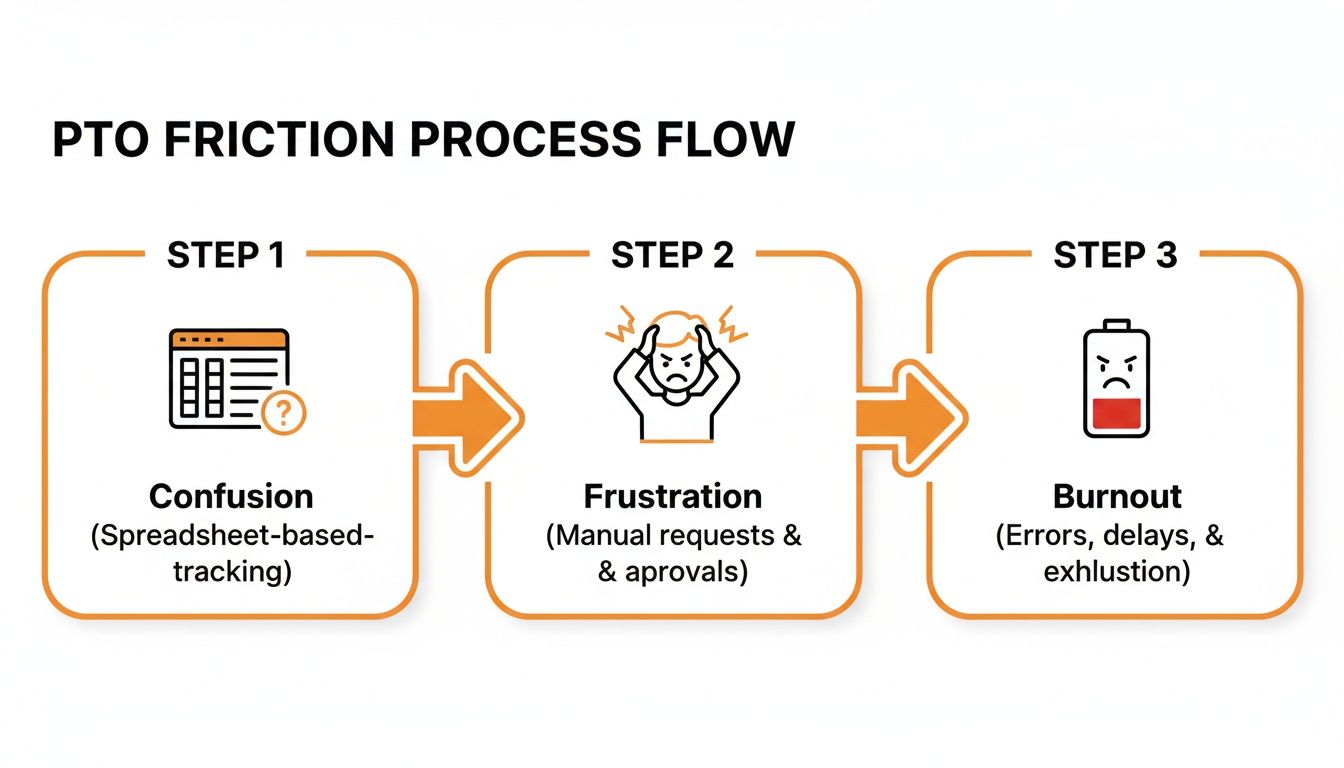
This isn’t just an administrative problem. It’s an emotional drain on the team.
The Simple Math Behind Accrual Rates
So, how do you figure out the accrual rate? You just work backward. Take the total vacation hours you offer for the year and divide by the number of paychecks.
The formula is always the same: Annual Vacation Hours ÷ Number of Pay Periods in a Year = Hours Accrued per Pay Period
Let’s say you offer 80 hours (two weeks) of vacation a year. Here’s how that breaks down depending on how often you pay people.
How 80 Hours of Vacation Accrues
Pay Frequency | Pay Periods per Year | Hours Earned per Paycheck |
|---|---|---|
Weekly | 52 | 1.54 hours |
Bi-weekly | 26 | 3.08 hours |
Semi-monthly | 24 | 3.33 hours |
Monthly | 12 | 6.67 hours |
See? The math isn't hard. The most important thing is being consistent. Once you pick a pay schedule, that little number—the accrual rate—is the heartbeat of your whole system.
This works for everyone. A salaried employee's accrual is based on their standard week. An hourly employee can accrue based on the hours they actually work. It’s inherently fair. If you want to get into the weeds, we wrote a deeper guide on how to calculate PTO accrual.
At the end of the day, this is about building a system people can trust.
When someone sees their vacation balance grow with every paycheck, the guesswork disappears. They can plan their time off with confidence, knowing exactly what they’ve earned. That clarity is everything.
A Vacation Policy Is a Statement of Your Values
Once the math is sorted, you hit the real challenge: the policy itself. This is where spreadsheets start to fall apart, and it’s where your company’s true culture shows itself. A good policy isn't a long list of rules. It's a handful of thoughtful decisions that feel fair to everyone.
Let’s be real. Nobody wants to feel like they’re getting a raw deal on vacation just because they started in July.
Onboarding and Proration
How you treat a new hire’s vacation time is one of the first tests of your policy. Prorating their time is the standard, but how you do it matters. The goal is simple: give them a fair amount of vacation based on the part of the year they'll actually be with you.
It's a small gesture that says, "We're glad you're here, and we want you to have a chance to recharge." A stingy or confusing rule sends the opposite message—that time off is a perk you have to fight for.
The Carryover Question
What happens to unused vacation at the end of the year? This is a big one. You're either in the "use-it-or-lose-it" camp or you let people carry some time over.
A strict use-it-or-lose-it policy feels punitive. It creates a mad dash to take time off in December, which is chaos. But letting people hoard unlimited time creates a huge financial liability for the company and fosters a culture where no one takes a real break.
We’ve found the best answer is a rollover cap. Let people carry over a reasonable amount—say, up to 40 hours. It respects the time they've earned while encouraging them to actually use it.
This approach gives people flexibility without letting balances get out of control. It’s a good balance.
Why You Need an Accrual Cap
Just as important is the accrual cap—the maximum balance someone can hold. Without a cap, you can have senior employees sitting on hundreds of hours of unused time. That’s not a badge of honor; it’s a red flag for burnout.
When you set a cap, often around 1.5 times the annual allowance, you create a gentle nudge. When someone’s balance hits the limit, they stop earning more until they use some. It’s a quiet way of saying, “You’ve earned this. Please, go take a break.”
These decisions are also shaped by where you are in the world. The U.S. is an outlier with no federally mandated paid vacation. Most of Europe, by contrast, requires at least 20 paid days off. If you have a global team, you have to build a policy that feels fair to everyone. It’s worth looking into how global paid time off standards compare to get some perspective.
A great policy isn't about compliance. It’s about building a system that genuinely supports your team’s well-being.
Ditch the Spreadsheet
Here’s the thing about tracking this manually: it doesn’t scale. The spreadsheet that worked for five people is a disaster for fifty. It becomes a tangled mess of broken formulas and human error. As you grow, the complexity multiplies.
We’ve all been there, squinting at a cell, wondering why the numbers don’t add up. It’s a waste of time and a source of needless stress. This is where good software changes the game.
The Point Is Trust, Not Just Efficiency
Imagine setting your rules once—carryover limits, proration, different rates for tenure—and then just letting it run. The software handles the rest. Balances update automatically. Everyone sees the same, correct number.
This is what automation should feel like.
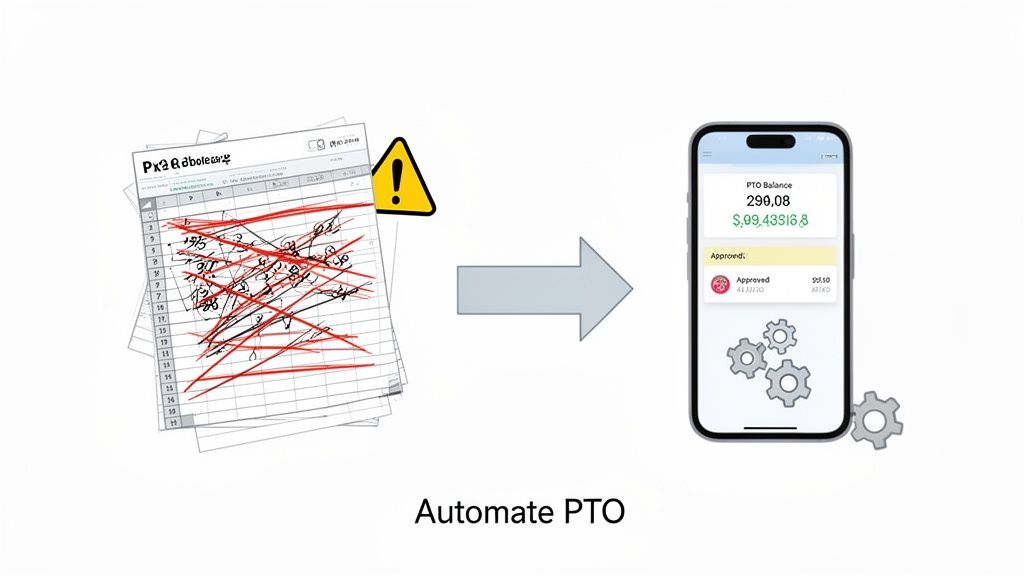
This is more than just convenience. It’s about clarity. When people can check their balance on their phone, the endless back-and-forth emails stop.
When your team trusts the system, the conversation shifts from "How much time do I have?" to "Where should I go?"
This shift is fundamental. Managers can approve requests knowing the data is right. HR can focus on people, not policing a spreadsheet. This idea isn't new; it's a core principle of good workflow automation, where you let machines handle the repetitive work so humans can do the thinking.
Why This Is Really a Cultural Decision
Let’s be honest. The real win isn’t just saving a few hours a week. The real value is cultural. A clunky, opaque system quietly tells your team that taking time off is a hassle. A smooth, transparent one says the opposite: “We value your well-being, and we want you to take this time.”
When you automate how you calculate vacation time, you’re not just buying a tool. You’re fixing a broken process. We’ve written about what to look for in the best employee PTO tracker app if you're curious.
It’s about removing friction from one of the most important parts of work. When people can easily see, plan, and take their time off, they come back better. And you can’t calculate that ROI on a spreadsheet.
Vacation Isn't a Perk. It's Part of the Job.
How you handle vacation time reveals what you truly believe about work. A clunky, untrustworthy system tells your team that their well-being is an afterthought. It turns rest into a transaction filled with friction.
A clear, fair, and simple system does the opposite. It shows you trust people and believe in the value of downtime.
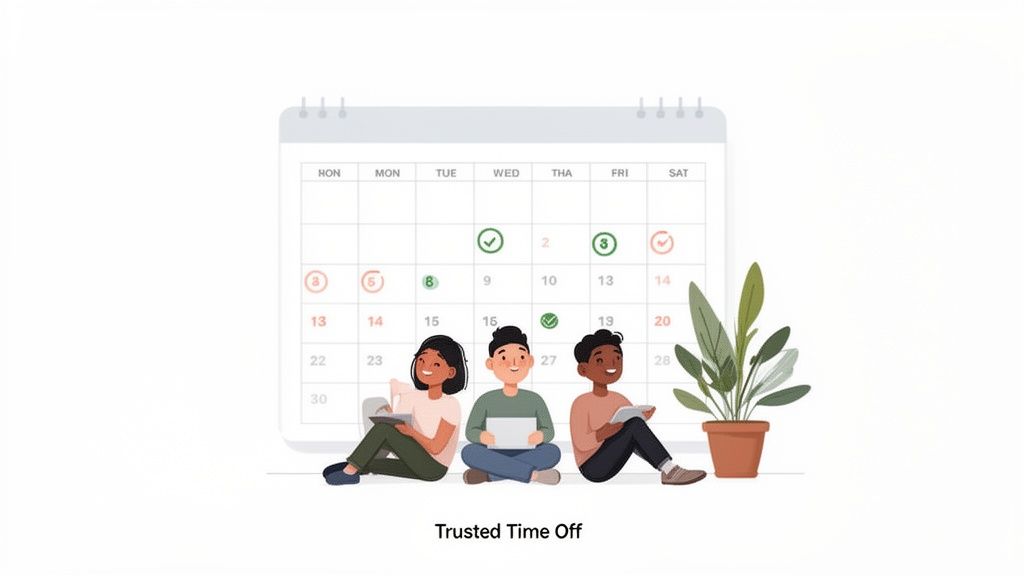
When someone can plan a trip without fighting a spreadsheet, they come back recharged. The small act of making time off easy has a huge impact on morale.
We’ve Created a Weird Culture Around Rest
Somehow, we got to a place where taking a break feels like a sign of weakness. It’s no surprise that 46% of people don’t use all their vacation, and a staggering 68% admit to working while they’re away.
But the evidence is clear: people who take at least 15 days of PTO report the highest job satisfaction. You can read through these intriguing PTO statistics and see the disconnect for yourself.
Getting this right isn’t about the numbers. It’s about creating a company where people feel not just permitted, but encouraged, to truly unplug. That’s the foundation of a sustainable, healthy team.
This is directly tied to retention and performance. Burned-out people do mediocre work, and then they leave. A good vacation policy is one of your best, and most overlooked, tools for preventing that.
Your Policy Is Your Practice
In the end, your vacation policy is part of the story people tell about working at your company. Is it a place that supports them, or one that makes simple things hard?
It’s about making sure your actions match your values. A simple, transparent system is a small investment that pays you back in trust and engagement. We’ve written more about how to build a culture of engagement that lasts. It all starts with trusting your people enough to let them rest.
Your Questions, Answered
Even with a clear policy, a few common questions always seem to pop up. These details matter. Getting them right is how you build trust.
Let's walk through the big ones.
How do you prorate vacation for someone who starts mid-year?
This is the first real test of fairness. Prorating just means giving a new person their fair share of vacation for the part of the year they’ll actually be working. No need to overcomplicate it.
The simplest way is to count the pay periods they'll work in their first year and multiply that by your normal accrual rate.
Say you offer 80 hours of vacation, accrued over 26 bi-weekly paychecks. That's 3.07 hours earned per check. If someone joins with 15 paychecks left in the year, they’ll earn 46.05 hours (3.07 x 15) before year's end. Simple.
What’s the difference between a lump sum and accrual?
A lump sum is like getting a gift card on day one. An accrual is like earning rewards points over time.
With a lump sum, people get their entire vacation allowance up front. It's easy to understand, but it also means someone could use all their time and then leave, which creates a payroll mess.
An accrual system, where time is earned with each paycheck, is much more common. It ties vacation directly to time worked, which feels more equitable and protects the company financially.
Do we have to pay out unused vacation when someone leaves?
This one is huge, and the answer is: it depends entirely on where you live. State laws are all over the map.
Some states, like California, view accrued vacation as an earned wage. If someone leaves, you have to cut them a check for every hour they have on the books.
Many other states leave it up to company policy. It is absolutely critical to know your local labor laws and state your payout rules clearly in your handbook. And be careful with "use-it-or-lose-it" policies—they’re flat-out illegal in several states. When in doubt, talk to a pro.
How do we get people to actually use their vacation?
This is a culture question, not a math problem. And it starts at the top. When leaders take real, unplugged vacations, it signals to everyone else that rest is not just allowed, but expected.
The goal is to build a culture where rest is seen as a responsibility, not a luxury. A transparent system is the first step.
Managers also have a huge role to play. They should be talking about vacation plans in their one-on-ones, framing time off as essential for performance, not as an inconvenience. Those small conversations change everything. They show your team you genuinely want them to recharge.
Managing vacation time shouldn't be this hard. With Pebb, you set your rules once and let the system do the work. Everyone gets a clear, real-time balance. Requests are simple. See how you can build a culture of trust and make time off easy at https://pebb.io.
