
The 4 On 4 Off Work Schedule: A Different Way to Work
Is the 4 on 4 off work schedule a good fit for your team? This guide explores the benefits, challenges, and how to manage it without the headaches.
Dan Robin

We’ve been conditioned to think of work in five-day blocks. Monday to Friday, nine to five. The weekend is a frantic two-day scramble to fit in errands, family, and a sliver of rest before the cycle starts again. We’ve accepted this as the default. But what if it’s just… an old habit?
The 4 on 4 off work schedule is a quiet rebellion against that default. It’s a simple idea with big consequences: you work four consecutive days, then you’re off for four consecutive days. That’s it. No more Sunday night dread. Instead, you get a four-day mini-vacation baked into every single week.
This isn’t some trendy new perk. It’s a practical answer for businesses that can’t just turn off the lights at 5 p.m.—hospitals, factories, data centers. It’s a way to keep things running around the clock without burning people out.
How Working Half the Year Actually Feels
Let's be clear. This isn't about working less; it's about working differently. To make the 4 on 4 off schedule work, the "on" days are long. Usually 10 or 12 hours. They are a grind. By day four, you’re tired.
But the trade-off is huge. Four full days off. That’s enough time to actually unplug. To take a short trip without asking for permission. To tackle a home project you’ve been putting off for months. It’s real, usable time to live your life.
This flips the whole idea of work-life balance on its head. Instead of cramming life into the margins of work, this schedule carves out substantial, dedicated blocks for both.
It’s a profound shift. You stop living for the weekend and start living in a rhythm of intense work followed by deep rest.
Of course, it’s a big adjustment. Your "weekend" might start on a Tuesday. When your friends are making Friday night plans, you might be halfway through a long shift. You’re marching to a different beat than most of the world.
So, is it good or bad? That’s the wrong question. The right question is whether the trade-off is worth it for you and your team. We’ve seen it transform businesses and give people their lives back. We’ve also seen it fall flat. The difference is always in the details.
How This Schedule Actually Plays Out
On paper, the 4 on 4 off pattern is simple. In practice, it means letting go of the traditional calendar. You stop thinking in terms of "Monday" or "Friday" and start thinking in "Day one on" or "Day three off."
Let's be real, this takes a mental shift. You'll be out of sync with the standard workweek. Your weekend might land on a Wednesday. You might be at work on a major holiday. But you also get quiet weekdays to run errands when the stores are empty.
The whole point is to create seamless, 24/7 coverage. To do this, you typically split your workforce into four teams. At any given time, two teams are working—one on days, one on nights—while the other two teams are on their four-day break. After their block, they rotate. The rested teams come in, and the working teams start their time off.
This steady rotation is what keeps the engine running. No coverage gaps. No last-minute scrambles. Everyone knows their schedule weeks, even months, in advance.
Visualizing The Rotation
To make this clear, imagine four teams: A, B, C, and D. Over a month, their schedules interlock. When A and B are working, C and D are off. Then they swap.
It's a simple, repeating flow from a block of work to a block of rest.
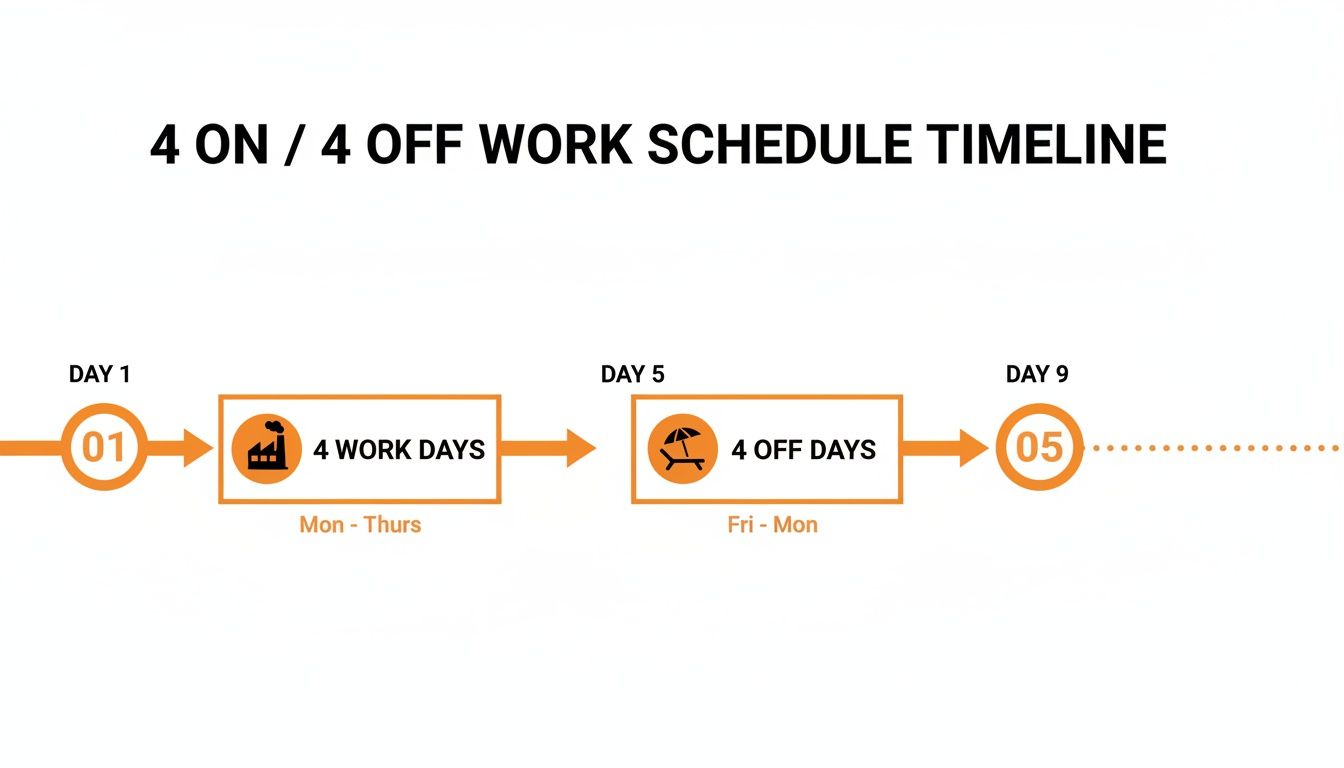
The visual makes it obvious. It’s a consistent cycle that keeps the operation covered while giving people a real break.
To see how this works for a full crew, here’s a sample rota. We'll use 'D' for the day shift, 'N' for the night shift, and 'O' for an off day.
Sample 4 On 4 Off Schedule Rota For Four Teams
Team | Week 1 (Days 1-7) | Week 2 (Days 8-14) | Week 3 (Days 15-21) | Week 4 (Days 22-28) |
|---|---|---|---|---|
A | D D D D O O O | O O O O N N N | N O O O O D D | D D O O O O N |
B | N N N N O O O | O O O O D D D | D O O O O N N | N N O O O O D |
C | O O O O D D D | D O O O O N N | N N O O O O D | D D D D O O O |
D | O O O O N N N | N O O O O D D | D D O O O O N | N N N N O O O |
As you can see, coverage is constant. There’s always a team on days and a team on nights. The pattern is so predictable you could map it out for the entire year.
Beyond The Standard 4 On 4 Off
Here’s the thing: the 4 on 4 off schedule is just one way to structure a compressed workweek. There are other patterns out there, like the Continental Shift, which uses a longer, more complex rotation. You can explore more options in our guide to work schedule examples.
These schedules aren’t better or worse, just different. Each one is a set of trade-offs between business needs and an employee's life. The key is understanding you’re moving away from a one-size-fits-all model.
The real beauty of the 4 on 4 off is its simplicity once you get into the rhythm. It’s a powerful tool for managers who need around-the-clock staffing and a life-changing schedule for people who value big blocks of personal time more than a traditional weekend. It's not for everyone, but for the right team, it just works.
The Real-World Benefits And Drawbacks
No schedule is perfect. Every single one is a balancing act. The 4 on 4 off work schedule is no different, and you need to go into it with both eyes open. The benefits can be life-changing. The drawbacks can be a dealbreaker.
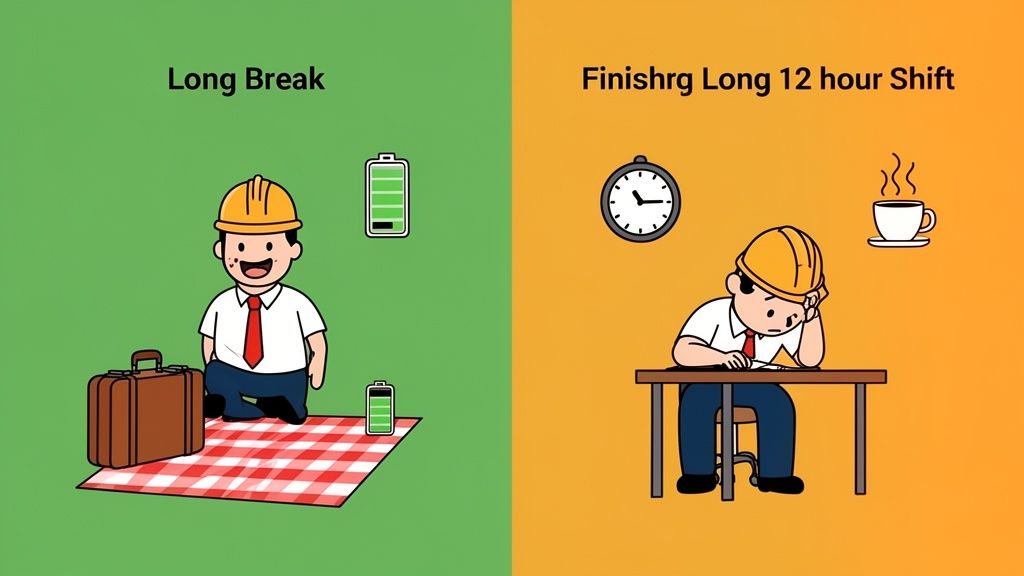
Let’s start with the upside. For employees, four consecutive days off is a game-changer. It’s a genuine mini-vacation built into your routine. It’s enough time to disconnect, take a trip, or dive into a project without using a single hour of paid leave. This rhythm is a powerful defense against burnout.
For the business, the appeal is just as strong. You get seamless, 24/7 coverage from a schedule that practically manages itself once it’s running. No more weekend scrambles.
Why Your People Might Love It
From your team’s point of view, the advantages are deeply personal.
Four days is enough time to truly switch off. People come back to their next shift feeling refreshed, not just rested. It’s also easier to handle real life—doctor’s appointments, banking, home repairs—when you have whole weekdays free. No more cramming errands into a rushed lunch break. And of course, the schedule makes spontaneous trips and hobbies a real possibility.
This kind of schedule is also a massive magnet for talent. When you offer a schedule that gives employees half the month off, you have a huge competitive edge.
A major UK pilot study of four-day workweeks found that companies saw a 57% drop in staff turnover and a 65% reduction in sick days. Meanwhile, employees reported a 71% drop in burnout.
Those numbers tell a story. When people get real time to rest, they are healthier, happier, and stick around. You can read the full findings to see what a better work-life balance can do for your team.
The Unfiltered Downsides
But that’s only half the story. The 4 on 4 off schedule demands a lot in return. Those 12-hour shifts are a grind. They are physically and mentally draining. By the fourth day, fatigue is a serious problem. In jobs where focus is critical—like in healthcare or manufacturing—this can become a safety concern.
Then there’s the social disconnect. Your "weekend" rarely lines up with the rest of the world. While your friends are heading out on Friday night, you might be clocking in. Holidays and birthdays become a coin toss. Over time, this can feel isolating.
For the business, implementation isn't a walk in the park. It requires a complete rethink of your payroll, overtime, and communication. A simple planning mistake can leave a critical gap in coverage.
This schedule is a choice with real consequences. It offers incredible freedom in exchange for on-the-job intensity. Before you leap, you have to weigh both sides—the promise of deep rest against the reality of demanding work.
How To Manage This Schedule Without Chaos
Putting a 4 on 4 off work schedule on the calendar is the easy part. The real work is making it run smoothly day after day.
Let's be honest, the idea is simple, but the execution can get messy. It’s not just about who works when. It’s about the flow of information. How does the day shift know what the night shift handled? How do you track overtime when the week isn't seven days long?
You can try to juggle it with spreadsheets, group chats, and paper logs. But you’ll spend all your time patching together systems that were never designed for this. The old way is fragile and creates more problems than it solves.
From Disconnected Tools To A Central Hub
The root of the problem is fragmentation. Scheduling happens in one app, communication in another, and time tracking in a third. Nothing is connected. A change in the rota doesn't automatically update everyone. A critical shift note gets buried in a chaotic group chat.
This is where you need a single source of truth. A unified work app. It’s not about adding another tool; it’s about replacing that tangled web with one calm, organized space. Instead of building rotas in a spreadsheet, you use a shared, living calendar. You replace chaotic text threads with dedicated channels for shift handovers. Time tracking is built right in.
Here’s what it looks like when all the critical elements come together in one clear view.
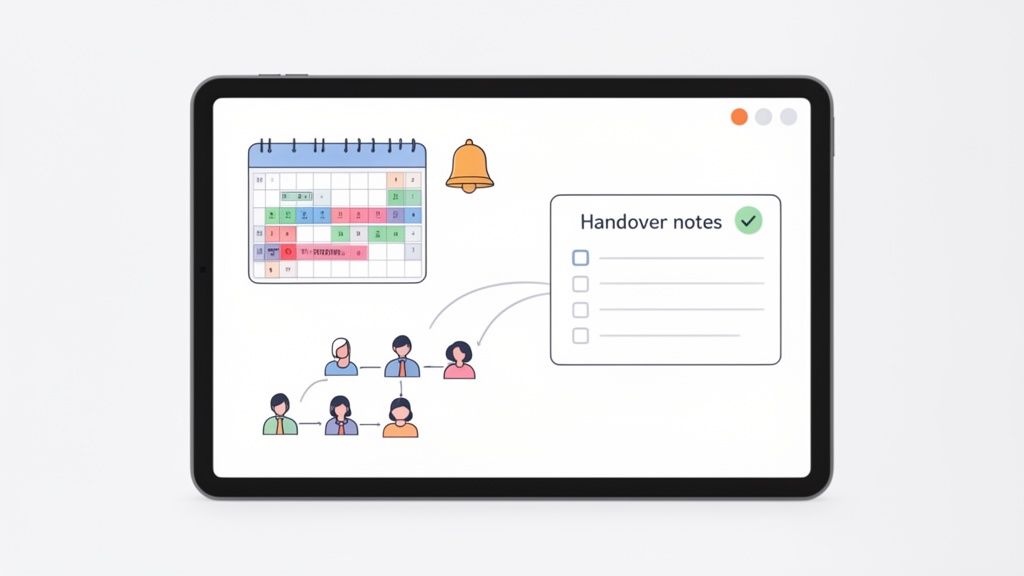
This kind of hub gives you a clear, at-a-glance understanding of who is working, what they need to know, and what's next.
The difference is night and day.
Managing A 4 On 4 Off Schedule The Old Way Vs The New Way
Operational Task | The Old, Disconnected Way | The Pebb Way (Unified App) |
|---|---|---|
Scheduling | Static spreadsheets that are hard to update and share. High risk of version control issues. | A dynamic, shared calendar that's always up-to-date and accessible on any device. |
Notifications | Manual emails, texts, or calls to inform staff of changes. It's slow and easy to miss someone. | Instant, automatic notifications for new schedules, shift changes, and reminders. |
Shift Handovers | Handwritten notes, word-of-mouth, or messy group chats. Information gets lost or misinterpreted. | Dedicated, organized handover notes logged in the app. Creates a clear audit trail. |
Time Tracking | Paper timesheets or separate clock-in systems that don't talk to the schedule. Prone to errors. | Integrated time tracking. Employees clock in and out on the same app where they view their shifts. |
Payroll Prep | Manually calculating hours, overtime, and shift differentials. It's a time-consuming, error-prone process. | Automated timesheet calculations based on real clock-in/out data, ready for payroll. |
As you can see, a unified approach makes your entire operation more reliable.
Key Workflows To Get Right
Centralizing your tools is the first step. Next is focusing on the three workflows that make or break this schedule.
Clear Communication: Notifications need to be automatic. When a new schedule is published, the right people should know instantly, without you having to chase them down.
Seamless Handovers: The moment one team clocks out and another clocks in is the most vulnerable point. Create a dedicated space for handover notes where the outgoing team can list critical updates, pending tasks, and any issues.
Accurate Time and Attendance: Manual timesheets are a disaster with a rotating schedule. Integrated time tracking means employees clock in and out on the same app where they see their schedule. This eliminates errors and makes payroll straightforward.
The goal isn't just to manage the schedule. It's to build a system where the schedule manages itself, freeing you up to support your team instead of fighting fires.
A dedicated employee shift scheduling app can help you build these workflows.
Ultimately, managing this schedule without chaos comes down to one thing: connection. When your tools are connected, your teams are too. The schedule stops being a source of stress and becomes what it was always meant to be—a simple, powerful rhythm that works for everyone.
Is The 4 On 4 Off Schedule Right For Your Team?
So, should you make the switch? The honest answer is always the same: it depends. The 4 on 4 off work schedule isn't a magic wand. Think of it as a specialized tool for a specific job.
For some businesses, it's a game-changer. Places that can't afford to power down—data centers, nonstop manufacturing, emergency services. For them, this schedule creates a predictable rhythm that just clicks.
But try to force that same schedule on a company built around standard business hours, and you’ve got a mess. You can't just bolt on a 24/7 model when your customers are only around from 9 to 5.
Beyond The Logistics
Here's the thing, though: operational needs are only half the equation. The other, more important half, is your people. You have to be brutally honest about what the work feels like.
Are the jobs physically draining? Are people on their feet for 12 hours, running heavy machinery, or making high-stakes decisions? If so, fatigue isn't just a buzzword—it's a safety risk. You have to weigh whether four days off is worth the physical toll of four long days on.
A few questions we always ask leaders to consider:
What is the real cost of a 12-hour shift in your workplace? Be realistic about burnout and the chance of mistakes on that fourth day.
Does your culture support this kind of independence? This schedule demands a ton of trust and personal responsibility.
How will you manage shift handovers? A sloppy handoff can wipe out the gains of a well-planned schedule.
Is your payroll system ready? Getting pay right is essential for keeping your team happy.
Tapping Into The Demand For Flexibility
Let's be clear. The 4 on 4 off schedule isn't the same as the "four-day workweek" you read about in the news. That model is usually about working fewer hours for the same pay.
But they both tap into the same powerful current: the growing hunger for real flexibility and more time away from the job. The ground is shifting under our feet. As of 2024, 22% of employees said their company offered a four-day workweek, up from just 14% in 2022. You can dig into these trends in workweek flexibility yourself.
The bottom line is this: The right schedule can be one of your most powerful tools for attracting and keeping great people. But it has to be the right schedule for your operation and your team.
This isn't a decision to be made in a boardroom. It demands open conversations with the people who will live this schedule. It takes smart planning and the right systems. If you're looking for help with that, our guide to the best shift planning tools is a good place to start.
Picking a work schedule is about getting clear on your priorities. If your goal is to build a resilient, 24/7 operation with a rested and engaged crew, the 4 on 4 off model might be what you're looking for.
A Final Word on a Different Way to Work
When you boil it down, the 4 on 4 off work schedule isn't just about shuffling hours on a calendar. It's about a different philosophy of work. It redefines the relationship between our jobs and our lives.
This schedule is built on a simple truth: some jobs are intense. So, the rest that follows has to be just as intentional. It’s a challenge to the five-day workweek, a model from a world that looks very little like ours today.
The Real Work Is Always Human
Let’s be honest. Making a schedule like this work isn't about perfect logistics or fancy software. The real puzzle is the human one. It’s about cultivating a culture of trust, clear communication, and genuine respect.
This system needs managers who have their team's back, not just someone who plugs names into a rota. It requires employees who feel a real commitment to the person taking over after them.
The schedule is just the framework. The human elements—seamless handovers, quick updates, a feeling of connection—are what make it click. That's the real puzzle you're solving.
You can design the most beautiful rota, but if the handoff between shifts is messy, things will break. If your team doesn't feel safe enough to say, "I'm hitting a wall," you're risking more than just burnout—you're risking serious mistakes.
A Choice That Carries Weight
Deciding to go with this schedule is a big deal. You’re asking for more from your people on their "on" days. In return, you’re giving them a real chance to unplug and live their lives on their "off" days. It’s a powerful trade-off.
Ultimately, the 4 on 4 off work schedule is an invitation to think differently. It pushes us to look past the default settings of work and ask what a structure built for balance and resilience could look like.
It's not the right fit for every team. But for the right ones, it can be a game-changer. The real question is: is our culture ready to make it work?
Frequently Asked Questions
We get it. The 4 on 4 off work schedule is a big change, so questions are normal. Here are some straight answers to the ones we hear most often.
How Many Hours A Week Do You Work?
This is the number one question. Because the schedule runs on an eight-day cycle, the hours can look strange at first. One week, you might work four 12-hour shifts for 48 hours. The next week, you might work zero.
It all evens out. Over the full eight-day rotation, an employee works 48 hours. This averages out to 42 hours per week. It's slightly more than a standard 40-hour week, but that’s the trade-off for the four-day block of personal time.
Is The 4 On 4 Off Schedule Healthy?
That's a tough one, because "healthy" is personal. For some people, having four full days off is a game-changer for their mental and emotional well-being. It gives them a chance to de-stress and truly recharge.
The flip side is the physical reality of four long shifts back-to-back. Twelve-hour days are tiring. Burnout is a real risk, especially in physically demanding or mentally draining jobs.
Making this schedule healthy comes down to culture. It’s about ensuring people take proper breaks, creating a supportive environment, and encouraging everyone to truly switch off during their time off. It’s a balancing act that requires a real commitment to well-being.
How Do Holidays And Overtime Work?
This is where things get complicated without a clear policy. Since the schedule always rotates, shifts will eventually land on public holidays. Businesses usually handle this in one of two ways:
Holiday Pay: Anyone working on a public holiday gets paid a premium rate.
Floating Holidays: The employee gets a bank of floating holidays to use on other days.
Overtime is the other big piece. With an average of 42 hours per week, some of that time will likely count as overtime, depending on your local labor laws. You need a payroll system that can handle this automatically. Trying to track this with spreadsheets is a recipe for headaches and errors.
Ready to manage your 4 on 4 off work schedule without the chaos? Pebb brings your scheduling, communication, and operations into one simple, unified app. Build clear rotas, streamline shift handovers, and keep everyone connected, all in one place. See how it works at https://pebb.io.
