
Rethinking Employee Time Tracking Software
Discover why modern employee time tracking software is about building trust and clarity, not just clock-watching. A guide for leaders.
Dan Robin
Let's be honest. When you hear “employee time tracking software,” what comes to mind? For most people, it’s a digital punch clock. A tool for watching people. A quiet hum of mistrust running in the background.
We get it. That old view is hard to shake.
But that’s not what this is about anymore. The conversation has changed.
The Conversation We Should Be Having About Time Tracking
Modern time tracking isn’t about counting seconds; it’s about creating a single source of truth that makes work easier for everyone. It’s about building a place where your team can relax, knowing their paycheck will be right, every single time. It’s about booking a day off from your phone without a headache.
From Mistrust to Mutual Benefit
This is a fundamental shift. We're moving away from a tool that asks, "Are you working?" to one that simply confirms, "Your work is being logged and valued correctly." The technology isn’t what’s new—it’s the thinking behind it. When you put a good system in place, you’re laying the groundwork for a calmer, more efficient operation.
A good system doesn't just record hours; it eliminates guesswork. It answers questions before anyone has to ask, cutting down on the back-and-forth between managers and their teams.
That kind of clarity builds trust. Employees trust the system because it's transparent and fair. Managers love it because it handles the tedious admin that used to pull them away from leading and supporting their people.
It's More Than a Tool, It’s a Turning Point
This operational backbone is quickly becoming a must-have. The market for employee time tracking software is projected to hit $6.1 billion in 2025 and swell to $11.43 billion by 2030. What's driving this? The simple reality of managing modern businesses with remote, hybrid, and frontline teams in places like retail, hospitality, and logistics. You can discover more insights about this market trend if you're curious.
This isn't just about cool features. It's about how a seemingly simple tool can become the calm, organized center of your business—making work simpler for everyone.
From Punch Cards To Integrated Platforms
To really get what modern employee time tracking software does, it helps to look back. For nearly a century, the final word on an employee's time came from a piece of cardstock and a loud, mechanical thunk.
The punch clock was an industrial-era invention for an industrial-era deal: you give us your time, we give you money. It was straightforward, direct, and completely separate from the actual work. Its only job was to record presence, nothing more.
Then came the digital age. We swapped punch clocks for spreadsheets. It felt like progress, but was it? Suddenly, hours were spent keying in numbers, fixing broken formulas, and chasing down corrections. This "fix" often created more administrative headaches than it solved, turning payroll into a puzzle with missing pieces. It was digital, sure, but it was still just a list of numbers.
The Shift from Tallying to Connecting
The real leap forward came when software stopped just counting hours and started connecting them to everything else. This wasn't a technical upgrade; it was a philosophical one. Think of it as the difference between a simple calculator and a central nervous system for your entire operation.
Today, a clock-in isn't just a timestamp. It’s a single tap that can confirm a scheduled shift, feed information directly to payroll, and update a manager’s dashboard. All at once.
This timeline captures the journey from basic timekeeping to the connected hubs we use today.
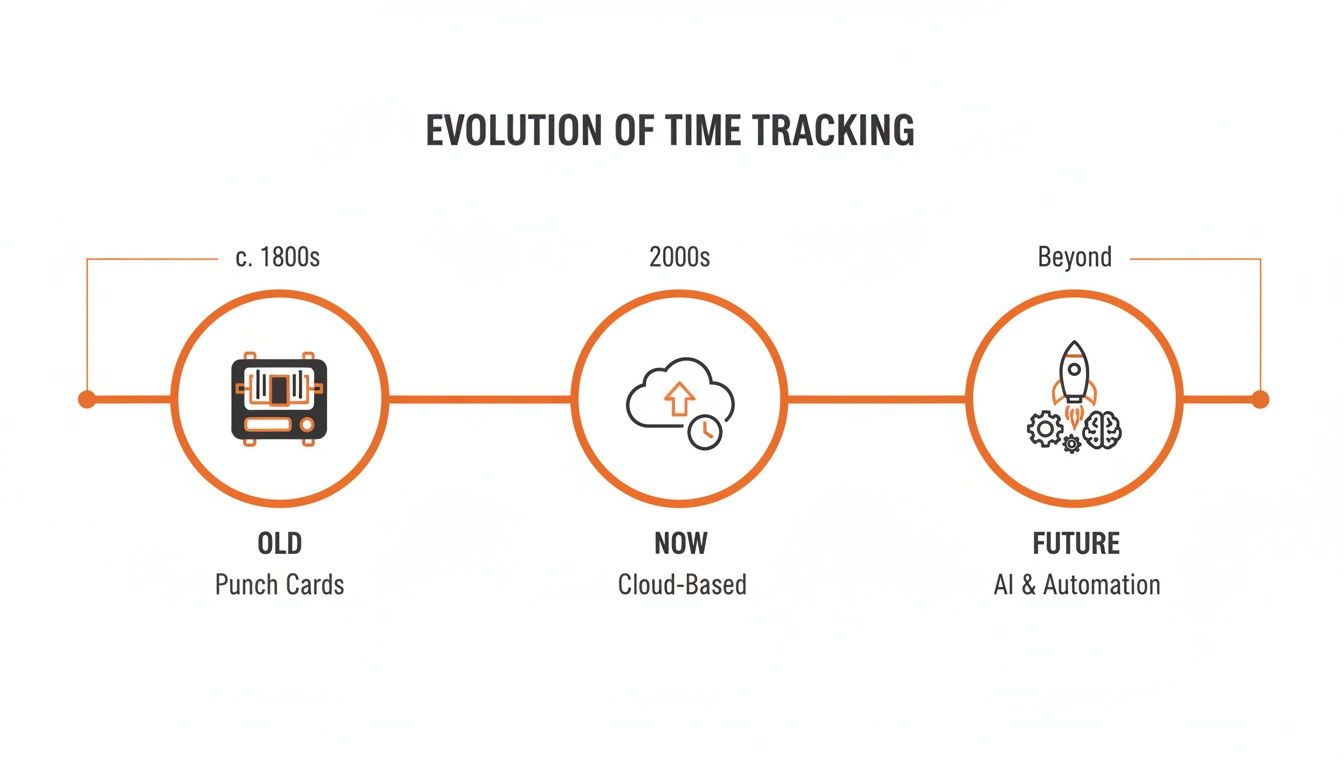
As you can see, we've moved from siloed tools to deeply integrated systems that do far more than just track time.
A Single Source of Truth
This evolution matters because the goalposts have moved. We're no longer just trying to stay compliant or get payroll right. We're building a single, reliable source of truth for our daily operations.
When time, scheduling, and communication all live in the same place, you eliminate the friction that slows businesses down. There’s no more "I didn't see the schedule change" or "Did you approve my time-off request?"
The information is just… there. Accurate, accessible, and connected. If you're curious how this works in practice, we've written about what a modern digital time clock for employees looks like and how it builds trust.
The journey from punch cards to integrated platforms isn't just a history lesson. It’s a reminder that the tools we choose reflect the kind of company we want to be. Do we want a workplace built on disconnected tasks, or one built on clarity, connection, and calm confidence?
What Good Time Tracking Software Actually Does
Let's cut through the marketing noise. The world of employee time tracking software is crowded with promises of a hundred features, dashboards that look like a spaceship cockpit, and endless talk about "optimization."
But when you get down to it, what does a good tool actually do?
It doesn't bury you in features. It solves real problems by delivering on three simple things: clarity, simplicity, and connection. That’s it. This isn’t about finding a tool that does everything; it’s about finding one that does the essential things so well you forget it’s there.
It Creates Unmistakable Clarity
The best kind of quiet in a workplace comes from clarity. That feeling when everyone knows what’s going on without having to ask. A great time tracking tool is the foundation for this.
Clarity means schedules are posted, updated, and accessible from anyone’s phone. It means a PTO request is a simple tap, not an email chain. Most importantly, it means payroll is 100% accurate, every single time. When your team trusts their pay is right, an entire category of stress just vanishes.
Good software doesn't create work; it absorbs it. It takes the messy parts of managing people—like scheduling conflicts and payroll corrections—and makes them predictable.
This sense of order ripples out. Managers aren't stuck chasing timesheets. They can focus on leading. Employees feel respected because the system is transparent and fair. This clarity isn't a feature; it's the bedrock of a well-run operation.
It Insists On Simplicity
If your team needs a training manual to clock in, the tool has already failed. Simplicity isn’t just about clean design; it’s a sign of respect for people’s time.
In the real world, simplicity looks like this: An employee pulls out their phone, taps a button, and they’re clocked in. It takes two seconds. A manager can approve a timesheet for their whole team with one click while waiting for coffee.
This isn't a minor detail. It’s everything. Tools that are hard to use don't get used, or they get used wrong, which creates more admin work. The very problem you were trying to solve. You can learn more about how modern time and attendance software nails this simplicity. True simplicity means the tool works for you, not the other way around.
It Builds Genuine Connection
Here’s where most time tracking tools miss the point. They treat time tracking as an isolated task. The data goes into a digital box and only comes out for payroll. But that’s only half the picture.
A truly modern tool understands that time tracking data shouldn’t live on an island. It needs to connect to everything else. The hours someone works are tied to the schedule they were assigned. A pattern of overtime might be a signal that a manager needs to check in. A clock-in error is a chance to start a conversation, not just send an alert.
This is why the market is undergoing such a massive shift. The demand for connected systems is projected to push the time tracking software market from $19.18 billion in 2025 to an incredible $149.92 billion by 2034. Businesses are realizing that integrating time data with HR and operations creates a level of insight that was impossible before. You can read the full research on this explosive growth.
When time tracking is part of a platform that also handles communication and scheduling, the data becomes human again. It provides context, starts conversations, and helps you run a more thoughtful business.
Why Time Tracking Is Really About Communication
Here’s a secret most software companies won’t tell you: employee time tracking software isn't really about time. It's about communication. We’ve been taught to see it as a ledger—hours worked for pay. But that’s like saying a smartphone is just for making calls. The real magic is in the connection it creates.
Think about a missed clock-in. In a typical system, it’s a data error. A red flag on a report. It creates another task for a manager to chase down. The conversation, when it finally happens days later, can feel awkward, even accusatory.
But what if that data point wasn't an endpoint? What if it was a conversation starter?
Turning Data Points into Human Conversations
Everything changes when your time tracking tool lives inside the same app your team uses for daily chat. A pattern of late arrivals might not be a performance issue. It could be a sign an employee is struggling with something at home, juggling new childcare duties, or heading toward burnout.
A manager who spots a clock-in issue can start a direct, private chat right then and there. The conversation shifts from, "Why were you late?" to a supportive, "Hey, I noticed you had trouble clocking in. Is everything okay?"
That simple change turns monitoring into support. It turns a system that just watches into a tool that connects people. This is where the true power lies—using operational data to build better relationships.
Time tracking data, isolated from its human context, is just noise. When it’s connected to communication, it becomes a signal that helps you take care of your team.
When done right, time tracking doesn't just log hours; it can dramatically improve team communication by creating a shared, factual starting point for conversations that might otherwise feel subjective.
The Problem with Siloed Information
The biggest failure of traditional software is that it creates information silos. Time data lives in one system, schedules in another, and team chat happens somewhere else entirely. This forces everyone to constantly switch gears.
Imagine a manager trying to figure out if a missed shift was due to a last-minute swap they approved via text. They have to jump between three apps to connect the dots. It’s inefficient and mentally draining. It shatters the story of the workday, leaving you with disconnected fragments.
This fragmented approach is quickly becoming a thing of the past. The market for online time tracking software was valued at $177.53 million in 2025 and is on track to hit $310.59 million by 2032. This growth isn't just about better digital clocks; it’s driven by a demand for unified platforms. Businesses are realizing that integrating time tracking with project management and payroll can slash administrative work by up to 50%.
A Unified Platform Builds a Unified Team
When time tracking is woven into your team’s daily communication, the benefits are immediate.
A scheduling conflict isn't buried in an email. It becomes a quick message in a team channel where everyone sees the issue and the solution. A time-off approval and the updated schedule appear together. No more ambiguity. And managers get the context they need to lead with empathy.
This isn't just about convenience. It’s a shift in philosophy. It’s an acknowledgment that work is a human activity, driven by conversations and relationships. The tools we use should reflect that. We dive deeper into this in our guide on what is organizational communication and why it's so vital.
By bringing time tracking and communication together, you aren’t just buying software. You’re building a more connected, understanding, and resilient team.
How To Choose The Right Tool For Your Team
Let’s be honest, the market for employee time tracking software is a crowded, noisy place. Every website screams about its features, hitting you with endless comparison charts until your eyes glaze over. It's overwhelming.
So, let's cut through the noise. Forget the feature checklists for a minute and ask three simple questions. You'll find the right tool for your team much faster.
Does It Solve Your Most Immediate Pain?
You’re not looking for software for fun. There’s a nagging problem that pushed you to start searching. Is payroll a monthly headache of chasing timesheets and fixing errors? Are you untangling scheduling conflicts from messy group texts?
Don't get sidetracked by a tool that boasts twenty features you'll never touch. Focus on the one thing that's causing the most chaos right now. If inaccurate payroll is costing you admin hours and eroding employee trust, a tool with rock-solid time capture and seamless payroll integration is your number one. Put out the biggest fire first.
Will Your Team Actually Use It?
This is it. The single most important question. The most advanced software on the planet is worthless if your team finds it clunky or ignores it. If a tool requires a special training session to get started, it’s already failed.
You need something designed for actual people, not just for the person signing the check. It should be intuitive, mobile-friendly, and take seconds to use. A great tool feels natural—as easy as sending a text or checking the weather on your phone.
The adoption of any new tool comes down to one thing: simplicity. If it's not effortlessly easy to use, it won't become a daily habit, and you'll be right back where you started.
Don't just fall for a slick demo. Get a free trial and hand it to a few of your busiest team members. Their unfiltered feedback is worth more than any sales pitch.
Can It Grow With You?
Okay, you're solving an immediate problem today. But what about six months from now? A tool that only tracks time might solve your current payroll headache, but it’s just another disconnected app. Soon you’ll have one tool for time, another for scheduling, and a separate one for team chat. That’s a recipe for confusion.
Look for a platform, not just a point solution. Think about the next step. Once you’ve got time tracking under control, you'll want to connect it to scheduling. Then you’ll see how powerful it is when your team's communication lives in the same place as their work hours and schedule.
Choosing an employee time tracking software isn't a technical decision; it's a people decision. You're not just buying features; you're choosing a new way for your team to operate. Go with the tool that will help you build the organized, transparent, and connected company you want to be.
Making Work Make Sense
I started this by saying this is about more than counting minutes. The right employee time tracking software isn’t a surveillance tool. It’s the quiet, reliable engine running in the background of a calm business.
It’s the confidence a manager feels, knowing payroll will be spot-on without double-checking a single timesheet. It’s the peace of mind an employee has when they can pull up their schedule from their phone. This operational backbone is powerful.
The Digital Home for Your Company
But here’s where it gets interesting. When you combine that operational clarity with the tools your team uses to talk and connect every day, you build something bigger. You create a digital home for your company.
This becomes the single place where work gets done. It's where your company culture is built, one message at a time. It’s where people feel seen and valued. This is how you turn a simple utility into an environment that fosters real connection.
That's the real promise of these tools—not to track every second, but to make every moment at work count. It's about turning operational data into human connection.
To truly make work make sense, you have to look at the whole picture. Consider how platforms that focus on positive employee experience, like goodkudos, can fit in. When you weave those elements together with your operational tools, you create a workplace where people feel they belong.
It's about building a space that feels less like a workplace and more like a community, even when your team is spread across different shifts and locations.
This shift in perspective is everything. You're not just buying a tool to solve a payroll problem. You’re making a choice to build a company that runs on clarity, trust, and human connection.
Frequently Asked Questions
After talking with hundreds of business owners, we know a few questions always come up. Let's tackle them head-on.
Is Time Tracking Just Micromanagement?
It can be. It all comes down to how you frame it. If you introduce the software as a way to "keep an eye on people," then yes, it’s going to feel like micromanagement. No one wants that.
But if you frame it as a tool to guarantee everyone gets paid accurately and make scheduling easier, it becomes a benefit for the whole crew. The goal isn't to watch every click; it's about bringing clarity and fairness to the workday. When the focus is on mutual benefit—accurate pay for them, better planning for you—that "Big Brother" feeling disappears.
What Is the Best Way to Track Employee Hours?
The best way to track hours is with a tool your team will actually use. A system can have every feature in the world, but it’s useless if it’s a pain to navigate.
This is why we believe the ideal solution is to put time tracking right inside the app your team already uses for daily communication. When clocking in is a button away from their chats and schedules, it stops being a chore and becomes part of their natural workflow.
It makes tracking time feel less like a separate, annoying task and more like a helpful part of the day. It’s about respecting your team’s time and attention.
How Much Do Time Tracking Apps Cost?
That’s like asking how much a car costs—the range is huge. You can find free basic timers and complex enterprise systems that run $10 to $20 per user per month, often bundled with a full suite of HR services.
A quick word of caution on "free" plans. They're often just a hook, with the features you actually need behind a paywall.
Instead of just looking at the price, think about the value. A tool that costs a little more but also handles your scheduling and team communication could easily replace three separate subscriptions. That saves you money and administrative headaches.
Look for simple, transparent pricing that can grow with you. The real cost isn't the monthly fee—it's the time, energy, and trust you lose with a clunky tool that doesn't solve your real problems.
Ready to see how a unified work app can bring a sense of calm and connection to your business? Pebb combines time tracking, scheduling, and communication into one simple, modern platform. Start your free trial today.
