
Your Company is a Conversation, Not a Machine
What is organizational communication? It's the lifeblood of your company. Discover how to improve clarity, culture, and teamwork with practical strategies.
Dan Robin
Let's be honest, the term "organizational communication" sounds like something straight out of a dusty textbook. It conjures images of complex flowcharts and rigid hierarchies, treating a company like a predictable machine.
But that’s where things go wrong.
A business isn't a machine with gears and levers; it's a living, breathing conversation. It’s the constant hum of human interaction—the project kick-off, the all-hands update, that quick Slack message, and the quiet chat by the coffee machine.
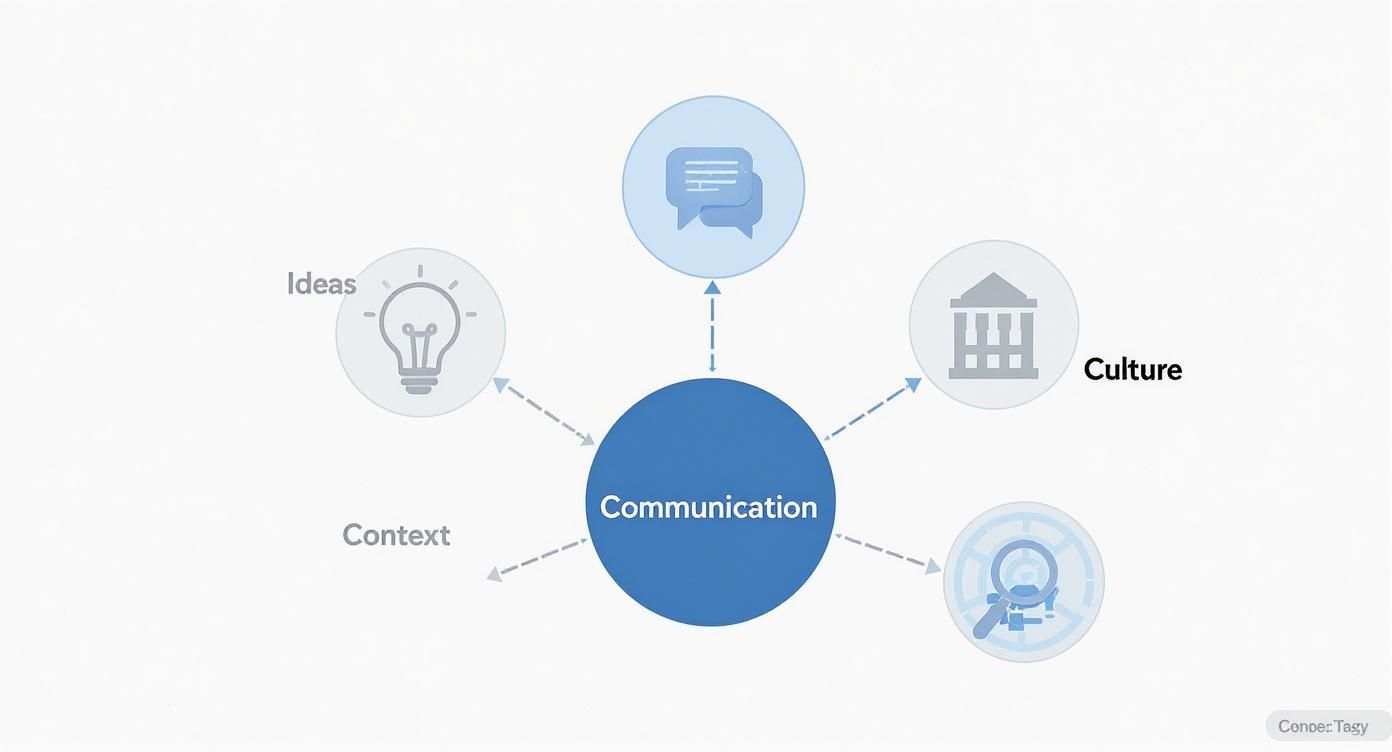
This ongoing dialogue is the lifeblood of your company. It carries ideas, shares context, and builds the culture that defines who you are. When that conversation is healthy, work flows. When it's broken, even simple tasks feel like a struggle.
So, what is organizational communication in plain English? Think of it as your company's nervous system. It’s the network that dictates whether your teams pull together or drift apart into silos.
Ignoring communication is one of the biggest—and most common—mistakes a company can make. It’s not about finding the perfect app or drafting the perfect memo. It’s about intentionally building a system where clarity and trust can thrive.
The goal isn't just to transmit information. It's to create shared understanding. A sent email does not equal alignment.
The Four Flows of Organizational Communication
Communication isn’t just a top-down broadcast. Information moves in all sorts of directions—up, down, sideways, and even through the grapevine. Acknowledging these different "flows" is the first step to understanding what's really happening in your organization.
Here’s the thing: most of us only think about the daily back-and-forth required to get work done, what academics call Activity Coordination. It’s the project updates, team meetings, and cross-departmental problem-solving. This is where collaboration lives or dies.
But that's only half the story. Communication also includes the "official" stuff like policy documents and mission statements (Self-Structuring), which sets the ground rules. It’s how your company talks to the outside world through marketing and PR (Institutional Positioning). And it’s the entire employee lifecycle, from recruiting to exit interviews (Membership Negotiation), which shapes a person's sense of belonging.
Understanding these flows helps you see that communication is happening everywhere, all the time—whether you’re managing it or not.
A Quick Look Back
The formal study of this field started long before the first instant message was sent. Back in the early 20th century, thinkers like Henri Fayol and W. Charles Redding began to unpack how information moved through a business. Redding, often called the "father" of the field, was one of the first to focus on the human behavior inside organizations, not just the org chart.
But that history just proves a point we see every day: communication has always been a fundamentally human challenge. It's less about the technology we use and more about how we use it to connect. When we rethink internal communication, we realize it’s about starting a conversation, not just broadcasting a message.
Ultimately, getting this right means fewer misunderstandings, less wasted effort, and a team that feels connected to the mission—and to each other. It’s the foundation for everything else.
The Unspoken Rules of Workplace Communication

Every company is having two conversations at once.
There’s the conversation you see on the org chart—the official memos, the scheduled meetings, the polished all-hands presentations. This is formal communication, and it’s how the company officially gets things done.
But then there’s the other conversation. The real one.
It’s the chat over coffee, the advice from a trusted colleague, or the “grapevine” that somehow knows about a new hire before HR sends the email. This is informal communication, and frankly, it’s the invisible network that holds the company together.
The Official Story and The Real Story
For years, leaders have tried to control or stamp out this informal channel. They see it as a source of rumors, a distraction, or a threat to the official narrative. I think that’s a huge mistake.
Trying to kill informal communication is like trying to stop the tide. It’s human nature. People will always talk, share, and make sense of their world together. The real work isn't to silence this channel but to understand it.
Informal communication isn't a bug; it's a feature of any healthy human system. It’s where culture is actually built, trust is earned, and small problems get solved before they become big ones.
A healthy company doesn't just tolerate the grapevine; it respects it. They know that when the informal network is buzzing with positive energy, it’s a sign the formal channels are working. But when it’s full of speculation and anxiety? That's a clear signal leadership isn't being transparent enough.
Vertical vs. Horizontal Conversations
This dynamic also plays out in the direction communication flows. We’re all familiar with vertical communication—the top-down directives from leadership and the bottom-up reports from the frontline. It’s essential for hierarchy and accountability. An instruction flows down, a status update flows back up. Simple.
But where does the real magic happen? More often than not, it’s in horizontal communication, the conversations between peers and across departments. This is where a designer and an engineer hash out a new feature, or where marketing and sales finally get on the same page.
This peer-to-peer flow is where the best ideas are born. It cuts through red tape and lets people solve problems directly. It's no surprise that a recent McKinsey study found that well-connected teams see a productivity jump of 20-25%. When people can talk to who they need to, work just gets done faster.
Putting It All Together
So, what does this all mean? It means you need to pay attention to both the official and the unofficial conversations in your company. The formal structures provide the skeleton, but the informal networks are the muscle.
If your big announcements are always met with confusion in the team chat, there's a disconnect. If your best projects start from friendships formed over lunch, that’s a sign of a healthy informal culture.
The goal isn't to turn every conversation into a formal, documented process. That would be exhausting. Instead, it’s about creating an environment of trust where the official story and the real story aren’t two different things. It’s about building a place where the grapevine confirms what leadership says, rather than contradicting it.
Where Communication Actually Breaks Down

It’s easy to blame our tools. "The chat app is a nightmare," "My inbox is a black hole," "This project tool is a mess." But if we’re being honest, that’s just a convenient excuse.
I’ve seen it countless times: a company invests a small fortune in some shiny new platform, promising it will solve everything. A few months in, the same old problems are back, just with a prettier interface. The truth is, communication doesn't fail because of a bad tool; it fails because of broken systems and human habits.
The real issues run much deeper. They’re cultural. And they almost always fall into a few common traps.
The Silo Effect
The classic culprit is the “silo effect.” This happens when teams act like independent city-states, hoarding information instead of sharing it. Marketing has its data, engineering has its roadmap, and sales has its customer insights—and nobody is talking to each other.
It’s rarely malicious. People are busy. They're focused on their own targets. But the result is a company accidentally working against itself. Projects stall because one team was missing critical context from another. I’ve even seen two separate departments trying to solve the exact same problem, oblivious to each other’s work.
This isn’t a technology problem; it’s a trust problem. The fix isn't another chat channel, but a fundamental shift toward making transparency the default.
The Top-Down Echo Chamber
Another common failure is the “top-down echo chamber.” This happens when leaders talk at their employees instead of with them. They broadcast announcements and share strategies, but there are no real channels for feedback to flow back up.
Communication becomes a one-way street. Leadership assumes everyone is aligned because they don’t hear any pushback. But on the ground, employees are confused, disconnected, or quietly disagreeing because they see the gap between the official message and their daily reality.
This creates a massive blind spot. Leaders miss out on invaluable feedback from the people closest to the customers and the actual work.
An organization that doesn’t listen is just guessing. The most valuable insights often come from the bottom up, but only if there’s a clear path for them to travel.
The Tyranny of the Urgent
Finally, we have the “tyranny of the urgent.” This is the state of being constantly wired for reactive, real-time messages. Every ping is an immediate demand. Every notification a call for a quick reply.
In this environment, truly important communication gets lost in the noise. The thoughtful document explaining a major company shift is buried under a mountain of @-mentions about minor bugs. We spend all our time putting out tiny fires, never getting a chance to focus on preventing the big ones.
This culture of constant urgency burns people out. It destroys deep work and makes it impossible to tell the difference between what’s important and what’s just loud. Getting out of this trap means being intentional about how and where different kinds of information get shared.
Ultimately, fixing these breakdowns isn't about tweaking software settings. It's about redesigning the human systems we work in. It’s about building a culture where sharing is easy, listening is a priority, and focused work is protected. It’s not about finding the perfect app, but about creating a calmer way of working together.
How Technology Shapes Our Conversations
https://www.youtube.com/embed/oxTUC5I22LU
We’ve come a long way from the handwritten memo.
The tools we use don't just send messages; they fundamentally shape the conversations themselves. When Alexander Graham Bell invented the telephone in 1876, it was a seismic shift, collapsing distance and adding a new, immediate layer to business. Flash forward to today, and we're drowning in digital noise. For a fascinating look back, check out the history of workplace communication on smallbiztrends.com.
This isn't just a history lesson. It's a story about how our relationship with work—and with each other—is constantly in flux. Every new tool has recalibrated our expectations, for better and for worse.
From Deliberate to Distracted
The jump from the phone call to the instant message is a perfect example. A phone call was an event. It demanded someone's full attention and had a clear beginning and end. It was synchronous, meaning both people had to be present.
Then came email, giving us the freedom of asynchronous communication. You could send a message, and the other person could respond on their own time. This was a huge leap forward for creating thoughtful, documented conversations.
And now? We're living in the age of chaotic, always-on chat apps. The expectation is pure immediacy. That little green dot next to someone’s name practically screams, "I'm available for an instant interruption!" This constant stream of pings has made communication faster, but has it made it better?
I would argue it often makes it worse.
Technology gave us speed, but we traded away depth. Faster communication hasn’t automatically created clearer understanding. In many cases, it’s just created more noise and less focus.
The Remote Work Amplifier
The explosion of remote work put these tools to the ultimate test. When you can’t walk over to a colleague’s desk, your digital channels become your office. This massive shift exposed a hard truth: many companies weren't communicating well to begin with; the physical office just hid the cracks.
Suddenly, the flaws in our tools and habits were laid bare. The endless chat threads, the back-to-back video calls, the documents buried in a forgotten channel—it all became painfully obvious. Companies were forced to get intentional about how they talk to each other.
Choosing the right communication channels suddenly became more than a matter of preference; it was essential for sanity and productivity. We had to start asking ourselves tough questions. Does this really need to be a meeting, or could it be a written post? Is this an urgent chat, or a topic for the weekly update? For a deeper dive, check out our guide on the most essential internal communication channels.
The real insight here is simple: the tool isn't the strategy. A great platform can support good habits, but it can't create them. Without a thoughtful approach, the most advanced technology just helps you spread confusion faster. True organizational communication is, and always will be, about the humans on either end of the screen—not the screen itself.
Practical Steps Toward Clearer Communication

Alright, enough theory. Let's get into what you can actually do to improve communication, starting now. I'm not going to list a bunch of academic "best practices." Instead, I'll share a few specific, opinionated habits that have a huge impact on creating clarity and calm at work.
These aren't quick fixes. They're intentional shifts in how you operate, built on a respect for people's time, attention, and ability to do great work.
Write It Down By Default
The single biggest change you can make is to make writing your default mode. When an important conversation happens, write it down. When a decision is made, write it down. New plan? Write it down. This simple act is the bedrock of healthy asynchronous communication.
Why does this work? Because writing forces clarity. You can't get away with vague statements when you have to put them into actual words. It creates a permanent record that someone can look up a week, a month, or a year later, long after the details of a verbal chat have vanished.
A verbal conversation is temporary. A written record is a source of truth. It respects people’s time by not forcing them to be in the same room at the same time just to get information.
This doesn't mean you stop talking to each other. It just means you stop relying on meetings to share information that could have been a thoughtful document in the first place.
Master the Weekly Summary
Back-to-back status meetings are a productivity killer. A much better way to keep everyone on the same page is the weekly summary. Each person, or team lead, writes a short summary of what they worked on, what they accomplished, and what's on their mind for next week.
This isn't a boring list of tasks; it's a narrative. It shares context, progress, and even setbacks in a human way. Spending 15 minutes reading these summaries once a week will give you a better pulse on what's happening than five hours of status meetings ever could. It's a calm, asynchronous way to stay in sync. For more concrete ideas, exploring different strategies to improve team communication can provide more actionable steps.
Fix Your Meetings
Let’s be honest: most meetings are a waste of time. They’re usually poorly planned, lack a clear purpose, and wrap up without anyone knowing what to do next. But it doesn't have to be this way.
The fix is simple but requires discipline:
No agenda, no meeting. If you can’t write down why you’re meeting and what needs to be decided, you shouldn’t be meeting. Period.
Fewer people. A meeting with ten people isn't for making a decision; it's for making an announcement. Keep the invite list to the absolute minimum.
End with a decision. The point of a meeting is to decide something and assign an owner to the next step. If you walk out without a clear "who, what, and when," the meeting was a failure.
Give Feedback That Helps, Not Hurts
Feedback is essential, but most of it is delivered poorly. Vague comments like "this needs more polish" are useless. Good feedback is direct, specific, and actionable. Instead of just pointing out what’s wrong, suggest how to make it better.
Frame it as your perspective, not objective truth. "I wonder if we could try..." is far more collaborative than "You need to change this..." The goal is to solve the problem together, not to prove you're right. Building this kind of trust is foundational, and you can learn more by reviewing these core best practices for internal communication success.
Each of these habits reinforces a culture of clarity and respect. They aren't about buying a new tool; they're about changing your behavior. Start small, be consistent, and watch as the noise fades and the real work gets done.
Aiming for Understanding, Not Just Transmission
When we strip it all down, organizational communication isn’t about sending more emails or scheduling another all-hands meeting. The point isn't just transmission—shouting a message into the void and hoping it lands. A sent memo doesn't automatically create shared understanding.
The real goal is to build a shared consciousness. It's that sweet spot where everyone has the context they need to make smart, independent decisions without constantly needing a manager's approval. You're trying to create an ecosystem where information flows so freely that it feels like intuition.
This is a subtle but critical shift in mindset. Too often, we treat communication like a leaky pipe we have to patch—a task to check off a list. But it's not a machine you can fix and forget.
Perfect communication is a myth. It doesn't exist. What does exist is the daily commitment to the messy, human, and ongoing process of trying to understand each other a little bit better.
From Broadcast to Buy-In
Once you see communication as a craft to be honed, your focus changes. Instead of asking, "Did everyone get the memo?" you ask, "Does everyone get why this matters?" You stop broadcasting information and start working to earn genuine buy-in.
This takes patience and humility. It means you’ll have to repeat yourself. You'll have to explain the same concept in a few different ways. Most importantly, it means creating space for questions, feedback, and even healthy dissent. It’s more work than just hitting "send," but the payoff is a team that’s truly aligned, not just quietly compliant.
Honing the Craft
So, how do you practice this? You start treating every interaction as a chance to build clarity. You choose your words with care. You listen more than you talk. You connect the dots for people, showing them how their work slots into the bigger picture.
Moving past simple transmission means putting comprehension first. Technology can help here, especially when you need to make dense information more accessible. For instance, using video summarizer tools can distill the core takeaways from a long recording, making sure the crucial points are absorbed, not just passively watched.
At the end of the day, great organizational communication isn’t about being a flawless speaker or a perfect writer. It's about having the discipline to be clear, the empathy to see things from someone else's shoes, and the persistence to keep the conversation alive. It’s not a problem you solve once; it’s a garden you tend every single day. And that’s a far more interesting challenge.
Frequently Asked Questions
Over the years, we've heard just about every question there is on this topic. Here are a few of the big ones we see pop up, answered straight up.
What Is the Biggest Mistake Companies Make with Internal Communication?
Hands down, the biggest mistake is treating it like a megaphone for leadership. We've seen it time and again: companies use communication as a one-way street to announce things at their employees. But real communication is a dialogue, not a monologue.
When leaders only push information down without carving out genuine paths for feedback to travel back up, they create a massive disconnect. This top-down-only approach leads to rumors, sinking morale, and that nagging feeling among staff that no one is listening. The solution isn't to talk more; it's to build better systems for listening.
How Can You Measure if Communication Is Good?
Toss out the complicated surveys and dashboards. You'll know your communication is working by what you see happening around you, not by staring at abstract metrics.
Good communication isn’t a number. It's a noticeable lack of friction in your daily work. It’s the feeling that things just flow.
Are projects moving along without all those "I didn't know that" moments? Do people grasp the company's direction without needing it explained over and over? Are meetings used to make decisions, not just to share updates that could have been a memo? Those are the real tells. A positive grapevine that reinforces what leadership is saying is another great sign.
Do We Really Need Another Tool to Fix Communication?
No. A tool will never fix a broken culture. Never. If your team operates with a lack of trust or a tendency to hoard information, a shiny new app isn't going to magically fix those behaviors.
However, the right tool can make it easier for good habits to stick. If your current system is a tangled web of chat apps, email threads, and lost files, it's actively sabotaging your efforts. A calm, unified platform creates the structure you need for asynchronous work and a single source of truth, giving good communication a real chance to take root.
Ready to stop the chaos and build a calmer, more connected workplace? Pebb brings your team, tools, and conversations together in one place, making clear communication the default. See how it works.
