
You Don’t Need a Comms Plan, You Need a Conversation
Stop broadcasting into the void. Build an internal communication plan that actually connects with every employee—from the front line to the back office.
Dan Robin
Let’s be honest. The term “internal communication plan” just feels heavy. It conjures up images of a dusty binder on a shelf, filled with Gantt charts and stakeholder matrices that nobody ever looks at. We’ve all seen them. Most are just a list of announcements we plan to make, a one-way broadcast from the top down.
It’s a quiet, slow-burning problem, this disconnect. It’s the cost of doing business, we tell ourselves. But it’s not. It’s a choice.
I once worked with a mid-sized retailer that was bleeding efficiency, and they couldn’t figure out why. Their communication was a chaotic mess of manager-run WhatsApp groups, printed memos taped to a breakroom wall, and urgent corporate emails that their frontline staff never even saw.

The result? Store teams were constantly out of sync on promotions. Office workers were drowning in notifications. And leadership was left wondering why their big, important initiatives never seemed to gain any traction on the floor.
The old ways are broken.
This isn’t just a minor annoyance; it’s a massive productivity killer. The old model of top-down, one-size-fits-all communication simply doesn't hold up in a world of distributed, mobile-first teams. The tools we inherited just weren't built for the way we work now.
Here’s the thing. Emails and intranets might reach your desk-based employees, but they completely miss the 82% of the workforce that isn't sitting at a computer all day. This creates a two-tiered system where your most critical, customer-facing people are the last to know anything.
And for the people at their desks? They’re buried. A constant firehose of messages from a dozen different channels creates serious fatigue. When everything is flagged as "urgent," nothing actually is.
The effects of this disconnect are subtle at first, but incredibly damaging over time. Trust erodes when employees hear about company news from a friend before they hear it from their boss. Engagement drops when people feel like they’re just cogs in a machine, receiving generic, impersonal updates. You can dive deeper into the real-world impact of the lack of communication in the workplace in our detailed guide.
A great internal communication plan isn't about sending more messages. It's about creating clarity. It’s about building a system so calm and reliable that your team can finally focus on their actual work.
A calmer, more intentional approach.
So, we’re not going to just hand you a stale template to fill out. Instead, we’re going to walk through a more thoughtful way to build a real internal communication plan from the ground up.
This isn't about buying another tool or cramming another weekly meeting onto the calendar. It’s about stepping back, truly understanding who you're talking to, and being intentional about how you connect with them.
It all starts with seeing communication not as a series of disconnected tasks, but as the central operating system for your company culture. When you get it right, you don’t just fix a broken process—you build a more connected, resilient, and effective organization.
First, Understand Who You're Talking To
Before you even think about writing a single objective for your internal communication plan, you have to know who you’re talking to. And I mean really know them. It’s the step everyone wants to skip, and it’s the single biggest reason most plans fail. A one-size-fits-all message that treats a warehouse worker on the night shift the same as a hybrid marketing manager is destined to fall flat.
We get so caught up in what we want to say that we forget to ask who actually needs to hear it. We draft the perfect, inspiring memo about our new company vision, blast it out to the "All Employees" list, and then wonder why it gets zero reaction from the people on the factory floor. Of course it didn't. They never saw it.
This isn’t about creating complex, jargon-filled "stakeholder maps." It's just about being thoughtful. It’s about exercising a bit of empathy and seeing the company through the eyes of the people who make it run every single day.
Go Beyond Job Titles
Start by sketching out your main employee groups. Don't just list departments like "Sales" or "HR." Think about their work realities. This might look something like:
Frontline Teams: Cashiers, nurses, drivers, or warehouse staff. They are almost always mobile, rarely at a desk, and work in shifts.
Office Teams: Finance, marketing, IT. These folks might be in-office, hybrid, or fully remote. They live and breathe in email and chat apps.
Leadership: Executives and senior managers. They need high-level summaries and data, but they also crave a direct line to the company's pulse.
People Managers: The crucial link. They need information not just for themselves, but to cascade down to their direct reports.
This is your starting point. Now, let’s bring these groups to life.
Imagine a hospital. A nurse on the floor needs immediate updates on patient protocols and available beds. That information is critical, and it needs to reach them on a device they can carry, not on an intranet they might check once a week.
An administrator in the billing department, on the other hand, needs to know about changes to insurance coding and compliance policies. For them, an email or a post in a dedicated digital space works perfectly. Same company, wildly different needs. Sending the billing update to the nurse is just noise. Sending the patient protocol to the administrator is completely irrelevant.
A communication plan that doesn’t start with the audience is just organized spam. It’s broadcasting, not communicating. The goal isn’t to make sure everyone receives every message; it’s to ensure everyone receives the right ones.
Answer the Simple Questions
Once you have your groups, dig a little deeper. For each one, ask yourself a few simple, practical questions. Don’t overthink it. Just be honest.
What’s their day like? Are they on their feet for eight hours straight? Stuck in back-to-back video calls? Driving between job sites? This tells you when and how they can even receive information.
How do they get information now? Is it from their manager in a morning huddle? A bulletin board in the breakroom? A flurry of texts from a supervisor? You have to be realistic about the channels they already use and trust.
What do they actually need to know? Be ruthless in separating the "nice-to-know" from the "need-to-know." A frontline worker needs safety updates and shift changes. They probably don't need the minute-by-minute marketing campaign results.
Answering these questions is the foundational work that makes everything else in your plan click into place. It transforms your strategy from a series of corporate announcements into a genuinely useful tool that helps people do their jobs better. This isn't just about being nice; it’s about being effective. You’re not just sending messages; you’re building a system of understanding.
Choose Your Channels and Reduce the Noise
We’ve all seen it happen. An urgent operational update gets buried in a crowded email inbox. A major policy change is announced in a Slack channel that half the team has muted. Meanwhile, a critical safety memo is pinned to a bulletin board no one ever checks.
The problem isn't a lack of communication tools; it's the overwhelming noise created by having too many.
Your internal communication plan will fall flat if your team has to check six different places just to stay in the loop. It creates a low-level anxiety that drains focus from their real work. The goal isn’t to add another shiny app to the mix—it’s to do the exact opposite. Simplify, centralize, and bring some calm to the chaos.
This whole process is often called channel governance. It’s a formal-sounding term for a simple, human idea: deciding what type of communication belongs where. When you get this right, you create clarity. Your team knows exactly where to find what they need, no hunting required.
The Fragmented Reality We All Live In
Let's be honest about the channels most companies are juggling today. Email is the default for everything, from company-wide announcements to casual team chatter. Chat apps like Slack or Microsoft Teams are fantastic for quick, real-time conversations among office workers, but they can quickly become a firehose of notifications. And the company intranet? It’s often where important documents go to be forgotten.
The real breakdown happens with your frontline teams. They aren’t sitting at a desk all day. They don’t live in their email inboxes. As a result, they get left out of the conversation entirely or are forced onto unofficial channels like WhatsApp, which opens up a huge can of worms with security and compliance.
This isn’t just a hypothetical problem. Recent data shows that a staggering 56% of internal communicators report that employees miss key updates, a direct result of this channel fragmentation. It's a real, measurable issue that can cost your team hours of productivity each week just trying to sort through the mess.
The real work here is subtraction, not addition. A great internal communication plan is defined by the channels it eliminates, not just the ones it chooses. You're building a system designed for clarity, not just for broadcasting.
Finding That Single Source of Truth
This is exactly why a unified, all-in-one work app is so often the right answer, especially for organizations with a mix of desk-based and frontline workers. It provides one central, reliable place for everyone. A single app can replace the messy combination of email, chat, and intranet, creating a genuine single source of truth for your entire team.
For instance, you can create dedicated spaces for different teams or projects, keeping conversations focused and relevant. You can then use a main news feed for those critical, company-wide announcements, ensuring they get the visibility they deserve without getting lost in chat.
This flowchart can help you visualize how to route communications to the right people through the right channels.
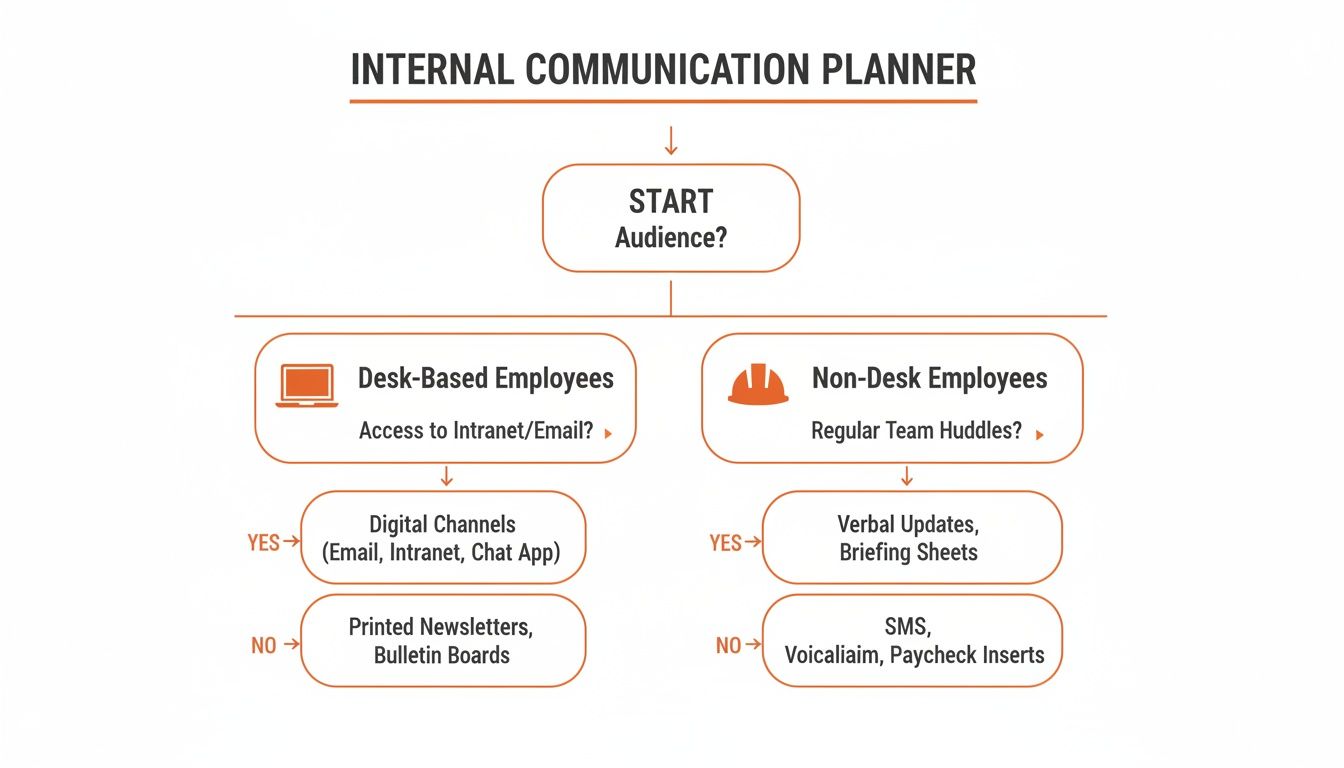
The visual drives home a simple point: a single, mobile-first channel is often the most direct path to reaching your entire workforce, finally bridging that gap between employees at a desk and those on their feet all day.
Setting Clear Guardrails for Your Channels
Once you’ve landed on your core channels, the next move is to set clear expectations for how they’ll be used. This is your channel governance in action. You don't need a fifty-page rulebook that no one will read. A simple guide will do the trick.
Here’s a quick overview of what that might look like:
Company News Feed: This is reserved for official, must-know announcements from leadership and HR. Think policy changes, major company milestones, and safety updates. The posting frequency should be low, so every message feels important.
Team Spaces (e.g., #Retail-West): This is where daily operational chat, shift-swapping, and team-specific updates live. It's the hub for the day-to-day work.
Direct Messages: For private, one-on-one conversations or small group chats that don’t need to be seen by the entire team.
Knowledge Library: The permanent home for documents like employee handbooks, training materials, and SOPs. This is what replaces that dusty, outdated intranet.
This simple framework eliminates the guesswork. An employee knows that if it’s a big company announcement, it will be in the news feed. If it’s about their shift tomorrow, it will be in their team space. They don’t have to check their email, a chat app, and a bulletin board "just in case."
To help you map this out, here's a quick reference table.
Choosing Your Communication Channels
Channel | Best For | Audience | Pitfall to Avoid |
|---|---|---|---|
All-in-One App | Critical announcements, daily operations, team chat, document access. | Entire workforce (desk & frontline). | Not setting clear rules for each space, leading to clutter. |
Formal, one-way announcements and external communication. | Primarily desk-based employees. | Overusing it for everything, burying important messages. | |
Chat (Slack/Teams) | Quick, informal conversations and real-time collaboration. | Desk-based teams. | Constant notifications and creating a "Fear Of Missing Out" culture. |
Intranet | Static document storage (policies, handbooks). | Anyone needing official documents. | Becoming a "document graveyard" that no one ever visits. |
In-Person Meetings | Sensitive conversations, major strategy rollouts, team building. | Specific teams or leadership. | Being inefficient and not having a clear agenda or outcome. |
Choosing the right platform is a big decision, but it's only half the battle. You can dive deeper into the nuances of selecting the best tools in our essential guide to internal communication channels.
Ultimately, reducing the noise is an act of respect. It shows your team that you value their time and attention. You're not just adding to their cognitive load; you're actively working to lighten it. That, more than any single tool, is what makes an internal communication plan truly work.
Crafting Messages That Actually Get Read
So, you’ve mapped your audience and picked your channels. Now for the hard part: writing something people will actually stop and read.
Let's be real for a second. Most corporate announcements sound like they were co-written by a lawyer and a robot. They're stiff, packed with jargon, and so dense that people's eyes just glaze over. It’s no wonder they get ignored.
This step in your plan is all about unlearning those bad habits. It’s about writing for smart, busy people who have zero tolerance for corporate fluff. Respect their time. Be clear, be direct, and above all, be human.
The secret isn’t some complicated writing formula. It’s just a shift in mindset. You're not "disseminating information" or "issuing a directive." You’re having a conversation, just at a larger scale. And every good conversation starts by getting right to the point.
Lead With the ‘Why’ and Get to the Point
Busy adults, especially those on the front lines, immediately want to know two things: “Why should I care?” and “What do I need to do?” The single biggest mistake I see companies make is burying these crucial answers under paragraphs of self-congratulatory fluff.
Always start with the “why.” People are far more willing to embrace change when they understand the reasoning behind it. Before you jump into what’s happening, explain why it's happening. Is this new process going to make their job easier? Will this new tool help them serve customers better? Lead with the benefit to them.
Then, be direct. Cut the long-winded intros. Our brains are hardwired to scan for the most important information first. If you make people hunt for it, you’ve already lost them. We’ve found a few simple principles can completely transform your messaging. For a deeper dive, check out our guide on how to make internal updates that people actually read.
From Corporate Bot to Human: A Side-by-Side Look
Let's make this real. Imagine you’re rolling out a new inventory management system.
The Old Way (Corporate Bot) | The New Way (Human) |
|---|---|
To all associates, | Team, |
See the difference? One is a memo that talks at people. The other is a message that talks to people. It leads with the benefit, explains what's happening in plain English, and actually sounds like it came from a person.
The goal isn’t to sound “professional.” The goal is to be understood. Clarity is the most professional thing of all.
Create Simple, Adaptable Templates
You shouldn't have to reinvent the wheel for every single announcement. Creating a few simple templates is a game-changer for common updates like:
Policy changes
Operational announcements
Welcoming new hires
Celebrating team wins
This not only saves you a ton of time but also keeps your messaging consistent.
The trick is to keep them flexible. A template should be a starting point, not a rigid script. It provides the core structure but leaves you room to tweak the tone and specific details for the audience and the channel you're using. An update pushed to a mobile news feed should be much shorter and punchier than a formal email to your leadership team.
This is where a targeted news feed in a tool like Pebb really shines. You can post one core message and instantly adapt it for specific teams. The warehouse crew gets the short, direct version focused on the operational impact, while office staff might get a little more background context. Everyone gets the right message without all the extra noise.
Building a Rhythm and Measuring What Matters
A brilliant plan gathering dust on a server is just a fancy document. It’s like drawing a detailed map for a trip you never actually take. To bring your internal communication plan to life, it needs two critical things: a pulse and a way to prove it's actually working.
This is where we get our hands dirty and move from theory to reality. It's about setting up a simple, sustainable rhythm for your communications and then, most importantly, having the guts to measure what truly matters. We're talking about real indicators that show your efforts are making a difference, not just numbers that look good in a report.
This is how you stop guessing and start knowing.
Find Your Cadence
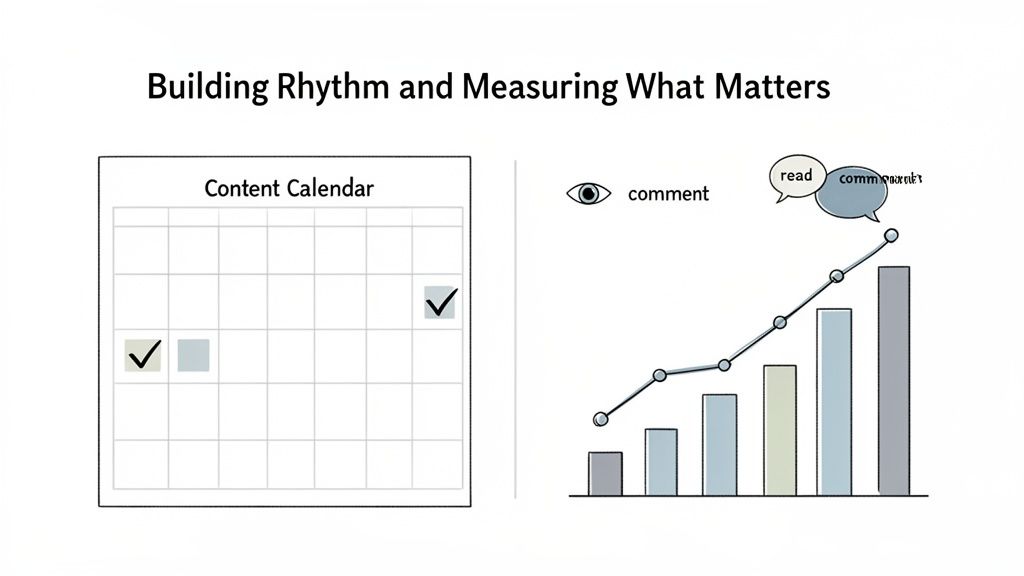
Let’s be real—nobody needs more noise in their day. The goal isn’t to drown your team in a firehose of updates. It's to create a predictable, reliable flow of information they can actually count on. Your best friend in this mission? A simple content calendar.
And I do mean simple. A basic spreadsheet works just fine, or you can use a dedicated tool. The whole point is to map out a rhythm that balances those big, company-wide announcements with the nitty-gritty, team-specific updates people need to do their jobs.
Think of this calendar less as a rigid script and more as a guide to keep you intentional. It’s what saves you from those frantic, last-minute email blasts and ensures you’re not radio silent for weeks, only to dump ten updates on everyone at once.
Here’s a great starting point:
Weekly: Team-specific operational updates. This is the "how we get work done" stuff—think shift schedules, project updates, and immediate logistics.
Monthly: A high-level company update straight from leadership. This is your moment to share progress on big goals, celebrate major wins, and keep everyone rowing in the same direction.
As Needed: Critical, time-sensitive alerts. These are the big ones: safety notices, system outages, or urgent policy changes. Keep them rare so they always cut through the noise.
This kind of rhythm builds an incredible amount of trust. Your team learns when to expect certain types of information, which cuts down on anxiety and helps them stay focused. They know they won't miss anything important because there’s a system in place.
Forget Vanity Metrics
Okay, let's talk measurement. This is where so many well-intentioned plans completely fall apart. We get obsessed with tracking things like email open rates and page views because, frankly, they're easy to count. But here's the hard truth: those numbers don't tell you the whole story.
An "open" doesn't mean the email was actually read, let alone understood. A "click" on an intranet link doesn't mean the message had any impact whatsoever. These are vanity metrics. They feel good to put in a deck, but they don't tell you if your communication is actually landing.
Measuring the right things is about connecting communication to real business outcomes. It’s about proving that when your team is informed and engaged, the company does better. Period.
We have to dig deeper. Instead of just asking, "Did they see it?" we need to start asking, "Did it change anything?" It’s a subtle but powerful shift in how we define success.
Measure What Actually Moves the Needle
The good news is, with the right tools, you can absolutely move beyond vanity metrics. A modern work app like Pebb gives you the kind of analytics that show how people are truly interacting with your content.
Instead of getting hung up on open rates, look for these indicators:
Engagement Trends: Are people liking, commenting, or asking questions? This is how you know a message resonated. A post with a dozen comments is infinitely more valuable than one with a high view count and zero interaction.
Read Receipts: Knowing precisely who has and hasn't seen a critical update is a game-changer. For safety or compliance messages, this isn't a vanity metric; it's a necessity.
Search Queries: What are people looking for in your company's knowledge base? A sudden spike in searches for "PTO policy" is a massive clue that your last update on the topic wasn't clear enough.
Feedback & Sentiment: Using quick pulse surveys or simple feedback forms gives you a direct line into how your team is feeling. This is how you measure genuine understanding and sentiment, not just reach.
This kind of data is gold. It’s not just about proving your own value; it's about constantly iterating and improving your communication plan. You see what’s working and what isn't, and you adjust on the fly.
Connect Communication to Business Results
This is where it all clicks into place. Once you start tracking real engagement, you can start drawing a line between your communication efforts and tangible business outcomes. This is how you elevate communication from a "cost center" to a strategic driver of the business.
Imagine you launch a new safety protocol with a series of targeted updates, training videos, and a quick quiz. You track engagement and see that 95% of your warehouse team has read the materials and passed the quiz. The following quarter, you see a 20% reduction in workplace incidents. That’s not a coincidence. That’s a direct link from effective communication to a real-world result.
This connection has a profound financial impact. Longstanding research shows that companies with highly effective internal communication can achieve up to 25% higher profitability. Yet, it's surprising how many organizations still don't connect these dots, with many still relying on outdated survey methods. You can dig into more of these insights in the state of internal communication measurement from Politemail.com.
This is the story you want to tell your leadership team. Not, "Our last email got a 60% open rate," but, "Our focused communication campaign on the new sales process directly correlated with a 15% increase in lead conversion this quarter."
One is noise. The other is value. Which conversation do you want to be having?
Keeping It Human: Your Plan Is a Living Thing
Here’s a hard truth I’ve learned over the years: a great internal communication plan isn't a static document you frame and hang on the wall. It’s not a project with a neat start and end date. If you treat it that way, it’ll be irrelevant in six months. Trust me.
The best plans are living, breathing things. I like to think of them more like a garden than a blueprint. You have to tend to them, listen to what they need, and adjust as your company grows and the seasons change.
Your Team Has the Answers
It's so easy to get caught up in crafting the perfect message and pushing it out that we forget the most important part of communication: listening. How do you really know if your plan is working? Are the messages landing? Is the frequency right? What are people still confused about?
You won’t find these answers in a dashboard. You find them by asking your team.
This doesn’t have to be some huge, complicated initiative. Simple, regular feedback loops are honestly all you need. Here’s what I’ve seen work wonders:
Quick Pulse Surveys: A simple, two-question survey asking, “How informed do you feel this week?” can tell you more than a hundred-page analytics report. It's gold.
Simple Feedback Forms: Create an always-on, open-ended form where anyone can submit a question or flag something that’s unclear. The key is making it dead simple to find and use.
Manager Check-ins: Your managers are your greatest allies here. Equip them to ask about communication during their one-on-ones. They’re on the ground and will hear the real story.
Answering these questions is how you keep your plan relevant and real. It’s the constant, humble act of checking in and making small, iterative improvements that makes all the difference.
From Tactical to Strategic
Analytics have been a game-changer, helping elevate internal comms from a simple tactical function to a truly strategic one. Modern tools can give us incredible real-time insights into employee sentiment, which can be a huge boost for engagement. Yet, many companies still struggle with the basics—I’m talking low intranet participation and dismal newsletter open rates, as plenty of industry findings show. You can discover more insights about internal communication best practices on prezent.ai.
This is where listening becomes your most powerful strategic tool. It closes the gap between the data you see on a screen and the reality your employees experience every day. It adds the human context that numbers alone can never provide.
Your internal communication plan isn't just about keeping people informed. It's the operating system for your company culture. It's the ongoing, daily practice of keeping everyone connected and rowing in the same direction.
Ultimately, keeping it human means staying curious. It means admitting you don’t have all the answers and trusting your team to help you find them. A big part of this human-centric approach is recognition, and I’ve seen tools like the goodkudos platform do a fantastic job of integrating that into the daily flow.
When you commit to this ongoing conversation, your plan transforms. It stops being a document and becomes what it was always meant to be: a reflection of a healthy, connected, and resilient organization.
Ready to build a calmer, more connected workplace? Pebb unifies all your communication, operations, and engagement in one simple, modern app for both frontline and office teams. See how it works at https://pebb.io.
