
What is a Town Hall Meeting, Really?
What's the real definition of a town hall meeting? It's not a boring lecture. It's your company's most important conversation. Here’s why.
Dan Robin
Let’s be honest. The words “company town hall” don’t exactly spark joy. Most of them are a slog. A top-down monologue where leaders talk at you, not with you. We've all sat through them.
But here’s the thing: a town hall isn't supposed to be a PowerPoint with a captive audience. The real definition of a town hall meeting is much simpler and more powerful than that. It’s a conversation. It’s a forum where people can ask hard questions and get straight answers.
It’s where your company’s culture is put on public display for everyone to see.
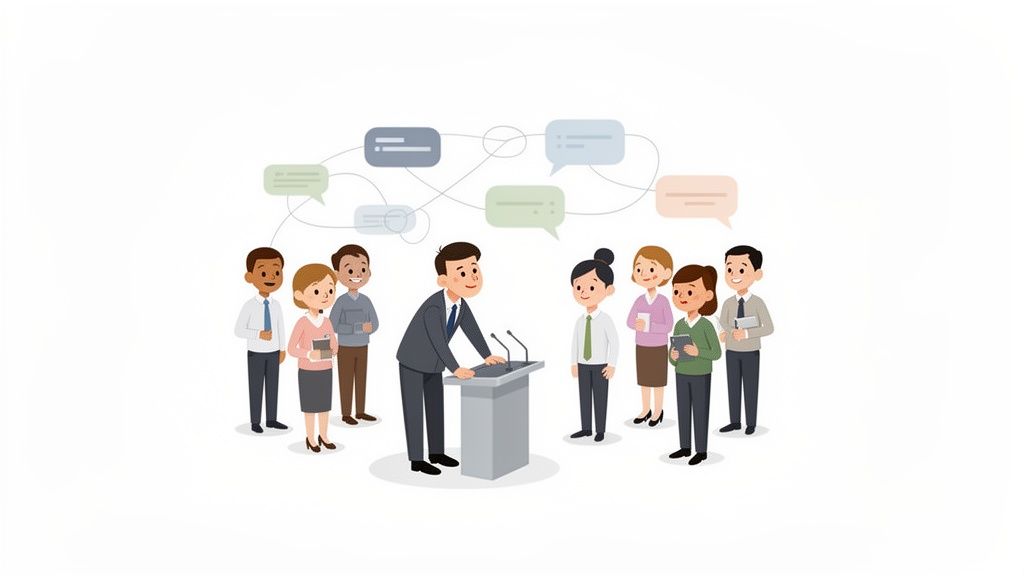
Think of it as a pulse-check for your entire organization. It’s the one place where leaders should listen more than they speak, and where trust is either built or broken, one question at a time.
With so many of us working from different places, this ritual is more critical than ever. It's one of the few things left that can bring everyone together. But to get it right, you have to shift your thinking. It’s not a broadcast; it’s a dialogue.
A town hall that’s transparent and well-run sends a powerful message: "We trust you with the truth." "Your voice matters here." "We are all in this together." A poorly run one says the exact opposite.
When you get it right, it can be the most valuable meeting on your calendar. It can turn a collection of individuals into a team. But that means we have to rethink this tired old ritual from the ground up, starting with a new definition.
The Surprising History of Company Town Halls
If you think the company town hall was dreamed up in a modern boardroom, think again. The idea is far older and has its roots planted firmly in American democracy, long before anyone was talking about quarterly earnings or KPIs.
To really get what a town hall is supposed to be, you have to go back to the beginning. It wasn't about a CEO talking at people. It was about a community deciding its future, together.
The original definition of a town hall meeting was about direct governance. The first recorded one happened way back in 1633 in Dorchester, Massachusetts. An 8 a.m. bell would ring, calling the townspeople to gather and settle matters for the "generall good."
These weren't just friendly chats. The decisions they made were binding—treated as law. Everyone who showed up was committing to the path they chose together. You can read more in this great piece from the Smithsonian Magazine on American town halls.
From the Public Square to the Modern Workplace
This tradition is incredibly durable. The longest continuously running town hall, in Pelham, Massachusetts, has been going since 1743. For nearly three centuries, that community has gathered to make decisions as a group.
And here’s the interesting part: those early settlers arguing in a drafty meeting house and a modern leader trying to unite a global team are wrestling with the exact same challenge. How do you get everyone aligned? How do you create a real sense of shared purpose?
The technology has changed, but the human need for connection hasn't. The town hall was, and still is, an exercise in building community.
It was never just about informing people; it was about forging a pact. That’s the thread connecting a 17th-century village to a 21st-century company. The goal was to make sure the community moved forward as one. That’s the true spirit we should be chasing in our own town halls. It’s not about a flawless presentation. It's about creating a space where people can honestly debate, decide, and then commit—a powerful idea that’s gotten lost in most modern meetings.
What Makes a Town Hall Actually Work?
We’ve all been in a town hall that felt more like a hostage situation than a meeting. Stiff presentations, pre-screened questions, and the feeling that “this could have been an email.” What separates those duds from a town hall that actually connects with people?
It’s not about slicker slides. It's about intent. A great town hall is a conversation with a purpose, not just a one-way broadcast. It’s designed from the ground up for two-way communication.
The idea of a public forum has evolved, of course.
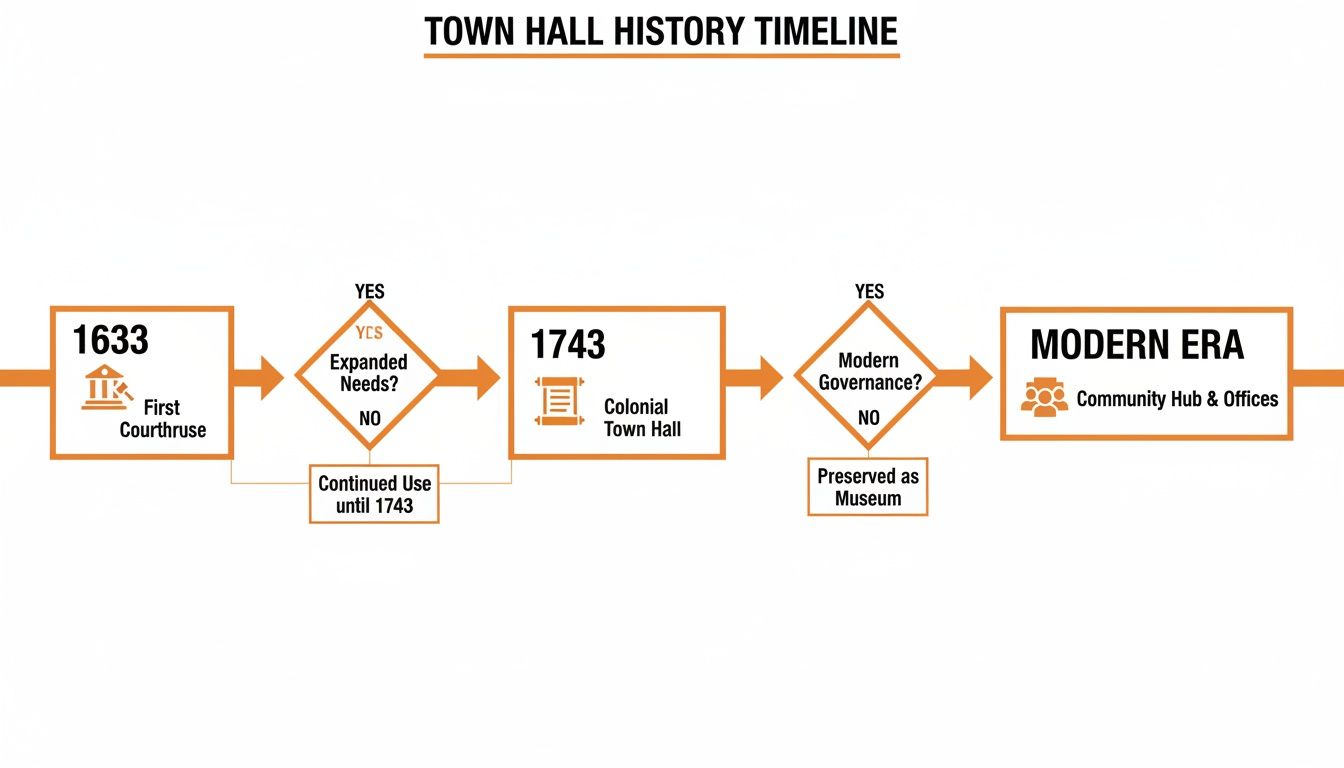
From a 17th-century courthouse to a modern hybrid meeting, one thing remains true: the format has to serve the goal of real engagement. If it doesn't, it's just noise.
Town Hall Types: Which One Do You Need?
Here’s where many companies get it wrong. They try to cram everything—big announcements, deep-dive Q&As, and team celebrations—into a single, chaotic hour. Nothing gets the attention it deserves.
To host an effective town hall, you need to pick a lane. Each type has a different goal, and your format should reflect that.
Town Hall Type | Primary Goal | Best For |
|---|---|---|
The All-Hands Sync | Company-wide alignment | Announcing major updates, strategic shifts, or reviewing quarterly performance. The focus is on creating a shared understanding of where the company is and where it's going. |
The Deep-Dive Q&A | Building trust and transparency | Addressing tough questions head-on. Leadership dedicates the entire session to answering unfiltered questions from employees, showing they’re listening and not afraid of feedback. |
The Celebratory Session | Boosting morale and culture | Recognizing wins, celebrating individual and team achievements, and reinforcing company values. This is all about building positive energy and making people feel appreciated. |
Choosing the right format isn't just a logistical detail. It sets the expectation for everyone involved. It signals why you’re gathering and what a successful meeting looks like.
An Agenda That Puts Discussion First
A good agenda shouldn't be a packed schedule of talking points. It should be a framework that carves out generous space for dialogue. A skilled Master of Ceremonies can help keep things on track, but the structure itself is what invites people to participate.
Here’s a simple, discussion-first framework that we like:
The Hook (5 minutes): Forget the boring agenda slide. Start with a compelling story, a customer win, or a key insight that grabs everyone's attention.
The "What" (15 minutes): This is where you share essential information—a strategy update, a new initiative. Keep it tight and clear. No fluff.
The "Why It Matters" (30 minutes): Here's where the magic happens. Open the floor. This section should be at least 50% of your total time. It's not just Q&A; it's a real conversation.
The Wrap-Up (5 minutes): Don't let the meeting fizzle out. End on a high note by summarizing key takeaways and stating the next steps.
This structure flips the script. It deliberately moves the meeting away from a top-down monologue and into a genuine forum for connection. And in the end, that's the only way to build a company where people feel heard.
Why Most Company Town Halls Fail
Let’s be honest. We’ve all been there: the mandatory town hall that everyone dreads. It’s easy to blame apathy, but that’s not the real story. People want to be connected. The problem is that most town halls fall apart in a few predictable, soul-crushing ways.
These aren't just bad meetings; they're symptoms of a deeper disconnect. We've seen these patterns play out time and again. They almost always boil down to three classic blunders.
The Executive Monologue
Picture this: a leader stands at the front, armed with a 50-slide deck. For the next 55 minutes, it's a one-way firehose of information—charts, strategic pillars, corporate announcements. They talk, and talk, and talk.
When they finally ask, "Any questions?", there are maybe three minutes left. The silence is deafening. Nobody wants to be the one to ask a tough question under that pressure. This isn’t dialogue; it’s a broadcast. Answering questions shouldn't be the last agenda item. It should be the main event.
The Dodged Question
Even worse than no time for questions is getting a non-answer to a great one. An employee summons the courage to ask something real—about rumored layoffs, a confusing strategy, or a dip in morale.
Instead of a straight answer, they get a mouthful of corporate speak.
"We're actively exploring synergies to optimize our operational footprint."
That’s not an answer. It’s a deflection. It sends a clear message to everyone listening: "We are not going to be transparent with you." Every time a leader dodges a real question, they kill psychological safety. Next time, no one will bother asking. Honesty and clarity have to be the bedrock of your communication. We’ve written more on creating that foundation in our guide to internal communication best practices.
The Tech Catastrophe
And then there's the modern classic: the tech catastrophe. In a world of hybrid and remote work, technology can either connect us or divide us. When it fails, it fails spectacularly. Someone’s audio is out. The video is frozen. And frontline workers dialing in can't see the slides or find the Q&A button.
Bad tech creates a two-tiered experience. You have insiders in the office who are part of the conversation, and then everyone else, who feels like they're watching a broken livestream. It’s an instant way to make a huge portion of your team feel like second-class citizens.
The good news? None of these failures are inevitable. They are the result of poor design, not bad intentions. You can choose to create something better.
Running Town Halls for a Modern Workforce in 2026
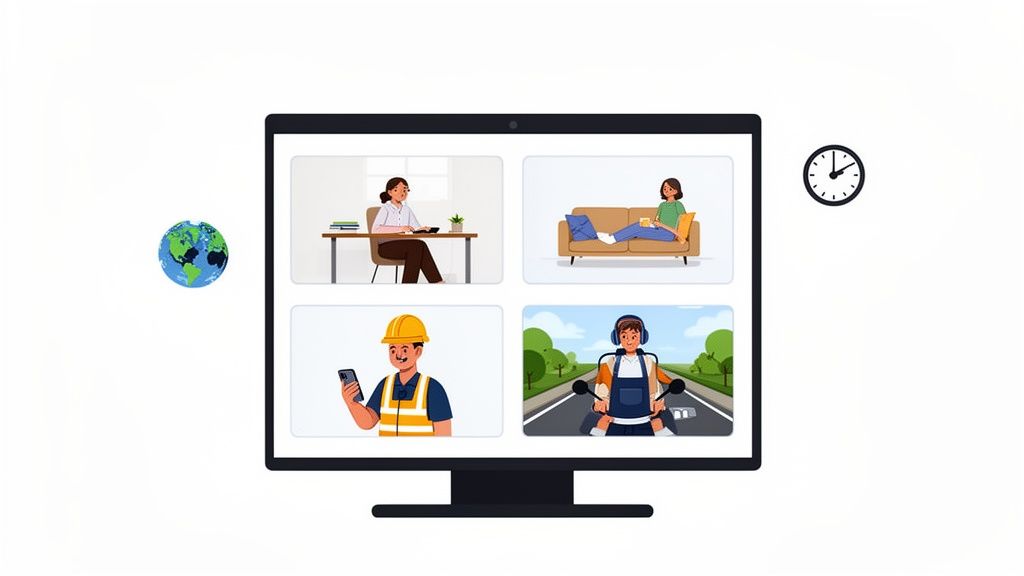
Let's face it, your team isn't in a single conference room anymore. They’re everywhere—at HQ, at home, on the factory floor, and across time zones. How do you hold a town hall that actually feels like one company, not just a broadcast for the folks at the main office?
The days of everyone gathering in one big room are gone for most of us. The trick is to use technology to bring people together, not to put up more walls.
This idea of creating a direct line to leadership is time-tested. Look at the political world. A 2024 study found that while virtual options are growing, a majority of public officials still prefer in-person town halls because the connection feels more direct. They know showing up matters. You can dig into similar data from past studies of lawmaker engagement at TheLawmakers.org.
Building a Bridge, Not a Barrier
For any business, the key is making it dead simple for anyone to participate. A frontline worker on a break should be able to join and ask a question just as easily as an executive in the boardroom. A mobile-first mindset isn't just a good idea; it's essential.
If your people need a laptop and perfect WiFi to join, you've already failed. You've excluded a massive chunk of your workforce. The right tech should be a bridge, not a hurdle. And for those who can't make it live, a flexible option like a tele-town hall is a game-changer.
The test of a modern town hall isn't how slick the presentation is. It’s whether the person furthest from the CEO feels just as heard as the person in the front row.
Practical Steps for Inclusive Gatherings
Getting this right means thoughtfully designing the experience around interaction.
Here are a few things we’ve found that truly work:
Collect questions in advance. Give everyone a chance to submit and upvote questions ahead of time using a simple, mobile-friendly tool. This gives a voice to introverts and ensures you're tackling topics that actually matter to your team, not just the loudest people in the room.
Use live polls for a real-time pulse. Polls are a fantastic, low-pressure way to get everyone to participate. Ask about morale, a recent company change, or what people are excited about. It’s a powerful way to get an instant read on how the whole organization is feeling.
Create clear channels for follow-up. The conversation shouldn't stop when the meeting ends. Make it clear where people can find answers to questions that weren't addressed live. This simple act of following through builds incredible trust.
A successful town hall isn't about finding that one perfect time on the calendar. It’s about creating an experience so accessible and valuable that nobody feels left out.
More Than a Meeting: It’s Your Culture on Display
Let's zoom out. At the end of the day, a town hall is never just another meeting. It’s a recurring, public demonstration of your company's real, lived-in culture.
When you run it with transparency, it says, "We trust you with the truth." A poorly run one says the exact opposite, loudly and clearly.
The frequency, format, and honesty of your town halls are a direct reflection of your organization's health. It’s the ultimate pulse-check.
Everything that happens in these meetings reveals the truth. It shows whether leaders are truly open to feedback or just performing transparency. It pulls back the curtain on whether you’re a company that confronts hard truths or sweeps them under the rug.
What Does Your Town Hall Say About You?
This isn't about a perfect agenda or a flawless slide deck. It's about recognizing that every single town hall is actively shaping your organization. We believe a strong culture is built through deliberate, repeated actions, and the town hall is one of the most visible rituals you have. We've shared more of our thoughts on what company culture is really about.
So, the final takeaway isn’t a checklist, but a question every leader should ask.
What does our town hall say about us?
We’ll leave you with that. Because this one meeting might just be the most profound opportunity you have to build a company where people genuinely want to belong.
Frequently Asked Questions
Even with the best plan, you're bound to have questions. Here are some common ones we get, along with straight answers from our experience.
How Often Should We Hold a Town Hall Meeting?
There's no single right answer, but whatever you choose, stick with it. Consistency is what matters. For fast-moving companies, a monthly rhythm often works well. For others, a quarterly check-in is enough. The goal is to create a predictable cadence people can rely on. A town hall shouldn't just be for putting out fires. When it becomes a regular event, it becomes the heartbeat of your company.
What if We Get Asked a Question We Can’t Answer?
First, don't panic. This is an opportunity to build trust. Be honest.
"That’s a great question, and to be honest, I don't have the answer right now. Let me find out, and I promise to get back to everyone on that."
Then—and this is the crucial part—you have to actually follow through. That simple act of acknowledging the question and closing the loop builds far more credibility than stumbling through a half-baked answer. Transparency isn't having every answer; it's being accountable for finding them.
How Do We Get More People to Ask Questions?
If your Q&A is met with silence, it's rarely because people have no questions. It's usually because they don't feel safe enough to ask. The key is to build psychological safety.
Here are two things that work:
First, allow anonymous questions beforehand. Using a tool like Pebb gives a voice to people who might hesitate to put their name on a tough question. It’s a great way to find out what's really on your team's mind.
Second, leaders must set the tone. When a tough question comes up, the leader's reaction is everything. Thank the person for asking. Answer directly, without getting defensive. When people see that hard questions are welcomed, they'll feel safe enough to ask more.
At Pebb, we believe great conversations are the foundation of great companies. Our tool is built to make these essential meetings simple and inclusive, helping you connect with every employee, no matter where they're working from. Find out more at https://pebb.io.
