
What Is Company Culture? (And Why Most Companies Get It Wrong)
What is company culture? A no-nonsense guide to the unwritten rules that shape your team's success, drive results, and make work better.
Dan Robin
So, what is company culture? Let's skip the buzzwords. Company culture is the sum of your shared habits, beliefs, and behaviors. It's your company’s personality—the unwritten rules that guide how your team acts, especially when no one’s watching.
It’s not the mission statement on the wall. It’s what happens when a customer complains, when a project goes off the rails, or when the boss isn't in the room.
Let’s be honest about company culture.
For years, I thought culture was something you could just install. Buy a ping-pong table, stock the kitchen with nice coffee, and you're done. Right?
We tried it all. We held off-sites. We wrote down our "values." We talked a big game about building an incredible workplace.
But it was all for show. The ping-pong table gathered dust. The great snacks didn’t stop great people from walking out the door. The values on the wall started to feel more like a joke than a promise. It took me too long to see the truth: we were decorating the house instead of strengthening the foundation.
Real culture isn't a perk. It’s not something you can buy or announce in an all-hands meeting. It's something you live. It's the quiet sum of thousands of daily interactions and decisions.
Culture is the invisible force that decides whether a tough project is met with collaboration or backstabbing. It’s what happens when things get hard.
Frankly, most companies get this wrong. They focus on the surface-level stuff because it’s easy. Ordering lunch is a lot simpler than building an environment of deep, psychological trust.
The Feeling vs. The Stuff
Think back to the best team you were ever on. What made it great? I’ll bet it wasn’t the brand of your laptop or the free coffee.
It was probably the feeling you had on a Sunday night—not dread, but a quiet readiness for the week. It was the trust you had in your colleagues. It was the clarity you felt about your role and why it mattered. That is culture. It's the invisible architecture that shapes how a team feels and performs.
You can't bottle that feeling, but you can see its effects everywhere:
In meetings, do people challenge ideas respectfully or stay quiet to avoid rocking the boat?
When information is shared, is it done openly or hoarded like a currency of power?
When mistakes happen, are they treated as lessons or as opportunities to point fingers?
These are the moments that truly define what company culture is. They are the small, daily tests of your company’s real character. A recent SHRM report found a toxic culture was the #1 reason people quit their jobs. It makes perfect sense. No amount of free kombucha can make up for an environment where people feel disrespected, ignored, or untrusted.
Culture isn't about keeping everyone happy. It’s about creating a place where smart, capable people can do their best work. It's about making sure your actions consistently match your words. Everything else is just window dressing.
What Company Culture Is Actually Made Of
Culture can feel like a big, fuzzy concept, but it's really the sum of a thousand tangible things. It’s what happens in the trenches, day in and day out.
Let's be real—when things go sideways, it’s rarely because the official "values" were wrong. It's because communication is a mess, or because the behaviors that get rewarded have nothing to do with the values you preach. To understand what company culture is, you have to look past the slogans.
I’ve always found it helpful to think of culture as a garden. You don't get a thriving garden by wishing for it. You need the right soil, consistent watering, and a clear vision. Everything else is just decoration.
The Anatomy of Company Culture
So, what are these nuts and bolts? They’re the observable systems and habits that shape every workday. When you know where to look, they're easy to spot.
Let's break down the core building blocks and see what they look like in a healthy culture versus an unhealthy one.
Building Block | A Healthy Example | An Unhealthy Example |
|---|---|---|
Values & Beliefs | They’re used to make real decisions about projects, hiring, and promotions. | A list of words on a poster that everyone ignores. Hypocrisy is the norm. |
Behaviors & Norms | People are recognized for collaborating, helping others, and finding smart solutions. | The "heroes" are the ones who work the latest hours or talk the loudest, regardless of results. |
Rituals & Routines | Daily huddles are quick and keep everyone aligned. Project kickoffs are genuinely collaborative. | Meetings are a soul-crushing waste of time. No one is ever sure what's going on. |
Communication | Information flows freely. People feel safe asking "dumb" questions and can get the context they need. | Information is hoarded. You have to "know a guy" to get a simple answer. Gossip is the main news source. |
Company Policies | Policies on time off, remote work, and expenses are built on trust. | Endless red tape for small requests signals a deep lack of trust. |
These aren't abstract ideas; they are the lived, daily experiences of your team. They’re the difference between a place people are excited to work and a place they can't wait to leave.
This is where so many companies get it wrong. They focus on the superficial perks—the free snacks, the ping-pong table—while the real foundation crumbles.
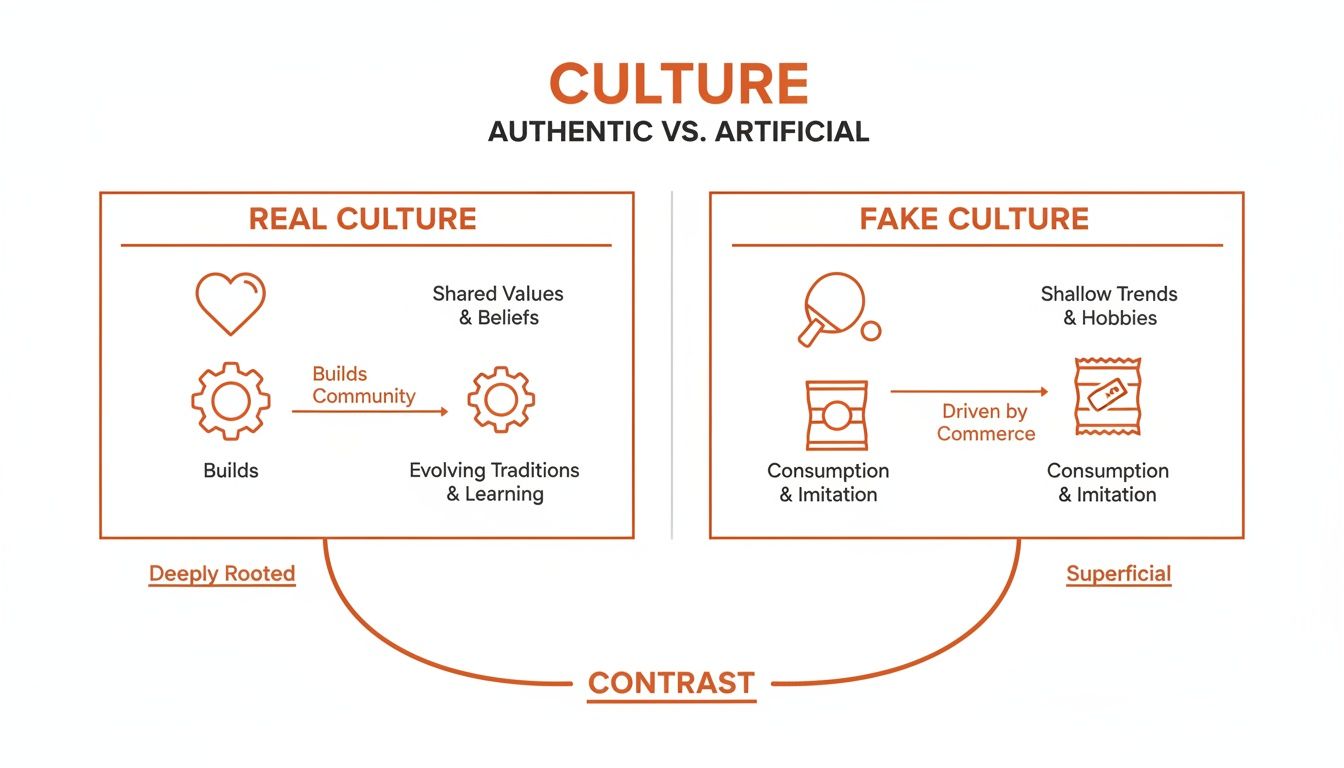
The image above says it all. Real culture is built from shared behaviors and genuine community. Fake culture is a collection of consumable perks designed to distract from deeper problems.
The Dangerous Gap Between Perception and Reality
Here’s where it gets tricky. Leaders often have a wildly different, more optimistic view of their culture than the people doing the work.
A recent study from SHRM found that executives are 2.5 times more likely than frontline staff to rate their culture positively. The report also dropped a bombshell: only 21% of global employees feel engaged, with toxic culture being a top reason people quit.
This disconnect is a ticking time bomb. If leadership thinks the garden is flourishing while the plants are withering, you're heading for a cliff.
The first step is acknowledging that the view from the top is never the full picture.
Your culture is the sum of all these parts—the good, the bad, and the broken. It's not a project you can launch and forget. It's the living, breathing result of choices made by everyone, every single day. The question isn't whether you have a culture; you absolutely do. The real question is: is it the one you want?
Why Your Bottom Line Depends on Your Culture
For too long, business has treated company culture like a side dish—nice to have, but not essential. Leaders would give it a nod, delegate it to HR, and then get back to the "real" work of chasing quarterly targets.
That's an expensive mistake.
Culture isn't some fluffy, feel-good concept. It's a core business system with a direct, measurable impact on your finances. A strong culture isn’t about making everyone happy. It’s about building an environment where smart, capable people can do their best work without unnecessary friction.
When your culture is broken, you are bleeding money. It's that simple.
The Invisible Tax of a Bad Culture
A toxic or indifferent culture acts like a hidden tax on everything your company does. Every project takes longer. Every decision is harder. You lose your best people, and the ones who stay become less effective.
Think about the real costs:
Employee Turnover: When good people leave, you’re not just paying to recruit and train their replacements. You’re losing irreplaceable knowledge, key client relationships, and team momentum. The true cost of replacing an employee can be anywhere from one-half to two times their annual salary.
Lost Productivity: In a low-trust environment, people spend more time on internal politics and watching their backs than solving problems. Communication grinds to a halt, collaboration falls apart, and everything moves slower.
Poor Customer Experience: Your customers can feel your internal dysfunction. Disengaged employees don’t provide great service. When your team is frustrated and disconnected, that feeling inevitably leaks out to the people you’re trying to serve.
A healthy culture is a powerful competitive advantage. You can copy a competitor's product or marketing strategy, but you can’t easily replicate a decade of built-in trust and collaboration.
The Financial Upside of a Great Culture
The flip side is just as compelling. Companies with high employee engagement—a direct result of a healthy culture—consistently outperform their peers. We're not talking about small gains. We're talking about a significant, bottom-line impact.
The data is clear. Gallup has found that business units with high engagement are 23% more profitable than those with miserable engagement. They also see lower absenteeism, fewer safety incidents, and higher customer loyalty. If you're curious, you can learn more about how to measure employee engagement and see its direct impact.
A strong culture isn't about being 'nice.' It's about creating an environment so effective that it becomes a financial engine for the business.
This is where things like great employee benefits packages that attract talent come in. They aren't just perks; they are clear signals that you value your people.
O.C. Tanner's 2026 Global Culture Report reveals that employees in organizations with high expectations and high support are likely to stay two years longer than their peers. What’s more, 83% of employees cite culture as their main reason for staying, yet only 32% of companies invest in the collaboration tools employees say are critical for building it.
Culture isn't an abstract ideal. It shows up on your P&L statement, in your retention numbers, and in your customer satisfaction scores. The question isn't whether you can afford to invest in your culture. It's whether you can afford not to.
Culture for Frontline and Office Teams
When you think "company culture," what comes to mind? For many, it’s an office. We picture people brainstorming in conference rooms or grabbing lunch together.
But what happens when most of your team has never seen the headquarters?
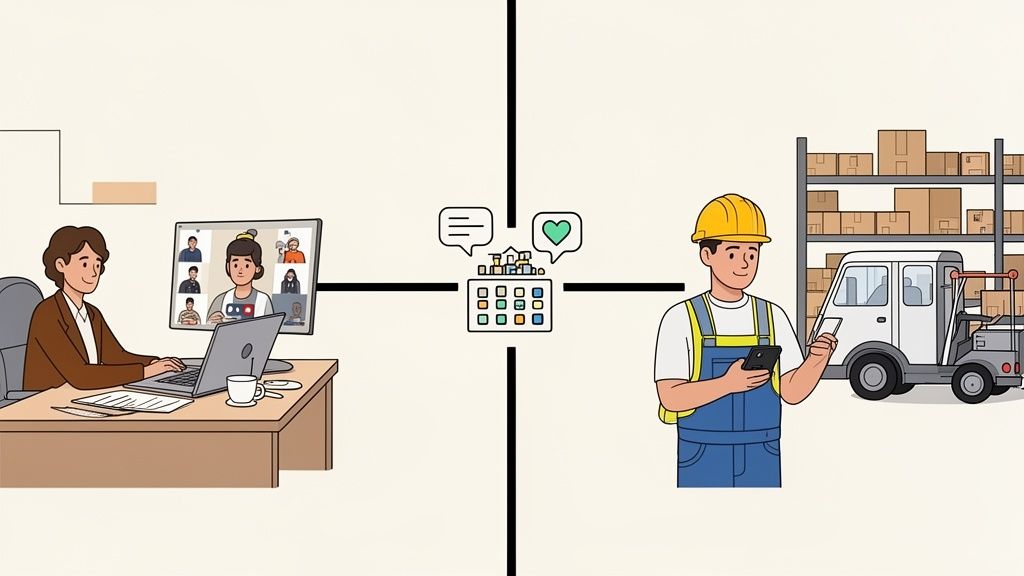
For millions of frontline workers, culture isn't found in a central office. It’s lived in the back of a delivery truck, on a hectic hospital floor, or during a rushed shift change. The daily reality for a logistics driver is worlds away from a software developer working from home. They don’t share a physical space, so where do they share a culture?
This is where the idea of culture gets tested. It’s one thing to talk about values when everyone’s in the same building. It's another challenge entirely when your team is scattered across dozens of locations and shifts.
The Two Worlds of Work
Let's be real. The way an employee experiences your culture is dramatically different depending on where they work. We can't pretend it's the same for everyone.
An office-based employee's culture is shaped by formal meetings, email etiquette, and social cues from the breakroom. A frontline worker’s culture is defined by different moments:
The pre-shift huddle: Is it a rushed, confusing mess or a clear, motivating start to the day?
The tools on their phone: Are they clunky and frustrating, or simple and genuinely helpful?
How they get critical updates: Is it a note on a messy bulletin board, or a clear notification sent right to them?
For these teams, culture happens in fleeting interactions and through the digital tools they use. If those tools are disconnected and poorly designed, the culture feels that way, too—fragmented, frustrating, and isolating.
The Disconnect Is a Ticking Clock
When frontline employees feel like an afterthought, they start acting like it. Disengagement creeps in. They stop caring about the details. Eventually, they leave. The cost of this disconnect is massive, showing up as high turnover, more safety incidents, and a nosedive in customer service.
For a distributed workforce, a lack of connection isn’t just a feeling—it's an operational failure. Information gets lost, best practices aren't shared, and no one feels like they're on the same team.
This is a problem you can’t fix with a company-wide newsletter that no one reads. You need a better way to bring everyone into the fold, no matter their role or location. Our guide on how to keep your frontline teams in the loop without overwhelming them offers some practical starting points.
Here’s the thing: you can't force people to feel connected. You can only create the space for it to happen.
For a modern, distributed workforce, that space has to be digital. You need a single place where the warehouse worker, the retail associate, and the marketing manager can all share information, celebrate wins, and solve problems together.
This isn't about recreating the office online. It's about building a digital town square—a central hub that’s actually accessible and useful for everyone. It’s a place where culture isn't just talked about, but is actively built by every single employee, one message and one task at a time. This is how you make culture real for the people who are the face of your business.
How to Intentionally Shape Your Culture
So, you've got a feeling your culture is off. Something isn't clicking. The first instinct is often to declare a "culture initiative." This usually involves a flurry of meetings, a new task force, and a consultant who hands you a list of generic values.
Let’s be real—that almost never works. It feels artificial because it is. You can't force a great culture with a top-down mandate.
Lasting cultural change isn’t born from grand announcements. It’s a quieter, more deliberate process. Think less about a dramatic overhaul and more about small, consistent adjustments that make it easier for people to do their best work together.
First, Just Listen
Before you change a thing, your first job is to listen. You have to understand the culture you have right now, not the one you think you have.
Forget the official mission statement. The real story is in the everyday interactions.
Pay attention to your meetings. What’s the energy like? Are people engaged and debating ideas, or quietly checking their phones? Notice who speaks up and what happens when someone offers a dissenting opinion.
Watch how work gets done. When someone needs help, is it easy to get an answer, or do they have to navigate a maze of approvals? Information flow tells you a lot about trust.
Read the digital chatter. Skim your company’s public chat channels. Is the tone helpful and collaborative, or tense and political? The way people communicate when they think no one is watching is revealing.
This isn’t about playing detective. It's about diagnosis. You're looking for the friction points, but you're also looking for the bright spots you can build on.
Define What’s Important (and Actually Reward It)
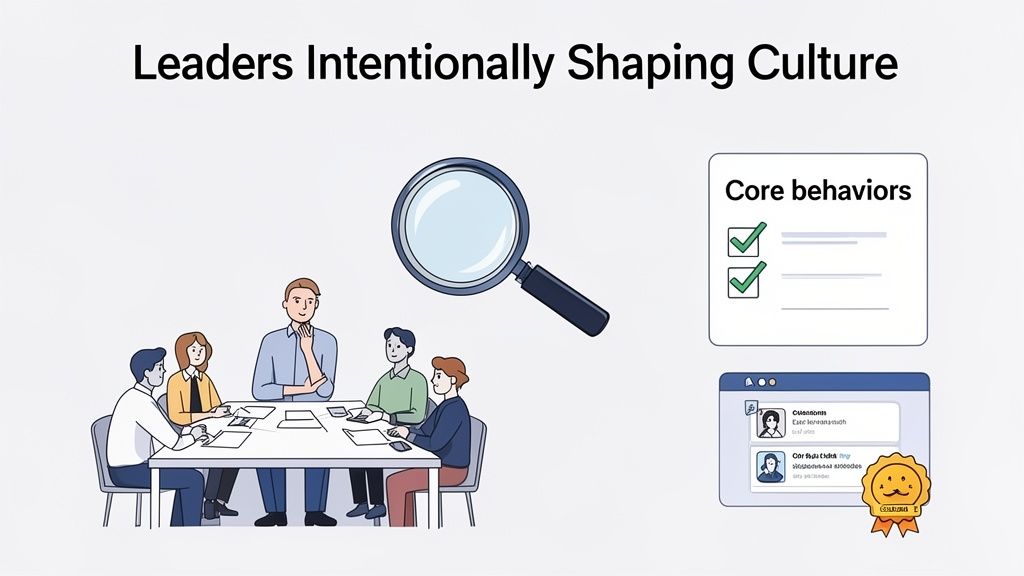
Once you have a clear picture, you can get specific about where you want to go. This isn't the time to brainstorm a dozen aspirational values for a poster. It’s about picking a few core behaviors that will genuinely improve how your team works.
Don’t just say you value “Collaboration.” Get specific. What does that actually look like? Maybe it means, “We share early drafts, even when they aren’t perfect,” or “We give and get feedback assuming positive intent.”
Then comes the most critical part: you have to build systems that reward those exact behaviors. If you say you value teamwork but only promote the individual superstars who hoard information, your words are empty. People will always follow the incentives, not the posters.
Here's a simple way to think about it:
Define 2-3 Core Behaviors: Keep it simple. Pick a handful of actions that would make the biggest impact. Think things like “Default to Action” or “Communicate with Clarity.”
Build Rewards Around Them: Look at how you recognize and promote people. Make sure those processes celebrate the behaviors you want to see. You could start a public channel to spotlight great examples of clear communication.
Talk About It Constantly: Weave these behaviors into the company's language. Reference them in meetings, project kickoffs, and one-on-ones until they become second nature. Our guide on improving company culture dives deeper into how to make these practices stick.
Your Tools Should Help, Not Hinder
This is where the right technology can be a game-changer. Your tools can't create your culture for you, but they can act as powerful amplifiers for the behaviors you’re trying to encourage.
Think of your internal communication platform as the digital town square where your culture is lived out loud, especially for distributed teams.
Create Shared Spaces for Collaboration: Tools like Pebb’s Spaces can be set up as dedicated hubs where those desired behaviors happen naturally. A well-organized project Space encourages clear updates and keeps everyone aligned.
Use a Company Feed for Recognition: A public feed where anyone can give a shout-out or celebrate a team win makes recognition visible and immediate. It’s a simple way to reinforce the behaviors you value in real time.
Look at Analytics to See What Connects: Understanding which announcements get the most engagement isn't about spying. It’s about seeing if your cultural message is actually connecting with people so you can double down on what works.
Shaping culture is a continuous process of paying attention, making intentional choices, and staying consistent. You don't build it once and walk away. You have to tend to it, every day.
Your Top Company Culture Questions, Answered
Alright, we've talked a lot about what company culture is—the real, day-to-day stuff, not the foosball tables. But knowing the theory is one thing. Making it happen brings up some tough, practical questions.
Here are some straight answers, based on what we've learned in the trenches.
How Long Does It Really Take to Change a Company's Culture?
Let's be honest: changing a culture is like turning an ocean liner, not a speedboat. It's a slow, deliberate process.
You won't see a transformation overnight. Real, meaningful change often takes years, not months. If someone offers you a "90-day culture fix," run.
The shift starts with small, consistent actions that slowly build trust. You'll see little wins along the way, like better meetings or people feeling safer to speak up. But deep, foundational change is a long-term commitment. It’s a marathon, not a sprint.
Can You Have a Strong Culture in a Remote or Hybrid Company?
Yes, you absolutely can. But—and this is a big but—you can't just try to digitally replicate your old office environment. It doesn't work.
A thriving remote culture is built on intentionality, not on spontaneous "water cooler" moments. It hinges on a few core pillars:
Crystal-clear written communication: Since you can’t rely on hallway chats, everything important has to be documented and easily accessible. This creates clarity and cuts down on anxiety.
Deep trust and autonomy: You have to trust your people to do their jobs without someone looking over their shoulder. This means measuring what gets done, not who is online the longest.
Deliberate connection: Instead of leaving social interactions to chance, you have to create dedicated spaces for them. Think specific chat channels for non-work stuff or structured virtual hangouts.
A great remote culture feels calm and focused. It’s built on the assumption that everyone is a responsible adult who wants to do good work.
The right tools become your digital headquarters, providing the space where this intentional communication and connection can happen.
What’s the Difference Between Culture and Engagement?
This is a great question because people mix these two up all the time.
Think of it like a garden. Culture is the environment—it's the quality of the soil, the amount of sunlight, and the weather. It's the how of your workplace: the systems, values, and behaviors.
Engagement is the result. It’s how the plants are doing in that garden. Are they thriving or wilting? Engagement is a measure of the health of your people within the culture.
You can't "fix" low engagement with a survey any more than you can yell at a plant to grow. You improve engagement by improving the culture. A healthy environment naturally produces engaged people because it gives them what they need: respect, purpose, and connection. Focus on the soil, not just the flower.
Is It a Leader's Job to Set the Culture?
Leaders don't set the culture with a memo, but they absolutely create the conditions for it to grow. Their actions, decisions, and—most importantly—what they choose to ignore have a massive impact.
If a leader preaches transparency but hoards information, guess which one becomes part of the culture? People are smart; they see the gap between what's said and what's done.
A leader's primary job is to model the desired behaviors with relentless consistency. They have to be the first to admit a mistake, the first to share bad news openly, and the first to give credit away.
They are the head gardeners, but culture is a team sport. Every single person adds to or takes away from it. Leaders set the tone and boundaries with their own behavior, but everyone helps the garden grow.
Ready to build a culture of clarity and connection? Pebb is the all-in-one work app that unifies your team, whether they’re in the office or on the frontline. See how you can build a better culture, one conversation at a time, at https://pebb.io.
