
The Unseen Tax on Your Business
Discover how problems in communication silently drain resources. Learn to spot the signs and build a more connected, resilient, and profitable company.
Dan Robin

The problems that sink a business are rarely the loud, obvious ones. They're the tiny, everyday fractures—the vague project brief, the memo that gets misinterpreted, the brilliant person who walks away because they never felt heard.
We’ve been conditioned to see these as "soft skill" hiccups. They’re not. They are serious business risks that quietly bleed your company of its potential.
Why Good People Leave Bad Systems
We’ve all heard it: “People don’t quit jobs, they quit bosses.” It’s a tidy explanation, but it lets organizations off the hook far too easily.
Let’s be honest. More often than not, people are escaping a bad system—a workplace tangled in confusion, crossed wires, and a chronic sense of being disconnected. At the heart of that broken system? You guessed it. Communication.
It's the engineer who burns out because her feedback disappears into a black hole. It's the frontline worker who feels adrift because crucial updates never make it to their shift. When your team feels unheard, undervalued, or just plain lost, they don't stick around. They mentally check out long before they hand in their notice.
Your Retention Strategy Is Your Communication Strategy
If your best people are walking out the door, the first place to look isn't your benefits package. It's how you talk to each other. Or, more to the point, how you don't.
The link between turnover and poor communication isn't just a theory. A Staffbase report revealed that a staggering 63% of employees who quit point directly to poor internal communication as a major reason. That’s nearly two-thirds of the workforce with one foot out the door because they feel disconnected. You can dive into the full workplace communication statistics to see just how widespread this issue is.
For anyone managing teams in industries like healthcare, retail, or logistics—where people are spread across different locations and shifts—this is a ticking time bomb.
When you fail to build clear channels for information and feedback, you're not just creating inefficiency. You're actively breaking the trust of your most valuable people.
This isn’t about some corporate kumbaya moment. It’s about fundamental respect and operational sanity. People need context to do their jobs well. They need to see how their work fits into the bigger picture. And above all, they need to feel like their voice actually matters.
The Real Cost of Confusion
We tend to dismiss communication problems as minor annoyances. A garbled email, a meeting that spirals into nothing—frustrating, sure, but ultimately fleeting.
But what if we saw each miscommunication for what it truly is: a hidden tax on your business? An invisible line item that quietly eats away at your budget, one confusing conversation at a time.
Recent research pulls back the curtain, and the numbers are staggering. Poor communication is a financial sinkhole, costing U.S. businesses an incredible $1.2 trillion every single year. That's not a typo. This figure covers everything from lost productivity and project redos to missed sales opportunities and the sky-high cost of employee turnover.
Let's bring this down to a more personal level. Think about your own company. How many hours does each employee waste per week just trying to get clarity? Chasing down information that should have been in the initial request, or redoing work because the instructions were a mess.
Even a conservative estimate is sobering. Let’s say it’s just three hours a week for each employee. For a 100-person company where the average employee costs $50 per hour (including salary, benefits, etc.), the math looks like this:
3 hours/week × 50 weeks/year × $50/hour = $7,500 lost per employee, per year.
For the whole company, that’s $750,000 gone. Poof. Vanished into thin air. That's not a "soft cost." That's real money that could have funded new hires, product innovation, or just gone straight to the bottom line. This is the communication tax in action. And this simple calculation doesn't even touch on the deeper issues of a lack of communication in the workplace.
Where the Money Really Goes
The financial drain doesn't just come from wasted time. The real damage happens as these small issues ripple across the organization. When you look at why things go wrong in business, poor communication is almost always the star of the show.
The data couldn't be clearer.
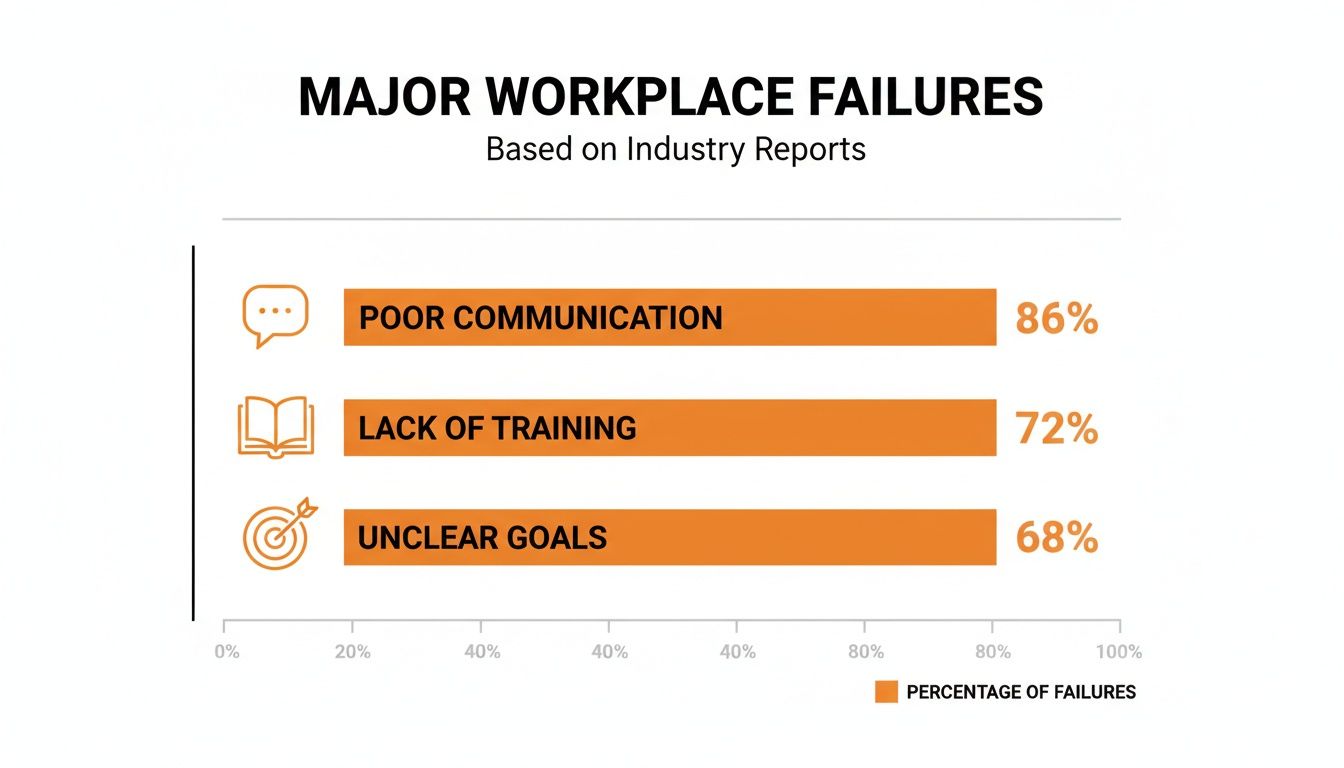
When projects fail, a shocking 86% of people point to communication breakdowns as the root cause. It’s not just one factor among many; it’s the main event. You can dig into the full context behind these communication statistics to see just how deep this rabbit hole goes.
The hidden "communication tax" shows up in a few key ways:
Project Delays and Redos: Ambiguous briefs and misaligned teams are a recipe for rework. Every time a project goes back to the drawing board, you’re paying for the same job twice. Simple as that.
Lower Engagement: When people feel out of the loop or unheard, their motivation dries up. A disengaged employee isn't just less productive; they can drag down the morale of their entire team.
Higher Turnover: It’s an old saying because it’s true: people don't leave bad companies, they leave cultures of confusion. The cost to recruit, hire, and train a replacement can be tens of thousands of dollars.
Poor Customer Service: Internal chaos always finds its way to your customers. If your team doesn't have the right information, they can't deliver the consistent, high-quality service that builds loyalty.
The financial cost isn't just a number on a report; it's a vital sign of your company's health. The more friction there is in how your people share information, the more you pay this hidden tax.
Five Communication Traps to Spot
The biggest problems in communication aren't dramatic arguments. They're the quiet, creeping habits that become "just how things are done here." The invisible friction that makes every task a little bit harder. You can't fix what you can't see, so let's shine a light on the five most common traps.
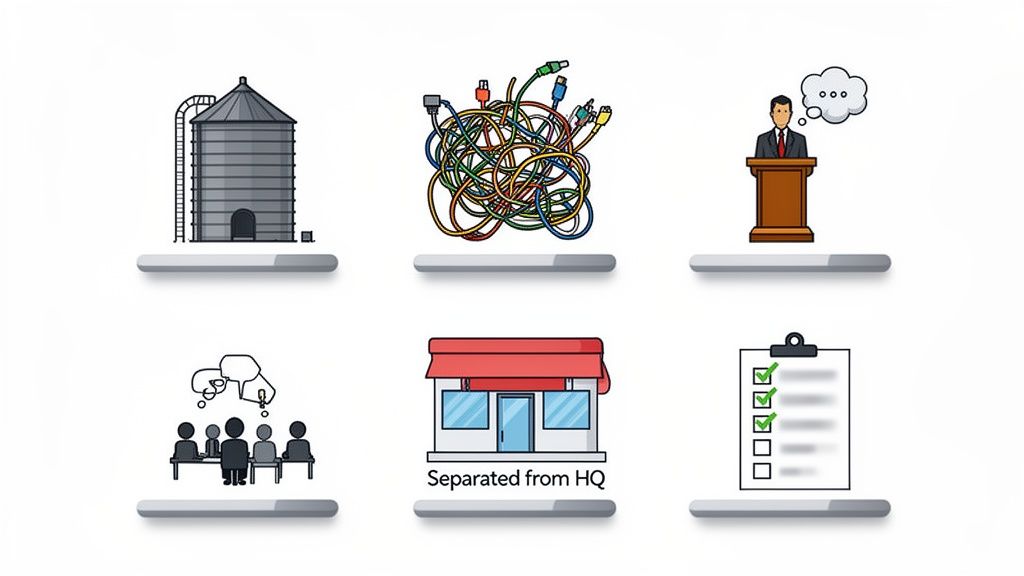
1. Information Silos
Think of these as invisible walls between departments. Sales has its customer data, marketing is working from a different list, and operations is using a spreadsheet from last quarter. Each team is running its own separate company. It’s usually a byproduct of specialized software, competing goals, and no single, shared space for knowledge. The result is duplicated effort and missed opportunities.
2. The Technology Tangle
Sound familiar? Your team uses Slack for chats, Asana for projects, email for "official" stuff, and a separate portal for HR. The intention was to give everyone the best tool. The reality? Total chaos. Important information gets scattered, and people waste time just trying to figure out where a conversation happened. That’s not productive; it’s digital whiplash.
3. The Leadership Perception Gap
This one is subtle but corrosive. It’s the gap between what leaders think they're communicating and what employees actually hear. A CEO gives a speech about a new strategic pivot. On the ground, the team is whispering, "What does that actually mean for my project? Am I getting laid off?" Leaders speak in broad strokes, but employees need specifics. Without that bridge, even the best message creates anxiety.
4. The Frontline Disconnect
Your frontline and non-desk workers—on the factory floor, in the warehouse, behind the retail counter—are often the face of your company. Yet they are almost always the last to get critical information. Major updates get sent in an email they rarely check or posted on an intranet they can't access. They end up relying on rumors. It’s not just inefficient; it’s a culture-killer.
5. Ambiguous Expectations
This might be the most common trap of all. A project gets assigned, but nobody is clear on what "done" looks like. A manager asks for a report by Friday but doesn't specify the format or key data points. The employee takes their best shot and is met with, "This isn't what I had in mind." This cycle of guessing and redoing is born from a culture that values speed over clarity.
Most organizations are tangled in all of these at once. The real question is, how many feel a little too familiar?
Fix the Flow, Not Just the Message
Ever told a struggling team to just "communicate better"? It’s like telling a team losing by 30 points to "play harder." It’s a nice thought, but it’s not advice. It misses the point.
Most solutions for poor communication focus on the message—workshops on writing clearer emails or tips for speaking more confidently. While well-intentioned, that's like patching a broken pipe with duct tape. You're not fixing the real problem. The problem isn't just what is being said; it's the tangled, frustrating, and inefficient flow of information.
Stop Blaming People, Start Fixing the System
As leaders, we have a bad habit of zeroing in on individual mistakes. When information gets lost, we point to the person who forgot to CC the right stakeholder. When a project goes off the rails, we blame the manager who gave a vague brief. This is the easy way out, but it’s almost always wrong. It’s like blaming a driver for being late when every road in the city is a dead end.
The real culprit is the chaotic environment we’ve created. We hand our teams a dozen different apps for chat, projects, and files, then act surprised when things fall through the cracks.
The biggest lie we tell ourselves about communication is that it will just happen on its own. It won't. Good communication isn’t a personality trait; it’s a design choice. You have to intentionally build the channels for it to flow.
The answer isn't asking everyone to try harder. It’s about building a system where clarity is the default.
Your Company Needs a Digital Home
Here's the bottom line: your company needs a digital home. Not another app or chat channel. A single, central hub where work and the conversations about work happen together. This is how you fix the system, not just the symptoms.
A unified platform changes the game. It’s not about adding another tool to the pile; it’s about consolidating the chaos into one logical space.
Dedicated Spaces Tear Down Silos: Imagine your sales team lives in one app and your marketing team in another. Now, picture creating a shared
Spacefor a new product launch. Suddenly, both teams are seeing the same conversations, sharing the same assets, and tracking the same to-do list. The walls disappear.A Single News Feed Ends the Guesswork: Critical company updates shouldn’t be lost in an email avalanche. A central news feed acts like a company heartbeat, ensuring everyone gets important information at the same time.
Integrated Tasks Provide Automatic Context: A typical email just says, "Please review this document." But a task inside a unified system says, "Here's the document, the project it belongs to, the deadline, and the entire conversation about it." The task and its context travel together.
Fixing problems in communication isn’t about scheduling more meetings. It’s about building a better infrastructure for information to move through. You can dive deeper into these systemic issues by exploring strategies for tackling communication problems in the workplace. When you fix the flow, the message almost always takes care of itself.
The Quiet Revolution
So, what does it look like when communication is working? It’s not a silent, hyper-efficient office. It's a business with a pulse. The low hum of a team in sync—where information flows like electricity, powering everything without making a lot of noise. This isn’t about more meetings or louder announcements. It’s a quiet revolution in how we connect.

In a connected company, a warehouse manager can push a new safety update, check a policy, and share a team win—all from her phone while walking the floor. She knows the message landed.
It’s the remote developer who feels just as looped-in as the person at headquarters. They aren’t a name on a satellite roster; they're part of the team, working from the same playbook. For many, tools like a hosted PBX can offer staff flexibility to work from anywhere, forming a key piece of the puzzle.
A truly connected company isn't one where everyone is talking all the time. It's one where everyone knows where to find the answers.
For years, we've approached communication problems like we're patching leaks on a sinking ship. We add an app, schedule a meeting, write another "best practices" doc. We’re bailing water, wondering why our feet are still wet.
What if we stopped patching and just built a better boat?
This is an invitation to think differently. To shift from "solving communication issues" to creating a foundation where those issues can't take root. A big part of that is a well-defined internal communication strategy.
The solution isn’t more noise or more emails. It’s a single, better place where your people can connect, collaborate, and feel like they belong.
Frequently Asked Questions
Look, we get it. Every leader I talk to knows communication is a challenge, but the thought of fixing it feels massive. We hear the same questions all the time, so let's get into some honest answers.
"Our Main Problem Is Reaching Frontline Workers"
This is the number one issue for a reason. Your frontline and field teams aren't chained to a desk, so why are we trying to reach them with tools built for office life? The real fix is a mobile-first approach that meets them where they are—on their phones.
You can replace messy, insecure group chats and endless email threads with a single, secure place for everything. When checking a schedule, getting a safety update, or clocking in happens in one spot, the wall between you and your team crumbles.
"Won't Another App Just Create More Noise?"
A fair and important question. The last thing anyone needs is another notification to ignore. The goal isn’t to add another app; it's to replace the chaotic mess of apps you’re already juggling.
This is what "tool sprawl" feels like—work happening in chats, email, tasks in another app, and HR info somewhere else. A proper work hub brings all of that together. It’s not about adding complexity; it's about simplifying work by finally putting everything in one place.
"How Do We Get Our Teams to Actually Use It?"
Adoption boils down to three things: It has to be easy, it has to be useful, and you have to lead the way.
First, the tool has to be as intuitive as the social media apps your team uses every day. If it needs a thick training manual, it has already failed.
Second, it needs to solve a real, nagging problem for them from the moment they log in. Can they swap shifts without a chain of ten text messages? Can they find a key document without digging through old emails? When it makes their day better immediately, they'll use it.
Finally, leadership has to be on board—not just in words, but in action. When all important company news comes through the new tool, it sends a crystal-clear message: this is how we communicate now.
Tired of patching leaks? Pebb is the digital home that unifies your communication, operations, and engagement into one simple app. See how it works at https://pebb.io.
