
The High Cost of Not Talking
Explore the real impact of the lack of communication in the workplace. Learn to diagnose the symptoms, fix the root causes, and build a truly connected team.
Dan Robin
A lack of communication in the workplace is more than an annoyance. It’s a quiet tax on everything you do. We've all seen it: projects go sideways because the brief was mushy, shift handovers get fumbled, and big company news trickles down through gossip instead of clear announcements.
This isn’t a small problem. It's a silent drain on your team's energy, your customers' experience, and your bottom line.
The Unseen Tax Draining Your Business
Let's talk about the elephant in the room. There’s a problem quietly siphoning trillions from businesses, and it isn't a market crash or a new competitor. It's the daily friction from simple, solvable communication gaps.
I like to think of poor communication as an invisible tax on every single thing your company does. Every time someone has to redo work because the instructions were unclear, you pay the tax. Every time a brilliant idea dies because teams aren't talking, you pay the tax.
The Staggering Financial Bleed
These small moments of friction add up. U.S. companies lose a mind-boggling $1.2 trillion every year because of it. No, that's not a typo. That massive figure comes from a waterfall of preventable issues, like misinterpreted emails and scattered updates.
This financial bleed happens quietly, day after day. It's the hidden cost of disengaged employees, which Gallup estimates drains the global economy of $8.9 trillion in lost productivity. When information doesn't flow, people check out. It's only natural. And when they check out, your business pays the price in lost momentum and missed opportunities.
The single biggest problem in communication is the illusion that it has taken place. It’s so easy to assume a message was not just sent, but also understood. That assumption is exactly where the costly mistakes begin.
From Small Gaps to Big Risks
Here’s the thing about poor communication: it snowballs. A minor misunderstanding on the factory floor can escalate into a serious safety incident. Vague instructions from a manager can delay a critical product launch.
When teams work in isolation, they create redundant work and internal friction. This is a classic symptom of communication silos, a topic we explore in our guide on the cost of communication silos and how to break them.
These aren't just hurt feelings. They are real, tangible business risks that start as seemingly harmless gaps. Fixing the lack of communication in the workplace isn't just about making everyone feel good—it's about plugging a massive leak in your budget. It's a financial and cultural must-do for any business ready to stop paying this unseen tax.
How to Spot the Symptoms of Broken Communication
Before you can fix poor communication, you have to learn to see it. It's rarely a single, loud event. It’s more like a series of quiet, corrosive habits that spread through a company like rust, slowly weakening its structure.
We’ve all been there. The classic “meeting after the meeting,” where a few people huddle to have the real conversation that never happened in the conference room. Or the project stuck in a cycle of rework because the initial instructions were murky. This isn't just about people not talking; it's about the quality of those conversations.
The Rise of Information Voids
When official communication channels go silent, people will create their own. Let’s be honest, an office abhors a vacuum. This information void is the perfect breeding ground for gossip and rumors.
Suddenly, the grapevine becomes the most trusted source of news—a massive red flag. When your team finds out about important changes from hallway whispers instead of their leaders, trust evaporates. Morale dips, anxiety spikes, and a culture of cynicism takes hold.
The path from miscommunication to financial loss is painfully direct. In fact, it costs U.S. businesses a staggering $1.2 trillion annually.
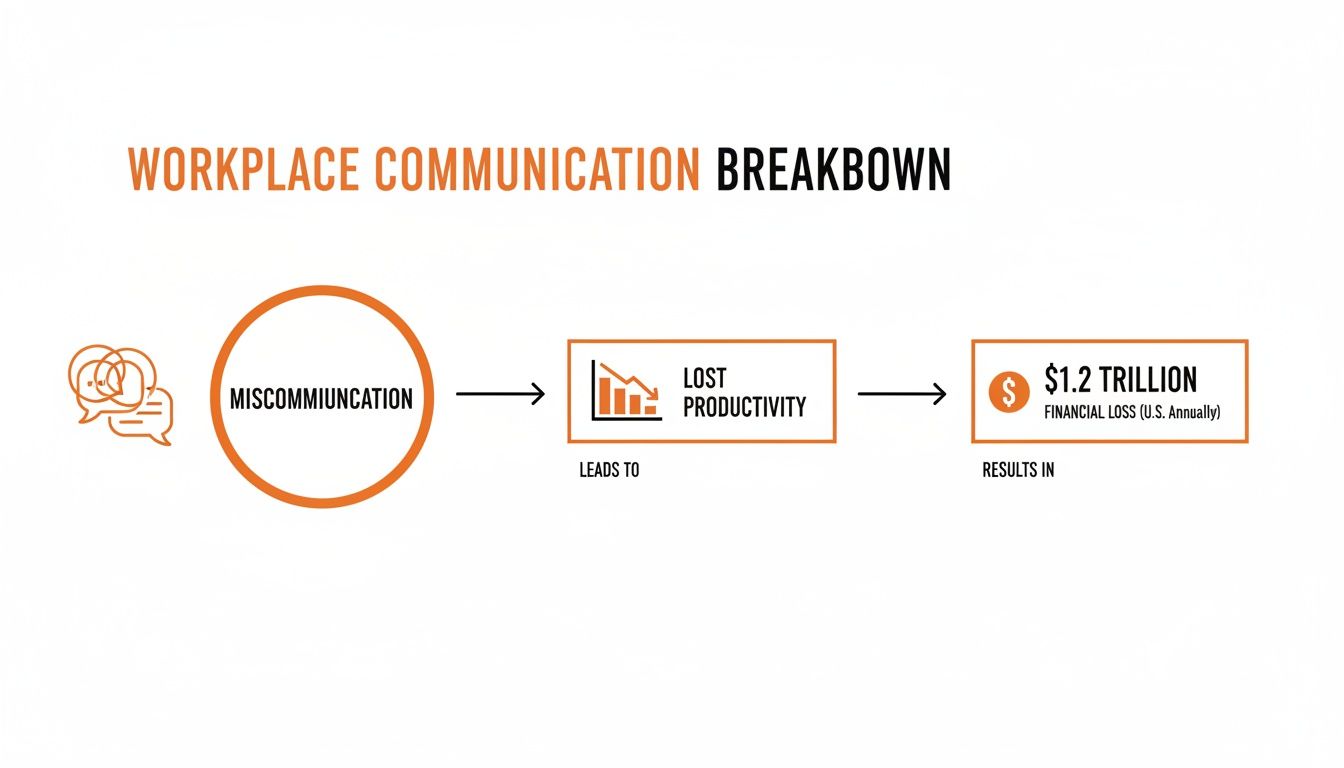
It’s a simple but brutal equation: when messages get tangled, productivity plummets, and the bottom line suffers.
Observing the Daily Friction
The most telling signs of a communication breakdown aren't hidden in engagement surveys; they're visible in the friction of everyday work. You just have to know what to look for.
Are teams constantly duplicating work? Classic sign one department has no clue what the other is doing. Are deadlines being missed without anyone noticing until it's too late? That points to a breakdown in progress updates and accountability.
Here are a few more subtle indicators I've learned to watch for:
Siloed Knowledge: Critical information lives inside one person's head or a single team's private chat. If a project grinds to a halt the minute someone goes on vacation, you have a communication problem.
Low Engagement in Meetings: Pay attention to who speaks up. If it's always the same handful of people while everyone else stays quiet, it might signal a lack of psychological safety. Silence is often a symptom of fear, not agreement.
A Disconnect Between HQ and the Frontline: Corporate announces a bold new initiative that makes absolutely no sense to the people who have to execute it. This gap shows information is only flowing one way—downhill.
Spotting these issues is about comparing how things are to how they should be. It’s often helpful to see the warning signs side-by-side with the signs of a healthy, well-oiled team.
Symptoms of Communication Breakdown vs. Signs of a Healthy Culture
Symptom of Breakdown (The Warning Sign) | Sign of Health (The Goal) |
|---|---|
"Meeting after the meeting" is common. | Important conversations happen openly, with the right people in the room. |
Gossip and rumors are the main news sources. | Official channels are trusted, transparent, and timely. |
Silos and knowledge hoarding are the norm. | Information is shared freely across teams to achieve common goals. |
Blame culture emerges when things go wrong. | Problems are treated as collective learning opportunities. |
Employee silence is mistaken for agreement. | People feel safe to ask tough questions and offer respectful dissent. |
Constant rework due to unclear expectations. | Projects have clear briefs, defined goals, and shared understanding from the start. |
Recognizing these contrasts is the first step. A healthy communication culture feels calm and clear. A broken one feels chaotic and confusing, wasting everyone’s energy just trying to figure out what’s going on.
Ultimately, diagnosing a communication problem means looking past the org chart to see how information actually moves. It’s about spotting the workarounds, the silences, and the rumors that signal a much deeper issue. Only then can you start to fix it.
Why 'More Communication' Is Almost Always a Trap
Here’s a hard truth I’ve learned: whenever a team says they have a communication problem, the first demand is almost always for more. More meetings. More emails. More pings. On the surface, it feels like action, but it’s a classic trap.
Piling on more information doesn’t create clarity—it just creates noise. You bury important signals under an avalanche of low-value updates. Before you know it, people are so overloaded they tune everything out. You’re right back where you started, except now everyone’s burnt out.
The real issue is rarely volume. It’s quality.
The Illusion of Constant Connection
We've somehow convinced ourselves that being constantly connected is the same as being informed. With a dozen apps vying for our attention—Slack, Microsoft Teams, email, texts—it certainly feels like communication is happening nonstop. But a lot of it is just frantic activity masquerading as progress.
It’s not just a feeling, either. A 2024 report from Grammarly and The Harris Poll found that poor communication is a direct cause of increased stress for 51% of knowledge workers. That’s a real impact on people’s well-being. When every notification feels urgent, nothing is. Your team's attention shatters, their energy drained by the cognitive load of just trying to stay afloat.
This "always-on" culture doesn't fix communication. It amplifies the breakdown. It fuels reactive, surface-level exchanges instead of thoughtful dialogue. What you’re left with is a team that’s busy but not productive, connected but not aligned.
Quality Over Quantity, Every Single Time
Think of it this way. Which is more effective: a dozen scattered emails and chat messages all trying to explain a shift in project strategy, or one well-written post in a dedicated company channel that clearly lays out the what, the why, and the what's next?
The first option is a recipe for chaos. The second creates a single, reliable source of truth. It's calm, clear, and respects everyone's time.
The goal shouldn't be to communicate more. The goal should be to communicate with such clarity that less communication is needed. One clear message is infinitely more powerful than a hundred vague ones.
This requires a fundamental shift. Move away from measuring communication by how often it happens and start measuring it by how effective it is.
Instead of another meeting… could this be a short, asynchronous video?
Instead of a flurry of emails… could this be a single, detailed post that serves as a permanent reference?
Instead of constant chat interruptions… can we encourage people to check dedicated channels in batches?
The fix for bad communication is rarely just 'more.' It’s being more deliberate. It’s thinking through what needs to be said, who needs to hear it, and the best way to deliver that message. It’s giving your people the space to do deep work, trusting that when a message does come through, it actually matters. That’s the calmer, smarter way to work.
Creating the Right Channels for the Right Conversations
Let’s get practical. When communication feels like a noisy mess, the fix isn't another mandatory meeting. It’s creating clean, predictable channels for information to flow.
Think about organizing a kitchen. You don't throw pots, pans, and spices into one giant drawer. You create specific spaces for each. That same logic is the key to fixing workplace communication.
An all-hands meeting, a manager’s daily huddle, and a project team’s private chat are not interchangeable. Each has a different job. Without that structure, important announcements get lost in casual chatter, and urgent project updates get buried under company-wide memos.
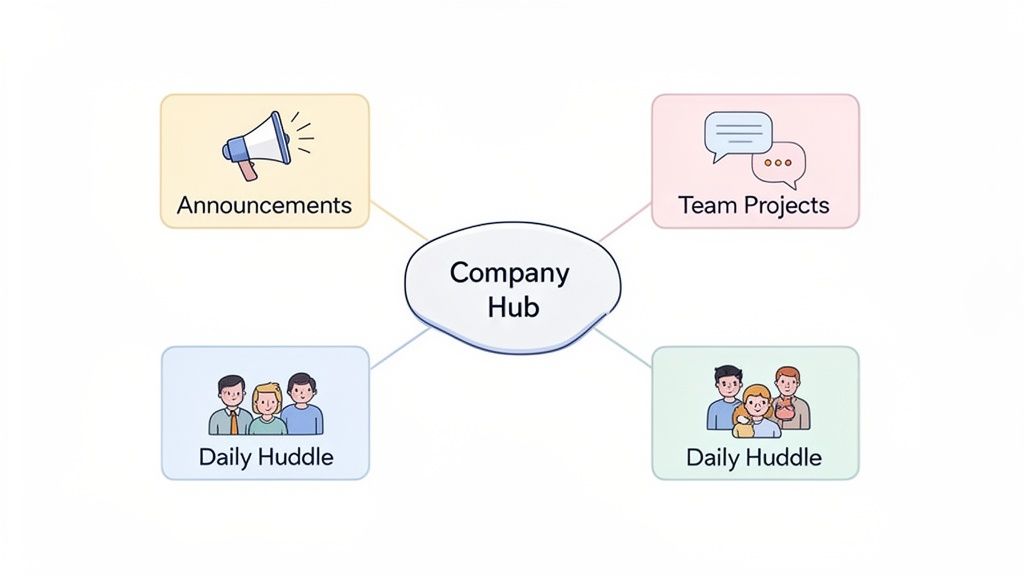
Giving every conversation a proper place is the first real step in turning down the noise and turning up the clarity.
Ending the Chaos of Tool Sprawl
Here’s the thing: most companies already have channels. The problem is they’re scattered across a dozen different apps. You’ve got email for official stuff, a chat tool for quick questions, a project management platform for tasks, and who knows what the frontline teams are using—probably personal WhatsApp groups.
This tool sprawl kills clarity. When people constantly jump between apps, they lose context and waste mental energy. Information gets trapped, and nobody has a single, reliable place to look for answers. That feeling of being overwhelmed by pings and back-to-back meetings? It’s a direct symptom of this chaos.
Simple routines, like using effective daily work logs, can bring a rhythm of accountability that a frantic chat stream never will.
The ultimate goal is to create a single source of truth—one unified platform where every type of conversation has a designated, easy-to-find home. This is especially vital for businesses with both desk and frontline workers, who are often the most disconnected.
A Blueprint for a Calm Communication Ecosystem
So, what does a well-designed system look like? It’s not about having more channels; it’s about having the right ones, each with a crystal-clear purpose. You don't need a dozen different tools, just a few that are consistently used and understood by everyone.
Here’s a simple blueprint that works for most organizations:
A Company-Wide Channel for Announcements: This is your digital town square. It’s exclusively for official news and leadership updates. Critically, this should be a low-noise channel, reserved for information that everyone needs to see.
Team-Specific Spaces for Projects: This is where the work gets done. Each team or project gets its own space for collaboration, sharing files, and managing tasks. It keeps conversations focused and relevant to only the people involved.
Channels for Social Connection: Work isn't just about work. A dedicated space for non-work chat—sharing vacation photos, celebrating wins, or planning a team lunch—is essential for culture. It gives social chatter a place to live so it doesn't clutter up the work channels.
This model brings order to the chaos. It’s a framework you can adapt, but the core principle is the same: create distinct, purposeful channels. You can explore more options in our essential guide to internal communication channels.
The beauty of this approach? It's calming. When everyone knows where to find what they need—and where to share what they know—the frantic search for information stops. Trust grows, anxiety drops, and people can finally focus on their actual jobs.
How to Bridge the Gap to Your Frontline Teams
In most companies, there’s a massive, invisible chasm. It’s the gap between the folks at headquarters and the people face-to-face with your customers every day. I'm talking about your cashiers, nurses, warehouse staff, and servers—the lifeblood of your operation.
And here’s the uncomfortable truth: they are almost always the most disconnected employees you have. A lack of communication in the workplace isn't just an office problem. For frontline teams, it’s a fundamental disconnect from the company itself.
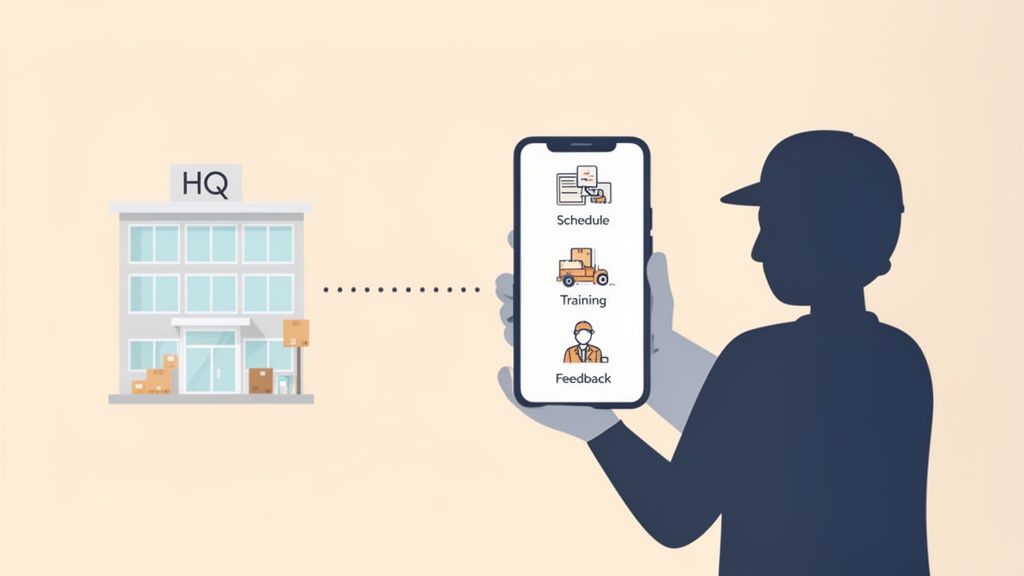
This isn’t their fault. We can’t expect them to stay plugged in when their reality is a world away from a desk. Many don’t have a company email. Their primary source of information is often a hurried chat with a manager or a notice pinned to a dusty breakroom bulletin board.
The Old Ways Are Broken
Let’s be honest. The old methods don't cut it anymore. Relying on managers to pass information down the chain is like playing a game of telephone—the message gets distorted, delayed, or lost. By the time an important update reaches the front line, it’s often too late or completely wrong.
This creates a dangerous two-tiered system. One part of your company gets instant access to everything, while the other gets a watered-down, second-hand version. This isn't just inefficient; it’s corrosive. It makes your most essential people feel like an afterthought, fueling the disengagement leaders are trying so hard to fix.
Meet Them Where They Are: On Mobile
So, how do we fix it? We stop trying to force frontline employees to use corporate tools and instead bring the communication to them. The one tool nearly every single one of them has in their pocket is a smartphone.
That’s the key. A simple, mobile-first app becomes the bridge. This isn't about adding another complicated system. It's about providing a single, easy-to-reach place on their own devices for everything that matters.
The solution isn't to pull your frontline teams into the corporate world of email and intranets. It's to build a communication system designed for their world—mobile, immediate, and straightforward.
A well-designed app can completely change the game. Imagine a world where your teams can:
Access Schedules Instantly: No more calling the store or snapping photos of a paper schedule. They can check shifts and request time off from their phone.
Get On-Demand Training: Did a new product just launch? A quick training video can be sent directly to everyone, ready to watch during a quiet moment.
Provide Real Feedback: You can create a direct line for them to share what they’re seeing on the ground. When an employee can report an issue and know it’s been seen, they feel heard.
This isn’t just about pushing information out. It’s about creating a genuine, two-way conversation. For a deeper look, our guide on how to make communication work in companies with frontline employees offers more practical strategies.
Bridging this gap means recognizing your frontline teams aren't a problem to be managed, but an incredible asset to be connected. When your culture and critical information reach every single employee—not just those with a laptop—you unlock a level of alignment you never thought possible.
The Quiet, Essential Work of Building Trust
We can talk all day about tools and processes. We can map out the perfect channels and craft the clearest messages. But let’s be honest: none of it matters if there’s no trust.
Ultimately, no app can fix a lack of communication in the workplace if people are afraid to speak up. The best tool in the world is an empty vessel without a culture that encourages people to fill it with honest questions, real concerns, and even the occasional mistake.
Great communication isn't built on technology; it's built on psychological safety. It’s that quiet, human sense that you can raise your hand, admit you don’t understand, or point out a problem without fear of ridicule.
The Slow Work of Leadership
This isn’t something you can fix in a quarterly sprint. Building trust is the slow, deliberate work of leadership. It’s a thousand small, consistent actions that create an environment where open communication becomes the default.
It starts with leaders modeling the behavior they want to see. When a leader is willing to say, “I was wrong,” or “I don’t have the answer,” it gives everyone else permission to be human, too. It replaces the pressure to be perfect with the freedom to be honest. Beyond just setting up channels, building genuine trust is foundational for any successful team, requiring effective team collaboration strategies.
This is about proving, day in and day out, that transparency is celebrated, not just tolerated.
Closing the Loop Is Everything
One of the fastest ways to erode trust is to ask for feedback and then do nothing with it. When employees share their ideas and their input disappears into a black hole, they learn a simple lesson: my voice doesn’t matter here.
Closing the loop is non-negotiable. Even if you can’t act on a suggestion, the simple act of acknowledging it and explaining the "why not" is incredibly powerful. It tells people they were heard.
Trust isn’t built in grand gestures. It's built in the quiet consistency of showing up, listening, and following through. It's the bedrock that makes every other communication effort possible.
This consistent, authentic communication is what transforms a group of individuals into a resilient, engaged team. It’s the difference between a company that merely survives and one that truly thrives.
We won’t offer you a five-step plan here, because one doesn't exist. There are no shortcuts. It’s just the patient, daily work of listening more than you speak, answering the hard questions, and treating every interaction as a chance to reinforce that it’s safe to be open.
The real work isn't about finding the right tool; it's about building the kind of culture where any tool can be used to its fullest potential.
Got Questions About Workplace Communication? We've Got Answers.
We spend a lot of time talking with leaders about the nitty-gritty of fixing communication breakdowns. It's a common struggle, and a few key questions come up again and again. Here’s our take on them.
What’s the Single Biggest Culprit Behind Poor Communication?
Time and again, especially for teams with frontline or hybrid workers, the biggest issue is tool fragmentation. This is what happens when your office crew lives in Slack and email, while your frontline employees are stuck with personal WhatsApp groups or word-of-mouth.
It’s a recipe for disaster. Information gets siloed, critical updates get missed, and one part of the company has no idea what the other is doing. The only real fix is getting everyone onto a single, mobile-friendly platform that every employee can actually access.
How Do We Know if Our Communication Is Actually Improving?
You need to look at both the numbers and the vibe in the room.
For the hard numbers, keep an eye on:
Employee engagement scores: Specifically, look for improvements on questions about feeling informed and connected.
Employee turnover: When people feel heard and in the loop, they're more likely to stick around. A drop in turnover is a fantastic sign.
But don't forget the softer signs. Are people asking smarter questions in meetings? Are you seeing less rework? A huge informal win is when the "meeting after the meeting"—where people gather to figure out what was really decided—starts to disappear. That tells you clarity and trust are on the rise.
The true test of better communication isn't just sending more announcements. It's about seeing less confusion, more initiative, and a team that's genuinely connected to the company's purpose.
How Can We Get Busy Leaders to Actually Communicate Better?
The trick isn’t to add more to their plate; it’s to make communicating easier. Pushing for another hour-long meeting is a losing battle.
Instead, coach them on smarter, asynchronous methods. A quick two-minute video recorded on their phone or a short, punchy post in a company-wide channel can be more effective. When they have a tool where they can post something once and trust it will reach every person, whether they're at a desk or on the factory floor, it saves them an enormous amount of time. It's all about getting more impact with less effort.
Ready to build a calmer, more connected workplace? Pebb unifies communication, operations, and engagement for your entire team on one simple platform. Learn more about Pebb.
