
How to Build Trust in Teams Without Awkward Exercises
Discover how to build trust in teams with practical strategies for modern work. Learn to foster reliability and genuine connection that actually works.
Dan Robin
Forget the trust falls. Forget the mandatory happy hours. If you want to build real, lasting trust in a team, you have to stop trying to manufacture it in a single afternoon.
Trust isn’t a line item on an HR checklist. It’s the quiet confidence that your teammates will do what they say they’ll do. That they’ll show up when it matters. It grows slowly, in the day-to-day rhythm of the work itself, built on a foundation of predictability and consistency.
Here's how we’ve learned to build it.
Forget Trust Falls—Lasting Trust Is Built on Predictability
We’ve all been there. The cringey team-building exercise. The awkward icebreaker that lands with a thud. The intention is usually good, but these events almost always miss the point. You can’t force camaraderie.
Real trust is much quieter. It's built on a simple, powerful idea: predictability.
The Quiet Power of Consistency
Think about it. The trust that actually matters is knowing your teammate will deliver what they promised. It’s the unspoken confidence that their work will be solid, and that they’ll have your back when things get messy. This isn't built with grand gestures. It's built in the small, repeated actions that prove someone is reliable.
This becomes non-negotiable for teams spread across different shifts or time zones. You can't rely on hallway chats or a quick coffee run to build that foundation. You need a system.
The data backs this up. An Interaction Associates workplace trust study found that 59% of people believe trust comes from the consistency and quality of their colleagues' work. It’s not about liking each other; it’s about depending on each other.
This is a fundamental shift.
We need to move away from the idea that trust is an emotional bonus and see it for what it is: a core component of an effective operational system. When I can predict my team's actions, I can move faster and take smarter risks.
From Old Rituals to New Realities
The old playbook for trust-building was written for a world where everyone shared the same four walls. Today’s reality of distributed teams and asynchronous work demands a more practical, intentional approach. It’s time to update our thinking.
Outdated Tactic | Modern Approach | Why It Works Better |
|---|---|---|
Mandatory after-work happy hours | Asynchronous non-work chat channels | Lets people connect on their own time, respecting personal boundaries and different schedules. |
Annual team-building offsites | Daily visibility into shared goals and progress | Builds trust through the work itself, making consistent effort something everyone can see and respect. |
Vague encouragement to 'be a team' | Clear, documented standards for communication and work quality | Removes ambiguity and gives everyone a shared definition of what 'good' looks like, making reliability the default. |
Let's be honest. The goal isn't to force friendships. The goal is to create a system where depending on each other feels effortless and safe.
When you know, without a doubt, that your team has your back because they consistently deliver, that’s real trust. It’s far more powerful than any trust fall.
Make Your Work Visible and Your Standards Clear
Trust can't grow in the dark. It just can’t. If you want a team to be predictable, you have to make the work visible. It's impossible to trust what you can't see, yet for so many teams—especially remote or frontline folks—the actual work happens in a black box.
Someone clocks in, does their job, and clocks out. Their wins, their struggles, their quiet, consistent efforts? Invisible to their colleagues. This is where mistrust breeds, because assumptions rush in to fill the void.
Let’s be honest: when you can't see the effort, it’s easy to question it. Breaking down these walls isn't about micromanaging. It's about creating a shared context.
Open Up the Workshop
The trick is to create a central, shared space where tasks are tracked, updates are posted, and good work gets seen. Think of it like opening up the workshop doors so the whole team can see the craftsmanship.
Something as simple as a shared project board can work wonders.
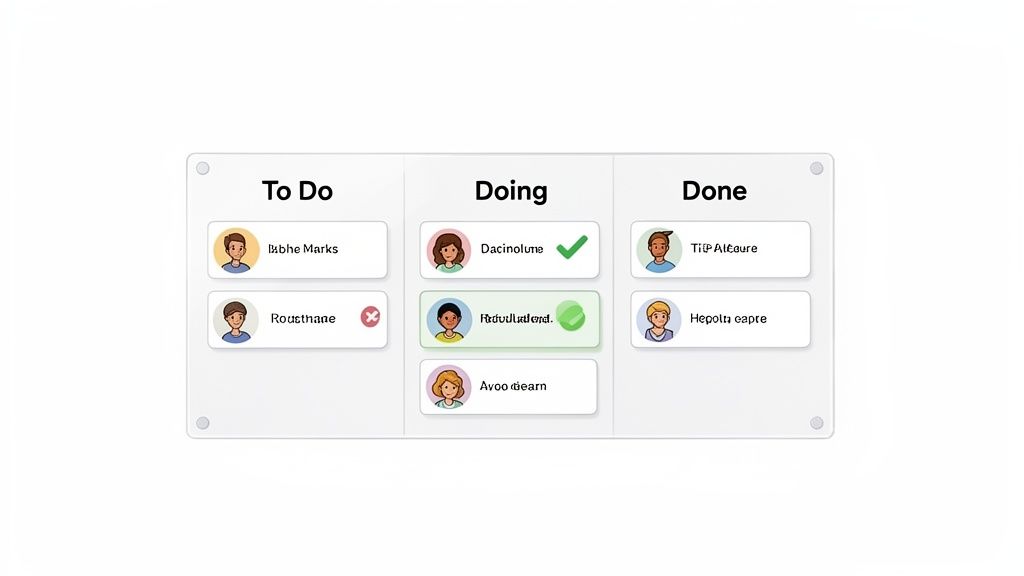
This isn’t just another to-do list. It’s a living record of your team’s collective effort. It makes it obvious who's doing what and how things are progressing.
When people see their teammates consistently move cards from "In Progress" to "Done," they're not just seeing a task checked off. They're seeing reliability in action. That builds a foundation of respect that no happy hour can replicate.
Define What “Good” Looks Like
But visibility isn't enough. You also need crystal-clear standards. If everyone has a different definition of "done," you're just creating friction. Trust erodes fast when you constantly have to redo a colleague's work because your standards don't align.
This is where documenting your processes becomes a game-changer.
Trust isn’t just about believing someone will do the work. It’s about believing they will do the work to the standard the team expects. Clarity removes the guesswork.
Here are a few practical ways to set clear standards:
Create simple checklists. For any recurring task, a shared checklist ensures everyone follows the same critical steps. No more missed details.
Use templates. For reports, project kick-offs, or client emails, templates guarantee a consistent level of quality.
Share examples of great work. When someone knocks it out of the park, share it as a model. This celebrates a job well done and sets a clear benchmark.
These simple tools create a shared language for what excellence looks like on your team. You can dive deeper into this by reading our guide on how to build a central knowledge hub for your team. Understanding the five core elements of effective team dynamics also plays a huge role here.
When the work is open and the standards are clear, trust almost builds itself. It becomes the natural byproduct of a transparent, predictable system.
Create Space for Genuine Connection, Not Forced Fun
Let's be real—nobody enjoys forced fun. We've all smiled through a mandatory virtual happy hour that felt more like a chore than a connection. But here’s the thing: just because people hate manufactured fun doesn't mean they don't crave real connection.
The secret is to stop engineering camaraderie and instead create an environment where it can grow on its own. It's about building a space where people are seen as whole humans, not just job titles. When you know a little about someone's life outside of work, you build empathy. And empathy is a direct path to trust.
Ditch the Events, Focus on the Environment
Instead of another one-off event, what if we focused on small, daily actions that build real bonds? This isn't about entertainment; it's about creating channels for human moments to surface naturally.
It can be as simple as a dedicated chat channel for non-work stuff. Think #pets, #music-lovers, or #weekend-adventures. These spaces give people permission to share a piece of themselves without derailing a work conversation. It’s a low-pressure way to discover shared interests and see colleagues in a new light.
Seeing the Whole Person
Another simple but powerful tool is the personal user profile. When someone adds a few details—their hobbies, a photo of their dog, what they’re reading—it immediately adds depth to their work persona. Suddenly, Sarah from accounting isn't just the person who processes invoices; she's also a marathon runner and a huge sci-fi fan.
These small windows into each other’s lives are what turn a group of individuals into a connected team. It’s how you learn that the quietest person on your team has the most fascinating hobby.
Research backs this up. A recent study showed that a structured program focused on building positive relationships led to huge increases in how much team members felt trusted. In fact, 100% of participants linked these improved relationships to a greater sense of capability and motivation at work. You can dive into the full study on team dynamics to see how effective these safe, positive interactions can be.
To foster this, leaders can even draw inspiration from strategies for building classroom community and adapt them. The principles are similar: create safety, encourage sharing, and celebrate what makes each person unique.
At the end of the day, genuine connection isn’t complicated. Make space for people to be people, not just employees. Trust follows.
A Leader’s Playbook for Building Trust
Trust doesn’t just magically appear. It’s built, and the project starts at the top. As a leader, your every move—from big decisions to off-the-cuff remarks—is either adding to or chipping away at the foundation.
This isn't about being perfect. It's about being real.
One of the most powerful things you can do? Admit you don't have all the answers. Your team isn't looking for an oracle. Saying, "That's a good question. I don't know, but let's figure it out together," builds more credibility than faking it ever will. It shows you're human and that you respect their intelligence.
And things will go sideways. Mistakes happen. When they do, the instinct can be to deflect. Resist it. Own your part. A simple, "I messed up on that call," can defuse a tense situation and makes it safe for others to admit their own stumbles.
Transparency Is Just Another Word for Respect
Being transparent doesn't mean oversharing every detail from every executive meeting. True transparency is about sharing the why behind decisions that affect your team.
When people understand the rationale, they feel included and respected, even if they don't love the outcome. You're treating them like the capable adults they are.
This flow chart shows a simple way to think about structuring communication to build these connections—using the right channels, consistent updates, and getting to know the people on your team.
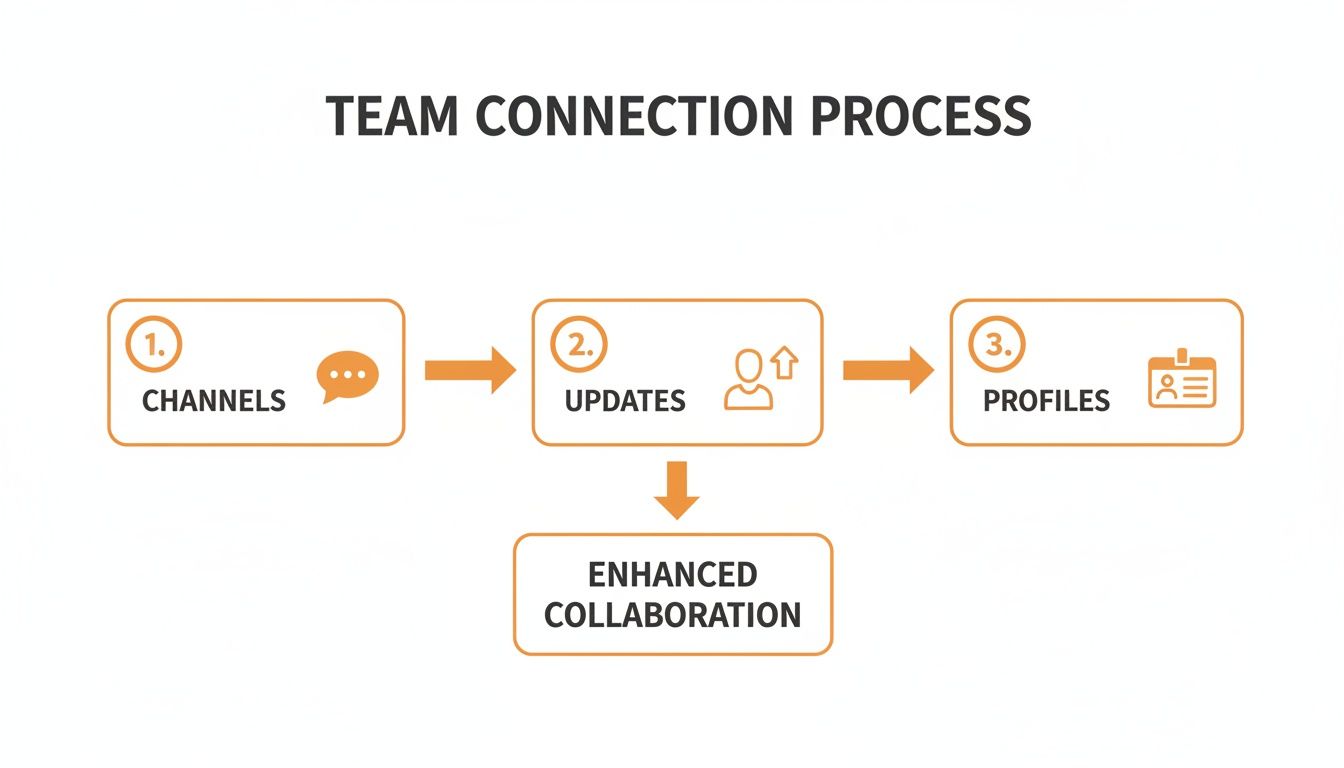
A little intention behind your communication process leads directly to better collaboration.
The last piece is to actually listen. Ask for feedback, and then—this is the critical part—do something with it. Nothing erodes trust faster than asking for an opinion and then letting it vanish into thin air. Acting on what you hear proves you're not just going through the motions. For a closer look, see our guide on how leadership communication impacts employee engagement.
The numbers back this up, by the way. Gallup found that highly engaged teams with high trust see a 10% increase in customer loyalty and a 20% spike in sales. These are real results that come from a high-trust environment.
Trust isn’t a soft skill. It's a performance multiplier. A team that trusts you will run through walls for you. A team that doesn't will just run out the clock.
Building this kind of team isn’t about some huge initiative. It's about the small things you do consistently. It's about being reliable, honest, and brave enough to be a little vulnerable. That’s how you get a team that not only crushes its goals but also has each other's backs.
Building Trust When You're Not in the Same Room
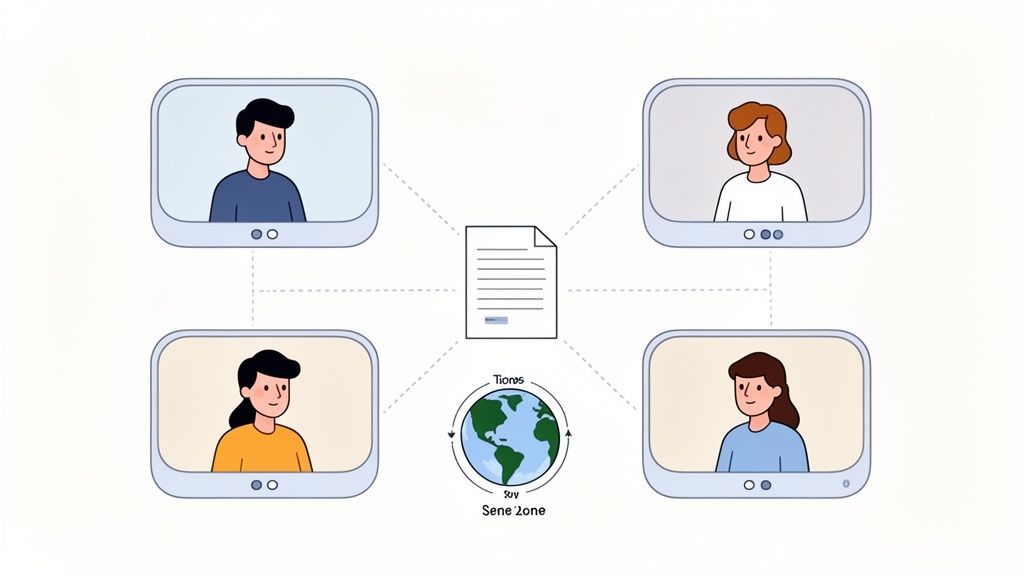
Let's face it: building trust feels different when you can't just grab coffee. All those small, human cues we rely on—a shared glance, a quick chat in the hallway—are gone. When your team is distributed, physical distance can easily create emotional distance.
Trust doesn't just happen on its own when you’re miles apart. It has to be built with intention.
Default to Positive Intent
We’ve all been there. A short Slack message comes through, and a missing emoji sends your mind spinning. Are they annoyed? Upset? We rush to fill in the blanks, and our brains are wired for worst-case scenarios.
This is where assuming positive intent becomes a team superpower. It’s a conscious choice to read a colleague's message through the most generous lens possible. This simple mindset shift prevents countless misunderstandings and stops minor hiccups from spiraling into real conflict.
It's not about being naive. It's about giving your teammates the same benefit of the doubt you'd want them to give you. That buffer of goodwill is essential for remote work.
Know When to Ditch the Keyboard
Text is fantastic for quick updates. It’s terrible for nuance and emotion. Some conversations were never meant to happen over a keyboard.
If you sense tension rising, or a topic getting complicated, just stop typing. The best move is to jump on a quick video call. Seeing someone's face and hearing their tone can resolve in five minutes what might have taken an hour of frustrating messages.
Making that switch isn’t an admission of failure; it’s a sign of emotional intelligence. Knowing the right tool for the conversation is a game-changing skill.
Trust in a remote setting is an active verb. It’s choosing clarity over ambiguity, connection over convenience, and assuming the best in people even when you can’t see them.
This challenge isn't just anecdotal. Research from Ohio State University confirms that trust develops more slowly in virtual teams. The study even found a negative link between increased virtual communication and team trust, which tells us that intentional strategies are non-negotiable.
A single platform can help bridge this gap by creating a digital home where communication feels clearer and connection is easier. It puts everyone in the same virtual room, even if they're worlds apart. Our checklist for building trust in remote teams has you covered.
Ultimately, building trust when you're not together comes down to being more deliberate. You have to over-communicate, assume the best, and remember there’s a real person on the other side of the screen.
Got Questions About Building Trust? We’ve Got Answers.
Even when you’re all-in on building trust, you’ll hit tricky situations. Things get messy. Questions pop up. We get it. We hear these all the time.
Think of this less as a perfect script and more as a reliable compass.
How Do I Rebuild Trust After It’s Been Broken?
This is the big one. Let’s be honest: rebuilding trust is slow, difficult work. Sometimes, it doesn’t work out. It has to start with one thing: a genuine, no-excuses apology. Not "I'm sorry you feel that way," but "I messed up, and here’s what I'm going to do to make it right."
From there, it’s all action. Words are cheap. The only way to mend the break is through a long series of reliable behaviors. You have to earn it back, one interaction at a time. No shortcuts.
Trust is like a mirror, you can fix it if it's broken, but you can still see the crack in that mother f*cker's reflection. – Lady Gaga
Lady Gaga’s take is a bit blunt, but the sentiment is spot on. That crack might always be there, but with enough consistent effort, you can make the whole thing strong again.
Can We Really Build Trust on a Virtual Team?
Absolutely. But you have to be far more intentional. You can't rely on random coffee machine chats. One of the best things you can do is surprisingly simple: carve out dedicated space for non-work talk.
This doesn't mean forced virtual happy hours. It means creating little rituals and opportunities for people to connect as humans.
When you get it right, the payoff is huge. A recent study found that 83% of companies saw an improved global perspective as a benefit of their virtual team-building, and 72% pointed to better diversity and creativity. It shows that being deliberate can turn the challenge of distance into a massive strength. You can dive deeper into building trust in modern teams to get the full picture.
How Can I Tell if Our Team’s Trust Is Actually Improving?
You can't slap a "trust score" on a dashboard, but you can see its effects in how your team operates. You just need to know what to look for.
Is healthy debate picking up? When people trust each other, they aren’t afraid to disagree. They know the conflict is about the idea, not the person.
Are people admitting mistakes? A team that feels safe will own their errors instead of trying to hide them. This is a huge sign of psychological safety.
Is information shared freely? In high-trust environments, people share what they know proactively instead of hoarding it.
These aren't hard numbers, but they are crystal-clear signals. They'll tell you more about your team’s trust level than any survey. Pay attention. They tell the real story.
Ready to build a high-trust culture with a tool designed for it? Pebb unifies your team's communication, operations, and engagement in one simple app, making it easier to build the predictability and connection that real trust is made of. Discover how Pebb can be your company’s digital home.
