
How to Master Communication Styles in Leadership
Discover communication styles in leadership and learn when to use each, with real examples and Pebb features to adapt and measure your impact
Dan Robin
Shift change is where leadership gets exposed.
A white-collar team can survive a fuzzy update for a few hours. A hospital floor can’t. A warehouse can’t. A restaurant dinner rush can’t. When one supervisor gives clipped orders, another softens everything until nobody knows what matters, and a third buries the key point in a long explanation, the handoff starts to wobble. Work still moves. But people fill gaps with guesses.
That’s what communication styles in leadership really are. Not personality trivia. Not a workshop slide. They shape whether people trust the message, understand the priority, and act in time.
I’ve seen teams blame “bad communication” when the underlying problem was style mismatch. The leader thought they were being clear. The team heard cold. The leader thought they were being collaborative. The team heard indecisive. The leader thought they were being supportive. The urgent point got lost.
The fix usually isn’t to become a different person. It’s to become a more flexible one.
Why Communication Styles in Leadership Matter
On a busy floor, nobody asks for your leadership philosophy. They react to your tone.
At shift change in healthcare, retail, or logistics, leaders often need to do three things at once. Pass on critical facts. Keep people calm. Make sure the next team knows what matters first. That sounds simple until stress gets involved. Then style starts doing as much work as content.
Style changes how people hear the same message
“Watch this patient closely.” “Watch this patient closely, and tell me the moment anything changes.” “We’ve had a rough handoff already, so don’t miss this.” Those sentences carry different weight, even when the instruction looks similar on paper.
That’s why communication styles in leadership matter so much. Teams don’t just need information. They need information delivered in a way they can use under pressure.
The practical mistake is assuming clarity lives only in the words. It doesn’t. It also lives in pacing, confidence, warmth, and restraint. A leader who sounds sharp all the time creates tension. A leader who avoids firmness creates drift. Both can hurt execution.
Leadership shows up in ordinary conversations
Most leadership failures don’t begin with a dramatic crisis. They start in routine moments. A rushed briefing. A vague update in chat. A correction delivered with too much edge. A good employee who stops speaking up because every question gets treated like pushback.
That’s where the essential principles of leadership become practical, not abstract. Good leadership isn’t only about direction. It’s also about how direction lands.
The team rarely remembers your intent. They remember your pattern.
Leaders who understand their own style create steadier teams. They reduce friction before it grows into conflict. They make handoffs cleaner. They make feedback easier to hear. And they help people stay engaged without needing constant repair work afterward.
Understanding Communication Styles in Leadership
Most leaders don’t use one style. They have a default, then a few backup moves. The trouble starts when the default shows up everywhere.
Some moments need a firm call. Some need questions. Some need warmth. Some need rules. Strong leaders know the difference.
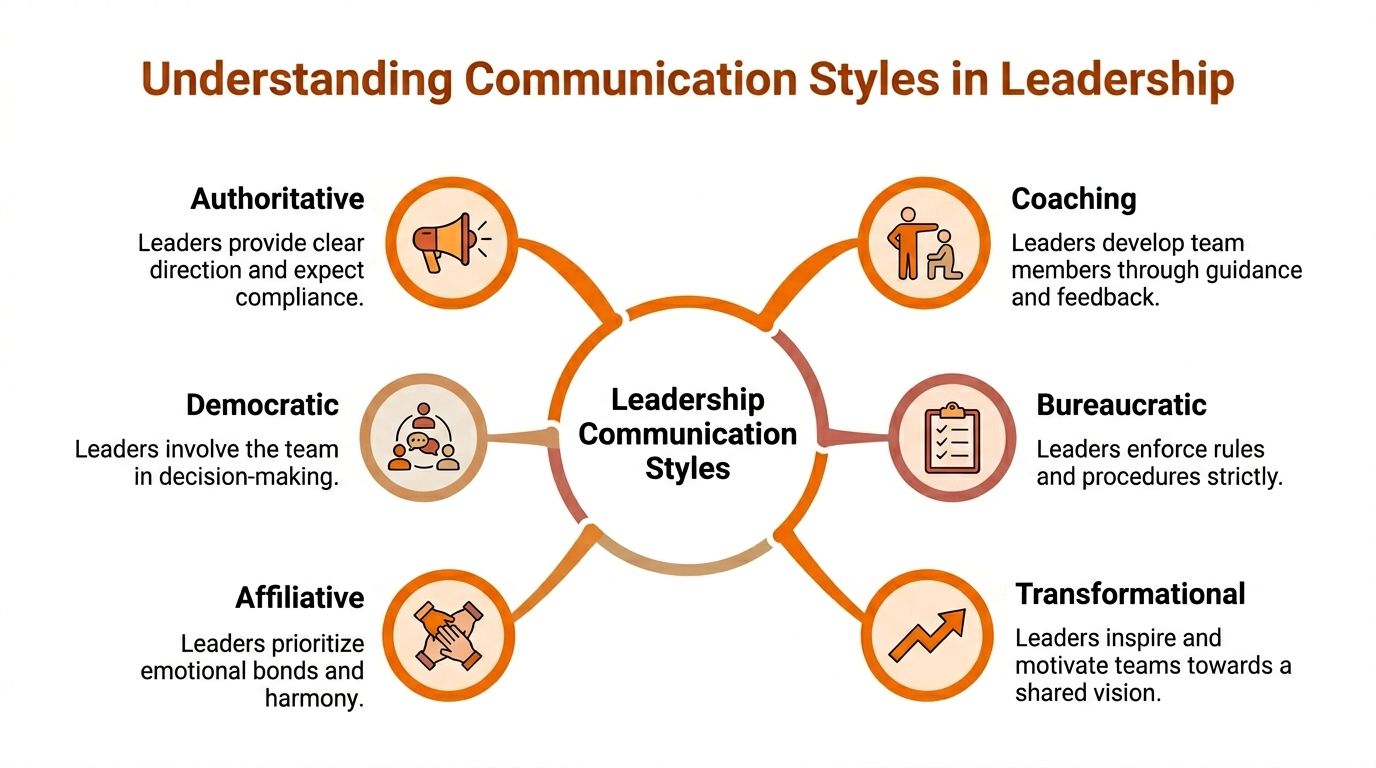
The six styles most leaders rely on
Style | What it sounds like | Where it helps | Where it goes wrong |
|---|---|---|---|
Authoritative | Clear direction, quick decisions | Emergencies, ambiguity, stalled teams | Feels controlling when overused |
Coaching | Questions, feedback, development | Skill-building, one-on-ones, growth | Too slow in urgent moments |
Democratic | Shared input, open discussion | Buy-in, creative work, change efforts | Drags when every decision becomes a group vote |
Affiliative | Support, care, relationship-first tone | Repairing trust, new teams, morale dips | Avoids hard truths if taken too far |
Bureaucratic | Rules, process, compliance language | Safety, regulation, audit-heavy work | Chokes initiative when used as a reflex |
Transformational | Vision, meaning, bigger-picture framing | Change, energy, commitment | Feels hollow if daily execution is weak |
None of these is “the best” style. That’s the wrong frame. The better question is whether the style fits the moment.
Why assertive communication keeps showing up
Across styles, one quality matters more than people admit. Assertiveness. Not aggression. Not dominance. Clear, respectful expression.
A global survey by the Niagara Institute found that assertive communication was the dominant workplace style at 75.3% among 1,930 professionals from 52 countries, which helps explain why teams respond well to directness without hostility (Niagara Institute). That tracks with what experienced managers already know. People can handle firm messages. What they resist is confusion, contempt, or both.
If you want a helpful companion piece on the basics, Pebb’s guide on three forms of communication is worth a skim because it grounds the medium, not just the message.
What each style is really doing
Authoritative leaders reduce uncertainty. Coaching leaders build capability. Democratic leaders create ownership. Affiliative leaders restore safety. Bureaucratic leaders protect consistency. Transformational leaders give people a reason to care beyond the task.
Practical rule: If your team keeps asking, “What exactly do you want?” you probably need more precision. If they stop talking altogether, you may be using force where curiosity would work better.
Most communication problems in leadership aren’t caused by having the wrong values. They come from using the right style at the wrong time, or worse, using one style because it feels comfortable.
Identifying Your Leadership Communication Style
You can’t adapt what you can’t see.
Most leaders have a style that comes out under pressure long before they’ve chosen it on purpose. Stress reveals the default. Some people get more directive. Some over-explain. Some ask for input when the team needs a decision. Some go quiet and call it “giving space.”

Start with your pressure pattern
Don’t begin with a personality label. Begin with behavior. Think about your last tense meeting, missed deadline, or messy handoff. What did you do?
Ask yourself:
When time is short, do I make the call quickly, open the floor, or keep explaining until everyone agrees?
When someone underperforms, do I coach, correct, soften, or avoid?
When conflict shows up, do I move toward it directly or hope it settles on its own?
When I send updates, do people reply with action, more questions, or silence?
Those answers tell you more than any quiz.
Use team feedback, but listen for patterns
You don’t need a formal assessment to spot your style. You need recurring feedback. Not compliments. Patterns.
If people often say you’re “clear,” that may mean authoritative or precise. If they say you’re “easy to talk to,” that may point to affiliative or coaching strengths. If they describe you as “intense,” “hard to read,” or “hard to pin down,” that’s useful too.
A simple check works well:
Ask three peers what it feels like to receive feedback from you.
Ask two direct reports what you do when things go off track.
Compare their answers with how you describe yourself.
The gap matters.
Look at what your team grows around
Teams adapt to the leader in front of them. If your team waits for every decision, you may be too authoritative. If they debate everything, you may be too democratic. If they like you but miss deadlines, affiliative habits may be crowding out clarity.
A study on transformational leadership found that leaders rated higher on that dimension also showed stronger emphatic communication and were associated with team engagement gains in the 20 to 30% range compared with low-transformational counterparts (RAIS study). The useful lesson isn’t to chase a label. It’s to notice that style changes what people bring back to you. Energy. Candor. Follow-through.
A leader’s style is visible in team behavior long before it’s visible in a self-description.
Your job isn’t to pick a flattering category. It’s to find the habits that appear so often they’ve started shaping the room.
Matching Style to Leadership Situations
A lot of leadership advice assumes every problem wants more collaboration. It doesn’t.
If a safety issue appears on a warehouse floor, people don’t need a brainstorming session. They need a direct instruction, fast. If a new process keeps failing because nobody understands the rule, bureaucratic clarity can save the day. If a burned-out team has stopped trusting management, authority alone won’t repair it.
A quick way to choose the right style
Use the situation, not your mood, as the deciding factor.
Situation | Style that usually fits | Why it works |
|---|---|---|
Safety issue, urgent customer failure, clinical escalation | Authoritative | It reduces delay and tells people what happens next |
New hire growth, recurring performance issue, succession planning | Coaching | It builds judgment instead of dependence |
Team redesign, process improvement, product ideas | Democratic | It surfaces useful information and creates buy-in |
Merger stress, morale drop, team conflict | Affiliative | It lowers defensiveness and restores working trust |
Audit prep, legal compliance, medication protocol, payroll process | Bureaucratic | It protects consistency and reduces preventable error |
Big change, culture reset, strategy shift | Transformational | It connects effort to meaning |
Match the style to the audience too
The same situation can still need a different delivery depending on who’s listening.
Research summarized by Instep UK found that adapting communication to audience types such as Drivers, Amiables, Expressives, and Analyticals can yield up to 35% higher buy-in, while concise Driver-focused briefs can double decision speed (Instep UK). That’s useful because leadership isn’t only situational. It’s relational.
A Driver often wants the short version and the decision. An Analytical wants the rationale. An Amiable wants to understand impact on people. An Expressive wants room to react and contribute.
What usually backfires
Leaders get into trouble when they keep using the style that made them successful in a different context.
Authoritative overuse creates compliance without ownership.
Coaching overuse frustrates teams that need a clear answer.
Democratic overuse makes simple decisions expensive.
Affiliative overuse turns accountability into an awkward afterthought.
Bureaucratic overuse makes capable people stop thinking.
Transformational overuse produces big language with thin follow-through.
The move isn’t to become balanced in the abstract. It’s to get sharper at reading the room, the stakes, and the timeline.
Real World Examples of Leadership Communication Styles
Theory sounds neat until a shift goes sideways.
That’s why examples matter. Not polished success stories. Ordinary leadership moments where style either helps or gets in the way.

Maria on a restaurant night shift
Maria inherited a night team that didn’t trust daytime management. The old pattern was simple. Managers only showed up to correct mistakes. So Maria didn’t start with stricter language. She started with affiliative communication.
She made room for quick pre-shift check-ins. She thanked people for specifics, not vague effort. She asked what made service harder than it needed to be. Then, when standards slipped, she corrected directly. Warmth first. Vagueness never.
That mix matters. Pure friendliness wouldn’t have fixed anything. But support made the hard feedback easier to hear.
Sam in a warehouse safety scare
Sam managed a warehouse team when a near-miss forced everyone to stop. In that moment, democratic leadership would have been the wrong move. So would coaching. He used an authoritative style.
He gave short instructions. He named what stopped, what changed, and who owned each next step. No speeches. No group processing while risk was active.
Later, once the floor settled, he switched styles and asked what people had seen that he hadn’t. That second move is what many managers miss. Authoritative communication works in the crisis. It wears people down if you leave it on all day.
In urgent moments, brevity is kindness. After urgent moments, curiosity is.
Priya with a team of junior engineers
Priya led a technical team that had become dependent on her. Every decision bottlenecked with the lead. She first responded with more process. More approvals. More checklists. That’s a bureaucratic reflex, and sometimes it helps. In this case, it slowed learning.
So she shifted to coaching. Instead of fixing every draft, she asked engineers to explain trade-offs, name risks, and propose the next move. Work got messier before it got better. That’s normal. Coaching often looks slower early on because the leader stops rescuing.
Lena during a hospital handoff reset
A nurse leader I once watched do this well used transformational communication in a very grounded way. She didn’t give a grand speech. She tied cleaner handoffs to patient dignity, team trust, and fewer avoidable mistakes. Then she backed that up with a repeatable routine.
That’s the key. Vision only helps when it lands in daily behavior. Otherwise it’s just mood music.
Good leaders don’t marry one communication style. They move. They know when to tighten, when to soften, and when to stop talking so someone else can speak.
Assessing and Adapting Your Communication Approach
Knowing your default style is useful. Catching it in motion is better.
Adaptation isn’t a personality overhaul. It’s a feedback habit. You try something, watch how people respond, and adjust before a small miss becomes a team pattern.
What to watch after you speak
Most leaders judge communication by delivery. Did I say it clearly? Did I cover the points? That’s incomplete. The stronger test is response.
Look for signals such as:
Confusion after clarity: People nod in the meeting, then ask the same question later.
Polite silence: Nobody pushes back, but execution gets thin.
Overdependence: The team keeps coming back for decisions they should own.
Defensiveness: Feedback triggers self-protection instead of problem-solving.
Those aren’t random. They usually point to a mismatch between your style and the moment.
The tone problem leaders underestimate
A 2010 empirical study of 95 leaders and 491 subordinates found a strong positive link between supportiveness and human-oriented leadership success (r = .87), while verbal aggressiveness showed a negative relationship (r = −.62) (PMC study). That lines up with daily management reality. Tone isn’t decoration. It changes whether people stay open enough to act on what you’re saying.
If you want practical ways to tighten the basics, this guide on how to improve communication skills in the workplace is useful because it stays close to day-to-day work.
Useful test: If your message was technically clear but people felt attacked, your communication still failed.
A simple adaptation loop
Try this for two weeks.
Pick one recurring setting. Team huddles, one-on-ones, shift handoffs, project reviews.
Name the style you usually use. Don’t overthink it.
Choose one adjustment. Shorter opening, more direct ask, less filler, one question before advice.
Check the response. Did the team move faster, speak more openly, or need less cleanup?
Keep the change only if it helps.
Leadership becomes practical. You don’t need a grand framework. You need a repeatable way to notice what lands.
Abrupt style changes can confuse people, so don’t swing wildly. If you’ve been highly collaborative for months, switching overnight to blunt command language will feel like distrust. Small, consistent adjustments work better.
Enhancing Communication Styles with Pebb Features
A hybrid supervisor posts a policy change in the main chat at 4:45 p.m. The office staff sees it. The evening shift on mobile misses it. By the next morning, one group is following the new process and the other is still doing yesterday’s version.
That is not a communication theory problem. It is a channel design problem.
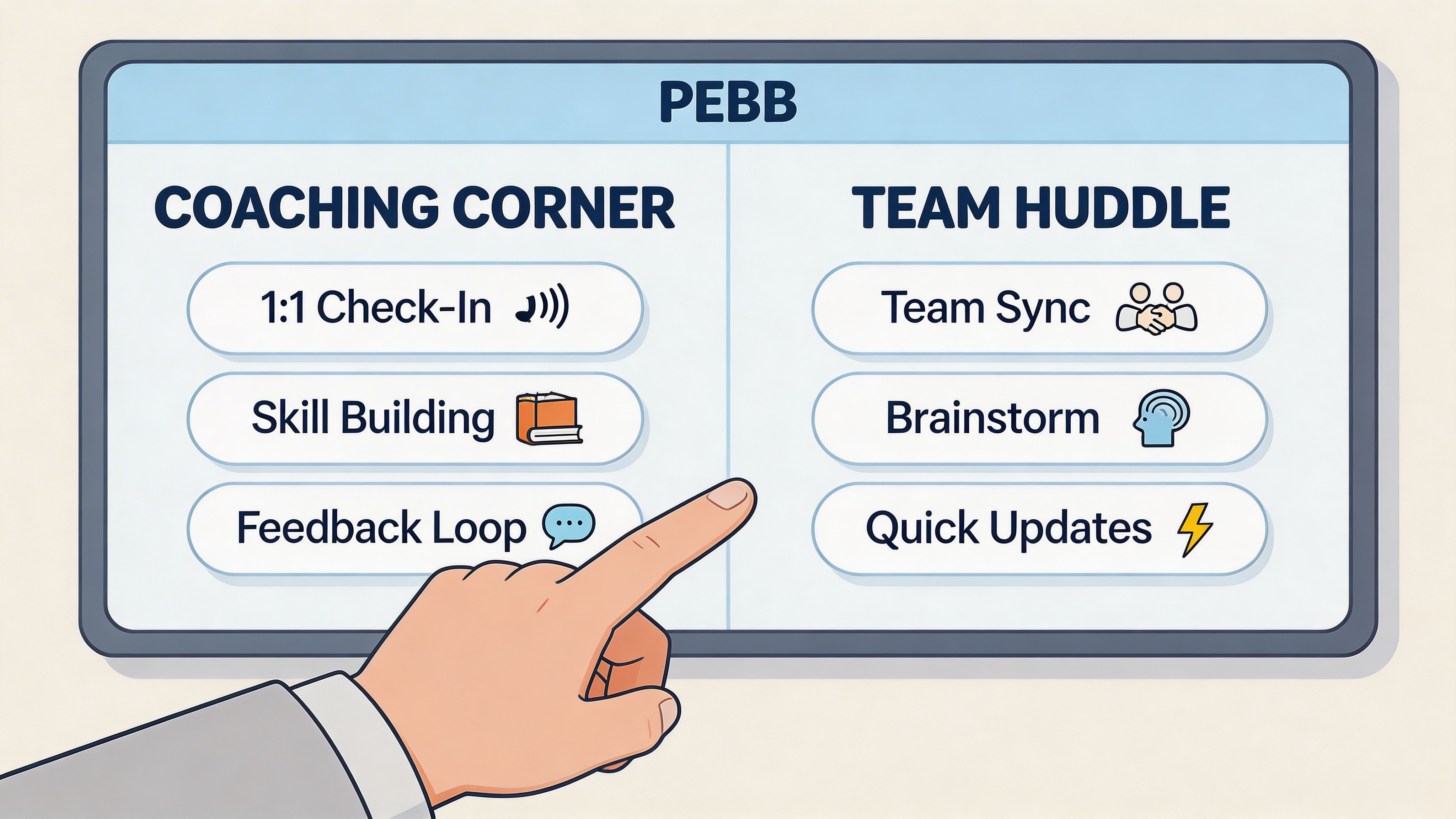
Leadership style shows up in the tools your team uses every day. Frontline and hybrid teams feel this faster than fully desk-based groups because they switch between shifts, devices, noise levels, and response windows. Psychologists writing for Psychology Today note that leaders need flexible communication skills across contexts. In practice, that means the same manager may need one style for a shift handoff, another for coaching, and a different one for a cross-site change update.
The setup matters as much as the message. A practical system matches the communication channel to the leadership intent.
Authoritative communication: Put urgent operational updates in a dedicated space employees can check quickly on mobile. Write the change, the affected team, and the required action in the first lines.
Coaching communication: Keep feedback out of crowded group threads. Use private messages or one-on-one follow-ups so correction stays specific and respectful.
Bureaucratic communication: Store SOPs, checklists, and policy notes in one searchable place. Managers should not have to resend the same instructions every week.
Democratic communication: Use comments, polls, or task-based prompts to collect input with boundaries. Open discussion helps. Open loops do not.
Affiliative communication: Give recognition its own visible place. Frontline teams notice quickly when every post is about errors, deadlines, or compliance.
Transformational communication: Pin the reason behind major changes so day-to-day execution does not get detached from the larger goal.
If you are comparing tools for that kind of setup, this guide to internal communication platforms for distributed teams gives a useful starting point.
Pebb helps because it keeps chats, posts, tasks, files, and analytics in one system. For frontline and hybrid teams, that reduces a common leadership mistake. Important updates get scattered across text messages, inboxes, and informal chats, then managers mistake missed messages for poor attitude.
I have seen the same pattern in operations teams more than once. Leaders assume they need to repeat themselves with more force. What they often need is a cleaner channel and a clearer format.
Good communication systems reduce the amount of sorting and guesswork employees do before they can act.
The measurement piece matters too. If a short mobile update gets read and acted on, while a long written post gets ignored, that says something about fit. If policy content gets views but the task completion rate stays weak, the issue may be your follow-through language, not awareness. If recognition posts get strong response from site teams but remote staff barely engage, your style may be favoring one group’s workday over another’s.
Use the platform to test and adjust. Compare response times across spaces. Check whether people complete tasks after an announcement. Review which updates frontline staff open on mobile. That gives you something better than instinct. It gives you a way to adapt your communication style based on how people work, not how you hope they work.
Reflecting on Your Communication Journey
Most leaders don’t fail because they care too little about communication. They fail because they assume effort equals effectiveness.
It doesn’t.
You can care a great deal, explain yourself fully, and still miss your team because your style doesn’t fit the moment. That’s the uncomfortable part of communication styles in leadership. Good intentions don’t carry much weight if people leave unclear, defensive, or disconnected.
Better questions to ask yourself
At the end of the week, skip the broad self-review. Ask narrower questions.
Where did I use the same style out of habit?
Which conversation needed more firmness?
Which one needed more patience?
When did my tone help the message land?
When did it get in the way?
Those questions usually reveal more than “How did I do as a leader?”
The work is never finished
Communication isn’t a trait you achieve. It’s a practice you revisit. Teams change. Context changes. Pressure changes. A style that worked beautifully with one group can fall flat with another.
That’s why reflection matters. Not the polished kind. The kind where you admit that your favorite way of leading may also be your blind spot.
One useful weekly habit is simple. Pick one conversation you handled well and one you’d redo. Write down what you said, what they heard, and what you’ll change next time. Keep it short. The point is awareness, not performance.
Leadership gets better when communication gets more intentional. Not louder. Not more inspiring. Just more fitting, more honest, and more responsive to the people in front of you.
If you’re trying to make that work across shifts, locations, and mixed desk and frontline teams, Pebb is worth a look. It combines chat, posts, tasks, knowledge sharing, and analytics in one place, which can help leaders test how different communication approaches land without juggling separate tools.
