
Mastering the Three Forms of Communication at Work
Stop talking past each other. Learn the three forms of communication—verbal, nonverbal, and written—to build a calmer, more connected, and productive workplace.
Dan Robin
We spend our days swimming in a sea of communication—emails, Slack messages, video calls, the works. But are we actually connecting? Too often, we’re just making noise. The problem isn't that we aren’t talking enough; it's that we aren't talking with intention. The fix starts with understanding the three forms of communication: verbal, nonverbal, and written.
The Hidden Tax of Bad Communication
Let's be honest. We've all seen a simple request devolve into a confusing, 20-reply email chain. We've watched a well-meaning update get completely misinterpreted. Or my personal favorite: a critical message vanishes into the chaos of a group chat. This isn't just annoying; it's a quiet tax draining our productivity and morale.

This friction almost always happens when we use the wrong tool for the job. Think about it: sending a long email when a five-minute call would have cleared everything up. Using a casual chat for a serious performance review. Not realizing our crossed arms in a meeting are screaming louder than our words. Every mismatch adds drag to the entire system.
Why Intention Matters More Than Volume
Here’s the thing: most people aren't trying to be bad communicators. The problem is our tools and habits push us toward the path of least resistance—lazy, thoughtless interactions. We fire off messages without stopping to think about the context, the audience, or the best way to get our point across.
Communication is not just about transmitting data. It's about creating shared understanding. When we fail, we pay for it in wasted time, blown deadlines, and a slow, creeping mistrust.
This cycle of misunderstanding is exhausting. It's not just a feeling, either. Research from Gallup shows that disengaged employees, often a direct result of poor communication, cost the global economy a mind-boggling $8.8 trillion. That number starts with small, everyday breakdowns—the misread email, the unheard concern, the unclear instruction. If you want to dig deeper, you can read our guide on how to avoid the top employee communication mistakes.
But there’s a way out. It starts by recognizing that communication isn't one-size-fits-all. By intentionally choosing the right form—verbal, nonverbal, or written—we can build a company where everyone feels heard, respected, and understood. From the C-suite to the front line.
Verbal Communication Is More Than Words
When we think of verbal communication, our minds jump to the words we use. But the words are only half the story. The real meaning is often tucked away in how we say them—the tone, the speed, the pauses, the confidence behind it all.
Think about it. A simple phrase like "we'll handle it" can land in two completely different ways. It can be a reassuring promise that puts everyone at ease, or it can feel like a total brush-off. The only thing that changes is the delivery.
Remember the last all-hands meeting you sat through? The CEO's steady, confident tone probably did more to boost morale than any of the data on the slides. Or picture a daily huddle on a factory floor. A supervisor’s calm, clear instructions can set the stage for a safe, productive shift. That’s the human element. The nuance that gets lost in an email or a Slack message.
The Unspoken Layers of Speech
Every conversation is packed with hidden data. A slight hesitation might signal uncertainty, giving you an opening to ask a clarifying question. Someone speaking a mile a minute could be anxious or maybe just trying to sidestep a tough subject.
Ignoring these cues is like trying to navigate a city with half the streets missing on your map. You'll end up somewhere, but probably not where you meant to go.
This is why getting good at verbal communication is so important. It’s not about giving a flawless speech. It’s about becoming a better listener—someone who can tune into the entire message, not just the spoken parts. In fact, how well we absorb information is a huge piece of the puzzle. A great way to get better at this is to improve active listening, which can deepen understanding and build stronger connections.
The most effective leaders don't just broadcast information. They tune into the frequency of their team, listening for the static and the silence just as much as the words.
Putting It Into Practice
So, how does this look in a typical workday? It's simpler than you might think.
For managers: During one-on-ones, listen to how your team members describe their projects. Is their voice full of energy, or does it sound flat? Their tone will tell you more about their morale than their polished words ever will.
For frontline teams: When a customer explains a problem, the frustration you hear in their voice is the real issue. Solving their emotional state is just as important as fixing the technical glitch.
For everyone: Before you fire off that long email, stop and ask yourself: "Does this conversation need to be heard?" A quick five-minute call can often accomplish more than an hour of typing, simply because tone provides the context that text strips away.
At the end of the day, powerful verbal communication isn’t just about what you say. It’s about what the other person truly hears and feels. It's where the human element is front and center. Learning to read it is a superpower.
What We Say Without Speaking
The most important messages are often sent without a single word. We spend so much time crafting the perfect email or rehearsing talking points, but the real story is often told through our nonverbal cues. This is the second of the three forms of communication, and it’s arguably the most honest one.

Think about your last one-on-one. Did your manager cross their arms while you gave your update? That single gesture probably told you more than their polite "thanks for the update" ever could. These small, unconscious signals reveal what people are really thinking.
When a team member nods with genuine enthusiasm during a brainstorm, it energizes the room. On the flip side, an employee slumping their shoulders after a tough call is a crystal-clear sign of strain. These signals are powerful, yet they’re the first thing we lose when we hide behind screens.
The Remote Disconnect
This becomes a massive challenge in a remote or hybrid world. We miss the subtle eye-rolls, the supportive smiles, and the anxious foot-tapping that give conversations their depth. A study by Microsoft found that as we shifted to remote work, our professional networks became more siloed and our connections weaker. It’s no surprise—we lost a whole layer of communication.
This is especially critical for leaders. Reading the nonverbal room is how you spot burnout before it becomes a crisis. It’s how you gauge morale without a sterile survey, and it's how you build genuine connections that make people want to stick around. You can find more practical advice on solving nonverbal miscommunication in global teams in our dedicated article.
We’ve become experts at broadcasting our thoughts but amateurs at observing the quiet truths right in front of us. Mastering nonverbal cues is learning to listen with your eyes.
How to Tune In
You don't need to become a body language expert overnight. It just comes down to paying closer attention. Here’s where to start:
Observe your own signals: In your next meeting, notice your posture. Are you leaning in, showing engagement, or leaning back, signaling distance? Your own nonverbals set the tone.
Look for mismatches: When someone says, “I’m fine,” but their expression is tense and they’re avoiding eye contact, which message do you believe? Trust the nonverbal cue—it’s much harder to fake.
Create opportunities for visibility: Whenever possible, encourage turning cameras on. It’s not about surveillance; it's about connection. For distributed teams, regular in-person meetups can be invaluable for recalibrating these human signals.
Ultimately, mastering nonverbal communication isn't a soft skill; it's a leadership imperative. It’s recognizing that people communicate volumes, even when they’re silent.
The Power and Pitfalls of Written Communication
Putting something in writing gives it weight. It feels permanent, official. It’s the backbone of how we work—how we document decisions, share complex ideas, and create a reliable record everyone can refer to. Good writing brings order to chaos.
But its greatest strength is also its biggest weakness.
A quickly fired-off email can be completely misread, losing all the nuance a person's voice or expression would provide. A dense, jargon-packed policy document will just sit unread. A critical update gets lost in a noisy chat channel.
Clarity Is Not a Luxury
The stakes of written communication are obvious in fields like copywriting for a website, where every word is chosen for clarity and impact. We need to bring that same intention to our internal communication. Too often, we treat writing as just another task to check off, not the precision tool it is.
Let's face it: email is still king. A 2024 McKinsey study found that the average employee spends 28% of their workweek just managing email. That's more than a full day, every single week. When communication is that broken, it's time to find an alternative to email for your team.
Written communication is a double-edged sword. It can create a single source of truth or a thousand points of confusion. The difference is intention.
From Text to Truth
So, how do we make sure we're on the right side of that sword? It comes down to building a system where clarity is the default, not an afterthought. For any company trying to grow, this is non-negotiable.
Here are a few principles we live by:
Write for scanners, not readers. People are busy. Use short paragraphs, clear headings, and bold text to help them get the key information upfront.
Use visuals to cut through complexity. A simple chart or a quick diagram often explains things far better than five paragraphs of text.
Create a single source of truth. Important documents, policies, and procedures should never be buried in an inbox. They need a dedicated, easy-to-find home where everyone knows to look.
The goal isn't to write more; it's to write better. It's about building a foundation of clear, dependable information that helps people do their best work without all the guesswork. When you get it right, good written communication doesn't just inform—it creates alignment.
Building a Unified Communication System
Knowing the three forms of communication is one thing. Getting them to work together in a calm, deliberate way is a different ballgame. It’s the difference between having a pile of lumber and building a house. The magic is knowing how the pieces fit together.
Great leaders seem to have a sixth sense for this. They know when a quick chat is enough, when a face-to-face talk is the only way, and when a detailed written follow-up is essential. But this isn't intuition—it's a skill we can build across the whole team.
The goal isn't to communicate more. Most of us are already drowning in messages. The goal is to communicate smarter by picking the right channel for the right message, every time.
Matching the Message to the Medium
Think about onboarding a new hire. It’s a perfect case study of how verbal, nonverbal, and written communication have to dance together.
You wouldn’t explain the company history and culture through Slack DMs. That needs the warmth of a verbal conversation. On the flip side, you wouldn’t rely on a verbal-only rundown of benefits information. That requires a clear, permanent written document.
And all through that first week, their manager is picking up on nonverbal cues—do they look confident or overwhelmed? Each form plays a distinct role. When used correctly, the experience feels seamless. When mismatched, it's chaos.
Here’s a simple way to think through which method to use.
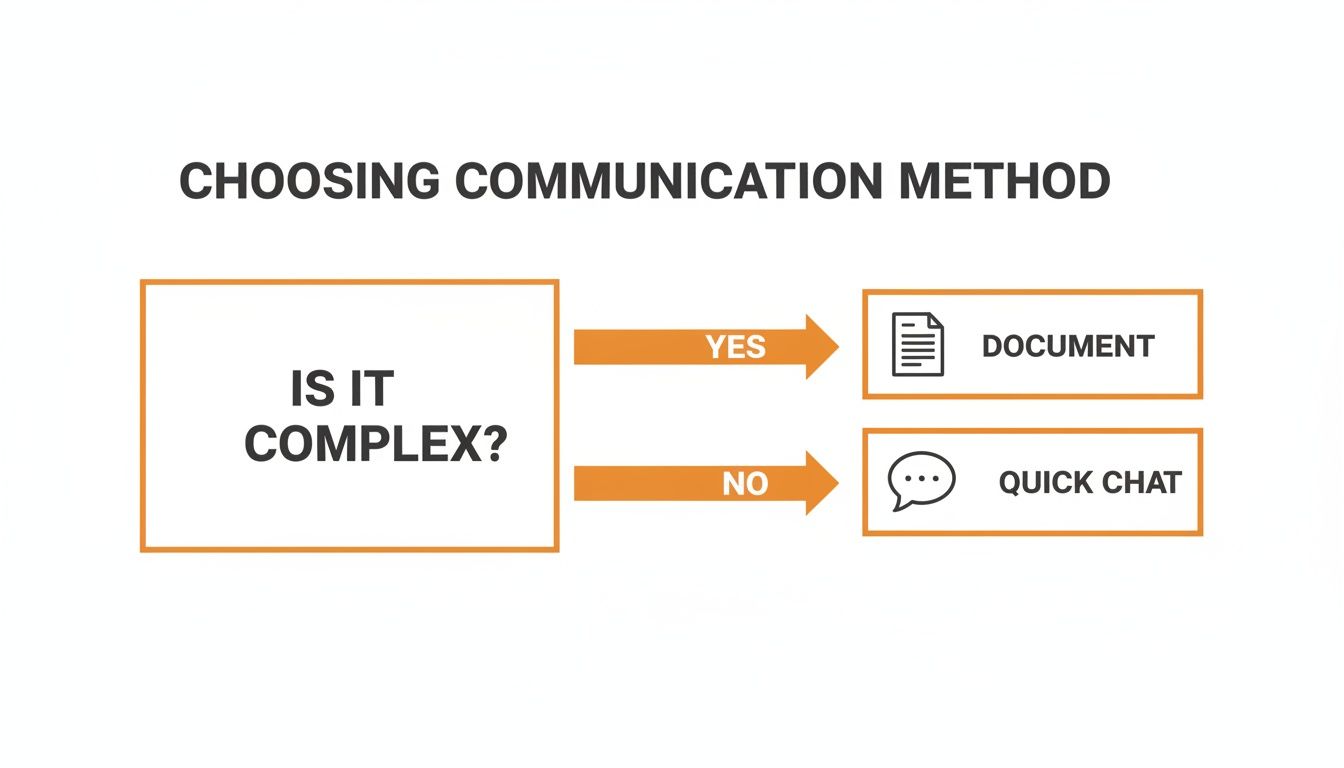
This makes it clear: complex or high-stakes topics need the staying power of writing, while simple, low-stakes issues are perfect for a quick chat.
Creating Intentional Workflows
This isn’t just theory; it’s about building a practical system. Start by mapping out your critical workflows—project management, customer support, daily shift handoffs. For each step, ask a simple question: What form of communication serves this moment best?
The point is to build a culture where the tools serve the people, not the other way around. Communication should feel like a well-designed system, not a constant fire drill.
By being intentional about which of the three forms of communication you use, you start to replace noise with clarity. You build a calmer, more organized, and more effective company where people can finally get back to doing their actual work.
Moving From Noise To Connection
In the end, this isn't really about picking the right channel. It's about something more fundamental: building trust, getting everyone on the same page, and creating a shared sense of purpose.
Clear communication bridges gaps and turns noise into connection.
When we get this right, it's about more than efficiency. We start to transform our company culture. Frontline workers feel connected to the mission. Remote employees feel like part of the team, not just a face on a screen. And leaders get a real pulse on how their people are actually doing.
The benefits aren't subtle. We see fewer misunderstandings, which can slash retraining time by as much as 30%. We see decisions get made faster because everyone has the context they need.
This isn’t about downloading another app or jumping on the latest trend. It's a foundational change in how we talk to each other. It’s choosing clarity over complexity and being intentional instead of just reacting.
Creating A Shared Language
So, where do we start? We begin by simply putting a name to what’s happening in our conversations.
Think of a daily huddle like a well-choreographed dance. Every piece—the tone of voice, the body language, the written summary that follows—is a deliberate move. When done right, the three forms of communication work together to create flow, not friction. This means actively listening for what isn't being said and checking that the written follow-up matches the conversation.
Little by little, your teams start speaking with one voice.
Alignment happens when everyone agrees on both the content and the context.
Building this shared language might look like:
Holding training sessions where teams role-play difficult conversations.
Using a tool like Pebb to tag different types of messages and see what's actually getting traction.
Mixing quick chats with clear, written summaries so nothing falls through the cracks.
Measuring What Matters and Making It Better
Next, we have to see if any of this is working. We can track metrics like message open rates or response times. But more importantly, we need to ask our people: do you feel more connected and informed?
You can dive into a tool's analytics to spot communication gaps in real time. From there, it's all about adjusting your approach based on what you learn. This is a continuous loop, not a one-and-done project.
Ultimately, moving from noise to connection is a journey. It requires curiosity, humility, and the willingness to keep tweaking things. Master the three forms of communication, and you'll build a workplace where clarity helps people do their best work, instead of getting in their way.
With a tool like Pebb, your teams can use real data to refine every conversation, turning clear communication from a goal into a daily habit.
Got Questions? We've Got Answers.
When teams get serious about improving how they communicate, a few questions always pop up. Here are the ones we hear most, along with our straight-up advice.
Which form of communication is most critical for frontline teams?
Honestly, that’s a trick question. There’s no single "best" form—it's all about using the right tool for the job.
If there's an urgent safety issue on the shop floor, nothing beats clear, direct verbal communication. But when you're sharing the new weekly schedule or a policy update, you need solid written communication to create a single source of truth.
And never underestimate nonverbal cues. A manager who can spot the signs of burnout just by looking at their team is invaluable. The real magic is weaving all three together.
How can we escape the nightmare of endless email chains?
Stop treating your inbox like a project management tool. It wasn't built for that.
The simplest fix is to move specific conversations into dedicated channels. Instead of a messy email thread about a new procedure, create a central place where all the relevant messages, documents, and updates live together.
When you give conversations a home, you get rid of the chaos. Information becomes organized, easy to find, and everyone is on the same page.
This one shift—from email chaos to organized channels—is one of the fastest ways to bring clarity back to your team's day.
How can you tell if your communication strategy is actually working?
Look for the signs, both in the data and in your people. You can track metrics like open rates and engagement. That's a great start.
But the real proof is on the floor. Talk to your employees. Are they less confused? Are projects getting done with fewer hitches?
Ultimately, the best signs are tied to your business goals. When you see a drop in mistakes, higher morale, and people choosing to stay with your company longer, you know you're doing something right. That’s when communication stops being a problem and starts becoming your greatest asset.
Ready to build a calmer, more connected workplace? Pebb brings all three forms of communication together in one simple tool, helping your team move from noise to real connection. See how Pebb works.
