
How to Improve Communication Skills in the Workplace
Learn how to improve communication skills in the workplace with practical advice on listening, clarity, and feedback that builds trust and boosts productivity.
Dan Robin
If you want to improve communication at work, you have to start by seeing what’s actually broken. Forget the generic tips. The real goal is to build clarity and trust. This isn't about a workshop or a new policy. It's about small, consistent habits: listening intently, speaking plainly, and giving feedback that helps instead of hurts. That's it.
Let's get real about workplace communication
We’ve all been in that meeting. The one that goes in circles and ends with more questions than answers. Or read that email, a masterpiece of confusion that requires three follow-ups to decode. These aren't isolated incidents. They're symptoms of a deeper problem.
The usual advice to "communicate better" is useless because it’s not a plan. Real improvement isn't about more meetings or slicker jargon. It's about making things clear.
Honestly, the biggest breakdowns happen in the small, unsaid moments. The hesitant question someone was afraid to ask. An assumption that quietly snowballs into a full-blown crisis. Great communication happens when people feel safe enough to be direct. I've seen it time and again.

This isn’t just a feeling; there's a real cost. A shocking 86% of employees and executives blame ineffective collaboration for failures at work. On the flip side, a report on communication statistics shows that teams with strong communication see productivity jump by up to 25%. When you see the numbers, it's hard to ignore.
Why the usual advice falls short
Most articles serve up a laundry list of disconnected tips. Make more eye contact. Have an "open-door policy." They miss the point entirely. The problem isn’t a shortage of tips; it's the lack of a coherent philosophy.
The goal isn't just to talk more. It's to understand more. The best communicators I know are masters of clarity and brevity. They respect your time by getting straight to the point.
This guide is different. It’s built on what actually works. And it starts with the most critical step: diagnosing what’s really wrong. Before we can fix anything, we have to recognize the symptoms.
Sound familiar?
Endless Meetings: Discussions wander aimlessly and end without clear next steps.
Email Overload: Simple questions explode into convoluted chains that are impossible to follow.
Recurring Mistakes: The same errors keep popping up, no matter who’s on the project.
Low Morale: People seem checked out, hesitant to share ideas, or quick to point fingers.
Let’s be honest about the gap between where most teams are and where they could be.
The shift from poor to powerful communication
Here’s a quick look at the difference between common communication pitfalls and effective habits.
Common Pitfall | Effective Habit | Why It Matters |
|---|---|---|
Vague Feedback: "This needs more work." | Specific Feedback: "The intro is solid, but the conclusion needs a stronger call to action." | Specificity gives people a clear path forward instead of leaving them guessing. |
Assuming Understanding: Rushing through explanations without checking in. | Confirming Clarity: "Does that make sense? What questions do you have?" | This simple check prevents small misunderstandings from becoming big problems. |
Email for Everything: Using long emails for complex or sensitive topics. | Choosing the Right Tool: A quick call for urgent issues; a shared doc for collaborative feedback. | The right tool makes communication faster, clearer, and more efficient. |
Talking at People: Dominating conversations, just waiting for a turn to speak. | Active Listening: Paraphrasing what you heard to confirm you understood. | It shows respect and ensures everyone is actually on the same page. |
Moving from the left column to the right isn’t about a massive overhaul. It’s about small, intentional choices. And while direct communication is key, how you present yourself also shapes how your message lands. Thinking about building a strong personal brand can lend your words more weight. But it all starts with a commitment to clarity.
Let's move past the buzzwords and get to what works.
The underrated power of listening
When we think about communication, we focus on what we're going to say next. We craft our arguments, polish our talking points, and wait for a pause to jump in. But the most powerful communication skill has nothing to do with talking.
It’s listening.
Not just being quiet while someone else speaks. I’m talking about active listening—the deliberate effort to understand where the other person is coming from before you even think about your response. It’s driven by curiosity, not courtesy. Think about the last time someone made you feel genuinely heard. It built a level of trust that stuck with you, didn't it?

This isn't a soft skill. It's a strategic tool. When you really listen, you gather vital information. You pick up on the why behind a request, notice the hesitation in a teammate’s voice, or find the real roadblock holding up a project.
From hearing to understanding
How do you make the leap from just hearing words to understanding the message? It starts with a mental shift. Your goal isn't to reply; it's to comprehend. One of the most effective ways to do this is something I call the "playback" method.
It's simple. After someone shares an idea, summarize what you heard back to them in your own words.
Then, you ask one critical question: "Did I get that right?"
It feels a bit strange at first, but the results are immediate. You aren't just confirming you heard them; you're confirming you understood their meaning. This one habit can prevent a major misunderstanding before it starts, saving hours of frustration down the road.
When you make employees feel heard, you build the foundation of a healthy workplace. It all starts with genuine attentiveness.
Putting it into practice
Listening is a muscle. It gets stronger with practice. Start with small, consistent exercises.
Here are a few things to try this week:
In your next one-on-one: Before jumping in with advice, ask at least two clarifying questions. "Could you walk me through that again?" or "What's the biggest hurdle here?" These force you to dig deeper.
During a team meeting: When a colleague is speaking, hit the pause button on your own internal monologue. Don't prepare your counter-argument. Just focus on their point of view. You’ll be amazed at what you notice.
The point is to move your default setting from "broadcast" to "receive." When you make that shift, you start solving problems you didn't even know you had.
Speak with clarity, not complexity
Our offices are drowning in jargon. We “leverage synergies” and “operationalize learnings” until the original meaning is lost in a fog of corporate-speak. This language doesn't make us sound smart. It builds a wall between us and the person we're trying to reach.
Let's be honest, it's often a defense mechanism. We use complicated words to sound important, or maybe to mask that we aren't entirely sure what we're saying. But the goal of communication isn't to impress; it's to be understood.
Ditch the jargon, respect their time
The most confident thinkers I know are almost always the clearest communicators. They have the courage to make their ideas simple because they've done the hard work of thinking them through. This isn’t about “dumbing things down.” It’s about respecting people’s time.
Instead of this:
"We need to leverage our core competencies to optimize our strategic outcomes and drive growth."
Try this:
"Let's use our strengths to hit our targets and grow the business."
One is a word puzzle. The other is a clear instruction. The second version invites collaboration because everyone immediately understands the goal.
When your message is clear, you’re not just sharing information; you’re building confidence. People trust what they can understand.
This applies everywhere. In an email, swap a vague subject like "Update" for "Draft of Q3 Report Attached for Review." It’s a small change that saves the recipient time and sets clear expectations. The same goes for meetings. A clear agenda is far more valuable than an hour of meandering discussion.
Beyond simplifying your words, how you deliver them matters. It's worth learning how to enunciate better and speak with clarity to make sure your message lands.
Ultimately, a commitment to clarity is a commitment to better teamwork. It removes the friction of misunderstanding and lets everyone focus on the real work.
Giving feedback that actually helps
Let’s be real: feedback is a mess at most companies. We’ve all been on the receiving end of the awkward “compliment sandwich,” where criticism is crammed between two pieces of fluffy praise. It doesn’t work. It just leaves you feeling confused.
Then there’s the other extreme: blunt critiques that create resentment and put people on the defensive. The goal of good feedback isn't to judge a person; it's to improve the work. It has to be both direct and kind.
This isn’t just about being nice. A recent McKinsey study found that when employees feel their voice is heard, they are five times more likely to report being productive. A healthy feedback culture doesn't just feel better—it drives better performance.
A better way to frame feedback
The trick is to make feedback specific, actionable, and tied to a shared goal. Pull personal judgment out of it. Focus on the work. Shift from accusation to collaboration.
Instead of a vague jab like:
"Your presentation was confusing."
Try reframing it as a shared problem:
"Could we look at slide three? I'm having a hard time connecting the data back to our main goal. I want to make sure I'm following."
See the difference? This opens a conversation instead of shutting one down. It makes the other person a partner in finding a solution, not the problem itself. For more on this, this complete guide to employee feedback is a great resource.
Learning how to receive it
Giving feedback is only half the battle. Learning how to receive it without getting defensive is just as critical. Our first instinct is to protect our ego, but that just closes us off from a chance to get better.
The real skill is listening for the useful nugget, even if the delivery isn't perfect. Separate the message from the messenger.
When someone gives you feedback, resist the urge to immediately explain yourself. Instead, get curious. Ask questions. "Can you give me an example?" or "What would have been more helpful?" These questions turn a tense moment into a genuine learning opportunity. It’s about mining for value, not defending your turf.
Choosing the right tool for the job
We're swimming in communication tools. Slack, email, video calls, shared docs—the options are endless. And yet, we're constantly picking the wrong one, creating a massive drain on everyone’s focus.
Think about it. A sensitive review flattened into a cold Slack message. A simple question that balloons into a 30-minute meeting for five people. This isn't just inefficient; it’s one of the biggest sources of misunderstanding in modern work.
The explosion of tools like Slack, which saw its user base jump an incredible 346% from 2019 to 2024, proves how much we rely on these platforms. But with about a third of workers unhappy with their current tools, it’s clear the problem isn't the technology. It’s how we use it.
Matching the medium to the message
The fix isn’t a complicated rulebook. It's about being more thoughtful. A small shift here can free up hours in your week.
Here’s a simple mental model I use:
Asynchronous (Email, Slack, Shared Docs): Use these for announcements, status updates, and questions that aren't on fire. They're perfect when you don't need an immediate back-and-forth. It’s a way of respecting everyone’s focus.
Synchronous (Video Calls, In-Person Meetings): Save this precious time for the heavy lifting—complex problem-solving, sensitive conversations, or real brainstorming. You need these when tone and body language are critical.
Picking the right tool is a core skill. Our guide on internal communication channels goes deeper on how to make these choices strategically.
The goal is to make every interaction count. If a meeting could have been an email, you've not only wasted time but also chipped away at your team's focus.
Before you send that meeting invite, pause. Ask yourself: "Does this truly need a real-time conversation?" If the answer is no, a well-crafted message will almost always be the better choice.
This simple decision tree is a great way to visualize the thought process, especially for giving feedback.
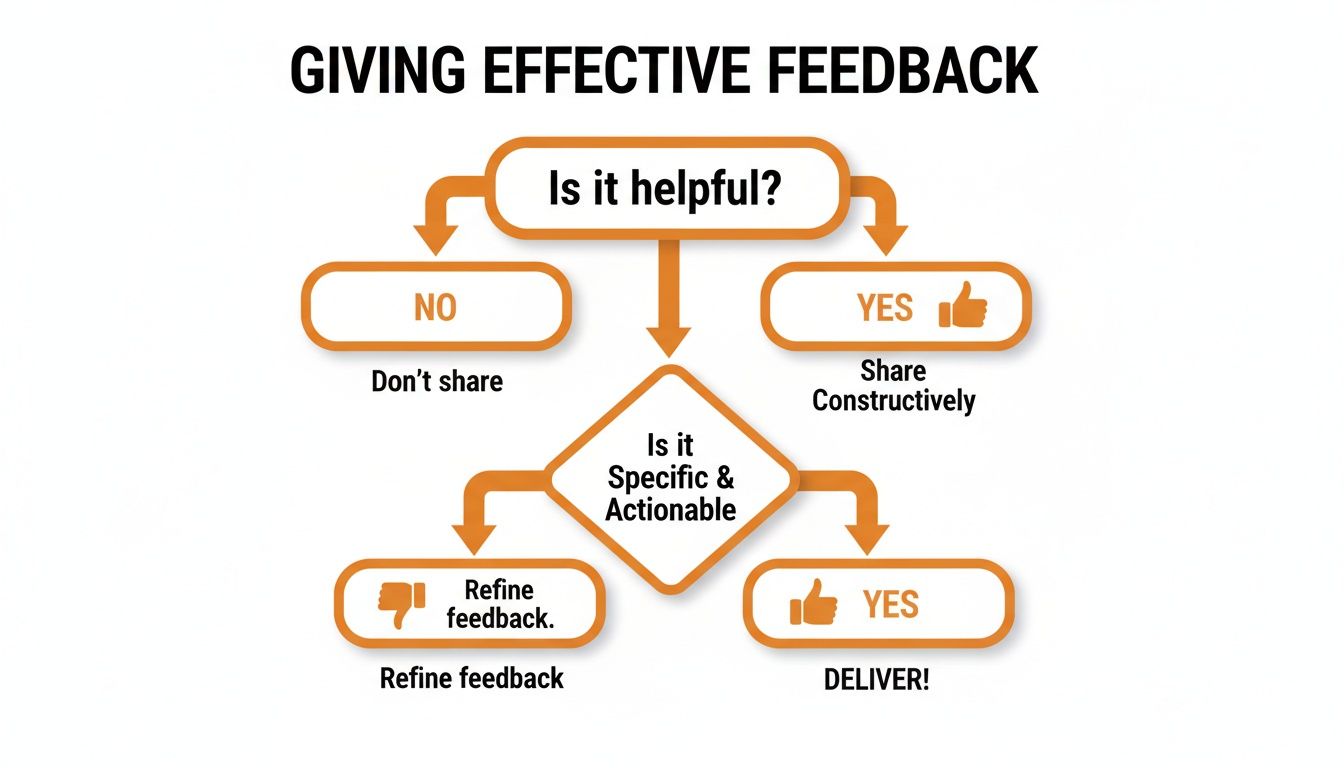
What I love about this is how it reinforces that intent—is it helpful?—is the first and most important filter.
Being intentional about your tools isn't about adding complexity. It's about removing it. It’s a simple act of respect for your colleagues’ time, and it pays you back tenfold in clarity.
Turning these ideas into daily habits
Knowing what to do isn’t the same as doing it. I’ve seen countless teams get fired up after a workshop, only to slide back into the same old routines a week later. Lasting improvement isn't forged in a big event; it's forged in the small, consistent efforts we make every day.
The real work is quiet. It’s having the courage to be the one person in a meeting who asks for clarification when everyone else is nodding along. It’s taking an extra two minutes to simplify an email so your team doesn't waste ten decoding it.
The power of one small change
Trying to overhaul everything at once is a recipe for disaster. You’ll get overwhelmed and give up. The most effective approach I’ve seen is focusing on one thing at a time. Build a single, durable habit before moving on.
The goal isn’t perfection; it’s momentum. It’s about making things a little clearer and a little more human, one conversation at a time.
Think about the compounding effect. A clearer project brief this week prevents a major misunderstanding next week. A moment of active listening today builds the trust you'll need for a tough conversation next month. These small acts are the foundation of a healthier culture.
So, instead of a tidy summary, here’s a challenge:
Pick one single idea from this guide. Just one. Maybe it’s the "playback" listening method, or cutting jargon from your emails.
Commit to practicing only that one thing for a week. Don't worry about anything else. Just focus on that single habit.
Notice what changes. Pay attention to how others react, and how it feels for you.
This is how you truly improve communication skills in the workplace—not by memorizing rules, but by choosing to be a little more intentional, starting now.
Frequently Asked Questions
People often ask for a silver bullet to fix communication, but it’s more about mindset than a single technique. It’s about being intentional. Here are a few common questions we hear.
Where should I start improving my communication?
Start with active listening. Before you obsess over your presentation skills or how you write emails, just focus on truly hearing what others are saying. It feels small, but it's the foundation for everything else. Ask clarifying questions. Summarize what you heard. When you understand your audience on a deeper level, your own message becomes sharper.
How can I encourage my team to communicate better?
Lead by example. You can't just send a memo about "better communication." If you want more direct feedback, be the first to ask for it—and then receive it gracefully, without getting defensive. If you want clearer emails, yours have to be models of clarity. When someone takes a risk—like speaking up with a dissenting opinion—thank them for it. Your reaction sets the tone for everyone else.
What are employers actually looking for?
They're crystal clear on this. A recent survey showed that 57% of global employers see communication as the most critical skill for new hires. They aren't looking for vague "good communicators." A deeper look at workplace communication trends shows they want:
Verbal communication (55%)
Presentation skills (47%)
Active listening (36%)
These are the areas to focus on for real career growth. Ultimately, improving communication isn’t a one-time project. It’s a continuous practice of being a little more thoughtful, one interaction at a time.
Ready to bring all your workplace communication into one place? With Pebb, you can connect your entire team, centralize information, and build a culture of clarity and engagement. See how it works at https://pebb.io.
