Why Your Team Needs an Internal Communication Platform
Discover how internal communication platforms can replace chaos with clarity, boost engagement, and create a calmer, more productive workplace.
Dan Robin

Think about how your team talks right now. Important announcements get buried in email chains. Project updates are lost in a river of chat messages. Nobody knows where to find the latest version of that critical document.
We’ve all lived this. It’s the constant, low-grade anxiety that you might have missed something.
That feeling isn’t just an annoyance; it’s a silent killer of productivity. The endless searching, the constant app-switching—it’s a tax on your team’s focus. When people spend their day just trying to keep up, they have less energy for the work that actually matters.

This isn't another guide about the latest app trend. It’s an honest look at why the old way of communicating is holding us back.
When Communication Becomes Clutter
The real problem is fragmentation. We’ve scattered our company’s brain across a dozen different places. Company news is here, project files are there, and team chats are somewhere else entirely. This creates a hidden “information tax” that everyone pays with their time.
Departments work in bubbles. Collaboration feels like pulling teeth. You get multiple versions of the same document floating around, or worse, teams working from outdated information. It’s a recipe for rework and frustration.
The business impact is real. This isn't just an operational headache; it's a cultural one that slowly erodes your company's foundation. For a deeper look at how these inefficiencies push great people out the door, check out this article on The Productivity Paradox.
Here’s the simple truth: when people have one place to find what they need, they do better work. It’s that straightforward.
This is why modern internal communication platforms aren't a luxury anymore. They’re essential for building a focused, connected, and frankly, calmer company. By creating one central place for everything—updates, projects, and culture—you cut through the noise.
This does more than organize things. It builds trust.
It means a new hire can find their onboarding guide without asking five different people. It means a frontline worker gets the same critical safety update as the CEO, instantly. It’s about giving your people back their two most valuable resources: their time and their attention.
What Are Internal Communication Platforms, Really?
The term “internal communication platform” gets thrown around a lot. It’s a catch-all for everything from a chat app to that ancient company intranet nobody’s logged into since 2012. Let’s cut the jargon.
Think of it less as a tool and more as your company’s central nervous system. It’s the digital town square—the one place for official announcements, deep work, and real water-cooler conversations.
Most importantly, a true platform is the single source of truth. It guarantees a frontline worker in a warehouse and a software engineer working from home get the same critical update at the exact same time. No more broken games of telephone. No more, "Wait, I never saw that email."
More Than Just a Chat App
Let’s be honest. A never-ending stream of instant messages isn't a communication strategy. It's a direct flight to burnout. While chat is fine for quick pings, it’s a black hole for important information. Need to find something from last Tuesday? Good luck.
A real internal communication platform is built with intention. It creates separate, dedicated spaces for different kinds of conversations.
Broadcasts: For the big, must-read company news that can't be missed.
Team Channels: For the focused, back-and-forth work on specific projects.
Knowledge Hubs: A permanent, searchable home for company policies, how-to guides, and all that essential stuff people are always asking for.
This separation is what makes all the difference. It takes the chaotic mess of emails and DMs and replaces it with one calm, organized place. It respects everyone’s time. It lets them tune in to what matters. You can learn more about how the right internal communication software can improve business efficiency and give people their focus back.
The Shift to a Central Hub
The idea is simple: stop scattering your company’s knowledge to the wind. Bring it all together. When your entire company operates from a single hub, good things happen. Onboarding gets easier because new hires can actually find what they need. Collaboration clicks into place because teams aren't wasting hours hunting for files.
This isn’t just about convenience. It’s a reflection of how we all work now. With so many teams working remotely or in hybrid setups, a digital headquarters is the foundation of a connected company.
The real purpose of an internal communication platform isn't just to pass information around. It’s to build a shared understanding and a sense of belonging, no matter where your people are.
The market shows how critical this is. The global internal communications software market was valued at USD 2.65 billion in 2024 and is on track to hit USD 7.21 billion by 2031. That growth isn’t a tech trend; it’s businesses finally realizing that fragmented communication is a huge, hidden cost they can no longer afford.
When it comes down to it, these platforms bring clarity. They answer the three questions every employee has: What do I need to know? What do I need to do? And do I belong here? When a single tool can answer all three, you’ve found something special.
The Few Features That Genuinely Matter
It’s easy to get dazzled during a product demo. Flashy dashboards, massive GIF libraries, AI-powered sentiment analysis. It all looks cool. But here’s the truth: most of it is a distraction from the real problems you’re trying to solve.
A fun emoji reaction won't fix a broken information flow. A colorful chart doesn't help a new hire find the benefits guide. After years in this space, we've learned that the best internal communication platforms aren't the ones that do everything. They're the ones that do a few essential things exceptionally well.
Let's cut through the noise. When you're looking at these tools, focus on the capabilities that deliver real value. Everything else is window dressing.
A Central Hub for Knowledge
The first non-negotiable is a central, searchable home for important information. I’m talking about a permanent place for company policies, project briefs, and key documents. This isn't about storage; it's about retrieval.
When an employee has a question, their first instinct shouldn't be to interrupt a coworker. It should be to search the hub. If the answer is right there—instantly findable—you’ve just saved everyone time and mental energy. This single feature eliminates countless wasted hours and the daily frustration of hunting through old emails.
A single source of truth is the foundation of a calm company. It replaces shoulder taps and frantic messages with quiet confidence.
This is where you see the core functions that make a real difference: a central hub for knowledge, a single source for official news, and a unified space for all your people to connect.
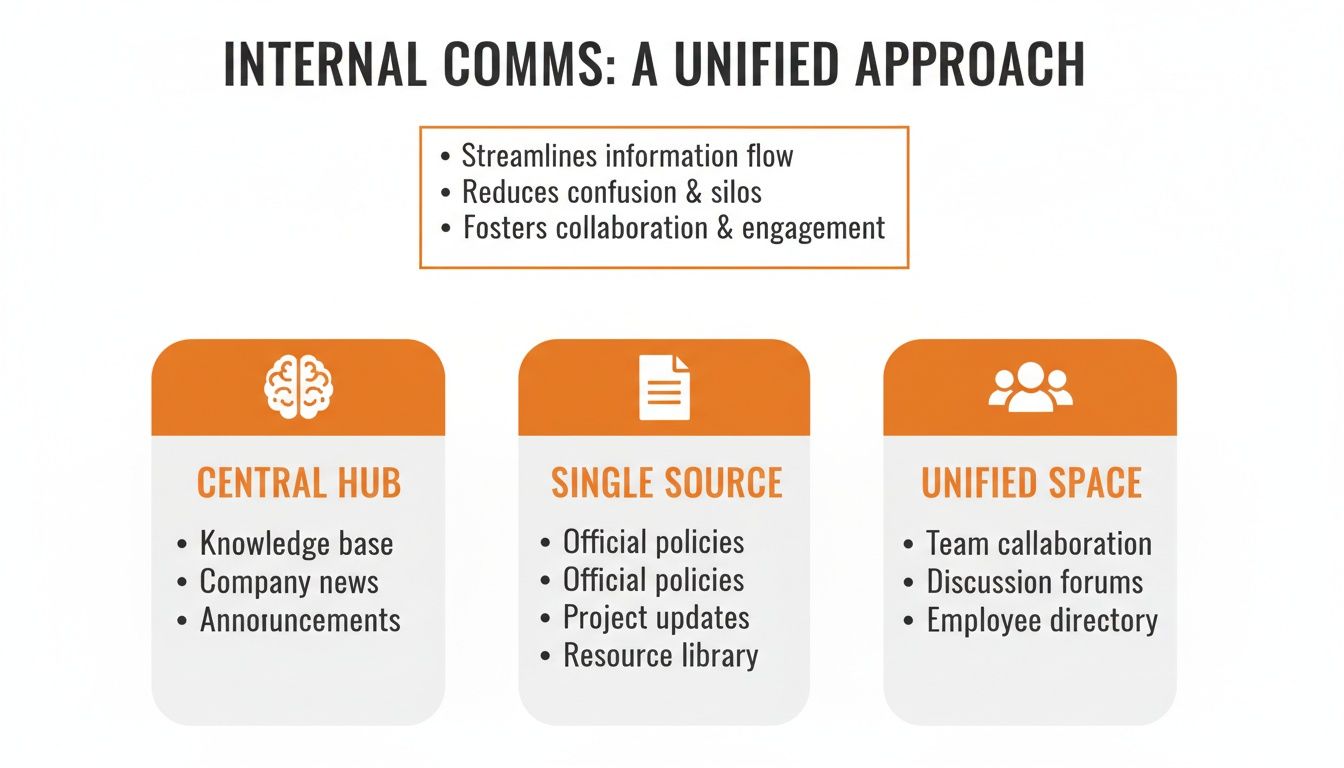
This simple breakdown shows how these three critical parts come together to create an effective communication system.
Clear Lanes for Communication
The second critical feature is creating distinct channels for different kinds of talk. A huge mistake is dumping everything—urgent announcements, project work, and casual chatter—into one chaotic feed. That’s just a prettier version of the overflowing inbox we’re all trying to escape.
A thoughtful platform separates the signal from the noise. It needs:
A Broadcast Channel: The modern company bulletin board. It’s a one-way street for official, must-read announcements. Making it read-only for most people ensures critical messages never get buried.
Team and Project Spaces: The digital workshops where work gets done. These are dedicated areas for collaboration, file sharing, and focused discussion.
Social Channels: Where company culture comes to life. An optional space for informal chats and personal connections that make work feel human.
By creating these lanes, you give people control over their attention. They know where to look for important news and where to go to focus, without being constantly pulled away by irrelevant noise.
Integrations That Actually Help
Finally, the platform must play well with the tools your team already uses. Seamless integration isn't just a technical checkbox; it's about reducing friction. If your team has to constantly switch between your communication hub, their project management tool, and their calendar, you haven't solved anything.
But be careful here. Don't be wowed by a logo wall of 500+ integrations. Focus on the handful that matter to your daily work. Does it connect to your shared calendar? Can you get notifications from your core work software right inside the platform? The goal is to make it a central command center, not just another app to check.
To help you sift through the marketing fluff, the table below separates the must-haves from the nice-to-haves.
Core Platform Capabilities Versus Nice-to-Haves
Feature Category | Essential Capability (Why It Matters) | Nice-to-Have (But Not a Dealbreaker) |
|---|---|---|
Knowledge Management | A powerful, intuitive search function that finds documents, posts, and answers instantly. | AI-powered content suggestions or automated tagging. |
Communication Channels | Ability to create distinct, targeted channels (e.g., read-only, team-specific, social). | Gamification features like points, badges, or leaderboards. |
Mobile Access | A fully functional, user-friendly native mobile app for both iOS and Android. | Advanced push notification customization options. |
Integrations | Deep, two-way integrations with core business systems (e.g., HRIS, calendar, project tools). | A massive library of integrations for niche, rarely used apps. |
User Experience | Clean, simple, and intuitive interface that requires minimal training for employees. | The ability to create custom themes, colors, and branding. |
This isn't about finding the platform with the most features. It's about finding the one with the right features, implemented with genuine care.
When you're evaluating platforms, constantly ask yourself if a feature solves a real, recurring pain point for your team. For a more detailed look, our guide on the top 10 features every employee communication app should have offers a practical checklist to keep you focused on what truly counts.
Connecting Your Desk and Frontline Workers
Let's talk about the secret of most internal communication platforms. They’re built for people who sit at desks. They’re designed for a world of dual monitors and ergonomic keyboards. But that’s just a sliver of the actual workforce.
What about your people on the factory floor? The retail associate helping a customer? The technician on a service call? These frontline workers make up the vast majority of employees, and frankly, they've been left out of the digital conversation.
I once worked with a manufacturing company that was a perfect example. In the main office, engineers debated product specs in a slick chat app. Walk a hundred feet to the plant floor, and managers were still taping printed notices to a bulletin board. It was like two different companies under one roof.

This isn’t just inefficient—it’s dangerous. It creates a massive information gap. One part of the company moves at the speed of light while the other is stuck in the dark. That’s how costly mistakes happen, how safety protocols get missed, and how a toxic "us versus them" culture starts to grow.
The Mobile-First Imperative
Let's be real. The solution isn't to hand every warehouse worker a laptop. The answer is to meet them where they already are: on their phones. A truly modern platform has to be built with a mobile-first mindset. It can’t be a clunky app tacked on as an afterthought.
This means more than a screen that resizes. It means an interface so simple someone can get an update with a quick glance during a coffee break. It means notifications that are smart, not a constant firehose of noise. To effectively connect everyone, mobile devices are essential, turning personal phones into powerful work tools. You can even find great guides on making your iPhone a business and job platform.
The giants of the desk-worker world, like Microsoft Teams and Slack, have proven the model. Teams, for example, hit 320 million monthly active users by 2024. But the execution has to break out of the office walls.
One Company, One Conversation
The goal is simple but profound: one company, one conversation. It means a CEO’s message should hit a delivery driver and a marketing manager at the exact same time, in a format that makes sense for them.
This is all about a few core ideas:
Targeted Announcements: You need the ability to send messages to specific roles or locations. A forklift operator in Dallas doesn’t need a memo about the London office's holiday party. It's just noise.
Simple Interfaces: Frontline workers don’t have time for complex menus. The experience has to feel as easy as scrolling social media.
Accessibility for All: Information needs to be easy to consume, whether that’s through short text, images, or quick video messages.
The right platform doesn't just send messages. It erases the invisible line between the office and the field, making everyone feel like they're on the same team.
Ultimately, bridging this divide isn't a technical challenge—it's a cultural one. Choosing a platform is your chance to declare that every single employee, regardless of their title, is a vital part of the story.
How to Choose the Right Platform Without Losing Your Mind
Shopping for a new internal communication platform can feel overwhelming. You're juggling demos, fielding calls from salespeople, and trying to make sense of presentations packed with features that promise the moon. It's exhausting.
Let’s try a calmer way. The secret isn't getting mesmerized by shiny features. It’s about starting with a simple, honest look at your own company’s problems.
Before you book a demo, get your team in a room. Ask some blunt questions. What is actually broken in how we communicate? Where are the bottlenecks? Who is consistently being left out of the loop?
Start with Your Problems, Not Their Features
The perfect platform is the one that solves your most persistent headaches. Don't start by asking, “Does this tool have AI analytics?” Instead, ask, “Can this tool make it easy for our night shift to see a schedule change before they leave for work?”
That’s a real problem. A GIF library is not.
Build a simple checklist based on what’s truly broken in your organization. This reframes the entire process. You stop feature-shopping and start problem-solving. It’s a subtle shift, but it makes all the difference.
The Things That Truly Matter in a Platform
Once you’re clear on your problems, you can start looking at tools. But again, don't get lost in the weeds. A few fundamentals will have a much bigger impact than a dozen flimsy features.
After helping hundreds of companies through this, here are the things we’ve learned to focus on:
Implementation and Support: How much help will you get setting this thing up? A brilliant tool with terrible onboarding is just an expensive line item on your budget. You want a partner, not just a vendor.
Security and Reliability: This is non-negotiable. The platform will house sensitive information, so it has to be secure and dependable. Ask the tough questions about their security protocols and uptime history.
The User Experience (UX): This might be the most important factor. Is the platform genuinely simple to use? If it feels clunky during a 30-minute demo, imagine how it will feel to your busiest employees who have 30 seconds between tasks.
The best platform isn’t the one with the most features. It’s the one your team will actually want to use. Simplicity always wins.
Investing in a modern platform is more than a software purchase; it's a strategic business decision. The data backs this up. A full 67% of organizations that increase their investment in these tools see market share growth. This shows how modern platforms help companies leave legacy systems behind and achieve better business outcomes. You can learn more about how the right tech doubles the rate of excellent communication by reading the full research on the state of internal comms.
Always Run a Small Pilot Program First
Finally, and this is a big one: never commit your whole company to a new platform without testing it first. The best way to know if a tool is the right fit is to run a small, focused pilot program.
Pick a single department or a cross-functional team of 20-30 people. Give them the platform and a few clear goals to achieve over a month. When it’s over, don’t just send a survey. Sit down with them and have a real conversation.
What did they love? What drove them crazy? Did it make their work easier? Their honest, unfiltered feedback is worth more than any sales pitch. It's the only way to choose with confidence.
A Tool Can Amplify Culture, It Can’t Create It
Here’s the plain truth: the world’s best internal communication platform will not fix a toxic culture. But the right one can help build a better one.
Let’s be honest about what software really is. It’s an amplifier. It takes whatever is already happening in your company and makes it louder and more visible.

If your leadership team is transparent and trusts its people, a good platform will amplify that trust. But if your culture is built on information hoarding, a new tool will just give you more organized silos.
The Human Side of the Technology
It’s easy to get lost in the technical details—the features, the integrations, the security. But as we wrap up, it’s critical to remember the human side of this. Because that’s what this is really about.
The goal isn't just to move information faster. That’s a byproduct.
The real purpose is to create a digital space where people feel seen, heard, and connected to something bigger than their to-do list. It’s about building a shared sense of purpose. When someone from accounting can see a photo of a new store opening and feel a genuine sense of pride, you’ve done something special.
A platform is a place. The culture is what happens inside that place. You can build a beautiful town square, but you can’t force people to have meaningful conversations in it.
This is why choosing one of these platforms is so much more than a software purchase. It’s a chance to be intentional about the kind of company you want to become.
A Reflection of Your Company’s Soul
Every choice you make sends a message.
Choosing a mobile-first tool says, “Our frontline team is just as important as our office staff.”
Creating open channels for feedback says, “We genuinely want to hear what you think.”
Having leaders who actively participate says, “We’re all in this together.”
These aren’t small things. They are powerful signals that shape how people feel about their work. The technology simply provides the stage for these human interactions to play out.
The tool itself is neutral. It will faithfully reflect the culture you already have. So, the final question isn’t just about which platform to choose.
It’s about what kind of company you choose to be.
Got Questions? Let's Talk.
We hear from a lot of teams who are weighing their options, wondering if it’s worth changing how they communicate. Most questions circle back to a few key concerns. Let's tackle them.
Can’t We Just Get By with Email and Chat?
For a tiny team, maybe. For a little while. But as soon as you grow, that combination becomes a recipe for chaos.
Think about it. Email is a black hole where important information gets buried. Chat apps create a constant, buzzing sense of false urgency. It trains your whole team to be distracted. A dedicated internal communication platform offers a smarter way to work.
It gives you separate spaces for different conversations. You get a permanent home for deep work, an official channel for company news, and quick chats for day-to-day coordination. This simple structure helps everyone tune out the noise and focus on what matters.
How Do We Get Our Team to Actually Use a New Tool?
This is the big one. Adoption is everything. The secret is to solve a real, nagging pain point from day one.
Don't just launch a new tool and hope for the best. Launch it with a specific, high-value purpose. For example, make it the only place to find the weekly meeting notes or the one official channel for HR announcements. When people know it’s the single source of truth for something they need, they’ll show up.
The best tool is the one your team actually wants to use. If it’s simpler and more helpful than the old way, people will adopt it. It's that simple.
Make sure your leaders are active on the platform. When they use it consistently, it sends a powerful message. And above all, pick a tool that’s clean, intuitive, and works flawlessly on a phone.
What’s the Biggest Mistake We Should Avoid?
The single biggest mistake is treating this like an IT project instead of a people project. Just flipping a switch on the software and sending a mass email is a guaranteed way to fail. You can't just install a tool; you have to help people change their habits.
A successful launch needs a plan. You have to clearly explain the "why" behind the change. Show your team exactly how this new platform will make their work lives easier. Offer simple training and set clear expectations. This isn't about adding another piece of software; it's about helping everyone work in a calmer, more focused way.
Ready to bring clarity and connection to your team? See how Pebb can become your company’s calm, organized center for communication, culture, and collaboration. Start your free trial today.
