
The Sanity Guide to Attendance Tracking Apps
Ditch the broken timesheets. Learn how a modern attendance tracking app brings clarity to payroll, compliance, and team management. Your calm guide is here.
Dan Robin
We used to call it "doing payroll." In reality, it was a multi-day forensic investigation. A stack of paper timesheets would land on my desk, each one a puzzle of sloppy handwriting, missing signatures, and suspiciously round numbers. My real job was to lead a team, but for a few days a month, I was a detective, hunting down signatures and deciphering scribbles. It was a tedious, soul-sucking ritual.
And I know I'm not alone. This is the quiet chaos humming in the background of so many businesses. We accept manual timesheets as a cost of doing business, but they’re not just inefficient. They’re active thieves, stealing time, money, and morale.
Your Timesheet Is a Time Thief
It's easy to dismiss the problem as just a bit of paperwork. But let's be honest. It's a broken system.
The most obvious cost is the hours spent on mind-numbing admin. The American Payroll Association found that processing manual timecards can take up to seven minutes per employee, per pay period. For a team of 50, that’s nearly six hours of tedious data entry every couple of weeks. Six hours you could have spent mentoring a new hire, talking to a customer, or just thinking.
But that’s only half the story. The real damage is harder to see.
Human Error: We all make mistakes. A typo here, a miscalculation there. It seems small, but payroll errors can cost companies up to 8% of their annual payroll, according to industry reports. That's real money walking out the door because of a clumsy process.
Lost Productivity: Every minute a manager spends chasing a timesheet is a minute they aren’t leading. It’s a tax on their most valuable work.
Employee Frustration: Nobody likes filling out timesheets. They forget. They lose them. They try to reconstruct their week from memory. It’s a layer of friction that grinds people down over time.
This isn't just about swapping paper for an app. It's about deciding that your team's time—and your own—is too valuable to waste on a system that belongs in a museum. The goal is to get your sanity back, not just to move a spreadsheet online.
The paper timesheet, like the fax machine and the filing cabinet, was built for a different world. Today, it creates more problems than it solves. Switching to a modern attendance tracking app isn't a tech upgrade. It's a decision to stop the theft. It’s about taking your time back.
What a Modern Attendance App Actually Does
Let's be real. "Attendance tracking app" is a profoundly boring phrase. It sounds like a digital punch clock, which, while better than paper, misses the point entirely.
The best ones aren't just for logging hours. They’re the central nervous system for your team's day-to-day operations.
It starts with the basics, of course: mobile clock-in and clock-out. This is the foundation. It lets your team sign in from their own phones, whether they're on a job site, in a warehouse, or starting a shift at a coffee shop. No more lining up at a dusty terminal.
More Than Just a Punch Clock
But that's just the starting line. The real value is in the thoughtful features built on top.
Take geofencing. This isn't about playing Big Brother. It’s a quiet, automated way to ensure accuracy. It simply confirms an employee is at the right location when they clock in. It prevents accidental punches from home and saves managers from having to ask, "Hey, are you here yet?"
Sticking with old-school, manual timesheets creates more problems than you might think.
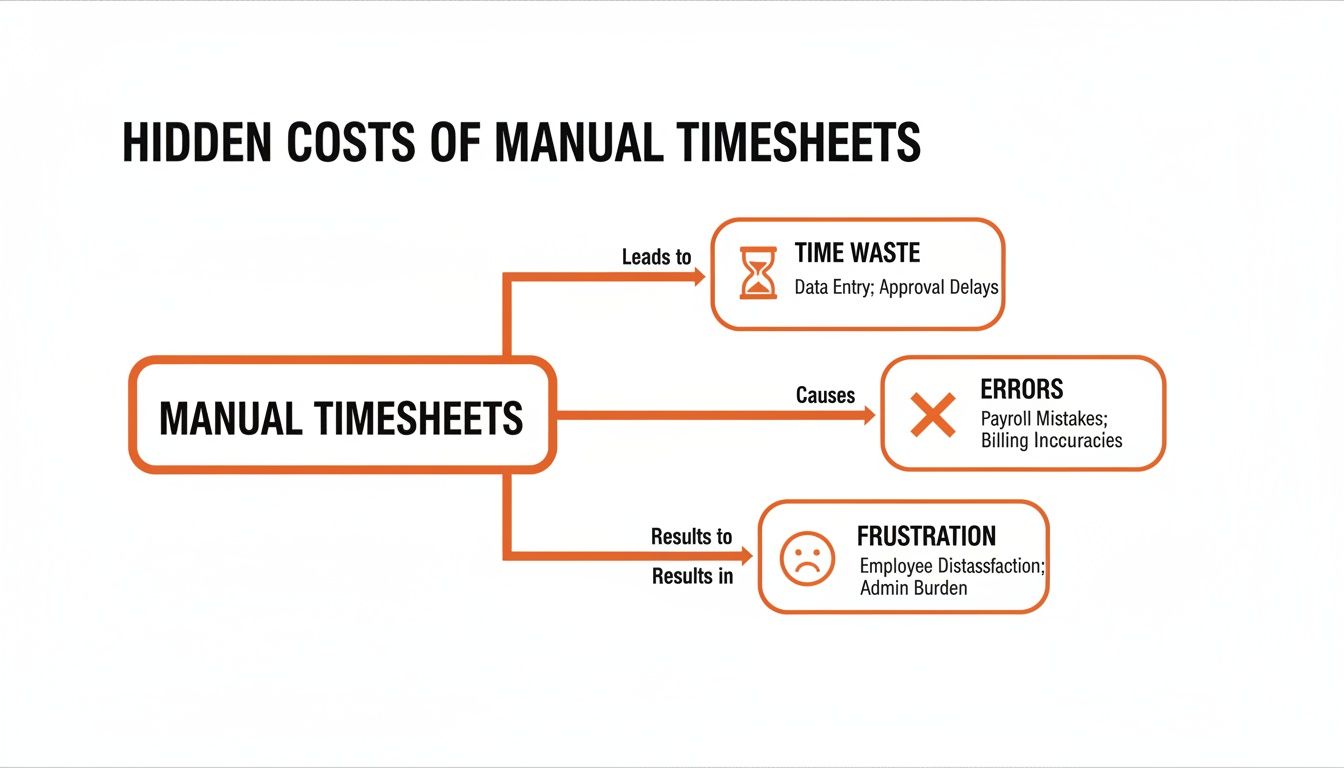
It’s easy to see how the administrative drain, payroll errors, and team frustration spiral into a cycle of inefficiency that costs a lot more than just time.
Then there’s Paid Time Off (PTO) management. For decades, this has been a messy tangle of emails, spreadsheets, and calendar invites. A good attendance app brings it all into one clean, simple place. Employees see their balances and request time off. Managers get a notification to approve it. Done.
A Single Source of Truth
The whole point is to create one calm place where time, schedules, and leave requests live together. When your attendance is connected to your schedule, a manager sees the entire week at a glance—who’s scheduled, who’s clocked in, and who’s on leave. This isn't a minor convenience. It fundamentally changes how you manage your team.
A modern attendance app answers three simple but critical questions: Who is here? Who is supposed to be here? And who is scheduled to be here later? When that information is instant and accurate, it frees up managers to actually manage.
This shift away from disconnected systems is why the time and attendance software market is projected to grow from USD 3.06 billion in 2024 to USD 5.58 billion by 2033. Leaders are realizing that as businesses grow, manual processes don't just slow you down; they break.
This table shows a clear picture of the shift from the frustrating old ways to a much smarter, modern approach.
From Manual Problems to Modern Solutions
The Old Way (The Problem) | The Modern App (The Solution) |
|---|---|
Paper timesheets or spreadsheets are prone to human error. | Automated clock-ins eliminate manual entry and reduce payroll mistakes. |
Managers spend hours manually verifying times and locations. | Geofencing and real-time alerts automate verification, saving hours. |
Time-off requests get lost in emails and calendars. | An integrated PTO system lets employees request and track leave easily. |
Schedules and attendance are in separate, conflicting systems. | A unified view shows who is working, who is scheduled, and who is off. |
Lack of real-time data makes it hard to manage staffing. | Instant insights help managers make smarter decisions on the fly. |
Employees feel a lack of transparency and fairness. | A clear, simple process builds trust and empowers the team. |
Moving to an integrated app replaces daily chaos with calm clarity.
A good attendance tracking app does more than record time. It provides clarity. It gives managers the real-time information they need to make smart decisions and frees them from chasing paperwork. For employees, it offers a fair, transparent way to manage their hours.
When you get this right, attendance tracking stops being a chore. It becomes an invisible, trusted part of the day. You can learn more about the different types of apps for attendance tracking in our detailed guide.
The Real Business Case Beyond Saving Time
Saving a few hours on admin is nice. But it's not the reason to change a core business process. The real power of an attendance tracking app isn't just speed. It's the crystal-clear picture you get from accurate data—and what that picture helps you do.
The most immediate payoff is payroll accuracy. Manual timesheets are a minefield of small errors, from innocent rounding to outright fudging. A few minutes here and there add up across an entire team. When your payroll is based on precise, automated data, you stop paying for time that wasn't worked. You also sidestep the compliance headaches that come from underpaying someone.
This isn’t just about the bottom line. It’s about trust. When the system is transparent and everyone knows their hours are exact, you remove a major source of workplace friction. A fair system is a consistent one.
From Reactive to Proactive Management
Here's where things get interesting. When your managers can stop putting out fires, they can start preventing them. With live attendance data, a retail manager can spot a staffing gap on the floor before it hurts the customer experience. A warehouse supervisor can see who's approaching overtime and adjust assignments on the fly, keeping costs in check.
This is the jump from managing a spreadsheet to leading a team. Instead of policing timecards, managers can spend their energy where it matters—coaching, mentoring, and supporting their people.
The goal isn't just to see who is late. It's to understand the rhythm of your operation. When you have clear data, you can spot patterns you would have otherwise missed.
This is where the analytics inside an attendance tracking app become so valuable. You might see a trend of late arrivals on Mondays, which could point to a public transit issue, not an employee problem. Or you might see absenteeism spike on one team, giving you a heads-up about potential burnout so you can step in before you lose someone great.
The Growing Need for Smart Tools
This shift toward data-driven work is becoming the standard. The market for mobile attendance tracking is projected to jump from USD 178.22 million in 2025 to USD 325.79 million by 2032. Why the surge? Because businesses see real results, like a 25% reduction in lates with geofencing and a 35% drop in compliance risks. You can discover more insights about the expanding role of mobile attendance tracking and its impact on modern businesses.
The business case is simple. You gain financial control through pinpoint payroll accuracy, operational agility with real-time insights, and a healthier culture built on fairness. It’s not just about tracking time. It’s about making that time count.
Where These Apps Make the Biggest Difference
An attendance tracking app is not a silver bullet. The problems a hospital faces are worlds away from those of a warehouse crew or a coffee shop. Forcing one rigid system on everyone is a recipe for frustration. A great tool doesn't dictate your process; it adapts to it.
Let's be honest, frontline work is messy. Schedules change. Shifts need covering. Teams are spread across different sites. This is where a flexible attendance app becomes an essential piece of your toolkit.
By looking at a few real-world examples, we can see how this plays out.
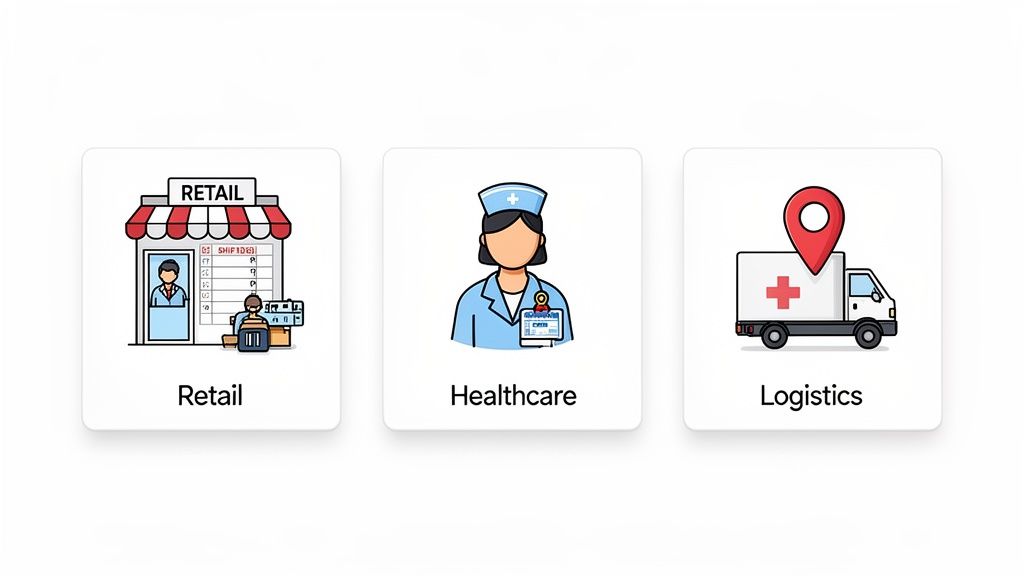
Retail and Hospitality
Anyone who’s managed a restaurant or retail store knows the daily staffing puzzle. You need enough people on the floor for the lunch rush but not so many that labor costs spiral. It’s a constant balancing act.
This is where integrating attendance with scheduling is so powerful. A manager can see, in real-time, who has clocked in and who hasn't. If someone's running late, they get an alert and can find cover from a list of available staff—all in the same app. No more frantic phone calls.
It's about turning chaos into calm. Instead of reacting to staffing gaps, you can anticipate them, ensuring the customer experience never suffers and your team feels supported.
For a sector with complex shift patterns and high turnover, this kind of stability is invaluable. It helps you manage labor budgets with precision. We've explored how to manage these types of schedules in our guide on creating effective shift work schedules.
Healthcare
In healthcare, the stakes are higher. A missed shift isn't an inconvenience; it can impact patient care. Compliance is non-negotiable. Every minute of a nurse's time must be meticulously documented for payroll, billing, and labor laws.
An attendance tracking app provides an indisputable, timestamped record of every shift. This eliminates the "he said, she said" of manual logs and creates a clear audit trail. Features like biometric clock-ins—using a fingerprint or facial scan—can be particularly useful here, ensuring the right person is clocking in for their shift in a secure environment.
Logistics and Field Services
Now, think about a business where your team is never in one place. Your people could be electricians, delivery drivers, or maintenance crews spread across a city. A central punch clock is useless.
For these teams, mobile clock-ins with geofencing are the core of the operation. A driver can clock in the moment they arrive at their first stop, and the system automatically verifies they are where they need to be. It gives managers a clear view of their entire field team's status without constant check-in calls. This gives the team on the ground autonomy and the manager peace of mind.
The need for these specialized tools is driving serious growth. The time and attendance industry is expected to reach USD 6.37 billion by 2031, with mobile-first tools making up over 70% of new deployments. This growth is a direct response to the demand for tools that handle the real-world complexity of different industries. Read the full research about the time and attendance market.
The right app doesn't just track attendance. It understands the unique rhythm of your business—whether that’s the unpredictable rush of a coffee shop, the critical compliance of a hospital, or the distributed nature of a field team. It solves the specific headaches that keep you from doing your real job: leading your team.
How to Choose the Right Tool for Your Team
The market for attendance tracking apps is crowded. After a few demos, every website with its shiny feature list starts to look the same. It's easy to get lost.
So how do you cut through the noise? It’s not about finding the app with the most features. It's about finding a tool that fits the way your team actually works.
Start with the practical stuff. Does it connect to your payroll system? The last thing you want is to swap one manual headache for another. And is it dead simple for your employees to use? If clocking in feels like a chore, people won't do it.
Look Beyond the Standalone App
But here’s a thought: focusing only on features misses the bigger picture. The most important question you should ask is: Does this tool add another silo to our workflow, or does it bring things together?
Most time-tracking apps are just that—standalone products. On the surface, that seems fine. But in reality, you're just adding another app to the pile. Another password. Another system that doesn’t talk to anything else.
Suddenly, your team is juggling one app for clocking in, another for team chat, and a third for checking schedules. This mess creates friction and complicates life for everyone.
The goal shouldn't be to add one more icon to your team’s home screen. The best attendance tracker is the one that disappears into a tool your team already uses every day.
When attendance is just one piece of a bigger hub for communication and scheduling, it stops feeling like a chore. Imagine a shift lead gets a message from someone running late. In the same breath, they can adjust the schedule and see the updated clock-in time, all without leaving the app. That's the difference.
The Power of a Unified Platform
This is where an all-in-one platform like Pebb flips the script. It’s not just an attendance tracking app; it’s the command center where your team’s day happens.
Communication: Your crew is already in the app, chatting with coworkers. Clocking in becomes a natural part of their "I'm here" routine, not a separate task.
Scheduling: The schedule lives in the same place as the timesheet. When a manager approves a shift swap, the attendance system knows about it instantly. No more confusion.
PTO Requests: An employee can request time off right inside their team chat. Once approved, it automatically populates the schedule and payroll reports.
When everything is connected, work gets simpler. You can stop cross-referencing spreadsheets or toggling between three different tabs. You get one source of truth.
Choosing the right tool isn’t about finding a fancier timesheet—it’s about finding a better way to operate. It’s about seeing attendance not as an isolated task, but as a connected part of your team's rhythm. Don't just look for an app that tracks time. Look for a platform that gives it back.
This Is About Trust, Not Tracking
Let’s end with a crucial point. The phrase "attendance tracking app" sounds cold. It might conjure images of managers watching the clock, waiting to catch someone who’s two minutes late. If that’s how you use it, you’re missing the point.
The goal isn't to track people. It's to build trust.
When an attendance app is done right, it creates a system that is fair, accurate, and effortless. It’s about having one source of truth that no one has to argue with.
Freeing People to Do Real Work
Think about it. The purpose is to free your managers from the soul-crushing admin of chasing timesheets and keying data into a spreadsheet. It’s about giving them back the time and energy to actually lead.
For employees, it’s about having a simple, reliable way to get paid correctly, every single time. No more guessing, no more lost paper, no more friction. Just a clear, transparent process they can depend on.
The best tools don't add another layer of management; they remove one. They make the administrative parts of work so seamless they become invisible, allowing the human parts to come forward.
Any modern attendance app must prioritize data protection. Having clear privacy policies isn't just a legal checkbox; it's a foundational element that shows you’re committed to protecting sensitive employee information. It's how you earn trust.
An Invisible Part of the Day
Here’s the thing: when attendance is seamlessly built into the same place your teams already communicate, it stops being a separate task. It becomes a natural part of the daily workflow. It’s no longer a chore. It’s just clarity.
The right tool doesn't erode trust; it builds it. It gives everyone—from the frontline employee to the operations manager—their focus back. It lets them get on with the work that matters. And isn't that the whole point?
If you're interested in going deeper, we have a piece on how to build trust in teams that you might find helpful.
Frequently Asked Questions
We get it. Moving from a system you know—even a broken one—to a new attendance tracking app feels like a big step. With change comes questions. We hear these a lot, so here are some straight answers.
Is This Even Legal? What About Privacy?
This is usually the first question, and it's a smart one. Yes, using an attendance tracking app is legal. In fact, it often strengthens your legal standing. A good app creates a precise digital record of hours worked, which helps you comply with labor laws and protects both the company and your employees.
Privacy is the other side of that coin. An app that uses geofencing isn't a surveillance tool tracking your team's every move. It's a digital fence that confirms an employee is on-site when they clock in. Think of it as a virtual punch clock, not a personal GPS. A trustworthy provider will always have a transparent privacy policy that explains exactly what data is collected and why.
How Do We Get Our Team to Actually Use It?
It comes down to one thing: simplicity. The biggest hurdle is a complicated tool. If people need a manual just to clock in, you've already lost. The best apps are so intuitive they barely need an introduction.
It's also about how you frame it. This isn't about "big brother" watching over everyone.
For employees: It's about getting paid accurately for every minute they work. No more trying to remember hours from last week.
For managers: It's about getting rid of paperwork. This frees them up to spend more time leading their team.
When a tool is genuinely easy and the benefits are clear, you won't have to force it. It'll just happen.
Will It Work with Our Payroll System?
It has to. Any attendance tracking app worth considering should connect with major payroll systems. This is a deal-breaker. The goal is to kill manual data entry, not just shift it from a spreadsheet to a clunky export process.
Before you commit, ask for their list of payroll integrations. If you don't see yours, ask what a custom export looks like. You're aiming for a seamless handoff from tracking time to running payroll.
Switching systems is more of a people decision than a tech one. By tackling these common worries head-on with clear, honest answers, you can make the transition a lot smoother. It gives everyone the confidence to finally leave the old, broken way of doing things behind.
Ready to stop chasing timesheets and start building trust? With Pebb, you can unify communication, scheduling, and attendance in one simple app your team will actually love. See how Pebb works today.
