
Arkansas Employment Law: A No-Nonsense Guide
A clear guide to Arkansas employment law. We cover at-will rules, wages, termination, and compliance for frontline & remote teams. Stay compliant.
Dan Robin
You’re probably here because you’ve got a real situation on your hands.
Someone’s attendance is slipping. A server says their tips don’t add up. A supervisor wants to know if breaks are required. A remote employee moved across state lines and nobody’s sure which rules apply now. That’s how arkansas employment law shows up in real life. Not as a tidy chapter in a handbook, but as a manager standing in a doorway asking, “Can I do this?”
I’ve found that most problems in Arkansas workplaces aren’t caused by bad intent. They come from half-remembered rules, outdated templates, and managers making judgment calls without a clear system. That’s fixable. You don’t need to become a lawyer. You do need to get the basics right, stay consistent, and document what you’re doing.
This guide is written the way I’d explain it to a new manager in Bentonville, Little Rock, Jonesboro, or Fort Smith. Practical first. Legal enough to keep you out of trouble. Focused on what matters when you run a team.
The Reality of Managing a Team in Arkansas
Arkansas is still a place where hiring and keeping good people takes work. In December 2025, the state had 65,000 job openings at a 4.5% rate, with 12-month averages of 48,000 hires and 46,000 separations. That tells you something important. There are jobs out there, people are moving, and employees usually have options.
That changes how you should think about compliance.
A lot of managers treat employment law like a penalty box. They only think about it when something goes wrong. I think that’s backwards. Good compliance is operating discipline. It helps you hire faster, correct problems earlier, and avoid turning a simple people issue into a messy one.
What managers actually need
Most day-to-day Arkansas employment decisions come down to a short list:
Pay people correctly: wages, time records, tipped pay, final pay.
Treat people consistently: same standards, same process, same paper trail.
Know your pressure points: terminations, complaints, leave requests, and remote work.
Keep basic records in order: because memory is not a system.
If you manage a restaurant, warehouse, clinic, retail store, or field team, this matters even more. Shift work creates little errors that pile up. A missed clock edit here, an off-the-record text there, a break dispute three weeks later. That’s usually where trouble starts.
Good managers don’t need more legal theory. They need a repeatable way to make fair decisions on ordinary Tuesdays.
There’s also a people side to this. In a tighter labor market, the businesses that keep solid employees are usually the ones that feel predictable. People know how pay works. They know what happens if performance slips. They know the rules won’t change depending on who’s on duty.
That’s the standard. Not perfection. Predictability.
The Foundation At-Will Employment
Most Arkansas managers have heard the phrase at-will employment. Many of them think it means, “I can fire anybody anytime for any reason.” That’s sloppy thinking, and it gets employers in trouble.
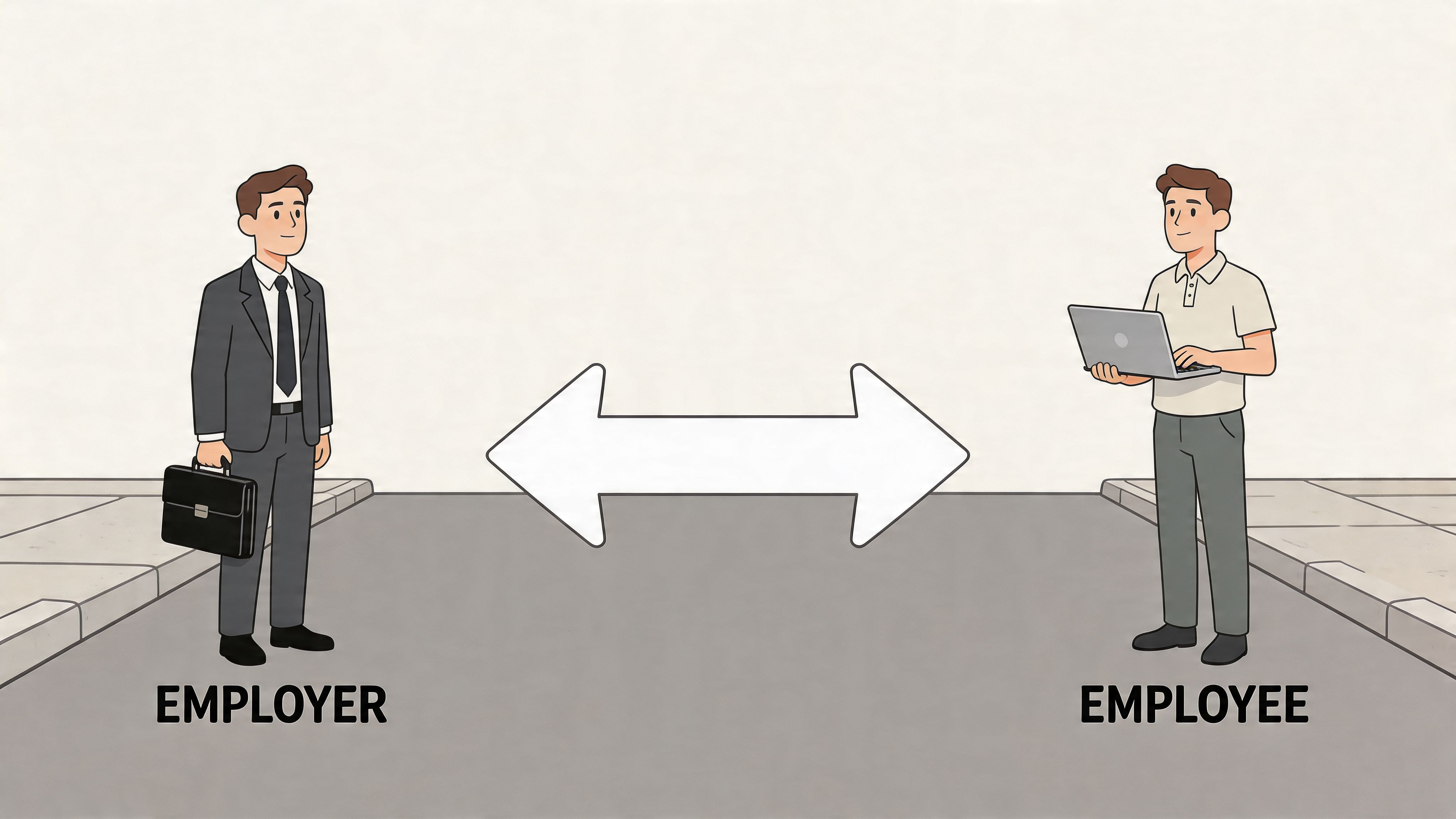
At-will is better understood as a two-way street. The employee can leave. The employer can end the relationship. But that freedom stops where illegal reasons begin.
What at-will actually lets you do
If someone isn’t doing the job, you can address it. If the role isn’t working out, you can make a change. If the business needs change, you can reorganize.
You do not need a dramatic event to act. That’s where some managers freeze. They wait for a final blowup because they think a termination has to look courtroom-ready. It doesn’t. Performance, conduct, reliability, attitude, and fit with job expectations can all be legitimate business reasons.
What matters is that your reason is real, documented, and not a cover for something improper.
The guardrails that matter
At-will has limits. The practical question isn’t “Can I terminate?” It’s “Why am I terminating, and can I show that reason clearly?”
Here’s the short version managers should keep in mind:
Situation | Manager takeaway |
|---|---|
Performance problem | Address it early, in writing, with clear expectations |
Complaint about discrimination or unfair treatment | Slow down and get HR involved before taking action |
Employee reports unlawful conduct or safety concerns | Treat any later discipline with extra care |
Sudden termination after a protected request or complaint | Expect your timing to be questioned |
That’s why I tell managers to stop using vague language. Don’t write “bad attitude” unless you can describe the behavior. Don’t say “not a fit” when you really mean missed deadlines, repeated call-outs, or failure to follow process. Specific facts hold up. General frustration does not.
Practical rule: If you’d be embarrassed to read your reason out loud in a meeting, it’s not ready yet.
The simple discipline model that works
You don’t need a fancy framework. Use this:
State the expectation. What exactly does the job require?
Name the gap. What happened, and when?
Explain the impact. What did it affect?
Set the next step. What has to change, by when?
Document the conversation. Same day if possible.
This approach helps the employee. It also helps you. If the person improves, great. If they don’t, your later decision looks measured instead of emotional.
At-will gives you room to manage. It doesn’t excuse lazy process.
Paying Your People Correctly Wages Hours and Breaks
Nothing burns trust faster than a bad paycheck. A missed hour, a short tip credit, a paycheck that doesn’t make sense. Employees may forgive a clumsy meeting. They won’t forget pay mistakes.
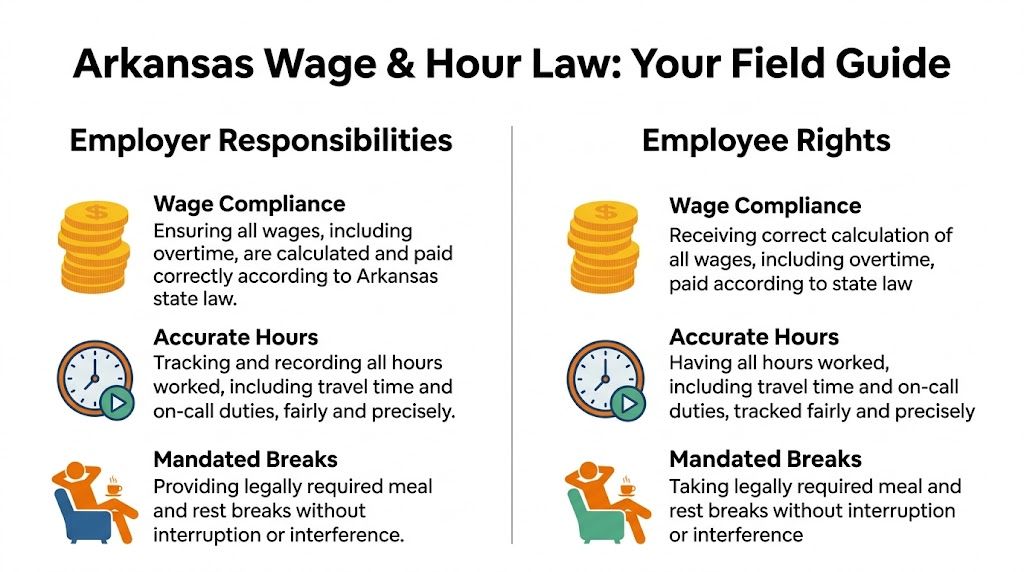
In Arkansas, the baseline rule is straightforward. The state minimum wage is $11.00 per hour for employers with four or more employees, and tipped employees may be paid $2.63 per hour in cash wages if tips bring them to at least the minimum wage.
Start with the paycheck, not the policy
Managers love to say, “We have a payroll process.” Employees care about one thing. Did the money come out right?
That means you need a habit of checking pay from the employee’s point of view:
Hours worked: Did the time record capture the actual start, stop, and any required edits?
Tipped roles: Did cash wages plus tips reach the required minimum?
Off-the-clock work: Did someone answer messages, prep early, close late, or work through lunch?
Job changes: Did a rate change get entered when the role changed?
If you run a shift-based business, don't rely on memory and handwritten fixes. Use a clean timekeeping process and teach supervisors to correct records the same day. If you need a practical walkthrough, this guide on how to track employee hours is worth keeping handy.
Tipped pay is where managers get sloppy
Arkansas hospitality employers trip over tipped wages all the time. The rule sounds simple, but the execution is where errors show up.
A server, bartender, or other tipped employee can be paid a lower cash wage only if tips close the gap to the required minimum. If they don’t, the employer has to make up the difference. That means managers need real records, not assumptions.
Don’t let anyone say, “They usually make enough in tips.” Usually is not a payroll method.
If a tipped employee’s pay is short, the problem is yours to fix, not theirs to explain.
Breaks are the gray area managers mishandle
Arkansas doesn’t have a broad adult meal-and-rest-break rule spelled out the way some states do. A lot of employers hear that and take the wrong lesson. They assume breaks don’t matter. They absolutely do.
If you run long shifts, physically demanding work, or customer-facing roles, a weak break practice creates three problems at once:
Timekeeping disputes: Was the meal period uninterrupted or not?
Morale problems: Employees compare treatment fast.
Manager inconsistency: One location allows breaks. Another implicitly discourages them.
My recommendation for break policy
Make a written break policy even if state law doesn’t force your hand in every situation. Keep it plain.
Policy area | What I recommend |
|---|---|
Meal periods | State when they’re expected, who approves timing, and what counts as interrupted work |
Rest breaks | Allow short breaks based on shift flow and role demands |
Time edits | Require employees to report missed or interrupted breaks the same day |
Supervisor rule | No off-the-clock work, ever, including “quick favors” before or after shift |
This is one of those spots where operational discipline matters more than legal theatrics. If your policy is fair, understandable, and followed in practice, you reduce confusion fast.
Pay rules are where small mistakes become expensive arguments. Clean time records, clear tipped-pay oversight, and a real break policy will keep you out of most of them.
A Fair Workplace on Discrimination and Leave
Most managers don’t wake up intending to discriminate. Problems show up in smaller ways. A joke nobody addressed. A pregnancy comment passed off as concern. A schedule change that looks neutral on paper but keeps hitting the same person.
That’s how trust breaks. Slowly at first, then all at once.
In Arkansas, the Arkansas Civil Rights Act applies to employers with nine or more employees and prohibits discrimination based on race, religion, gender including pregnancy, national origin, and disability. That threshold and those protections matter, especially for smaller businesses that assume they’re too small to attract scrutiny.
Fair treatment is a management skill
The managers who stay out of trouble usually do three things well.
First, they use the same standards for everyone. Same attendance expectation. Same write-up process. Same promotion criteria. They don’t improvise depending on who they like.
Second, they watch their language. Careless comments create evidence. You may think you’re being conversational. The employee may hear bias, and a judge might too.
Third, they respond early. Small complaints become formal ones when nobody takes them seriously the first time.
A fair workplace isn’t built by a policy binder. It’s built by managers who act the same way on good days and bad ones.
Leave is where fairness gets tested
Arkansas doesn’t require private employers to offer every kind of paid leave people want. That is the case. But smart employers don’t hide behind that. They create simple, written policies for vacation, sick time, call-ins, and protected absences, then they apply them consistently.
You don’t need an elaborate leave menu. You do need clarity.
Put it in writing: if you offer sick leave, vacation, PTO, or personal days, define how employees earn and use it.
Keep approval rules simple: managers should know who can approve what and when HR needs to step in.
Separate performance from protected requests: don’t punish someone for raising a legitimate accommodation or leave issue.
Train front-line supervisors: they’re often the ones who say the wrong thing first.
A small mistake that becomes a big one
A common Arkansas scenario goes like this. An employee says they need time off for a medical issue or pregnancy-related appointment. The supervisor rolls their eyes, complains about coverage, and starts cutting hours. The employer may believe the issue is attendance. The employee experiences it as retaliation.
That gap is where claims start.
Use a basic decision check before acting on any leave-related issue:
Question | Why it matters |
|---|---|
Did the employee raise a medical, disability, pregnancy, or religious issue? | That can trigger legal protections |
Have we handled similar requests the same way before? | Inconsistency creates risk |
Is the manager reacting to the request or to documented job problems? | Those are not the same thing |
Is HR reviewing the action before discipline happens? | They should be |
If you run a small company, this can feel heavy. I get it. But the answer isn’t to wing it. The answer is to write down your policies, train your managers, and slow down when an issue touches protected status or leave.
Most discrimination problems don’t come from policy gaps. They come from unmanaged managers.
The Hard Part Navigating Terminations and Final Pay
Terminations are part of management. They’re still hard. If you’re doing them often, something upstream is broken. If you avoid them too long, you punish the people who are carrying the load.
The cleanest terminations are rarely dramatic. They’re usually the end of a documented process where expectations were clear, the employee had a chance to improve, and the business finally made the call.
Documentation is not about building a case
Managers sometimes resist documentation because it feels cold. I think the opposite is true. Good documentation is respectful. It tells the employee where they stand.
A useful note should answer four things:
What was expected.
What happened instead.
What conversation took place.
What improvement was required next.
That’s enough. You don’t need legal theater. You need an accurate record.
A termination meeting should be brief
Don’t turn the meeting into a debate. By the time you’re ending employment, the decision should already be made.
Use plain language. Be respectful. Don’t overexplain. Don’t stack on extra accusations because you feel uncomfortable.
A calm script usually works best: the decision, the effective date, what happens next with access, company property, and final pay. Then stop talking.
People remember the tone of a termination long after they forget the exact words.
Final pay needs its own checklist
Final pay is where administrative sloppiness shows up. Don’t let the separation be cleaner than the payroll follow-through.
Use a short checklist:
Confirm all hours worked: including recent edits, missed punches, and approved corrections.
Review PTO policy: if your policy or practice calls for payout, calculate it carefully. This explainer on how to calculate PTO payout is a practical reference.
Recover company property: keys, badges, devices, uniforms, documents.
Lock access promptly: email, systems, shared drives, scheduling apps.
The biggest mistake I see is inconsistency. One employee gets a formal process. Another gets walked out with no paperwork. One manager documents every issue. Another relies on memory. That’s what makes ordinary terminations look suspicious after the fact.
If the person needs to go, act. Just do it with a process you’d be willing to use every time.
Rules for the Modern Distributed and Frontline Team
A lot of arkansas employment law guidance still assumes work happens in one building, with one manager, on one schedule. That’s not how many teams operate now.
Some people clock in on a loading dock. Some work a hospital floor. Some split time between home and the road. Some were hired in Arkansas and now work somewhere else. That’s where the clean old rules start getting fuzzy.
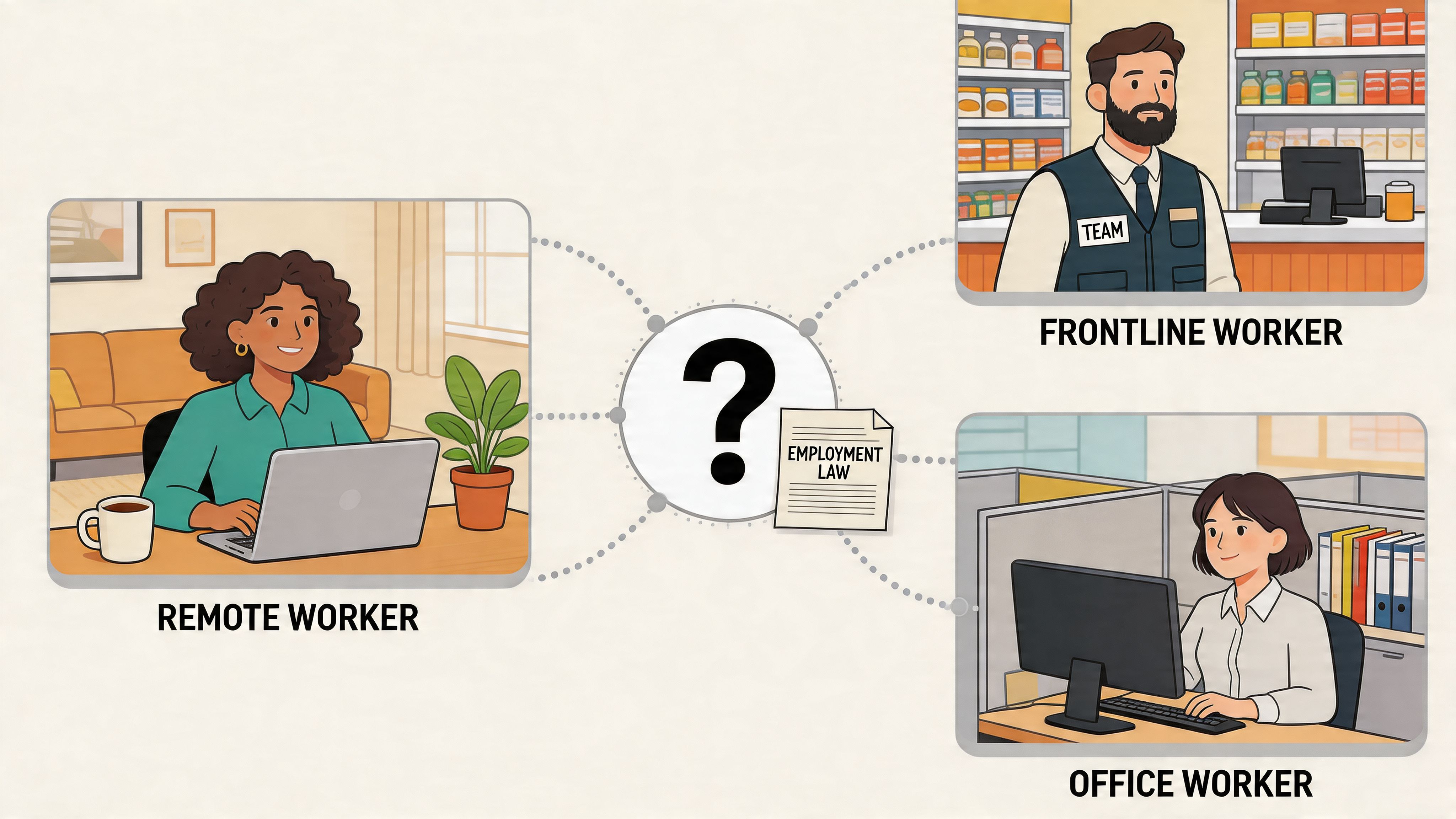
One of the biggest problems is that there is virtually no official guidance on how key Arkansas employment protections function for distributed teams. That creates real ambiguity for employers with remote workers tied to the state.
My advice on remote work is simple
If the law is gray, don’t get clever. Be conservative.
That means you should not assume one handbook covers every remote arrangement. You also should not assume an employee’s home address, reporting office, and actual work location all point to the same legal answer.
Use a basic decision framework:
Remote work question | Conservative approach |
|---|---|
Employee lives in Arkansas but works elsewhere | Review both states before making pay or leave decisions |
Employee was hired in Arkansas and later moved | Update records and recheck wage and policy rules |
Team works across several states | Standardize core practices, then add state-specific rules where needed |
Manager supervises mixed remote and onsite staff | Train them to escalate location-specific questions instead of guessing |
Frontline teams need tighter systems than office teams
Frontline operations create a different kind of risk. Not because the work is worse, but because there are more handoffs. Shift swaps, late arrivals, rounding issues, manager texts, coverage gaps, missed meal periods. It’s easy for small errors to become a pattern.
If you manage multiple locations, put extra discipline around:
Time capture: every shift starts and ends in the same way
Schedule changes: who approved them and when
Policy access: every employee can see the same current rule
Manager notes: attendance, coaching, and exceptions are recorded consistently
This isn’t bureaucracy. It’s how you avoid location-by-location drift.
Don’t let convenience become policy
A lot of distributed teams build bad habits because managers improvise. One supervisor approves time by text. Another uses a spreadsheet. A third keeps notes in their phone. That may feel efficient in the moment, but it gives you no consistent record when a dispute shows up.
If your team works across locations, your process has to be stronger than your memory.
For remote and frontline teams alike, the winning move is boring. Centralize policies. Standardize timekeeping. Train managers to escalate gray areas. Treat location changes as compliance events, not just address updates.
Modern work has outpaced a lot of plain-English guidance. Your job is to create order before the ambiguity hurts you.
Your Final Compliance Checklist
The last part of compliance is usually the least glamorous. It’s also where employers get caught looking careless.
Nobody gets excited about posters, payroll files, or handbook acknowledgments. That’s fine. They still need to be done. These are the housekeeping items that make the rest of your process credible.
A key Arkansas recordkeeping rule is simple. Employers must maintain payroll records for three years, and violations can trigger civil penalties, liquidated damages, and attorney fees. A lot of wage problems come from poor records and bad classification calls, not some grand scheme.
The checklist I’d use
Keep this short and operational:
Payroll records: retain complete records for the required period and make sure they’re readable.
Posters and notices: put required workplace notices where employees can see them.
Handbook distribution: don’t just write policies. Confirm employees received them.
Manager training: your supervisors need basic wage, complaint, and documentation training.
Role review: check how jobs are classified and how pay practices line up with the work performed.
If your documents are scattered across email attachments, desktop folders, and old paper packets, fix that. A central library matters. This practical guide to building a policy and procedure manual is a good starting point.
Keep your paperwork usable
At this point, many small and mid-sized employers lose the plot. They have documents, but they can’t find them. Or the signed version is different from the one managers are using.
I’d rather see a plain set of current forms than a beautiful mess of outdated templates. If you need a cleaner way to organize agreements, acknowledgments, and HR forms, a dedicated resource for legal documents can help you stop reinventing the wheel.
The boring work protects you
Here’s the truth. Your compliance process doesn’t fail when a lawyer asks a hard question. It fails earlier, when nobody can produce the time record, the signed policy, the write-up, or the poster history.
Clean records make ordinary decisions look ordinary. Missing records make ordinary decisions look suspicious.
Treat this section like closing duties at the end of a shift. Not exciting. Still necessary. If you stay current on records, notices, and manager basics, you’ll solve a lot of problems before they ever become problems.
Frequently Asked Questions About Arkansas Employment Law
A few questions come up over and over. The answers are usually less dramatic than people expect, but they still matter.
Quick answers to common questions
Question | Answer |
|---|---|
Can I fire an employee in Arkansas without giving a long reason? | Usually yes, but your reason still matters. At-will is not a license to act carelessly. If the decision touches discrimination, retaliation, or another protected issue, your timing and documentation will be examined. |
Do I have to offer breaks to adult employees? | Arkansas is not known for a broad break mandate for all adult workers, but that does not mean you should run without a written break practice. For shift teams, a clear policy is the safer and smarter move. |
Can I pay tipped employees less than the regular minimum wage? | Only if your pay practices satisfy the tipped wage rules discussed earlier and total earnings still meet the required minimum. If they don’t, the employer has to make up the difference. |
We have a remote employee in Arkansas. Can I just use the same rules we use everywhere else? | I wouldn’t. Remote arrangements create gray areas, especially across state lines. Review location-specific rules before you make pay, leave, or separation decisions. |
Do small employers get a pass on discrimination issues? | No. Some legal thresholds differ, but sloppy, inconsistent, or biased management is risky at any size. Good habits matter even when coverage rules vary. |
Should I document verbal coaching if it seems minor? | Yes. Keep it brief and factual. Minor issues become major disputes when nobody wrote down the earlier conversations. |
The questions behind the questions
Most managers asking these things are really asking something else.
They’re asking if they can move faster. They’re asking how much process is enough. They’re asking whether a common-sense decision will hold up if someone challenges it later.
My answer is steady: yes, you can move fast, if your foundation is clean.
That means a few habits need to become automatic.
Write things down: not everything, but every meaningful expectation, correction, complaint, and decision.
Use one standard: if two employees do the same thing, start from the same response.
Pause on protected issues: complaints, medical needs, pregnancy-related matters, religious concerns, and similar topics deserve a second look.
Keep managers in their lane: supervisors should manage performance, not freelance legal interpretations.
When to slow down
Some situations deserve a deliberate pause, even in a fast-moving operation.
If a termination comes right after a complaint, slow down.
If a pay issue depends on memory instead of records, slow down.
If a remote employee changed states and nobody updated the file, slow down.
If a manager says, “I just know this person is going to be a problem,” slow down and ask for facts.
The fastest way to create HR trouble is to let a frustrated manager act before the paperwork catches up.
My plain advice
Arkansas employers don’t need perfect systems. They need disciplined ones.
You don’t need a giant HR department to run a fair workplace. You need managers who know when to act, when to document, and when to ask for help. You need policies people can understand. You need payroll records that make sense months later. You need enough consistency that your team knows what to expect.
That’s what good compliance looks like in practice. Not fear. Not legal theater. Just a business that runs in a way people can trust.
If you’re managing a mix of frontline, office, and remote employees, the hardest part usually isn’t writing the policy. It’s keeping communication, schedules, time records, and updates in one place so managers can follow the rules. Pebb gives teams a single home for chat, shifts, clock-ins, tasks, knowledge, and day-to-day coordination, which makes it a lot easier to run a workplace that’s both organized and fair.
