
8 Feedback to Manager Examples You Can Use Today
Looking for a feedback to manager example? Here are 8 scripts for positive and constructive feedback, with tips for delivery in-person or on apps like Pebb.
Dan Robin
A manager makes an off-the-cuff comment in a meeting. The room goes quiet. By the end of the day, three people have interpreted it three different ways, and now you have a choice. Let the confusion harden into resentment, or say something useful while the moment is still recoverable.
That choice feels loaded because upward feedback carries real risk. Your manager has more authority, more context, and more influence over your day-to-day experience. Still, staying silent has its own cost. One unclear habit from a manager can slow decisions, muddy priorities, and wear down trust across the whole team.
The problem is rarely courage alone. People often know what needs to be said. They just do not know how to say it in a way that is specific, fair, and hard to dismiss. That is why a strong feedback to manager example matters. Good wording lowers the temperature. Good structure keeps the conversation on the work instead of turning it into a judgment of the person.
I have found that the best upward feedback does two jobs at once. It names the issue clearly, and it makes it easy for the manager to act on it. That is the difference between a tense conversation that goes nowhere and one that improves how the team works.
This guide treats feedback as a strategic skill, not a collection of scripts. Each framework works for a different reason. Some reduce defensiveness. Some create clarity in messy situations. Some are better for frontline teams, where a missed update or rushed decision shows up immediately on the floor. On a platform like Pebb, where distributed teams are sharing updates across chat, voice, and announcements, the delivery channel matters almost as much as the wording.
If you want a little help before you start, these effective communication strategies for talking with your boss are a solid companion to what follows.
Use the frameworks that fit the moment, the relationship, and the level of risk. The goal is not to sound polished. The goal is to help your manager hear something useful early enough to do something about it.
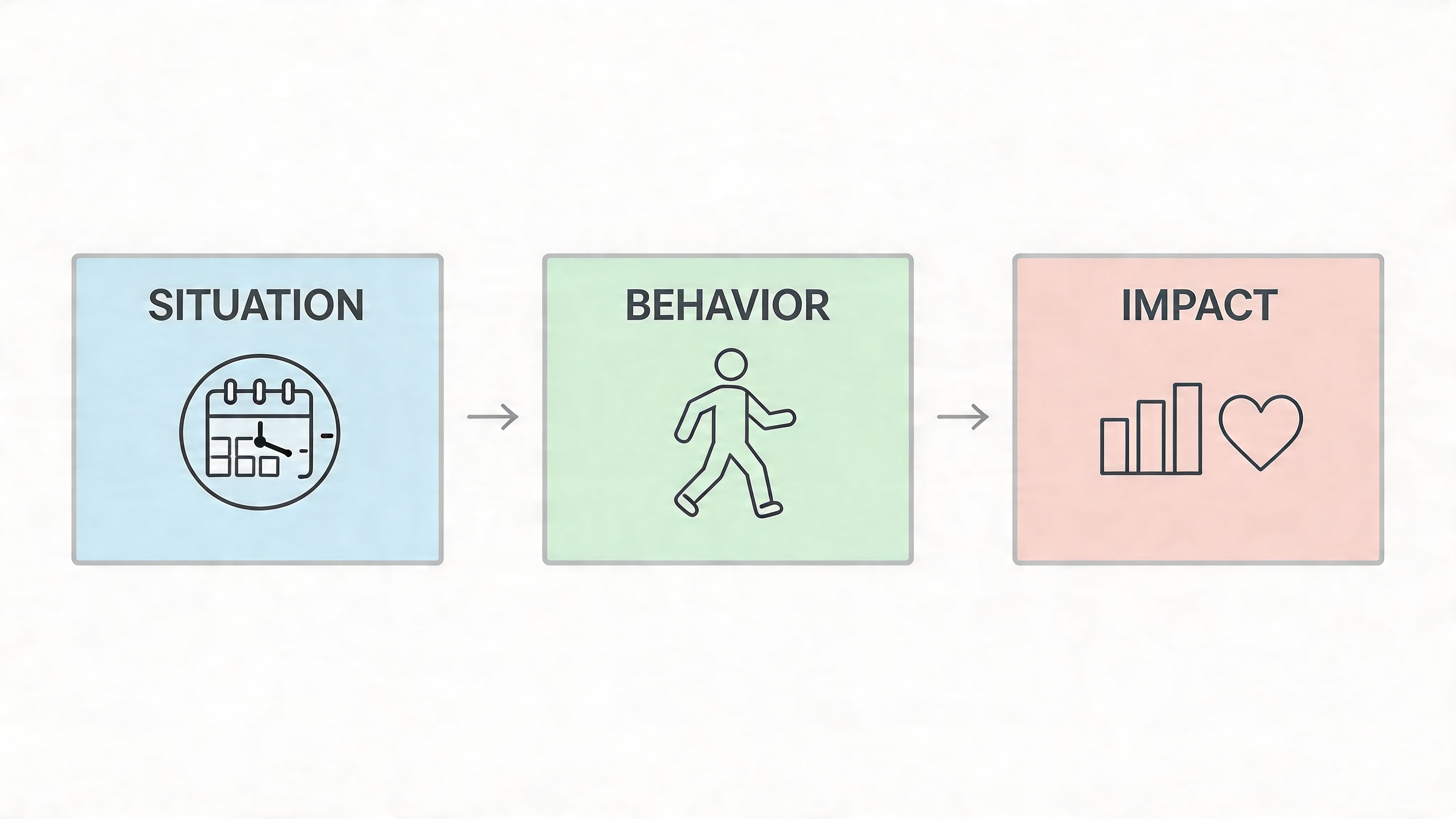
1. The SBI Framework
The SBI model works because it forces you to stop editorializing. Instead of saying, “You’ve been hard to work with lately,” you anchor the feedback in one moment, one behavior, and one result. That makes the conversation fairer for your manager and safer for you.
Use it when emotions are running a little hot and you want the feedback to stay grounded. It’s especially useful in distributed teams, where half the conflict comes from people reacting to fragments of context rather than the full event.
What it sounds like
Here’s a simple feedback to manager example using SBI:
During Tuesday’s all-hands in Pebb, you changed the shift schedule without checking with the floor team first. A few people left that meeting confused about coverage, and by the next morning the mood on the floor was tense because it felt like the decision had been made without the people doing the work.
And here’s the positive version:
In our last one-on-one on Pebb voice call, you asked a few clarifying questions before offering advice on my project. That helped me think more clearly, and I left the conversation feeling supported instead of rushed.
Same structure. Different direction. That’s one reason SBI is so dependable. It works for praise, correction, and mixed feedback.
Why it works
Value lies in precision. The SBI framework described by Learnit emphasizes naming the situation, observable behavior, and impact. The same source notes that feedback given within 24 to 48 hours creates the strongest connection between what happened and what should change.
That timing matters more than people think. Wait two weeks and the conversation becomes a debate about memory. Say it while the details are fresh and you can talk about what happened, not what each person later reconstructed.
A few practical rules help:
Pick one incident: Don’t stack three meetings, two Slack threads, and last quarter’s review into one speech.
Describe what you saw: “You interrupted Sam twice” is stronger than “You don’t respect the team.”
Name the effect clearly: Did people lose clarity, confidence, time, or trust?
Good upward feedback should sound almost boring. If it sounds dramatic, it usually won’t land.
For sensitive feedback, don’t do SBI over a rushed text message. Use a private conversation, ideally voice or video. In tools like Pebb, that usually means capturing the moment in a note or task so you don’t forget it, then having the actual conversation in a call where tone can carry some of the weight.
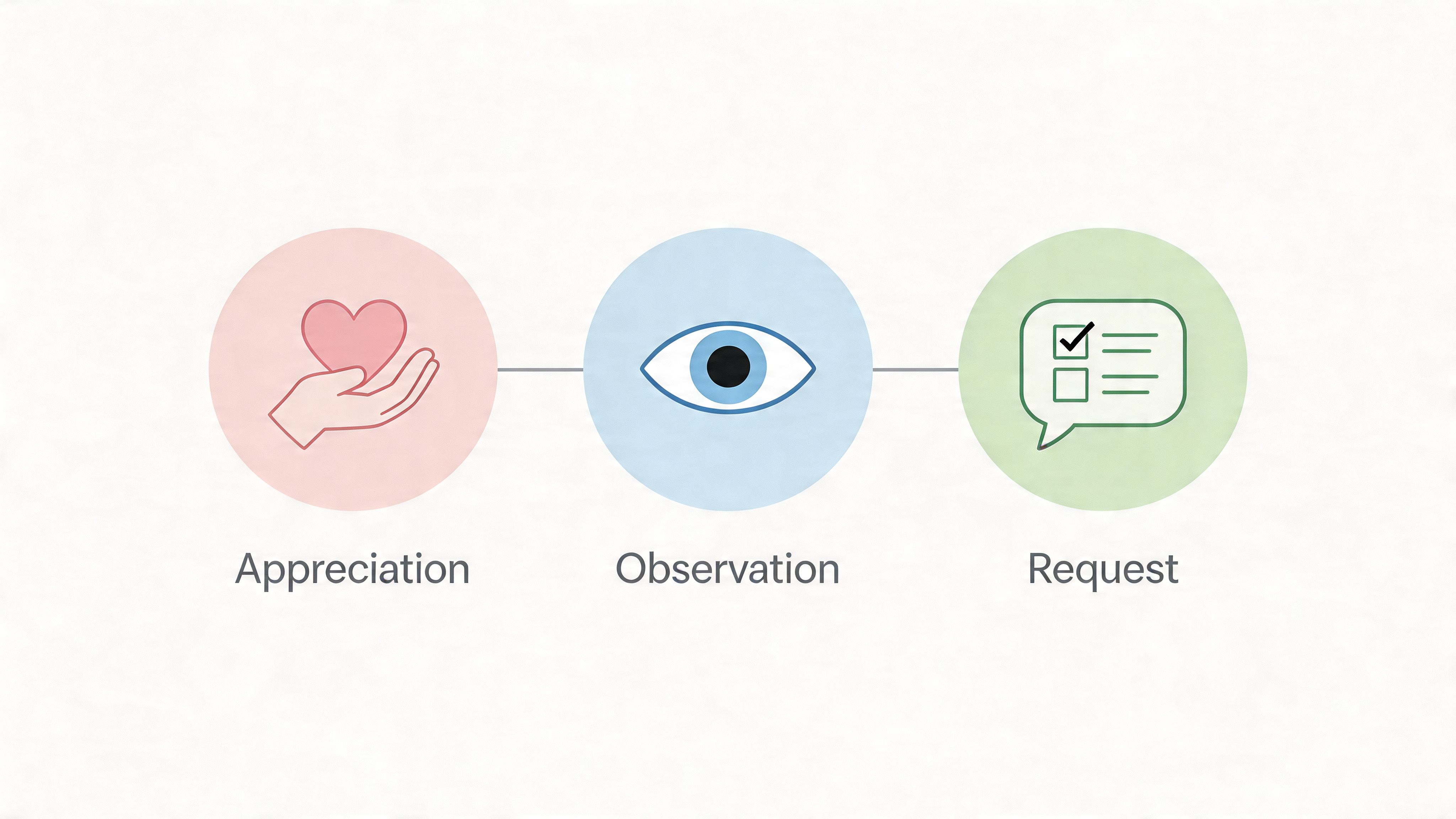
2. The Appreciation Observation Request Model
Some managers hear feedback as a threat, even when they asked for it. That’s not ideal, but it’s real. The AOR model helps because it lowers the temperature without watering down the message.
You start with genuine appreciation, then share a specific observation, then make a clear request. The sequence matters. Not because managers need flattery, but because people listen better when they know what you value and what you’re asking for.
A practical script
Try this:
I really appreciate how seriously you take safety during our warehouse shifts. I’ve noticed that schedule changes sometimes go out before the night team has a chance to weigh in. Could we review shift preferences in Pebb before finalizing the roster?
Or this:
Thanks for being easy to reach in chat. I’ve noticed some urgent messages come in late at night, and people aren’t always sure whether they’re expected to respond right away. Could we set a shared rule for what counts as urgent and what can wait until the next shift?
That’s respectful, but it’s not soft. It says what needs saying.
Where people get this wrong
The failure mode is fake appreciation. If the opening sounds canned, the whole thing collapses. “I appreciate your leadership” means nothing. “I appreciate that you check safety issues yourself instead of passing them down” sounds like you were there.
The request also has to be concrete. “Can you communicate better?” is not a request. “Can we post schedule drafts first, then confirm after team input?” is.
If you manage supervisors or want your team leads to get better at this, supervisor communication skills training is the right kind of support. Upward feedback works better when managers already know how to receive it without getting defensive.
Use AOR when the relationship is worth protecting and the issue is fixable. Don’t use it to dance around serious misconduct. That needs a different channel.
3. The What Worked What Didn’t What Could Be Better Template
This one is useful when the issue is operational. Process changes, meeting routines, scheduling habits, rollout mistakes. It gives enough balance to keep the conversation constructive, but it doesn’t force a fake compliment sandwich.
The reason it works is simple. Managers are often juggling trade-offs the team can’t see. This structure lets you acknowledge what did help while still naming what caused friction.
A balanced example
For example:
What worked: Using Pebb Spaces for team coordination gave everyone one place to check tasks and updates.
What didn’t: The rollout happened so fast that some people didn’t know where to look, especially across different shifts.
What could be better: Next time, post a short preview in announcements before the change goes live so each shift knows what’s changing and why.
That lands better than “The rollout was messy.” It tells your manager which part to keep and which part to fix.
You can use the same structure for recognition too:
What worked: You’re consistent about calling out strong work in team updates.
What didn’t: Some schedule decisions still conflict with time-off requests already in the system.
What could be better: A short review window before finalizing schedules would probably prevent those clashes.
Why teams like this one
People trust feedback more when it feels proportionate. This template helps with that. It’s hard to accuse someone of taking cheap shots when they’ve clearly separated the useful parts from the painful parts.
It also works well in recurring one-on-ones because you can revisit the same categories over time. If your manager changed one thing and ignored another, the next conversation has continuity instead of starting from zero.
The best upward feedback doesn’t just identify friction. It preserves what’s already working.
For frontline teams, I’d keep this one short and plain. Three clean points. No essay. If you use Pebb, write the summary after the conversation so there’s a shared record, but have the discussion live if the topic has any emotional charge at all.
4. The Question Based Coaching Approach
Sometimes the smartest feedback is a question that makes your manager stop and think. Not a trap question. A real one.
This approach works best when your manager is reflective enough to process what happened without needing everything spelled out. Instead of telling them the conclusion, you create a path for them to reach it themselves. That usually creates less resistance and more ownership.
Questions that open, not corner
A few examples:
I noticed the new scheduling process rolled out pretty quickly in Pebb. What drove that timeline?
How do you think the night shift experienced that change?
I’ve heard some frustration about delays inside our team Spaces. What do you think is causing that?
When updates come in after hours, how do you want the team to interpret the urgency?
Those questions aren’t passive-aggressive if your tone is clean. They’re useful because they invite your manager to examine the gap between intent and effect.
When to use it
Use this when your manager is smart, busy, and maybe a little blind to patterns. It’s also useful when the issue is still emerging and you want to understand their reasoning before offering a recommendation.
What doesn’t work is turning this into courtroom cross-examination. If you fire six sharp questions in a row, people feel managed, not supported. Ask one or two. Then wait.
If you want a lighter, future-oriented version of this style, feedforward vs feedback is a useful distinction. Some conversations go better when you focus less on what went wrong and more on what should happen next time.
Ask questions you genuinely want answered. Managers can tell when a question is just criticism wearing a tie.
In distributed teams, I like sending one thoughtful question in writing first, then discussing it on a call. Pebb is useful here because async messages can create reflection time, especially across shifts and time zones. The written question slows the conversation down in a good way.
5. The Before During After Narrative Template
Some feedback is easier to understand as a story. This is especially true in hospitality, healthcare, retail, and logistics, where a manager’s decision changes the flow of a real shift, not just a calendar invite.
The BDA structure is simple. What was happening before the action, what happened during the decision, and what changed after. It gives your manager the operational context and the human effect in one pass.
A frontline example
Try this:
Before the dinner rush, the restaurant team had a good rhythm and was coordinating well in Pebb. During the shift, you changed task priorities without checking with the floor leads. After that, people weren’t sure what mattered most, service slowed down, and the team got visibly frustrated.
Or a positive version:
Before the rollout, the night shift felt disconnected from company updates. During the last two weeks, you started posting short voice updates in our team Space and answering follow-up questions the next morning. After that, people seemed more informed and less left out of decisions.
This format works because it mirrors how people remember work. Not as isolated incidents, but as sequences.
Why stories travel further than labels
When you tell a clean story, your manager doesn’t have to decode what you mean by “supportive” or “chaotic.” They can see the chain of events. That makes the feedback more persuasive and less personal.
This approach is also good for shared review. If multiple shifts felt the same impact, a before-during-after summary gives everyone a common reference point without turning the conversation into a pile-on.
A few ways to keep it useful:
Use real markers: Name the shift, the meeting, or the handoff point.
Stay with observations: “Orders backed up” is stronger than “everyone panicked.”
Keep the story short: Three to four sentences per phase is plenty.
In Pebb, voice messages can help here because tone carries context that text often strips out. If the event had emotional fallout, use a live conversation first, then summarize the sequence in writing so the follow-up is clear.
6. The PREP Framework
A manager keeps changing the rota at the last minute. The first time, people work around it. By the third or fourth time, the issue stops being an inconvenience and starts becoming a pattern that affects trust, coverage, and morale. That is where PREP helps.
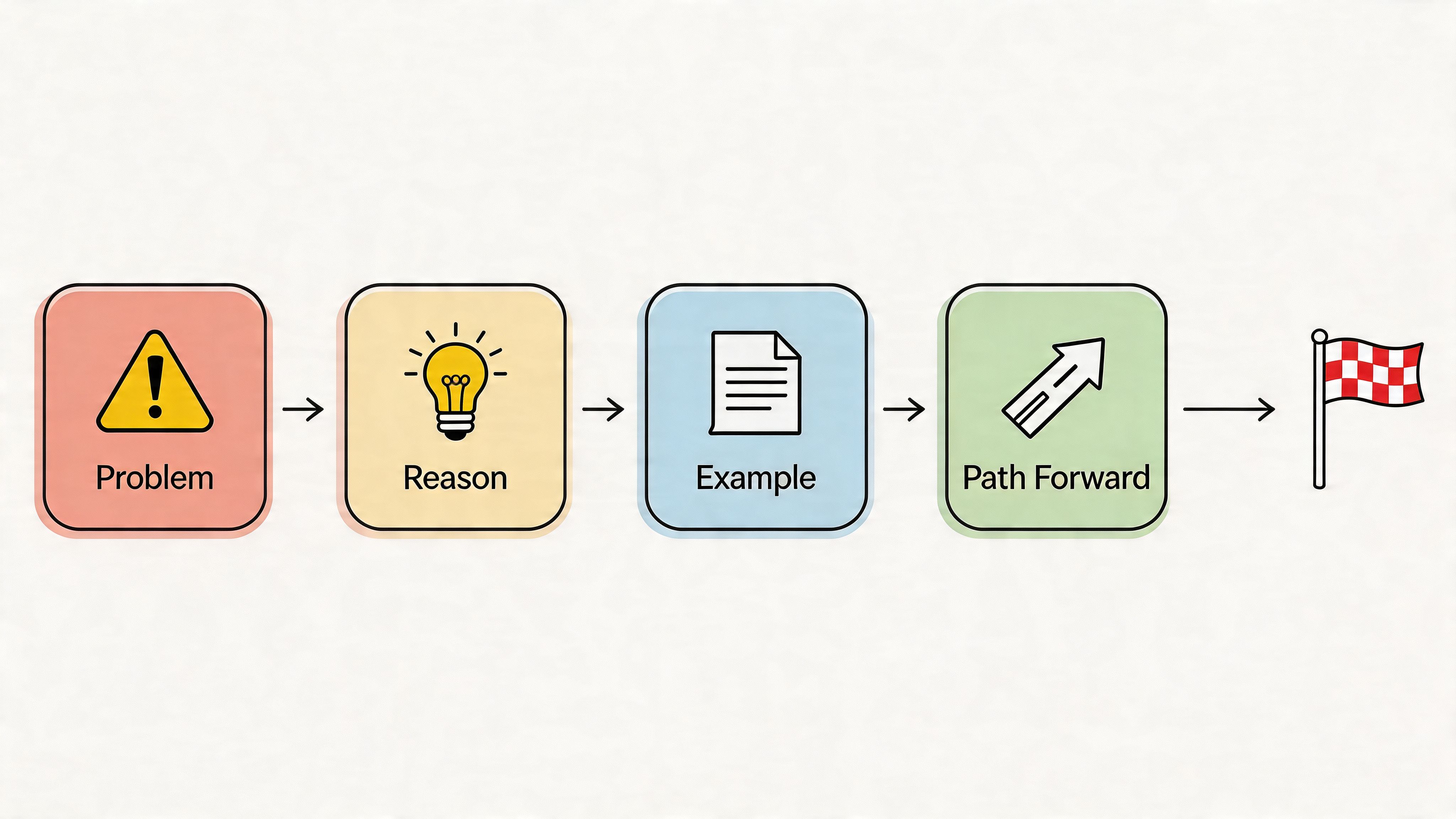
Problem. Reason. Example. Path forward.
I use PREP for recurring issues that need more than a quick comment in chat. It works well when the feedback may need a record, a follow-up conversation, or agreement across shifts and locations. The structure matters because it lowers the chance that your message gets dismissed as frustration in the moment.
A stronger way to raise a recurring issue
A feedback to manager example in PREP might sound like this:
Problem: Shift changes are often shared too late. Reason: That disrupts childcare, transport, and personal plans, and it creates avoidable stress. Example: It happened on the Tuesday night update, again on the Friday consolidation, and once more over the weekend. Path forward: Could we agree on a notice window before schedules are final, with confirmation in Pebb once changes are locked?
Or this:
Problem: Important updates are getting lost in announcements. Reason: Teams across locations need a clear way to confirm what they’ve seen. Example: Two recent policy changes had to be explained again on the floor because not everyone caught the original post. Path forward: Could managers confirm those updates in team Spaces during handoff?
What makes PREP effective is the sequence. You start with the operational problem, explain why it matters, ground it in a repeatable example, then offer a workable next step. That order reduces defensiveness because the conversation stays tied to impact and process, not personality.
The "reason" line does a lot of work. It answers the question many managers ask themselves: why should I treat this as a priority? If you can connect the pattern to missed handoffs, avoidable rework, schedule stress, or inconsistent communication, the feedback has weight.
The last step matters just as much. A path forward gives your manager something they can respond to, refine, or test. It does not need to be the perfect fix. It needs to be concrete enough to act on.
For more wording ideas that stay specific without turning sharp, these colleague feedback examples are useful reference points.
On a platform like Pebb, PREP works especially well for distributed and frontline teams because the written trail is clear. You can raise the issue in a private message or meeting, then document the agreed next step in the right Space so shift leads and managers are working from the same version of the plan.
7. The Micro Feedback or Pulse Approach
A manager finishes a hectic shift update. Ten minutes later, they get a short note: “Your recap of the new Space structure was clear. People knew where to look, so the usual follow-up questions never started.”
That kind of feedback works because it arrives while the behavior is still fresh. The manager can connect the comment to a specific choice they made and repeat it. No meeting required. No build-up. Just a useful signal, delivered at the right time.
Small messages that change behavior
A few examples:
Loved how you explained the new Space structure in this morning’s update. It made the change easy to follow.
Asking for roster input before posting next week’s schedule helped a lot. People were calmer because they felt included.
I noticed the night shift seemed more involved in planning this week. What changed?
Smart call putting that process note in the Knowledge Library. It saved people from asking the same question over and over.
The value is not the praise alone. It is the precision. Each message points to one action, one effect, and one reason it mattered. That is what makes a manager more likely to keep doing it.
This approach also changes the emotional tone of upward feedback. If the only time a manager hears from the team is during a formal review or after a problem, every comment carries extra weight. Short, steady feedback makes the exchange feel normal. That matters on teams where people are busy, distributed, or working different shifts.
Why the pulse approach works
Micro-feedback reduces friction. People are more willing to send a two-sentence note than schedule a difficult conversation they may postpone for weeks.
It also helps with pattern recognition. One message rarely changes much. Five short comments over a month, all pointing to the same strength or same point of friction, are hard to dismiss. Managers start to see the pattern without feeling ambushed by a long list of complaints.
On Pebb, this fits the actual rhythm of work. A quick message after a shift handoff, a reply in chat after an announcement, or a short voice note after a team update is often more realistic than waiting until everyone is available at once. For frontline and hybrid teams, that timing advantage matters as much as the wording.
A few rules keep it useful:
Be specific: “Nice job” is pleasant, but it does not tell the manager what to repeat.
Use it for reinforcement and adjustment: If every pulse is corrective, people start reading every message as a warning.
Keep sensitive feedback private: Public channels are fine for recognition. Corrections usually belong in a direct message or conversation.
Watch the cadence: Too frequent, and it becomes noise. Sent at the right moments, it becomes guidance.
Short feedback is often the easiest feedback to act on in a busy week.
8. The Strengths First Amplify Adjust Model
A manager I once worked with had a clear strength. In a messy week, she kept the team steady. People trusted her judgment and followed her lead. The problem was speed. She made fast decisions without enough context, so good calls still created frustration. Direct criticism would have missed the point. She did not need a personality transplant. She needed help using her strength with more precision.
That is where this model works well.
Start with a real strength. Show how that strength could have a bigger positive effect. Then name one adjustment that would make it easier for the team to feel the benefit of that strength, not just the manager’s intent. This is often the right fit for newer managers, strong operators promoted into leadership, and supervisors who are respected but still rough around the edges.
A constructive way to build capability
For example:
You’re very good at building trust with the team. People come to you because they feel heard. You could strengthen that by using Pebb Spaces for regular one-on-ones with newer staff, so that trust reaches people who do not speak up on their own. One adjustment would help even more. Check for team input before making changes, because a few recent decisions felt sudden.
Or this:
You stay calm during rush periods, and that steadiness helps everyone else. You could strengthen that by documenting your approach in the Knowledge Library so other supervisors can copy what works. One adjustment would make the impact clearer. Explain the reason behind urgent changes more often, because some team members read speed as dismissal.
The psychology matters here. People can accept harder feedback when it fits a strength they already recognize in themselves. That lowers defensiveness without watering down the message. It also makes the advice more usable. The manager knows what to continue, what to expand, and what to change.
Why this approach works
Managers rarely improve by trying to become a different type of leader. Improvement usually comes from using their existing strengths with better judgment and fewer side effects. The adjustment is not an afterthought. It keeps a strength from becoming overused or misread.
That balanced view matters in manager feedback. As noted earlier in the article’s 360-feedback source, people respond better when feedback reflects both what is working and what needs attention. In practice, I have found that this is especially true with competent managers who are already carrying a lot. If feedback only lists problems, they hear rejection. If feedback only praises, nothing changes.
For distributed and frontline teams, this model holds up because manager impact often shows up in repeated daily moments, not big speeches. Calm communication on a hectic shift, clear priorities in a group post, or visible recognition after a tough handoff can shape morale fast. On Pebb, that gives teams a practical delivery choice. Reinforce the strength in a visible update when appropriate, then send the adjustment privately so the manager can act on it without losing face.
Used well, this is not a softer version of feedback. It is a sharper one. It tells the manager what to keep, what to expand, and what to correct.
8 Feedback-to-Manager Frameworks Compared
A framework earns its place only if it helps in the moment you need to speak up. I have seen people pick the wrong one, not because the feedback was bad, but because the format created more friction than the issue itself. A quick scheduling miss does not need a formal four-part case. A repeated leadership pattern usually does.
That is the real comparison to make. How much structure does the moment need, how much prep can the employee realistically do, and how likely is the manager to hear the message well. For distributed and frontline teams using tools like Pebb, delivery matters too. Some methods work cleanly in a short async message. Others are better saved for a private call or one-on-one.
Method | Implementation Complexity 🔄 | Resource Needs ⚡ | Key Advantages ⭐ | Expected Impact 📊 | Ideal Use Cases | Quick Tips 💡 |
|---|---|---|---|---|---|---|
The SBI (Situation-Behavior-Impact) Framework | Medium, needs specific incident recall and clear structure | Low, documentation time; occasional voice/video follow-up | Fact-based clarity; reduces defensiveness | Clear, actionable behavior changes tied to concrete events | Distributed teams; asynchronous feedback; event-specific input | Document incidents quickly; focus one situation per message |
Appreciation + Observation + Request (AOR) | Low, simple three-part script | Low, requires genuine appreciation and a clear request | Preserves relationships; increases receptivity | Higher acceptance of feedback; maintains trust | Frontline/hourly teams where power dynamics matter | Make appreciation specific; frame requests as collaborative |
What Worked / What Didn't / What Could Be Better (WWW) | Medium, three balanced sections, can be detailed | Medium, prep for strengths, gaps, and suggestions | Balanced view; encourages collaborative improvements | Identifies key improvements and operational fixes | Operations, multi-location orgs, process-focused feedback | Limit to 2–3 points per section; standardize format across sites |
Question-Based / Coaching Approach | Medium–High, demands strong questioning skill | Low, time for reflection and follow-up | Builds self-awareness; less likely to trigger defensiveness | Promotes long-term behavior change and autonomy | Manager development; senior leadership; continuous-learning cultures | Ask genuine open questions; allow time for reflection |
Before / During / After (BDA) Narrative Template | Medium, requires narrative framing and context | Medium, time to craft a clear story with consequences | Memorable and empathetic; shows sequence and impact | Deep understanding of human and operational consequences | Hospitality, retail, healthcare, frontline storytelling | Keep each section concise; include specific timeframes |
PREP (Problem, Reason, Example, Path Forward) | High, four-part, formal and structured | High, needs multiple examples and documented reasoning | Detailed, professional, solutions-focused | Strong accountability and clear follow-up actions | Formal performance feedback; high-accountability settings | Gather 2–3 examples; schedule dedicated discussion and follow-up |
Micro-Feedback / Pulse Approach | Low, very brief and frequent messages | Medium, requires discipline and consistent cadence | Timely, low-pressure, builds continuous improvement | Rapid course-correction and habit formation | Shift-based, distributed teams needing real-time input | Aim for 1–2 sentence messages; balance positive and corrective feedback |
Strengths-First / Amplify-Adjust Model | Low–Medium, requires accurate strength identification | Low, observation and recognition tools suffice | Motivating; builds confidence and retention | Increased engagement and scalable development | Emerging leaders, retention-focused and distributed teams | Identify 1–2 genuine strengths first; suggest small complementary tweaks |
The trade-off is simple. More structure gives you better control over hard conversations, but it also raises the effort required to prepare and deliver the message. Less structure makes feedback easier to send, but only works when the issue is narrow and the trust level is decent.
If you are choosing fast, use this rule. Pick SBI for precision, AOR for tact, WWW for process review, coaching questions for reflective managers, BDA for context-heavy team stories, PREP for repeated concerns, micro-feedback for speed, and strengths-first when you want change without flattening morale.
Feedback Is a Conversation, Not a Verdict
A team member once waited three months to tell me that my last-minute changes were creating confusion across shifts. By the time she said it, she had examples, frustration, and a tone that made the conversation harder than it needed to be. Her point was fair. The delay was the problem.
That pattern shows up often with manager feedback. People hold it until they are certain, annoyed, or boxed into a formal review cycle. Then the message carries more charge than clarity.
Useful upward feedback works better when it arrives early, while the issue is still fixable and before either side starts building a private story about intent. The framework matters less than the fit. A good model gives enough structure to keep the conversation specific, but not so much that it feels scripted or adversarial.
That is the value of the eight approaches above. Each one solves a different problem. SBI helps when accuracy matters and you need to separate facts from interpretation. AOR lowers the temperature when the relationship feels sensitive. WWW is practical for team process reviews. Question-based coaching works with managers who respond better when they can reason through the issue themselves. BDA helps in shift-based or distributed teams where sequence and context affect the outcome. PREP suits repeated patterns that now need a firmer conversation. Micro-feedback keeps small issues from turning into recurring ones. Strengths-first helps you correct course without draining confidence.
Good judgment comes from matching the method to the moment.
A scheduling change that keeps breaking handoffs may need PREP because the pattern now affects accountability. A one-off communication miss after a stressful week may only need a short pulse message. A manager habit that is hurting trust usually needs a private, well-framed conversation with clear examples. Same goal, different delivery.
The psychology matters here. Managers are more likely to hear feedback when it feels usable, not accusatory. Specific observations reduce the instinct to defend. A clear request gives them a next step. A calm tone signals that the relationship is still intact. That is why these frameworks work. They help the other person process the message without getting stuck on your wording.
Safety still sets the boundary. If the issue involves retaliation, harassment, discrimination, or repeated behavior that makes direct feedback unrealistic, use the proper reporting channel. Frameworks help with hard conversations. They do not replace judgment.
Regular feedback also depends on the system around the conversation. Teams need a reliable place to raise issues, respond, document decisions, and follow through across locations and shifts. A simple one-on-one cadence can do that. So can a platform that combines chat, calls, documentation, and tasks in one workflow. Pebb fits that use case well for frontline and distributed teams, where useful feedback often gets lost between shift changes or scattered across apps.
Start small. Use one framework on a low-risk issue. Notice how your manager responds, then adjust your approach next time. Feedback habits grow the same way trust does. Through repeated, clear conversations that give both sides something they can apply.
If you’re building a feedback habit across frontline and office teams, Pebb gives you one place for the conversations and the follow-through. Teams can use chat, voice and video calls, Spaces, tasks, scheduling, file sharing, and a Knowledge Library to keep feedback timely, specific, and visible across shifts and locations.
