
Understanding What Is Two Way Communication: Key for Success
Discover what is two way communication and its critical role for teams. Foster an effective feedback culture.
Dan Robin
A policy changes on Monday morning. Someone in the office writes a clear memo, prints it, pins it to a breakroom board, and calls the job done. By lunch, the warehouse team has three different interpretations of it. The night shift hasn't seen it. A supervisor is answering questions with guesses. By Tuesday, people are annoyed, managers are defensive, and nobody trusts the message anymore.
That scene is ordinary. It's also expensive.
The gap between office teams and frontline teams usually isn't caused by bad intent. It's caused by one-way communication pretending to be communication. A message got sent, so leadership assumes it landed. But sending isn't the same as understanding. And understanding isn't the same as agreement, adoption, or action.
That's why the question matters. What is two way communication? Not as a textbook term. As an operating principle. If your company relies on shifts, handoffs, policies, deadlines, or customer-facing work, this isn't a soft idea. It's how you stop preventable confusion from becoming part of the culture.
We've Been Talking At People Not With Them
I've seen this pattern too many times. Corporate writes the update. Regional leaders approve it. A manager posts it in a channel or tapes it to a wall. Then everyone waits for compliance, as if silence means clarity.
It never does.
A frontline employee reads the note and has one practical question that decides whether they can do the job correctly. They ask their supervisor. The supervisor doesn't know, because nobody asked for input before the policy went live and nobody set up a way to clarify it after. So now the question climbs a ladder, sits in someone's inbox, and comes back too late to help.
That's how small communication mistakes become operating problems. Missed handoffs. Rework. Friction between departments. Quiet resentment from people who feel managed from a distance by people who don't understand the floor.
The breakroom board problem
One-way communication looks efficient from the sender's side. Write once. Distribute widely. Move on.
But the receiver does all the extra work.
They interpret missing context. If the message is vague, they fill in the blanks.
They absorb the risk. If they guess wrong, they deal with the fallout.
They carry the frustration. They were informed, but they weren't included.
Practical rule: If the people doing the work can't question the message, the message isn't finished.
The frontline and office split gets dangerous. Office teams usually have easier access to meetings, email, and leaders. Frontline teams often work across shifts, on mobile devices, in noisy environments, or under time pressure. When communication runs in one direction, the people closest to the work are the last to shape it.
Silence is not buy-in
Leaders often mistake silence for alignment. It's usually one of three things.
What leaders think | What's often true |
|---|---|
“Nobody objected” | People didn't feel safe speaking up |
“The message was clear” | People adapted around confusion |
“The rollout went fine” | Supervisors patched the gaps manually |
That's the trap. One-way communication can look neat on a slide and still create chaos on the floor. The cost shows up later, in mistakes, turnover, and the slow erosion of trust.
So What Is Two-Way Communication Really?
Two-way communication is simple. It's not sending information and hoping for the best. It's an exchange where both sides can speak, respond, clarify, and confirm understanding.
Consider the game of catch. One-way communication is throwing the ball and walking away. Two-way communication is staying in the game long enough to know the other person caught it, understood where to throw it back, and had a chance to say, “Wait, I need that explained again.”
That last part matters more than is generally admitted.
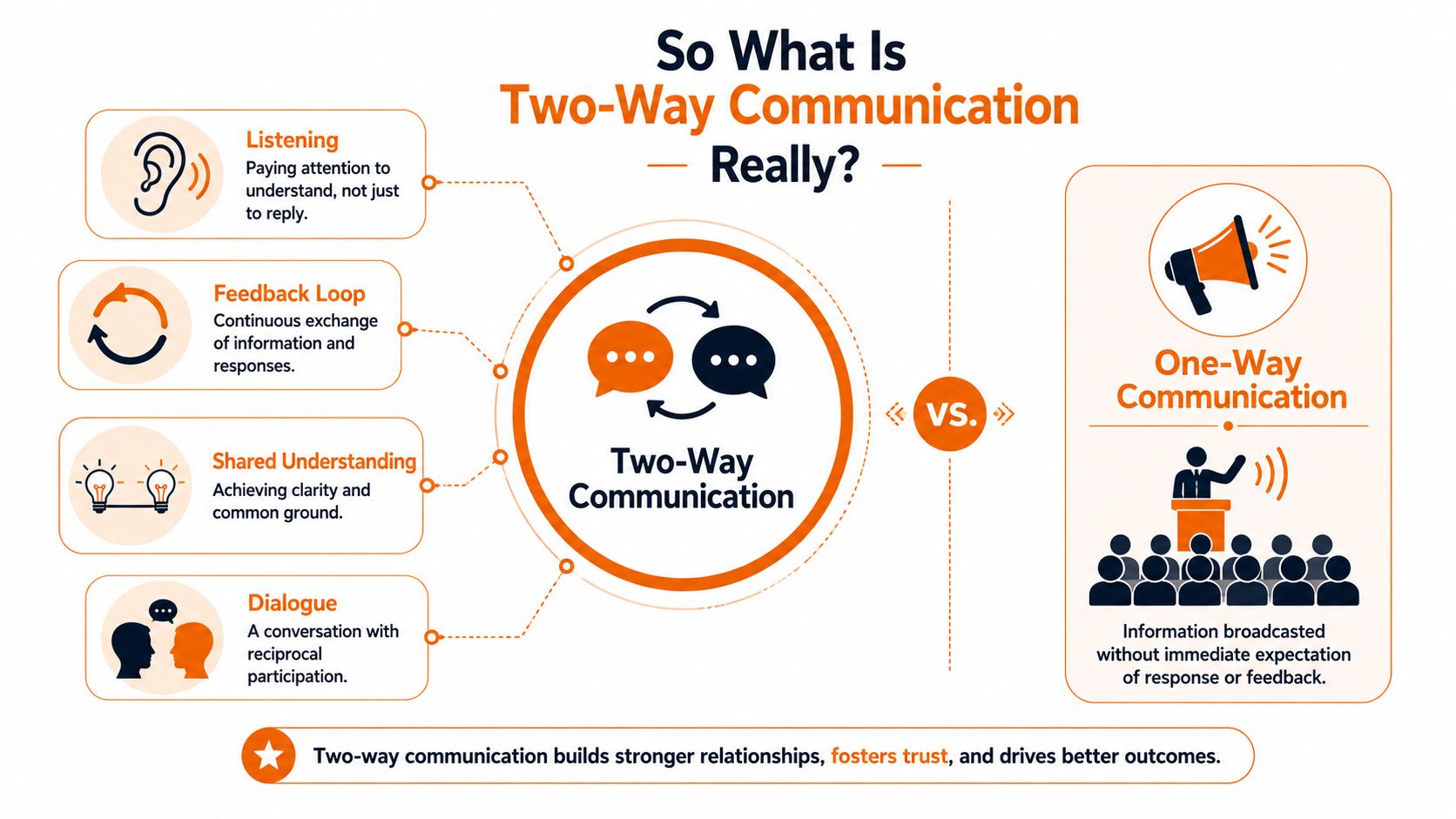
Communication isn't complete until feedback happens
A solid definition comes from the classic communication model. It includes seven core components: message, sender (encoder), receiver (decoder), channel, feedback, noise, and context. The part people skip is the part that makes it work. Feedback is what confirms whether the message was understood, and when teams use it consistently, it can reduce communication errors by up to 40% in workplace settings, according to Statistics Canada's discussion of communication models.
That's why asking “Did everyone get this?” isn't enough. Real feedback is more specific than that. It sounds like:
“Tell me how you'll handle this on your shift.”
“What part of this policy is unclear?”
“What will make this hard to follow in practice?”
Those questions turn transmission into understanding.
What it looks like in real work
In practice, two-way communication means the sender isn't the only active party. The receiver can answer back in a way that changes what happens next. A dispatcher sends an update. A driver confirms the route issue and flags a timing problem. A manager shares a schedule change. Staff point out a conflict that wasn't visible from the office. A nurse leader explains a process update. The care team asks for the exact step that applies during a busy handoff.
Good communication isn't “message delivered.” It's “message understood, tested, and adjusted.”
There's also a technical side to this. In some systems, two-way communication is designed around bidirectional exchange and acknowledgment, where the receiver provides a verifiable response that confirms comprehension, as described in this architectural guidance on bidirectional feedback loops. You don't need to be an engineer to appreciate the point. Closed loops prevent bad assumptions.
One-way has its place. It's just smaller than people think
Not every message needs a long discussion. Fire alarms, legal notices, emergency alerts, and certain policy statements may need a direct broadcast first.
But even then, the work doesn't end at announcement. People still need a way to ask, confirm, and adapt. Otherwise leadership is just publishing, not communicating.
Why This Is More Than a Soft Skill
A lot of leaders talk about communication as if it lives in the same bucket as morale posters and workshop icebreakers. That's a mistake. In a business with shifts, sites, departments, and deadlines, two-way communication is part of the operating system.
It affects whether people understand what to do. It affects whether problems surface early or late. It affects whether frontline teams trust office teams enough to raise a concern before it becomes a mess.
That's not soft. That's throughput, retention, and recovery speed.
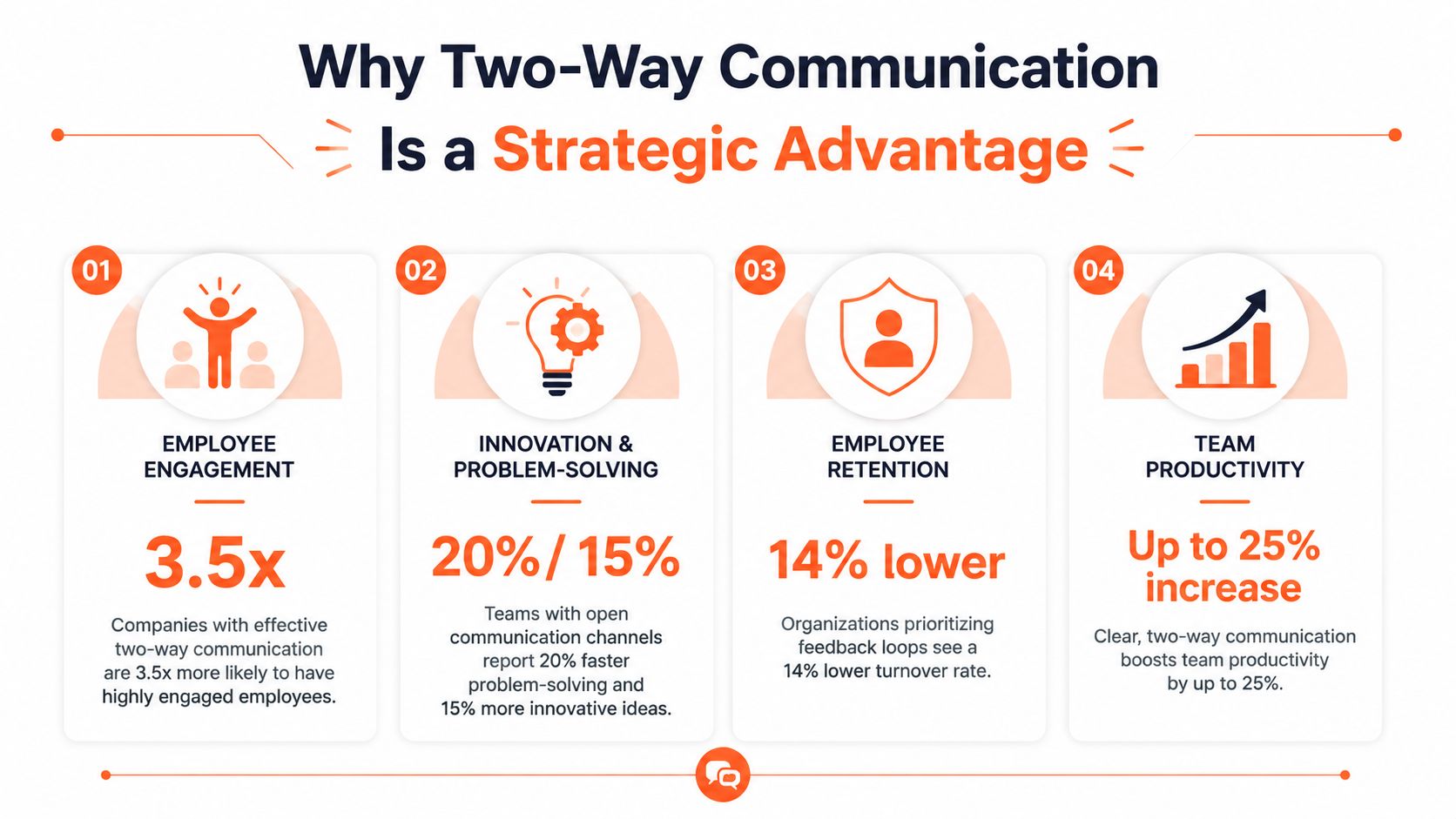
The business case is straightforward
When companies build structured two-way feedback systems, the results are measurable. Organizations using those systems see a 35% increase in employee engagement scores and a 22% reduction in turnover rates within 12 months, compared with companies that rely on top-down communication, according to Vonage's overview of two-way communication.
If you lead operations, those numbers point to something practical. People stay longer when they feel heard. They engage more when they know their voice changes something. And teams work better when questions don't have to fight their way through hierarchy just to be acknowledged.
Frontline reality changes the stakes
Office teams can often compensate for weak communication. They have meetings, calendars, inboxes, and quick access to leaders. Frontline teams don't always have that luxury. They're moving. Serving customers. Handling patients. Loading trucks. Covering shifts.
So when communication breaks, the frontline pays first.
Here's where two-way systems earn their keep:
Faster clarification. Teams don't lose half a shift waiting for someone to interpret a vague message.
Better judgment at the edge. The people closest to the work can flag what leadership can't see from a spreadsheet.
Stronger retention. Employees are less likely to feel invisible or managed by memo.
When people can answer back, leaders get reality sooner.
This is how efficiency actually improves
Many companies chase efficiency by tightening control. More approvals. More formal announcements. More polished messaging. In practice, that often slows the organization down because the message reaches the floor without enough reality in it.
Two-way communication works the other way. It lets the message meet the work early, while there's still time to adjust. That means fewer avoidable mistakes and less manual cleanup from supervisors who are constantly translating office language into something usable.
A communication culture that invites response also changes who gets to contribute. The office doesn't stop being important. It just stops being the only place where understanding gets defined.
It's also a retention system
People rarely leave because of one memo. They leave after months of preventable friction. They stop believing feedback matters. They stop raising issues. Then they stop seeing a future with the company.
That's why I don't put two-way communication in the “people stuff” category. It belongs next to scheduling, staffing, safety, and execution. If your teams can't reliably ask, answer, confirm, and close the loop, you don't have a communication issue. You have an operations issue.
The Four Walls That Block Real Conversation
Most companies don't fail at communication because nobody cares. They fail because a few predictable barriers keep showing up, and everyone starts treating them as normal. They aren't normal. They're structural.
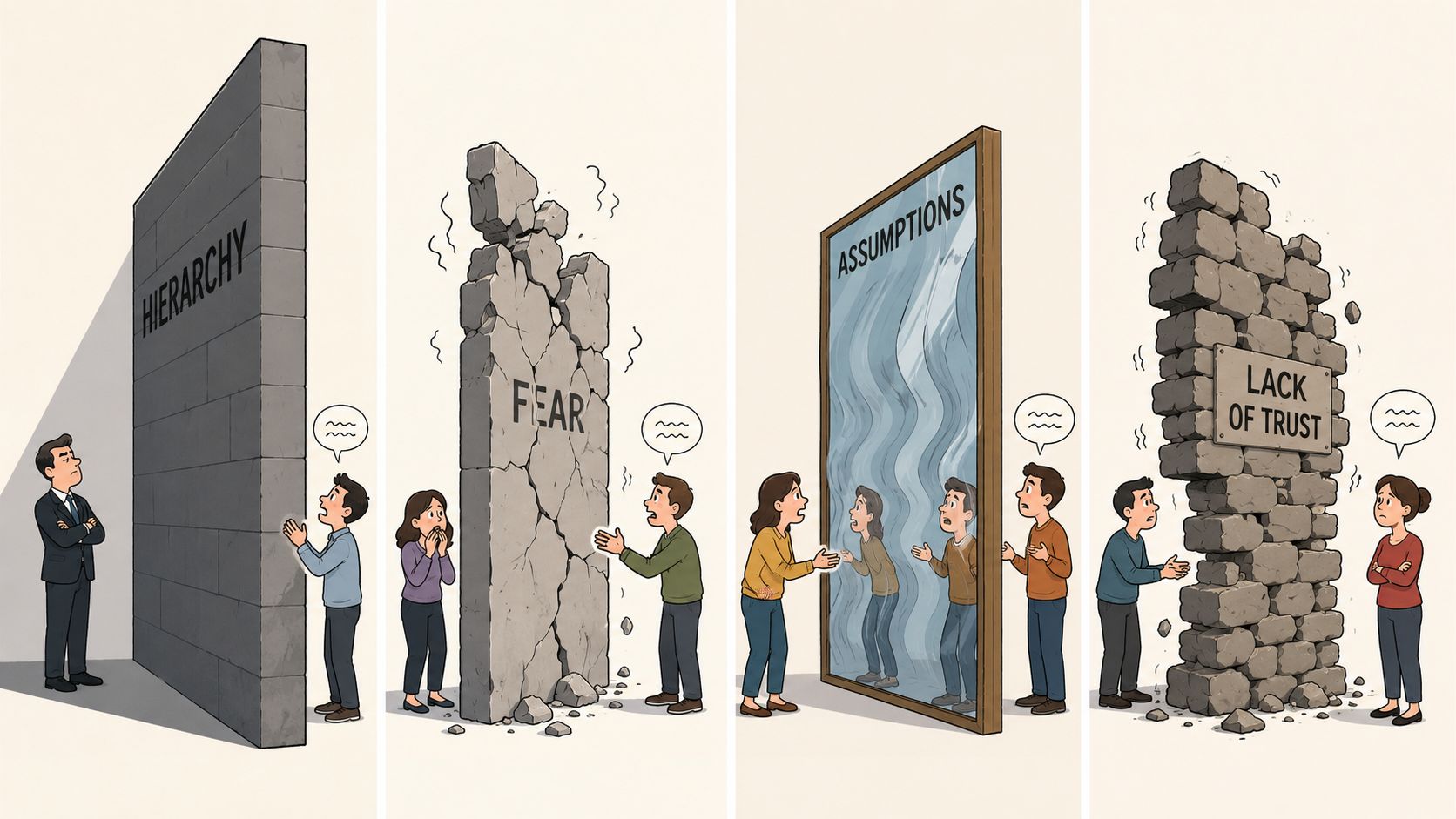
If you can name the walls, you can start removing them. If you can't, people keep blaming attitude for what is really design. A useful place to start is this guide to common communication barriers in the workplace, because most breakdowns don't come from one dramatic failure. They come from the same few obstacles repeated every day.
The wall of hierarchy
This one sounds like, “I didn't want to question the decision,” or “That came from head office, so we just had to deal with it.”
Hierarchy is useful for accountability. It's terrible when it blocks signal. Frontline employees often see the problem first, but if speaking up feels risky, leaders get a filtered version of reality. By the time the issue reaches the top, it's already expensive.
A healthy chain of command should help information travel. It shouldn't punish it.
The wall of silos
Departments love to optimize their own view of the world. HR sends one message. Operations interprets it another way. Store managers explain it a third way. The result is not alignment. It's fragmentation with branding.
This wall is especially damaging in companies with both office and frontline teams because every handoff adds interpretation. The people writing the message and the people living with it often work in different rhythms, use different tools, and care about different constraints.
The wall of wrong tools
Some tools are built for discussion. Some are built for recordkeeping. Some are built for urgency. Companies get into trouble when they use one tool for all three.
Email is a classic example. It can work for formal documentation. It's often poor for fast clarification with distributed frontline teams. A printed notice can be necessary. It's useless as a feedback channel. A chat thread can solve a problem quickly. It can also bury a policy update if nobody pins, confirms, or summarizes it.
The wrong tool doesn't just slow communication. It changes who gets to participate.
The wall of silence
This is the most damaging one because it teaches people not to bother. Leadership asks for feedback. Employees give it. Nothing happens. Or worse, something happens but nobody tells them.
Two-way communication is not a survey box. It's a loop. The loop closes only when people can see what changed, what didn't, and why. Without that last step, requests for input start to feel performative.
A quick diagnostic helps:
Wall | What it looks like day to day |
|---|---|
Hierarchy | Questions move up slowly, concerns stay hidden |
Silos | Teams hear different versions of the same message |
Wrong tools | Urgent updates get buried or missed |
Silence | Feedback is collected, then disappears |
When a company says, “People just don't speak up here,” one of these walls is usually doing the talking for them.
Building a Culture of Feedback That Works
Most communication fixes fail because they're too grand. A new value statement. A once-a-year survey. A town hall where leaders ask for honesty and then move on. People can feel the gap between ceremony and practice.
What works is smaller and more regular.
Two-way communication holds up when it's built into recurring habits. Not annual rituals. Daily and weekly mechanics. That matches what Prezent recommends for sustaining two-way communication, including weekly check-ins, open forums, and informal chats so feedback becomes an ongoing exchange instead of waiting for annual reviews.
Start with recurring moments
The easiest way to improve communication is to stop treating feedback as a special event. Put it where the work already happens.
A good weekly check-in doesn't need a long agenda. It needs a few honest prompts and enough consistency that people trust the pattern.
Try questions like these:
What's getting in your way this week
What changed on the floor that leadership should know
What are we saying in policy that doesn't match the reality of the work
What's one thing we should keep doing
Those questions invite useful friction. Not complaint for its own sake. Useful friction.
Close the loop or don't ask
One of the clearest truths about two-way communication is that collecting feedback isn't the finish line. Leaders have to act on it, or explain why they won't. That idea sits at the heart of TrueConf's view of two-way communication, which frames it as a circular process where leaders actively seek input and close feedback loops with visible action.
Trust either grows or breaks here.
When employees hear “thanks for sharing” and then see nothing change, they learn that participation is theater. When they hear, “We changed the schedule handoff because three teams raised the same issue,” they learn that speaking up is worth the effort.
One test: If employees can't name a recent change that happened because someone on the frontline raised it, your feedback culture is probably weaker than you think.
Use feedforward, not just postmortems
A lot of teams only talk after something goes wrong. That's better than silence, but it's still reactive. It helps to pair feedback with feedforward, which means asking what should happen next, not only what failed last time. This piece on feedforward versus feedback is useful because it shifts the conversation from blame to adjustment.
That small move changes the tone of meetings. Instead of asking, “Who missed the mark?” you ask, “What would help the next shift handle this better?”
Give managers a short script
Managers are the hinge. Most communication cultures rise or fall at the supervisor level. If supervisors aren't taught how to ask, listen, and confirm, the whole system gets patchy.
A simple script works better than vague advice:
State the change plainly. One sentence. No jargon.
Ask for the obstacle. “What makes this hard in real conditions?”
Confirm the understanding. “Tell me how you'll handle this.”
Report back. “Here's what we changed after your input.”
That rhythm is manageable. It also respects time.
Keep the bar low for speaking up
If feedback requires a perfect sentence, a formal meeting, or the courage to challenge a senior leader in public, many people won't do it. Give them lighter doors. Quick polls. Small group check-ins. Informal chats after shift. Space to raise practical concerns without making a speech.
You're not trying to turn everyone into a public speaker. You're trying to make reality easier to report.
And once teams get used to that pattern, communication gets calmer. Less guesswork. Less chasing. Less “I thought someone told them.”
The Tools You Use Shape the Conversations You Have
Culture matters more than software. That's true.
It's also true that bad tools train bad habits. If your frontline team has to dig through email, log into a desktop portal, or wait for a meeting to ask a simple question, you've made two-way communication harder than it needs to be. People won't fight that friction forever. They'll route around it.
Pick tools that fit the work
A decent communication stack should match how people work, not how headquarters wishes they worked. For teams split between desk-based and frontline roles, that usually means mobile access, clear channels for urgent versus non-urgent information, and simple ways to reply, acknowledge, or ask a question.
The checklist is practical:
Mobile-first access so frontline staff aren't excluded by default
Different lanes for different messages such as alerts, policy updates, chat, and knowledge
Built-in feedback mechanics so a message can become a conversation
Searchable history so supervisors aren't re-explaining the same thing all week
If you're evaluating options, this guide to internal communication software for frontline and office teams is a useful place to compare categories and trade-offs.
Tools don't fix trust, but they can support it
Some teams use Slack, Microsoft Teams, WhatsApp, email, intranet tools, or shift-specific apps. The question isn't which brand sounds modern. The question is whether the tool supports the behavior you want.
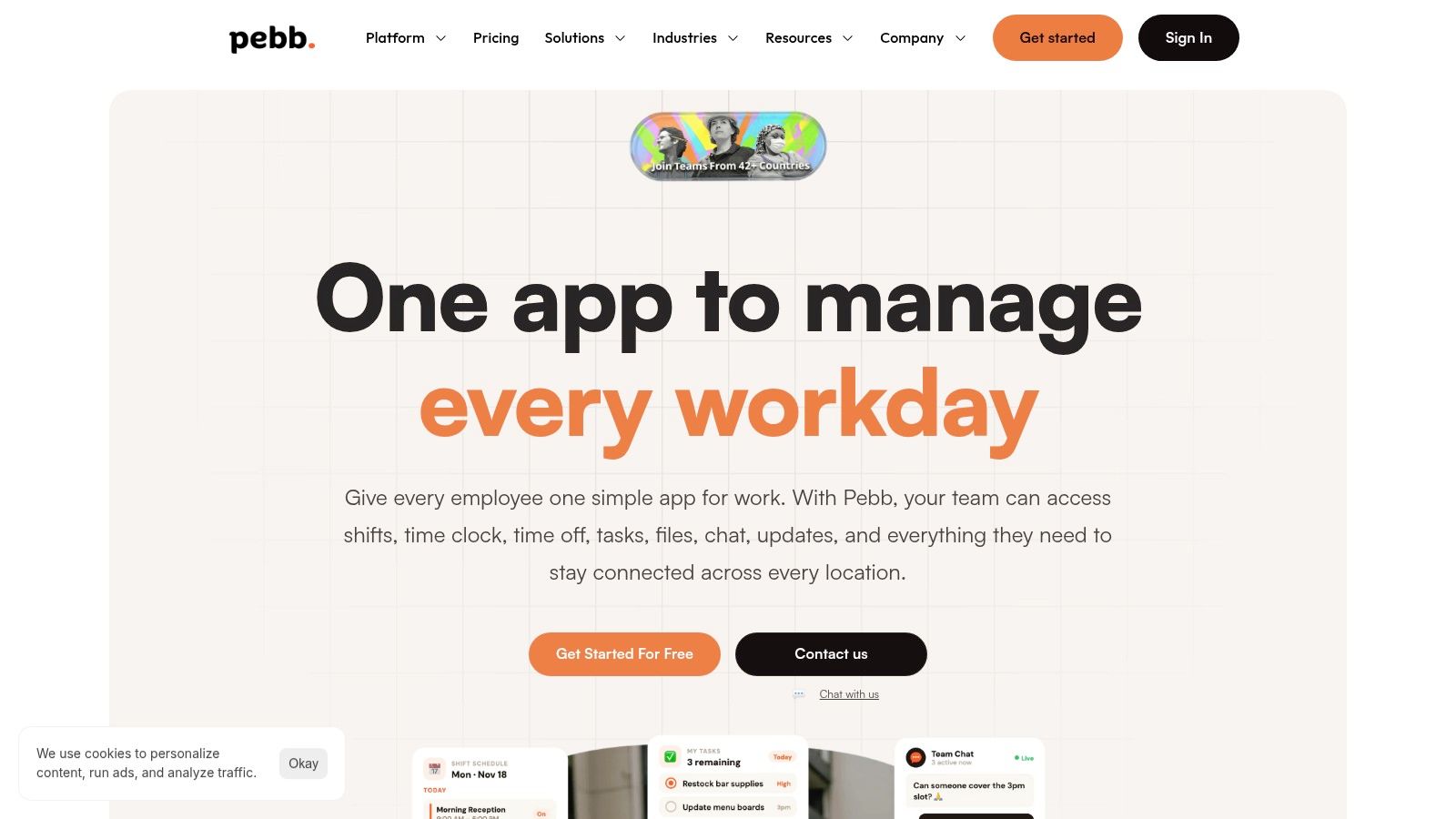
For example, a platform like Pebb combines work chat, updates, spaces, tasks, file sharing, and a mobile-friendly employee experience in one place. That kind of setup can help teams keep policy updates, questions, and daily coordination closer together, especially when office and frontline employees need access to the same information without relying on scattered systems.
The wrong tool creates distance. The right one removes excuses.
And once the friction drops, people do something very old-fashioned. They ask clearer questions, give faster answers, and stop treating confusion like part of the job.
The Sound of a Healthy Company
A healthy company doesn't sound like nonstop chatter. It sounds steady.
You hear a question asked early, before the mistake happens. You hear a supervisor say, “That won't work on the late shift, let's fix it now.” You hear office teams checking whether a policy makes sense in real conditions, not just in a document. You hear frontline teams answer back because they know someone's listening.
That sound is easy to recognize once you've heard the opposite. Less rumor. Less rework. Less translation by exhausted middle managers trying to make unclear decisions usable.
Two-way communication creates that calmer rhythm. Not because everyone talks more, but because the right people can respond at the right time.
If you listened closely to your company for a week, would it sound like a conversation or a broadcast?
If your teams need one place to communicate across shifts, locations, and departments, Pebb is built for that kind of day-to-day work. It brings chat, updates, voice and video calls, tasks, file sharing, scheduling, and a searchable people directory into a mobile-friendly app, so frontline and office teams can ask, answer, and stay aligned without jumping between disconnected tools.
