
Define Communication Barrier: A Guide for Real Workplaces
Let's define communication barrier not as a textbook term, but as the real friction holding your team back. Learn the types, causes, and how to fix them.
Dan Robin
You can spot a communication barrier before anyone names it. A shift starts late because the update sat in the wrong app. A store runs the old promo because headquarters sent the new one by email and the floor team lives in chat. A manager says one thing, a supervisor hears another, and the customer gets the fallout.
That’s why “define communication barrier” isn’t a school exercise. It’s a work problem. If your team can’t send, receive, find, or trust the right message at the right time, the job gets harder than it needs to be.
The Unsent Message and the Million-Dollar Mistake
A warehouse lead approves a change. The sales team thinks the order is still standard. Customer support flags a special request, but the note lives in a thread nobody on the floor checks. By the time the truck leaves, the wrong shipment is already wrapped, labeled, and halfway out the door.
Nobody planned to mess it up. That’s the point.
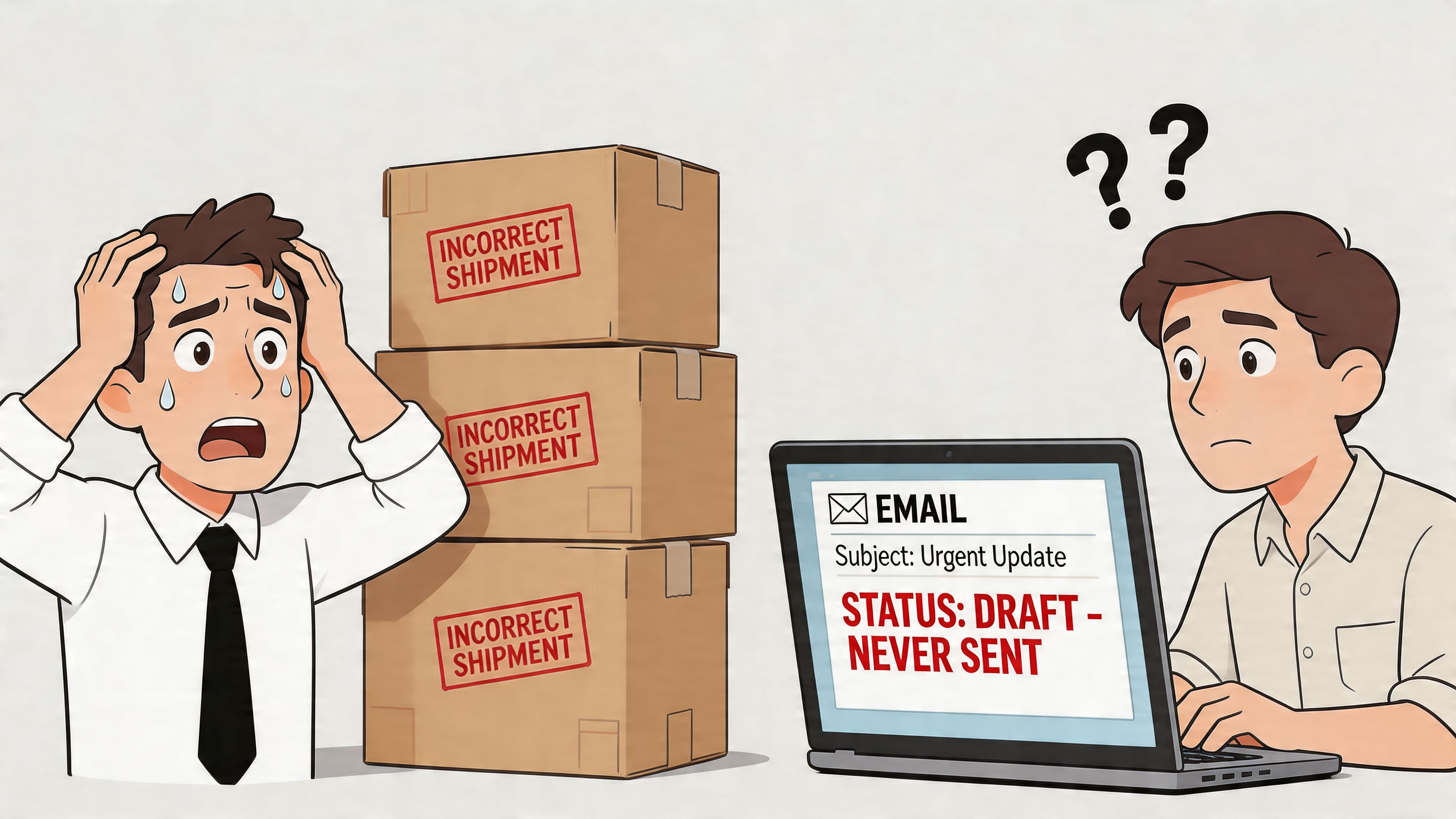
Most communication failures at work don’t look dramatic at first. They look small. A missed message. A vague instruction. An update sent to the wrong place. Then the cost shows up later in rework, frustration, refunds, missed deadlines, and people blaming each other.
If that sounds familiar, it’s because this isn’t rare. A 2026 study reported that 86% of employees and executives point to ineffective communication as the main reason for workplace failures, costing U.S. businesses an estimated $1.2 trillion annually, or over $12,500 per employee according to Sociabble’s workplace communication statistics.
I’ve seen teams waste more time arguing about what was said than fixing what broke. Once that happens, trust drops fast. People stop assuming the system will help them, so they build side channels. More texts. More calls. More screenshots. More chaos.
Poor communication rarely begins with bad intent. It usually begins with friction nobody took seriously early enough.
If you want a grounded look at how these failures show up day to day, this breakdown of problems in communication is worth reading. It gets closer to real work than the usual corporate advice.
So What Is a Communication Barrier Really
A communication barrier is anything that blocks, distorts, delays, or changes a message between the person sending it and the person receiving it.
That’s the formal idea, and it’s useful. Dr. Suruj Kumar Debnath describes these barriers as factors that inhibit transmission from source to receiver in this communication barriers reference. In plain English, if what you meant to say isn’t what they heard, a barrier got in the way.
Think of static, not silence
People often assume communication breaks only when nobody speaks. That’s too narrow. A barrier can show up even when everyone is talking all day.
It’s more like static on a radio. The signal exists, but it arrives warped. Someone hears half of it. Someone else fills in the blanks. Then the team moves forward on different versions of the same message.
A simple example is jargon. In mixed-expertise teams, industry jargon can reduce comprehension by up to 60% in the same SESRIC communication barriers reference. That’s what happens when one group says “KPI variance,” another hears “something is off,” and the frontline worker just wants to know what to change before lunch.
The practical definition
If you need a working definition you can use, use this:
A communication barrier is any obstacle that makes the right message harder to understand, trust, find, or act on.
That includes language, noise, hierarchy, bad timing, tool sprawl, and unclear ownership. It also includes the quieter stuff, like fear of asking a basic question or not knowing where the final answer lives.
For more grounding on what workplace communication means before barriers get in the way, this quick guide on what is workplace communication is a useful companion.
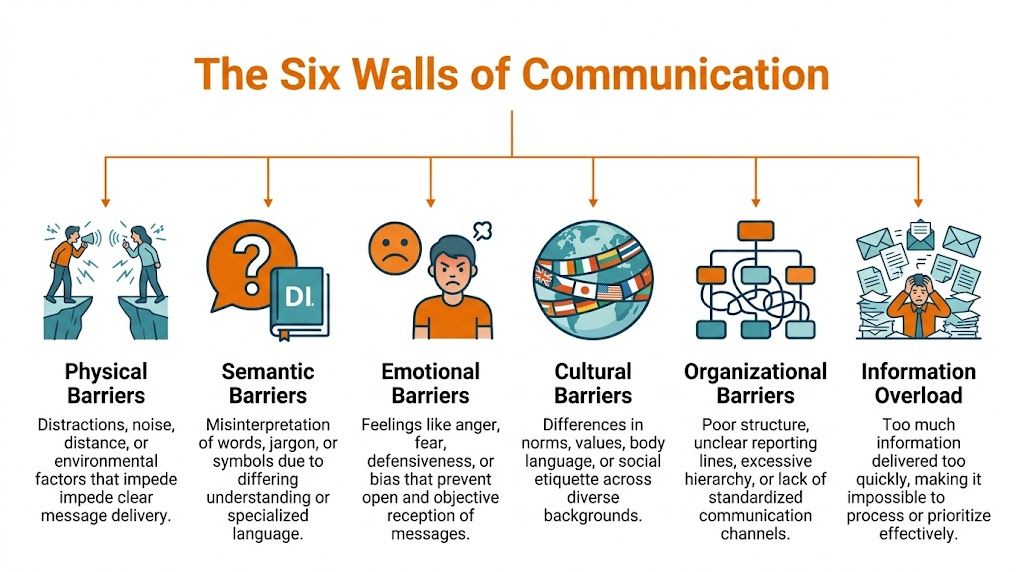
The Six Walls We Build Without Realizing
Teams typically don’t set out to create communication barriers. They build them by accident, one habit at a time.
One manager sends half the updates verbally. Another stores files in their own folder. A third uses acronyms that make sense only to veterans. Put that inside a business with multiple shifts, departments, and locations, and the walls go up fast.
Research backs that up. Poor manager communication skills were cited by 41% of employees as a common barrier, alongside jargon and constant distractions, according to Pumble’s workplace communication statistics.
The barriers that show up most often
Some barriers are obvious. Some hide inside normal work.
Barrier Type | What It Looks Like at Work | The Core Problem |
|---|---|---|
Physical | A supervisor gives instructions on a loud floor and half the team misses key details | The environment interferes with message delivery |
Semantic | Teams throw around acronyms, shorthand, and insider language | People attach different meanings to the same words |
Cultural | One employee sees direct feedback as useful, another reads it as disrespect | Norms and assumptions don’t match |
Organizational | Store teams, field teams, and headquarters all keep separate updates | Information gets trapped in silos and hierarchy |
Language | A non-native speaker understands the task late or incompletely | Meaning gets lost in translation |
Technical | Updates are spread across email, chat, spreadsheets, and project tools | People don’t know where the real answer lives |
What these walls look like in practice
Physical barriers are the old-school kind, but they still matter. Noise, distance, shift handoffs, and weak audio all change what people receive. This is why a message that works in a quiet office falls apart in a warehouse, hospital corridor, or busy restaurant.
Semantic barriers are self-inflicted. They come from writing for ourselves instead of the reader. Acronyms, shorthand, and polished nonsense make the sender feel efficient and make everyone else guess.
Practical rule: If a new hire can’t understand the message on first read, it isn’t clear enough.
Cultural and language barriers get brushed off as soft issues, but they’re operational. Different norms around tone, silence, urgency, or feedback can create friction even when the words look harmless.
Organizational barriers are what happen when the org chart becomes a communication map. The frontline hears news last. One department protects information because it feels safer. Another assumes “someone else already told them.”
Office design plays into this more than people admit. If your workspace creates constant interruption, visibility without focus, or awkward handoffs, communication gets worse. This piece on rethinking open plan office design is a useful reminder that the room itself can create noise before anyone opens their mouth.
Technical barriers are the newest wall and, in many teams, the tallest. When every kind of message has its own app, people stop knowing where to look. That doesn’t speed communication up. It just spreads it thin.
How Barriers Thrive in a Distributed Workplace
Distributed work doesn’t create every communication barrier, but it gives them room to grow.
A frontline manager starts the day in email because that’s where head office posts updates. Then they switch to chat for urgent issues, a spreadsheet for schedules, a project tool for tasks, and text messages because some staff never check anything else. By noon, they’ve spent more time hunting for information than using it.
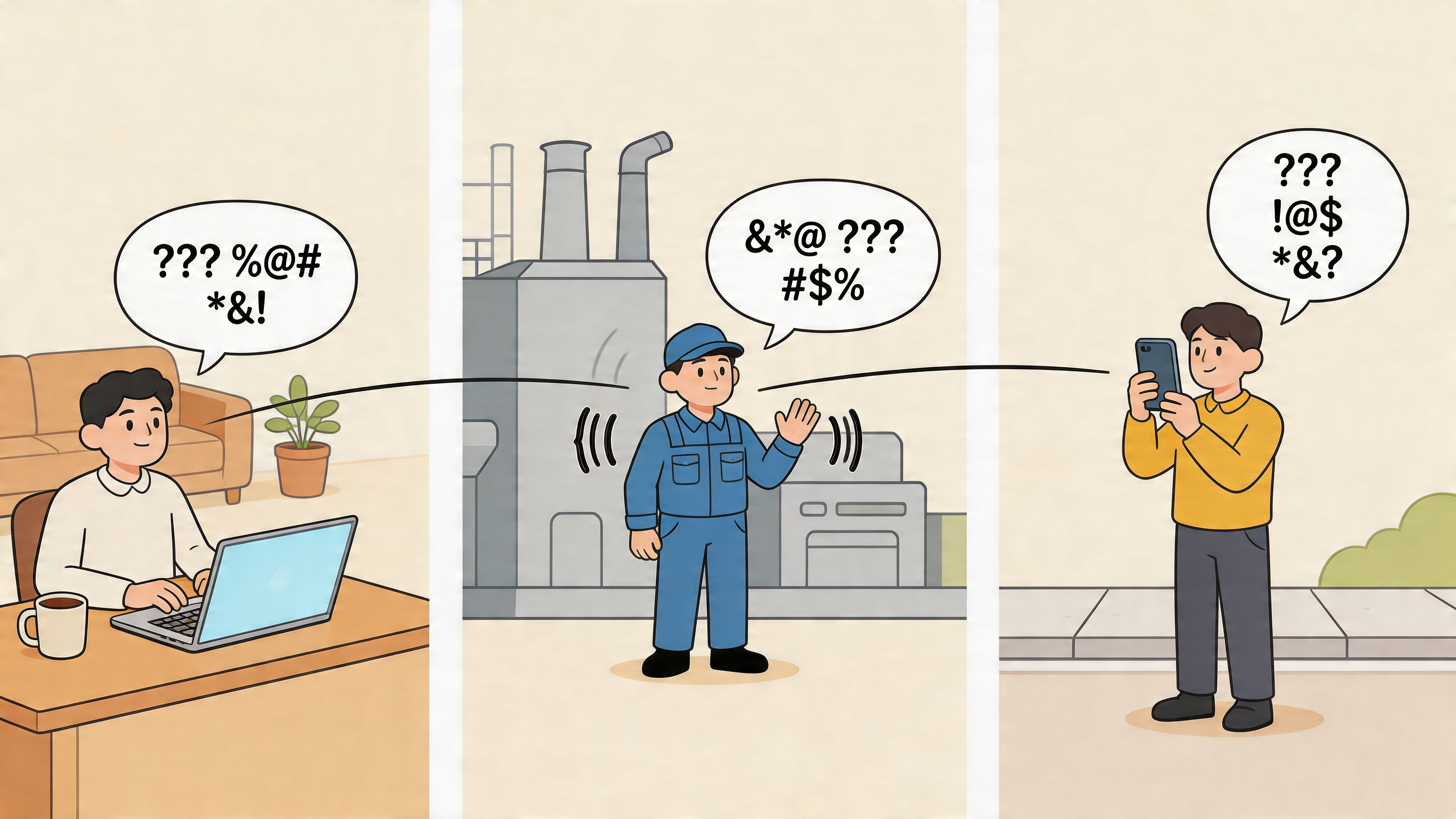
That mess creates a specific kind of failure. Not silence. Overload.
In some teams, tool fragmentation can overwhelm cognitive load and spike error rates by as much as 40%, while accents or poor audio in noisy settings can filter out up to 35% of intended meaning, according to Study.com’s overview of communication barriers.
The daily pattern
The pattern is usually the same.
Head office broadcasts. The field gets a polished announcement with no room for questions.
Supervisors translate. They re-explain the message in practical terms, often differently from one another.
Teams improvise. People act on whatever version reached them first.
Managers clean up. The rest of the day goes into correction, not progress.
That’s how silos form. Not because people are stubborn, though sometimes they are. Silos form because the system rewards local workarounds. If the official channel is slow, buried, or unclear, people create an unofficial one.
Why distributed teams feel this harder
Remote and frontline teams don’t share the same room, the same schedule, or the same context. One person joins mid-shift. Another checks messages hours later. A third never sees the post because it lived in a channel they don’t use.
When teams use too many tools, the real job becomes remembering where each conversation happened.
That’s why broad advice like “communicate more” falls flat. The problem usually isn’t volume. It’s fragmentation. If you want a sharper look at that specific problem, this guide to remote work communication challenges and fixes gets into the practical side.
Tearing Down the Walls One Action at a Time
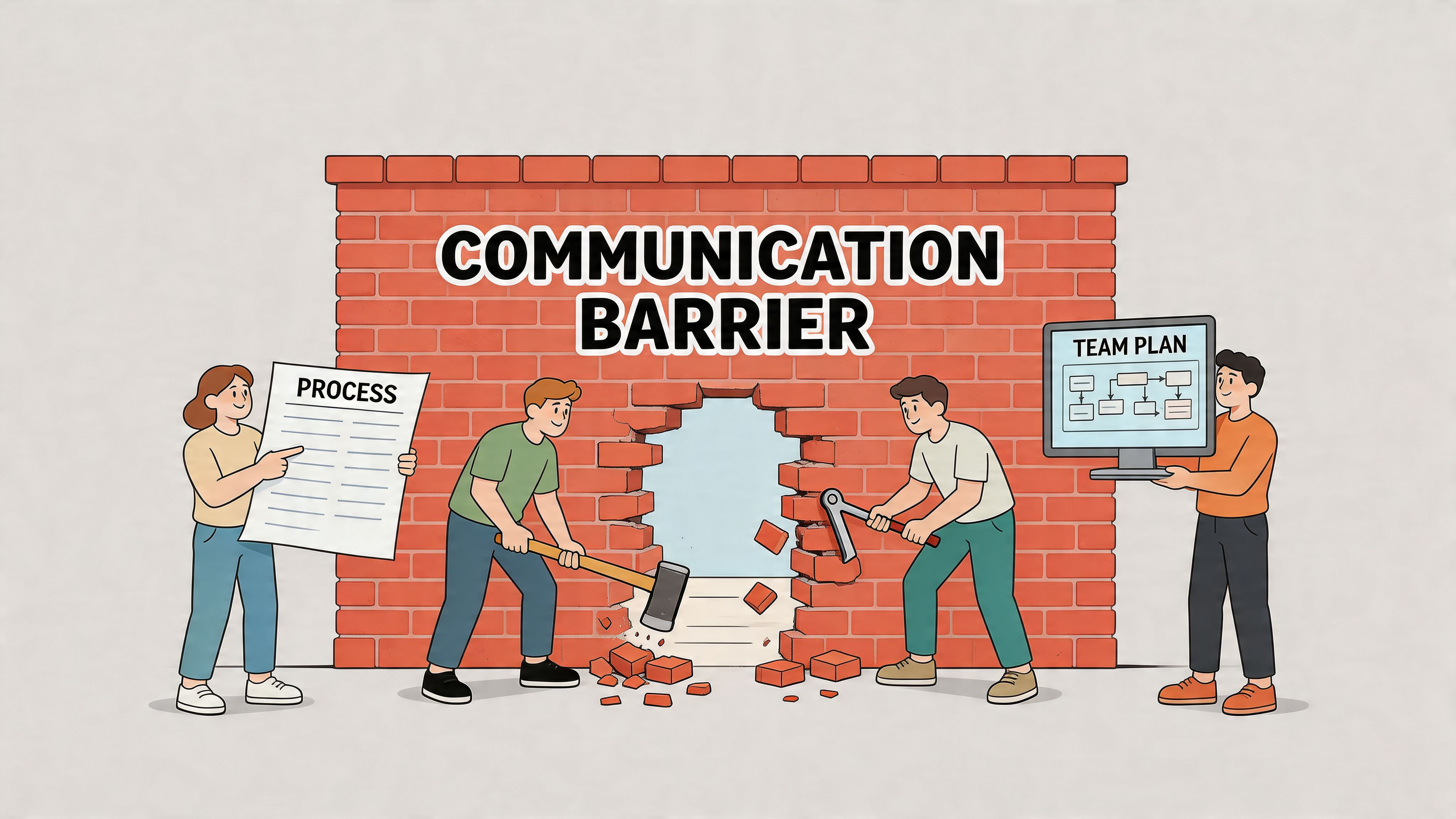
Teams don’t fix communication by holding another meeting about communication. They fix it by changing how work moves.
The useful changes usually fall into three buckets. Process, because people need a clear path. Behavior, because tone and clarity still matter. Tools, because bad systems make good habits collapse.
Start with process
A team needs one source of truth for key information. Not three possible places. One.
Policies, shift changes, task ownership, customer-impacting updates, and approved documents should live somewhere searchable and obvious. If a supervisor has to ask around to confirm the latest version, your process is broken.
What works is simple:
Define the home for each message type. Urgent alerts go in one place. Policies go in another. Tasks go somewhere trackable.
Name the owner. Every critical update needs a person responsible for accuracy.
Close the loop. Don’t assume “sent” means “understood.”
Then fix behavior
A clean process still fails if people communicate badly. Managers who ramble, bury the point, or hide behind vague wording create confusion no tool can rescue.
Drop the jargon when plain words will do. Ask people to repeat back key actions. Write dates, times, and ownership clearly. If the matter is sensitive, talk directly instead of launching another long thread.
A useful outside read on this is actionable strategies to improve team communication. The value isn’t in lofty theory. It’s in reminders that clear expectations, direct feedback, and listening are still the basics.
Clear communication is specific communication. Who does what, by when, and where the final answer lives.
Use tools that reduce, not add, friction
Many companies sabotage themselves. They keep layering tools and call it flexibility. In practice, it means nobody knows where to look and everyone duplicates work.
A unified tool can remove several barriers at once if it gives teams one place for updates, tasks, documents, and people. That’s the primary benefit. Not novelty. Less switching, less guessing, less rework.
Technology can either help or get in the way. Emerging data shows nonverbal tech barriers have risen 40% in hybrid work when interfaces ignore cultural norms, as noted in School Training Solutions’ discussion of cross-cultural communication barriers. That’s a reminder that rigid software often creates new friction while pretending to solve old friction.
One example is Pebb, which puts chat, posts, tasks, files, a Knowledge Library, and a searchable People Directory inside team Spaces. Used well, that setup helps reduce technical sprawl, gives teams a single place to find approved information, and makes cross-department communication less dependent on who happens to know whom.
The trade-off is straightforward. A unified system takes discipline up front. People have to stop hoarding information in private channels. But once that shift happens, the noise drops.
Beyond Just Talking The Real Goal Is Connection
Teams often express a desire for better communication. What they usually mean is they want less confusion, fewer surprises, and fewer days spent cleaning up preventable mistakes.
That’s fair. But the underlying goal goes deeper than efficiency.
When people can trust the message, find the answer, and ask a basic question without feeling stupid, work feels different. A night shift stops feeling invisible. A field team stops feeling like the last to know. A new hire stops pretending they understand terms nobody bothered to explain.
Communication barriers matter because they shape whether people feel included in the work or stuck outside it.
Good communication doesn’t just move information. It tells people they belong inside the same operation.
If you need to define communication barrier in one line, use this. It’s anything that gets between intent and understanding. If you want to fix it, don’t start with slogans. Start by asking where messages go to die on your team, who gets left out, and which tool or habit keeps making people guess.
That answer is usually more honest than any policy document.
If your team is tired of scattered updates, siloed knowledge, and too many apps pretending to help, take a look at Pebb. It gives frontline and office teams one place for communication, tasks, knowledge, schedules, and day-to-day coordination, without forcing people to stitch work together across disconnected tools.
