
Understanding What Is Split Shift: A Guide for Teams
Discover what is split shift, its definition, pay rules, and pros & cons for your team. Our guide helps you decide if a split shift is right for your business.
Dan Robin

A split shift is a workday broken into two or more paid parts with a long unpaid break in between, often at least two hours. In practice, that usually looks like someone working the lunch rush, going off the clock for the slow middle of the day, then coming back for dinner.
If you manage a restaurant, store, transit team, or service crew, you already know why this shows up on the schedule. The morning is chaos. The afternoon goes quiet. Then the evening hits hard.
On paper, the split shift looks tidy. You put labor where demand lives and stop paying people to stand around during the lull. I've built enough schedules to know why managers reach for it. But I've also seen what that long gap does to a person trying to build a normal day around work.
That tension is the core story. If you're asking what is split shift, you're not just asking for a definition. You're asking whether this scheduling move is smart, fair, legal, and sustainable for the people who have to live inside it.
That Awkward Gap in the Middle of the Day
The classic version happens in hospitality. Breakfast is busy. Mid-afternoon is dead. Dinner gets slammed. So a manager takes one long day and cuts it in two.
That's the split shift.
More precisely, a split shift is a work schedule where an employee's day is divided into two or more distinct paid work periods separated by an unpaid, non-working break exceeding one to two hours, a pattern commonly used in hospitality and retail when demand rises at separate points in the day, as described by AttendanceBot's explanation of split shifts.
Why managers keep using it
I understand the appeal because the math is easy to see. If customer traffic peaks twice, continuous staffing through the lull feels wasteful. You don't need a full floor team folding napkins and waiting for the next wave.
In that sense, split shifts aren't some strange HR concept. They're an operating choice. A very practical one.
But practical for the business doesn't always mean practical for the person wearing the apron or name tag. That unpaid gap in the middle of the day often isn't long enough to enjoy and too long to ignore. People sit in cars, kill time in break rooms, or make a commute that turns one workday into a much longer personal day.
A split shift solves a coverage problem for the business. It often creates a life problem for the employee.
The hidden question behind the definition
Most articles stop at the definition and move on. That's too shallow. The better question is why this schedule feels so divisive.
Some employees like the break, especially if they live close by or need midday flexibility. Others hate it because it fractures the day. Same schedule. Different reality.
So when people ask what is split shift, I answer it plainly. It's a schedule built around business peaks, not human rhythm. Sometimes that trade works. Sometimes it doesn't.
The Anatomy of a Split Shift
The easiest way to understand it is to lay the day out on a timeline. Think of a café worker opening in the morning and returning for the late afternoon push.
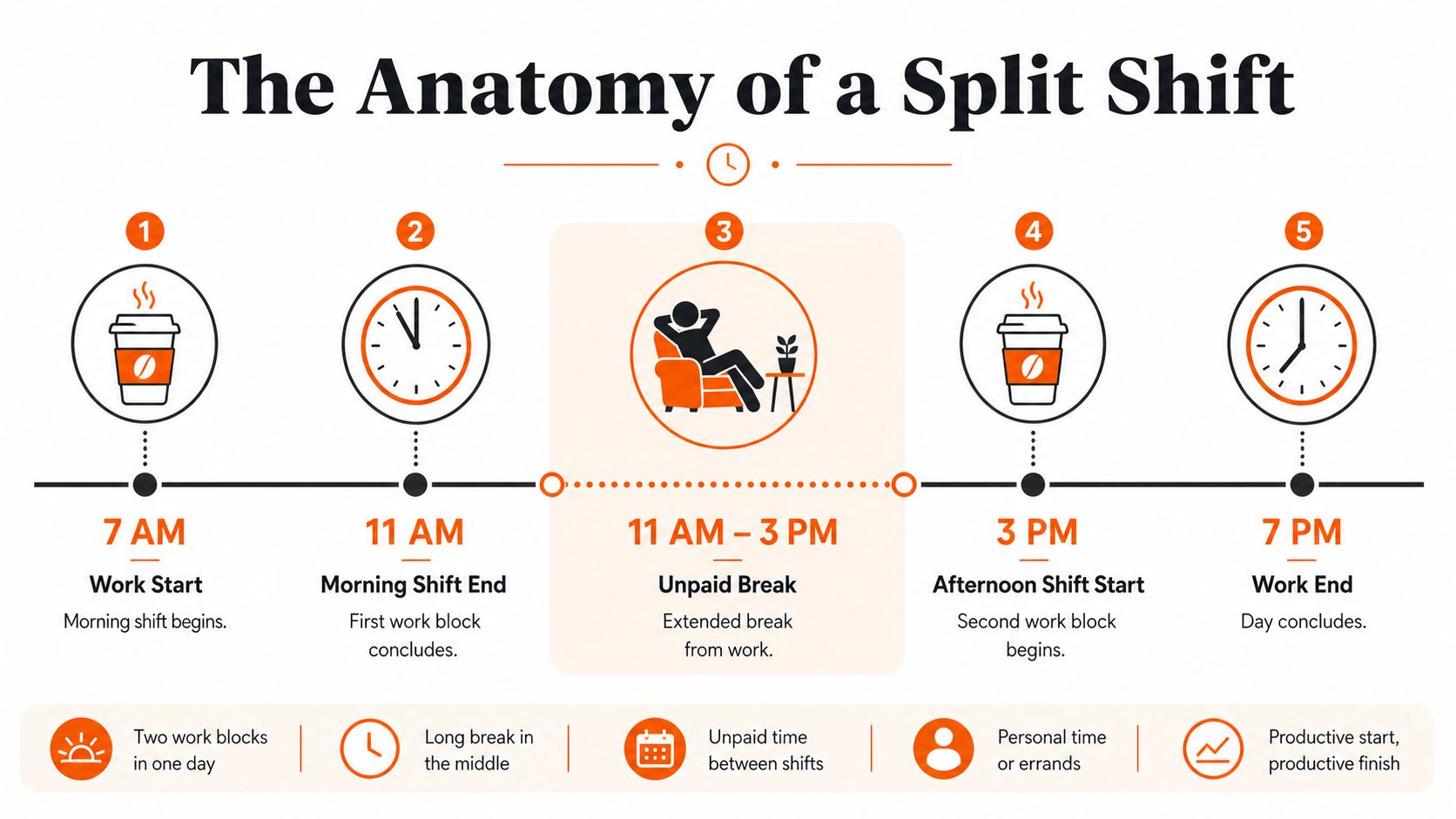
A standard example is this: 7:00 to 11:00, then off the clock from 11:00 to 15:00, then back from 15:00 to 19:00. That kind of schedule fits the accepted definition because the workday is split into separate paid segments with a long unpaid break in between, as outlined in Wikipedia's split shift overview.
What counts and what doesn't
A short lunch break inside a normal day is not a split shift. A regular 9-to-5 with a meal period is still one continuous shift for scheduling purposes.
What changes the category is the length and nature of the gap. The unpaid middle block isn't a normal meal break. It's a real interruption in the workday.
That's why a split shift feels so different to the employee. You're not taking a simple pause from work. You're stopping, leaving, waiting, and restarting.
If you're comparing different shift work schedule patterns, this is the one that stretches across the day without paying continuously across the whole span.
Why the model keeps showing up
Some industries are built around predictable waves:
Industry | Typical peak pattern | Why split shifts show up |
|---|---|---|
Restaurants | Lunch and dinner | Slow hours sit in the middle |
Passenger transport | Morning and evening commute | Demand clusters around travel peaks |
Retail | Opening and closing periods | Midday coverage may need fewer people |
This is why managers keep coming back to the format. It lines labor up with revenue-producing hours.
Practical rule: If the middle of the day is too quiet to justify full staffing, someone will eventually suggest a split shift.
That suggestion isn't wrong. It just isn't the whole story.
The Legal Maze of Split Shift Pay
Many managers assume split shifts are just a scheduling decision. They aren't. They're also a payroll decision, and in some places a compliance trap.
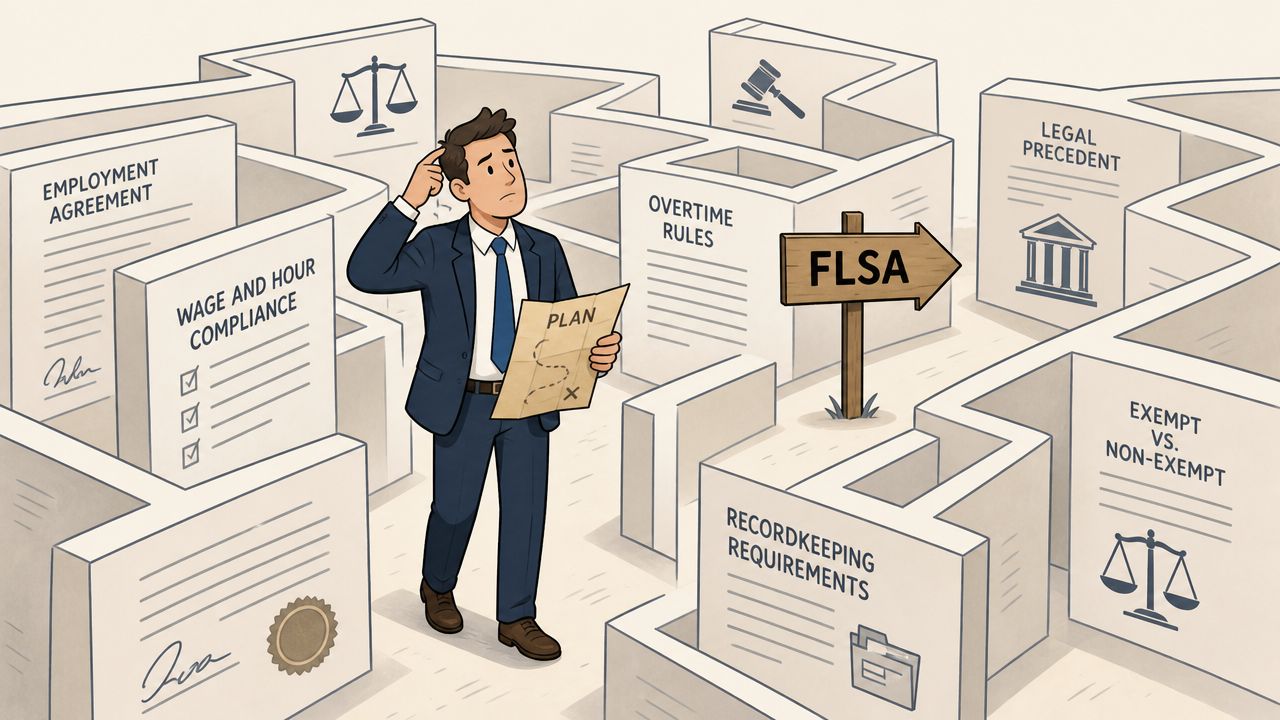
Under federal law, the FLSA does not require a split shift premium. But California does. There, employers may owe one additional hour of pay at the applicable minimum wage if the employee's daily pay falls short of what they would have earned at minimum wage for all hours worked plus one extra minimum wage hour, as explained in Homebase's guide to split shift premium rules.
Why that catches people off guard
Multi-state operators often face serious financial repercussions. A schedule that is perfectly ordinary under federal rules can trigger extra pay obligations in California.
The detail that matters is this: the premium is tied to the applicable minimum wage, which can mean the higher local minimum wage in some places. So the same scheduling habit can produce different payroll outcomes depending on city and state.
If you're already juggling break rules and California overtime calculations, split shift pay adds one more layer that managers can't afford to wave away.
The manager's version of the rule
You don't need to be a lawyer to understand the operating risk. Ask two questions every time you build one of these days:
Was the day split by an employer-set unpaid gap? If yes, keep looking.
Does local law require a premium? In California, the answer may be yes.
That's the part many teams miss. They design the schedule first and check the rule later. By then, payroll has to unwind the mess.
When a schedule creates extra pay obligations, “we didn't know” isn't much of a defense.
For California employers that need help interpreting wage-and-hour exposure around scheduling practices, employer protection services from Lerner & Weiss can be a useful legal resource. Not because every split shift becomes a lawsuit, but because routine scheduling errors have a way of becoming expensive when repeated.
Why the premium exists
The logic behind the premium is simple. The law recognizes that a split shift inconveniences the employee. The worker gives up the middle of the day, even if that time isn't paid.
That doesn't mean the extra pay solves the underlying frustration. It just means the law treats the inconvenience as real.
The Two Sides of the Schedule
Here, the spreadsheet and the human calendar start arguing with each other.

For the business, split shifts can be efficient. You cover peaks, avoid paying for dead hours, and keep the schedule tight. Managers like that because it feels disciplined.
For the employee, the day can feel chopped up. You may not have enough time to go home, rest properly, pick up kids, or handle life in any meaningful way. The break is unpaid, but it still owns the day.
What works for the business
There are real benefits, and pretending otherwise isn't useful.
Business upside | What it means in practice |
|---|---|
Better coverage | You staff the busiest windows instead of the whole lull |
Tighter labor control | Paid hours sit closer to customer demand |
Less idle time | Fewer people standing around waiting for traffic |
If you're running a dinner-heavy restaurant or a commuter-driven operation, that logic is hard to dismiss. Some businesses need that flexibility to stay sane.
What it costs the employee
Now the harder part. Recent findings from 2024 to 2025 show that employees on split shifts report 23% higher stress levels and 18% lower job satisfaction than workers on continuous shifts, and 31% of hourly workers would reject a split shift if offered a continuous alternative at the same pay. Since no source URL was provided with that verified data, the safest takeaway is qualitative as well as quantitative: the strain is not theoretical.
That matches what frontline managers hear when people are honest. The complaint usually isn't about the total hours. It's about the shape of the day.
The gap feels wasted: People are off the clock, but not really free.
Commuting gets worse: Two trips can turn a workday into an all-day obligation.
Routine falls apart: Meals, family time, errands, and rest stop fitting cleanly.
For employees who already struggle with rest, resources like SleepHabits' shift work sleep guide can at least help frame why broken schedules feel so draining. Managers should understand that fatigue isn't always about long hours. Sometimes it's about fractured hours.
The worst split shifts aren't always the longest ones. They're the ones that leave a person unable to use the break for anything that restores them.
The retention problem hiding inside efficiency
A split shift can save a schedule and still damage the team. That's the leadership tension.
People rarely quit because a manager used one split shift. They quit when the schedule keeps telling them their time is cheap. If the most reliable employees get handed the most inconvenient patterns because they're dependable, they'll eventually stop being available.
That's why I think split shifts need to be treated as a limited-use tool, not a default operating model.
Managing Split Shifts with Empathy and Tools
If you have to use split shifts, manage them like they have a human cost. Because they do.
The first fix isn't software. It's respect. Give people notice. Keep the schedule stable when you can. Don't spring a split day on someone at the last minute and act like the unpaid gap is a favor.
What better management looks like
I've found a few habits matter more than anything else:
Ask who wants them: Some employees prefer midday flexibility. Others don't. Don't guess.
Spread the burden fairly: The same dependable people shouldn't absorb every awkward schedule.
Build around commute reality: A split shift is harsher when someone lives far away or relies on transit.
Explain the why: People may still dislike the shift, but surprise plus inconvenience is worse than inconvenience alone.
That sounds basic because it is. Most schedule resentment starts with inconsistency and poor communication, not just the structure itself.
Where tools help and where they don't
A good scheduling app won't make a bad shift feel good. But it can reduce the administrative sloppiness that makes everything worse.
Look for tools that make the full week visible on mobile, support shift swaps, track clock-ins cleanly, and help managers flag patterns that could create payroll mistakes. If a team is managing rotating coverage and split days, a dedicated employee shift scheduling app can remove a lot of avoidable confusion.
Software can't create empathy. It can make it easier for a thoughtful manager to act on it.
The wrong way to use software is to automate inconvenience at scale. The right way is to make the schedule clearer, fairer, and easier to adjust before frustration turns into callouts or turnover.
A simple standard worth keeping
If you wouldn't want the schedule yourself, stop and review it. That's not a legal test. It's a leadership one.
Split shifts should be intentional, explained, and used sparingly. Once they become your lazy answer to every demand spike, the team feels it.
So Is the Split Shift Worth It
Sometimes yes. Often less than managers think.
A split shift can absolutely match labor to demand in a smart way. In the right setting, with the right people, it can be workable. Some teams even prefer it. But that's only true when the schedule fits real lives and not just labor targets.
The mistake is treating split shifts as neutral. They aren't. They shift cost off the payroll line and onto the employee's day. The business may save money. The worker gives up time, routine, and often peace of mind.
The real test
When you're deciding whether to use them, ask questions that don't show up in the staffing model:
Would my best employees choose this schedule repeatedly?
Am I solving a demand problem or avoiding a staffing problem?
If I use this often, what does it say about how we value people's time?
Those questions matter because culture isn't built in the handbook. It's built in recurring choices. The schedule is one of them.
So if you're still asking what is split shift, my answer is this. It's a useful tool with real costs attached. Not evil. Not elegant. Just consequential.
And the better question may be whether your schedule reflects the kind of company you want to run.
Pebb gives teams one place to handle the messy reality of frontline work, from scheduling and clock-ins to team communication, updates, tasks, and documents. If you're trying to run shifts without losing visibility or culture, Pebb is worth a look.
