
The Art of a Better Shifts Work Schedule
Stop the chaos. This guide shows you how to build a shifts work schedule that respects your team, boosts morale, and improves operations.
Dan Robin
The typical shift schedule is a quiet source of anxiety. It’s the last-minute text that nukes your evening plans. It’s the frantic scramble for childcare because you’ve been asked to work a double. It’s the nagging feeling that your life is permanently on-call, tethered to the whims of a spreadsheet.
For decades, we just accepted this as the cost of doing business in retail, hospitality, and healthcare. Instability was part of the job description.
But here's the thing: this chaos isn't just bad for people—it's terrible for business. High turnover, burnout, and disengagement aren't random misfortunes. They are the direct results of schedules that treat people like interchangeable parts.
This isn’t some abstract theory. It’s a reality playing out on warehouse floors, in hospital corridors, and behind cash registers every day.
The Real Price of Unpredictability
The core problem is a huge disconnect between how businesses plan their labor and how people live. "Just-in-time" scheduling, which tries to match staffing perfectly to customer demand, pushes all the uncertainty onto the employee.
Research from The Shift Project at Harvard paints a stark picture. A stunning 60% of service-sector workers get less than two weeks' notice for their schedules. This forces two-thirds of them to keep their personal lives "open and available" just in case. It's a system that might look good on a P&L statement in the short term, but it slowly erodes your most critical asset: your people. You can read the full research about these scheduling practices to see the data for yourself.
This constant uncertainty creates a ripple effect. When your team can't reliably plan medical appointments, attend their kids' school events, or even just schedule dinner with friends, their stress levels skyrocket.
The schedule is more than a list of times. It's the framework upon which your team builds their lives. When that framework is constantly shifting, everything else feels unstable, too.
To get a sense of the full scope of these hidden costs, it can be helpful for an individual to assess their own well-being with a tool like this Work-Life Balance Calculator.
A Calmer, More Thoughtful Approach
The good news is, there’s a better way. Moving away from chaotic, last-minute scheduling doesn’t require a monumental shift. It starts with a simple change in perspective—seeing the schedule not as a cost center to be minimized, but as a tool for building a more stable, engaged team.
Here is what a clear, predictable schedule can look like in a modern tool.
This view isn’t just about filling slots on a calendar; it’s about providing clarity. It gives everyone the confidence to plan ahead.
Let’s be honest. The old way isn’t sustainable. In the sections that follow, we'll walk through the practical steps for creating a calmer, more thoughtful shift work schedule—one that respects your team and, in doing so, builds a stronger business.
Understanding Common Shift Patterns and Their Tradeoffs
A shift schedule isn't a one-size-fits-all template. It’s a puzzle where the pieces look a little different for every business. To build a schedule that works, you first need to understand the basic building blocks.
Let's walk through the most common patterns and talk honestly about what each one feels like for the people working it. The goal isn’t to pick a single "best" schedule, but to see the real human trade-offs involved in each choice.
The Predictable Power of Fixed Shifts
The fixed shift schedule is the old reliable. Employees work the same days and the same hours, week in and week out. The morning person is always the morning person; the night crew is always the night crew. It’s beautifully simple and, most importantly, predictable.
For your team, this predictability is gold. It gives them a foundation to build a life outside of work—to schedule appointments, arrange childcare, or sign up for a weekly class. For the business, it builds tight-knit teams who get used to working together.
But that same rigidity is its weakness. If someone from the night shift calls in sick, it’s a huge ask for a morning-shift person to cover without blowing up their life. This model works best when your staffing needs are incredibly stable.
The real power of a fixed schedule lies in its respect for personal time. It sends a quiet message: your life outside this workplace matters. That builds loyalty.
The Dizzying Dance of Rotating Shifts
Then you have the rotating shift schedule, where employees cycle through different shifts—mornings one week, evenings the next, maybe overnights after that. You see this a lot in 24/7 operations like manufacturing or emergency services, where the idea is to "fairly" spread out the less desirable shifts.
But let's be real. While it might look fair on paper, this schedule can be brutal on the human body. Constantly yanking your sleep patterns around is a known health risk that leads to fatigue and burnout. A 2024 McKinsey study found that burnout rates are still alarmingly high, and you can bet erratic schedules are a big part of the problem.
The business gets flexible coverage, sure, but often at the expense of its team's well-being. And a tired employee is far more likely to make mistakes.
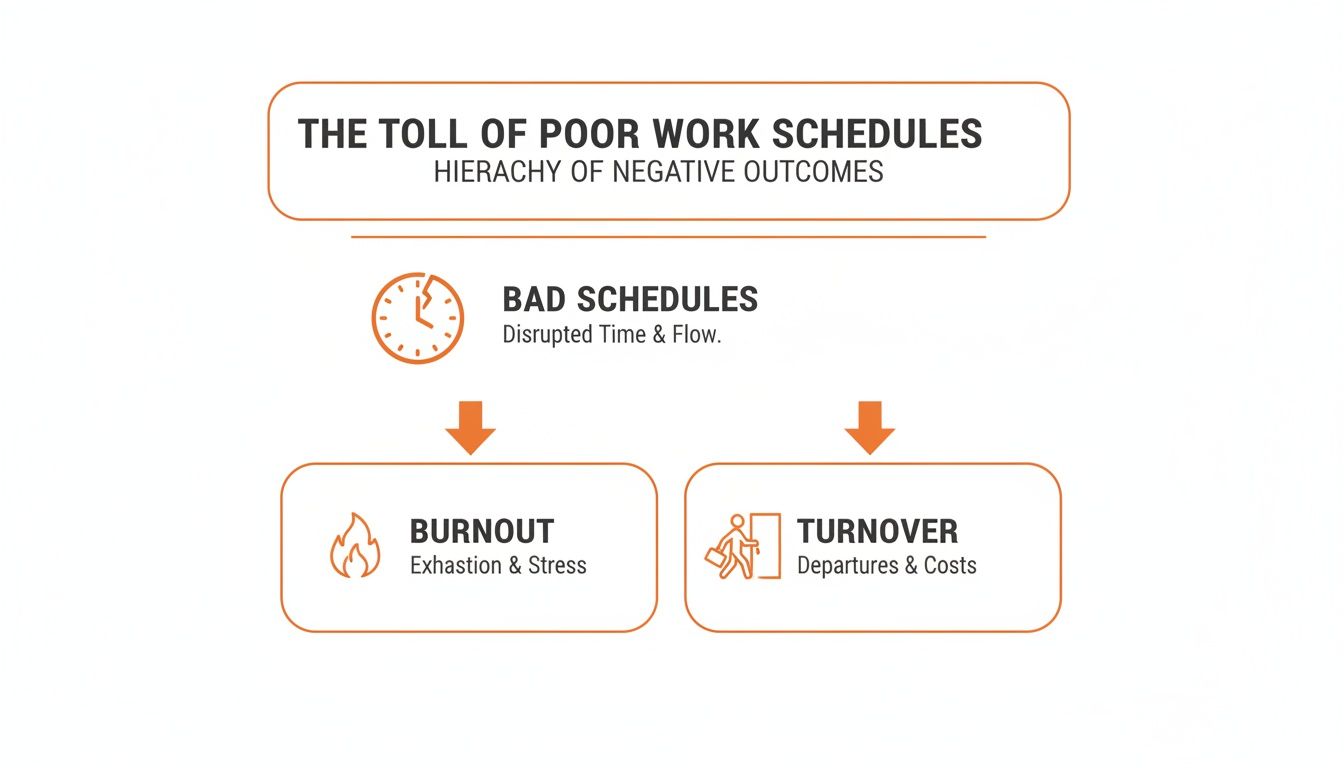
The path from a poorly designed schedule to losing your best people is shorter than most managers realize.
Comparing Common Shifts Work Schedule Patterns
Every scheduling model presents a different set of pros and cons. This table breaks down the core trade-offs between business needs and the real-world impact on your employees.
Shift Pattern | Best For Business When... | Impact on Employee Life | Key Consideration |
|---|---|---|---|
Fixed Shift | You have consistent, predictable demand and value team stability. | High predictability makes planning personal life easy and reduces stress. | Can be inflexible when unexpected absences or coverage gaps pop up. |
Rotating Shift | You need to cover a 24/7 operation and want to distribute unpopular shifts. | Very disruptive to sleep, health, and social life; high burnout risk. | The "fairness" it provides often comes at a steep cost to employee wellness. |
Split Shift | Your business has distinct peak periods with lulls in between (e.g., restaurants). | Creates awkward, unusable gaps in the day, making personal errands difficult. | Can save on labor during slow hours but may hurt morale and retention. |
On-Call Shift | You need experts available for unpredictable, urgent issues (e.g., IT, healthcare). | Creates constant mental load; the employee is never truly "off." | Compensation for on-call time must fairly reflect the disruption it causes. |
Looking at them side-by-side, it's clear the "perfect" schedule is less about a specific pattern and more about finding the right balance for your situation.
Split Shifts and On-Call Realities
Two other patterns you’ll run into are the split shift and on-call schedules.
A split shift breaks a workday into two chunks. Think of a restaurant worker who covers the lunch rush, takes a few hours off, and comes back for dinner. While efficient for staffing peak hours, it often leaves the employee with an awkward, unusable block of time in the middle of their day.
On-call schedules are standard in fields like IT support and healthcare, where a crisis can happen at any moment. While necessary, being on-call means an employee is never truly disconnected. The mental load of waiting for a call can be exhausting, even if one never comes. In high-stakes environments like hospitals, finding the best tools for coordinating shift changes is critical to preventing burnout.
Each of these patterns forces a trade-off between business efficiency and employee well-being. Understanding that balance is the first step toward building something better.
How to Build a Schedule That Actually Works
Let’s get practical. Building a shift schedule that doesn’t cause headaches is less about fancy software and more about a thoughtful process. It’s a series of deliberate choices, not a magic formula.
Think of this as a guide to balancing what your business needs with what your people need. It starts with getting honest about your daily operations.
Start with Real Coverage Needs
Before you touch a spreadsheet, you need a solid foundation. Get clear on your actual coverage needs—not what feels right, but what the data shows. When are you slammed? When are things dead quiet?
Too many businesses build schedules out of habit or guesswork. A smarter approach is to map out the rhythm of your operation. Dig into your sales data, customer foot traffic, or production logs, hour by hour. This simple exercise often reveals you're overstaffed during lulls and scrambling during predictable rushes.
Understanding this rhythm lets you staff smarter, not just harder.
Weave in Fairness and Consistency
Once you know what you need, the next hurdle is fairness. This is where most scheduling systems fall apart. Fairness doesn't mean treating everyone the same. It means applying the same rules to everyone, every time.
This is where documenting your process is a game-changer. Just like you would for any other key part of your business, you need to create standard operating procedures for scheduling. This moves decisions about shift assignments and time-off requests out of the "who asked last" zone and into a clear, transparent system.
A documented scheduling process is your best defense against claims of favoritism. It replaces subjective decisions with a clear system everyone can understand and trust.
Navigate the Rules and Regulations
You can't talk about scheduling without talking about labor laws. These aren't suggestions; they are hard rules with serious penalties.
For example, places like Los Angeles County are rolling out Fair Work Week Ordinances. These laws require things like giving schedules 14 days' advance notice and making sure employees get at least 10 hours of rest between shifts. They also introduce "predictability pay"—an extra hour of wages for certain last-minute changes.
Staying compliant means keeping meticulous records and thinking ahead. You have to save schedules, employee requests, and written consents for years. Building compliance into your process from day one is the only way to go.
Master the Handoff
Finally, a great schedule isn't just about having people in the right place. It's about making sure work flows smoothly from one person to the next. The shift handoff is a classic failure point—where crucial details get lost and mistakes happen.
A well-designed schedule accounts for this. It might mean building in a 15-minute overlap so outgoing and incoming staff can talk. It also means having one central place for shift notes—a single source of truth that isn't a rushed chat in the hallway. Our guide on how to share shift schedules with restaurant staff has some fantastic tips on this that work for just about any industry.
Building a schedule that works is an act of communication. Be clear on your needs, transparent with your rules, and thoughtful about transitions. Get those pieces right, and you're building a foundation of respect for your entire team.
Why Flexibility Is The New Standard
The conversation around work schedules has changed. For years, the deal was simple: the company dictated the hours, and employees showed up. Flexibility was a rare perk, not the norm.
That world is gone.
Today, flexibility isn't a perk; it's the baseline expectation. Your frontline team has more choices than ever, and they’re looking for jobs that give them more say over their time. The power dynamic has shifted. The old, rigid model just doesn't fly anymore.
The Pull of Autonomy
Let's be real. Nobody enjoys pleading for a day off or navigating a maze of approvals to swap a shift. People want simple ways to pick up open shifts, trade with coworkers, and get time-off requests approved without a week of back-and-forth emails.
This isn't entitlement. It’s about wanting the same control over their work life that they have everywhere else. They can order dinner, book a flight, and manage their bank account from their phone. Why should managing their shifts work schedule feel stuck in 1995?
The data backs this up. Recent research shows a staggering 82% of shift workers see control over their schedule as a top priority. The numbers speak for themselves— 40% say they'd consider a pay cut just to have more say over their hours. You can discover more insights about flexible work arrangements on epi.org. This isn’t a passing fad; it's a fundamental change in what people value.
More Control for Them, Fewer Headaches for You
Here’s where many managers get it wrong: giving your team more control isn't a loss of power for you. It’s the smartest move you can make.
When an employee can see an open shift on an app and claim it, that’s one less gap you have to scramble to fill. When two people can arrange a swap on their own—with your final approval, of course—that’s one less fire you have to put out.
Giving your team autonomy over their schedule isn’t about losing control. It's about creating a system so smart it practically runs itself. It frees you up to lead, not micromanage a calendar.
This approach changes the manager's role from a scheduler to a facilitator. You set the rules and define the needs, then help your team solve the day-to-day puzzles themselves.
Building a System That Works for Everyone
Embracing flexibility is about building a better system—one based on trust and respect. When you give people the right tools to manage their schedules, you send a powerful message: "We trust you. We respect your life outside of work."
That simple act does more for morale and retention than any pizza party ever will. It fosters a culture where people feel like active participants, not just names on a roster. They feel a sense of ownership.
Ignoring this shift is a huge risk. In today's labor market, a rigid schedule is a liability. It’s the silent reason your best people start looking for the door. The businesses that thrive will be the ones that stop fighting this change and build a calmer, more flexible way of working. It’s not just better for your people; it’s better for business.
Your Scheduling Tool Is Your Culture Tool
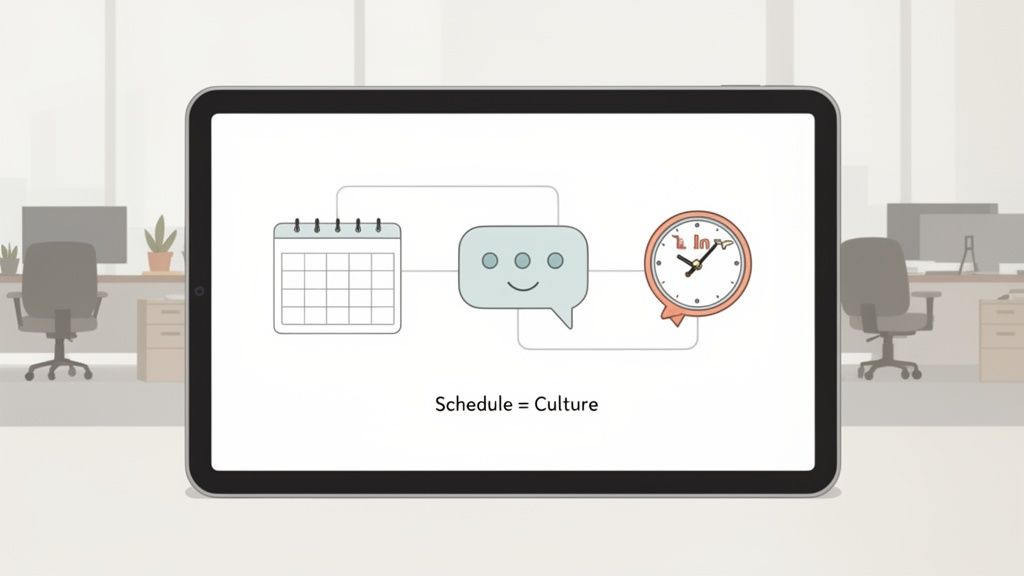
Let's be honest. The tools we use send a message. A clunky spreadsheet or a coffee-stained paper schedule pinned to a corkboard doesn't just look messy—it tells your team that scheduling is a chore and their time might be an afterthought.
Your shifts work schedule is a direct window into your company culture. It can be a source of daily frustration, or it can provide a foundation of clarity and stability.
For too long, we’ve treated scheduling like a separate, thankless task. But that’s a huge miss. The schedule is the pulse of your frontline team; it should be woven into the fabric of their entire workday.
From Static Document to Living System
This is where a modern, all-in-one tool changes everything. When you pull scheduling into the same app your team uses for communication and time clocks, you do more than make things convenient. You eliminate friction and create a single source of truth.
Suddenly, the schedule is no longer a static document that’s immediately out of date. It becomes a living, breathing part of the team's daily rhythm—dynamic, accessible, and always accurate.
The right tool transforms the schedule from a top-down mandate into a collaborative system. It stops being something that happens to your team and becomes something they participate in.
This shift feels small, but its impact is massive. It changes the dynamic from rigid control to shared ownership.
Connecting the Dots for a Better Experience
Think about the usual scheduling chaos. The schedule is on a spreadsheet, but shift swap requests happen in a group text. PTO forms are in the back office, and announcements are on a bulletin board no one looks at. It's a jumble of systems that creates confusion.
Now, picture a different scenario.
Integrated Communication: A last-minute shift opens up. A notification pings the team's chat space, and someone claims it with a tap. Problem solved in seconds.
Seamless Clock-In: Your phone buzzes with a reminder for your upcoming shift. When you arrive, you open the app you're already using and clock in. Effortless.
Unified Information: The weekly schedule lives right alongside team checklists and important updates. It’s all in one place, right in their pocket.
When all these pieces are connected, work just feels less hectic. It feels organized. It feels like people’s time is respected. Finding the right employee shift scheduling app isn't just about plugging holes in a calendar; it's about building a smoother, more human experience for your staff.
A Tool That Respects Your Team
At the end of the day, the tool you choose is a proxy for how you see your people. A system that makes them jump through hoops sends a clear message: their time isn't that valuable.
On the other hand, a simple, mobile-first system that puts control and clarity in their hands says the opposite.
Investing in a modern tool pays for itself far beyond saved admin hours. It pays off in the culture it helps to build—one of clarity, fairness, and mutual respect. And in the long run, that’s the secret to building a team that wants to stick around.
Wrapping It All Up: A Calmer Way Forward for Your Team
We’ve dug into the nitty-gritty of shift work, from the human cost of a bad schedule to the nuts and bolts of building a better system. If you walk away with one thought, let it be this:
A good schedule isn't a zero-sum game. It’s about creating something predictable for the business that’s also flexible for the people doing the work. This isn’t a weak compromise; it's just a smarter way to operate.
Moving from chaos to clarity doesn’t mean flipping the company upside down overnight. Real, lasting change starts with a few small, intentional decisions.
The Power of Smart, Simple Choices
It begins with something as simple as committing to communicate every schedule change clearly. It’s about giving your team tools they’ll actually use—tools that live on their phones and make life easier.
The real goal is to build a system that feels fundamentally fair and respectful from the ground up.
When you build a schedule that lets people plan their lives, something incredible happens. They show up as their best, most focused selves. It’s a quiet change, but it’s the kind that improves everything.
This isn’t about being soft; it’s about being strategic. You're removing the constant, low-level stress that comes with unpredictable hours. In its place, you build a foundation of stability and trust that becomes a real competitive edge.
It's a System, Not a Silver Bullet
Look, there’s no magic template that will solve every problem. Finding a calmer way forward is about committing to a better process—one that treats the schedule not as a spreadsheet, but as the heartbeat of your operation.
It all comes down to balancing the needs of your business with the realities of human life. When you get that right, you’re not just filling shifts efficiently. You’re building a stronger, more resilient team. And that's a change worth making.
Frequently Asked Questions
We get a lot of questions from managers trying to nail down their team's schedule. Over the years, we've noticed the same ones pop up again and again. Here are a few honest answers to help guide your thinking.
What Is The Best Type of Shifts Work Schedule?
Honestly, there's no silver bullet. The idea that a single "best" schedule exists is a myth. A 24/7 hospital has wildly different needs than a local coffee shop, and their schedules should reflect that.
The best shifts work schedule is the one that keeps your business covered reliably while giving your team as much predictability and flexibility as possible. It's a balancing act. The real work is in weighing the trade-offs of different patterns—like fixed versus rotating—and landing on a system that supports both your business and your team.
How Can I Make Our Scheduling Process Fairer?
Fairness boils down to two things: transparency and consistency. It starts with getting the rules out of your head and onto paper. Create and share clear guidelines for how shifts are assigned, how weekends are handled, and how time-off requests are approved.
Fairness isn't about treating everyone the same. It's about applying the same rules to everyone, every single time. That’s what builds trust.
Next, get everyone on a centralized tool where the team sees the same schedule in real-time. This puts an end to the side-channel texts that make people feel like there’s favoritism at play. Finally, let employees swap shifts among themselves, with you giving the final sign-off. This gives them control and helps you fill gaps without playing middleman.
How Do We Get Our Team to Adopt New Scheduling Software?
If your team is pushing back on a new tool, it's usually because they've been burned by clunky software in the past. The trick is to introduce it by focusing entirely on what's in it for them.
Don't start with, "We're implementing new software."
Try this instead: "We found a much easier way for you to see your schedule, pick up extra hours, and swap shifts, all from your phone." See the difference?
Pick a tool that's genuinely simple and works great on a phone. Run a small pilot with a few trusted team members. Get their honest feedback and let them become your champions for the new system. When a tool solves more problems than it creates, your team will wonder how they ever managed without it.
Ready to build a calmer, more flexible shifts work schedule? Pebb brings your schedule, team chat, and daily operations into one simple app your team will actually love to use. See how Pebb can transform your scheduling today.
