
What Is Retail Operations? a No-Nonsense Guide
Wondering what is retail operations? This guide breaks down the core components, metrics, and pain points, showing how to build a team that runs like clockwork.
Dan Robin

Saturday at 11:15 a.m. is when a lot of stores tell the truth.
A promotion went live. The window signs are up. One associate thinks the discount applies to the full category. Another thinks it's for loyalty members only. The back room has stock, but nobody's brought it out. A customer asks for a size that the website says is available, and the person on the floor isn't sure whether that count is real or old. The line grows. The manager gets pulled to the till. Everyone's busy, and somehow the important work still isn't getting done.
That mess is often identified as a staffing issue, or an inventory issue, or a training issue. Sometimes it is. But usually it's a communication issue wearing one of those costumes.
That's why the question isn't just what is retail operations. The key question is what keeps the promise a store makes to customers from falling apart between head office, the stockroom, and the sales floor.
The Unseen Engine of Retail
Retail operations is easy to ignore when it's working. Shelves are full. Prices scan correctly. The team knows the day's priorities. Returns get handled without drama. Customers leave with what they came for, or at least with the sense that someone competent tried to help.
When it's broken, everyone notices.
I've seen stores with decent products and good people still miss the mark because the basics weren't connected. A planogram update sat in an email nobody on the early shift read. A promotion changed overnight, but the cash wrap didn't get the memo. A delivery arrived late, so the replenishment routine got skipped, and by noon the best sellers were missing from the floor. None of that sounds strategic. All of it affects sales, margin, and customer trust.
Retail operations lives in the gap between what the business intends and what the customer actually experiences.
That gap matters because retail is not a small side show. Retail sales are projected to reach $32.8 trillion by 2026, and in the United States the industry contributes $5.3 trillion to annual GDP and supports over 55 million jobs. Big numbers, yes, but the work still comes down to ordinary things done well, in the right order, by people who have the right information at the right time.
Why the floor tells the truth
A lot of strategy decks make retail operations sound like a back-office discipline. It isn't. It shows up in plain sight.
A missing item on the shelf means replenishment failed somewhere.
A long queue at checkout often means staffing, training, or task timing was off.
A frustrated customer usually met a process that made sense on paper and broke in real life.
That's why I think of retail operations as the unseen engine of the store. Customers don't come to admire the engine. They come to get somewhere. But if that engine misfires, they feel it immediately.
So What Is Retail Operations Really
The cleanest way to explain retail operations is this. A store is a theater.
Customers see the stage. They see the displays, the lighting, the products, the greetings, the fitting rooms, the checkout, the easy exchange, the polished experience. That's the part everyone talks about.
Retail operations is everything backstage that makes the stage work.
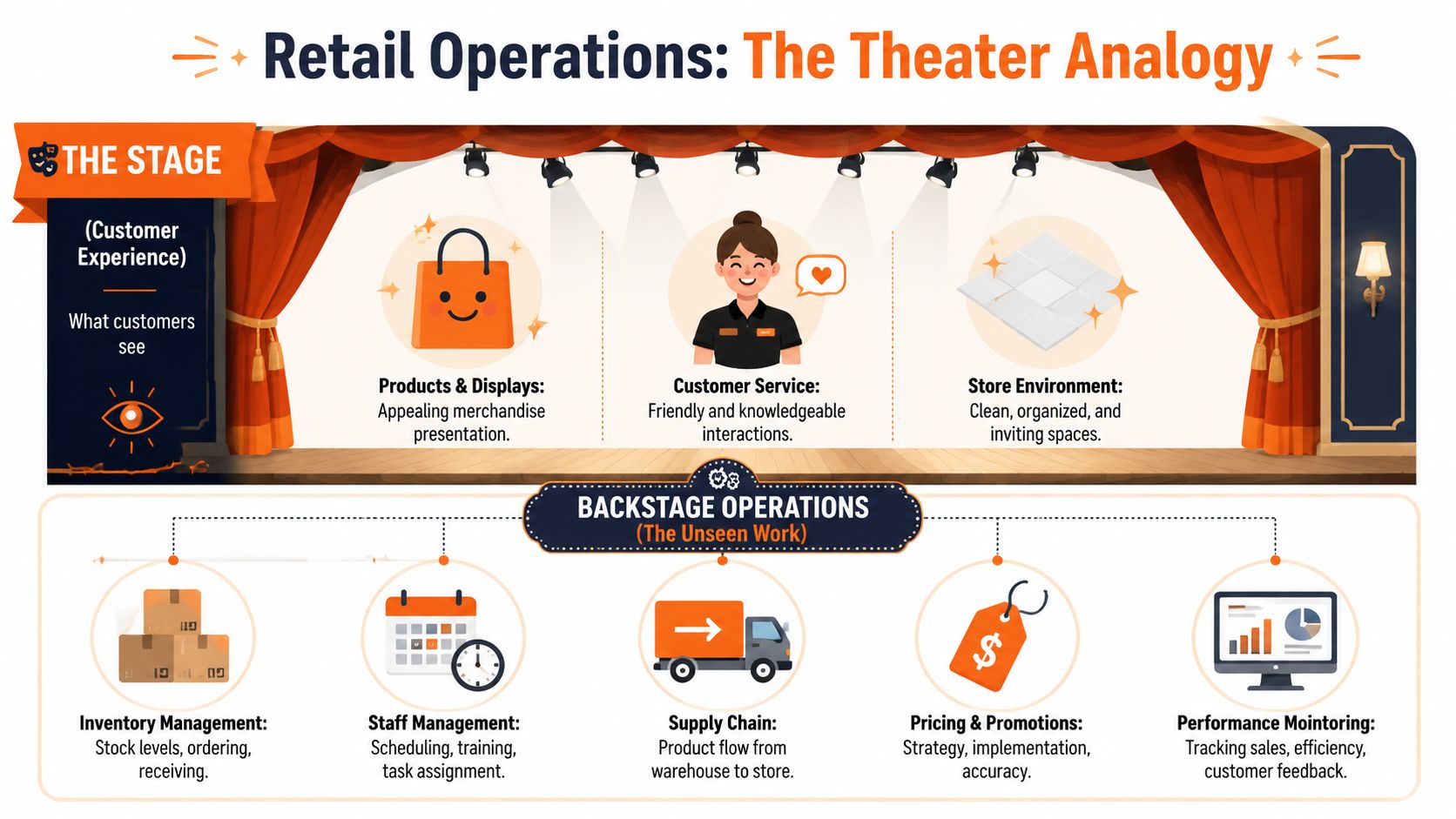
If you want a practical answer to what is retail operations, it's the day-to-day system that gets the right product, to the right place, with the right price, supported by the right people, at a cost the business can survive.
The stage and the backstage
On stage, the customer sees three things first.
What customers notice | What it depends on backstage |
|---|---|
Products and displays | Replenishment, merchandising, receiving, stock accuracy |
Helpful staff | Scheduling, onboarding, coaching, clear tasking |
Clean, calm store | Opening routines, maintenance, standards, follow-through |
Backstage is where critical work sits. Inventory has to be received, counted, and moved. Promotions have to be loaded and signed correctly. Schedules have to match traffic. Returns have to flow back into stock or markdown processes. Cash has to reconcile. Someone has to notice what's slipping before customers do.
Why it's more than store management
“Store management” sounds like one person keeping an eye on things. Retail operations is broader than that. It reaches from warehouse handoff to floor execution to checkout to after-sale service. It connects people, process, and tools so the brand promise survives contact with a busy day.
A good operation doesn't just keep the lights on. It protects margin. It reduces waste. It makes work predictable enough that teams can spend more time helping customers and less time cleaning up preventable mistakes.
Practical rule: If the customer experience depends on it happening consistently, it belongs to retail operations.
That's why this discipline matters so much. It sits under an enormous part of the economy, but its success is usually measured in small moments. The product is where it should be. The promotion is explained correctly. The line moves. The return doesn't turn into an argument. The customer gets a smooth experience and never sees the scrambling it took to avoid chaos.
That's the point. Backstage did its job.
The Core Components of Retail Operations
Retail operations covers a lot of ground, which is why people often describe it badly. They either make it sound like stock control, or they make it so broad it means everything and nothing.
I prefer a simple frame. Retail operations is about managing stuff, managing people, and managing risk. That's not the official org chart language. It's just the most honest version.
A stronger formal frame from T-ROC's overview of retail operations management defines seven core functions: staffing, merchandising and planogram execution, inventory replenishment, customer experience, technology systems, compliance and audit, and financial performance measurement. That list is right. What matters is seeing how tightly those pieces depend on each other.
Managing stuff
This is the physical side of the job. Inventory comes in, moves through the back room, reaches the floor, gets counted, sold, returned, transferred, or marked down. Merchandising sits here too. If the shelf is set wrong, pricing signs are late, or replenishment timing slips, the customer sees the failure immediately.
This part gets harder when supply chain execution is weak upstream. If you want a clear breakdown of the logistics side, Peak Transport's guide to WMS and TMS core components is useful because it explains the warehouse and transportation pieces that store teams inherit, whether they want to or not.
Managing people
People are not an “input” you plug in and forget. They are the operating model.
Scheduling, coaching, task clarity, shift handoff, and customer interaction all sit here. A store can survive imperfect displays for a day. It won't survive a team that doesn't know priorities or can't coordinate across shifts. This is why schedule quality matters so much. If you're reviewing that piece, it helps to look at how retail employee scheduling software affects coverage, handoffs, and last-minute changes on the floor.
Managing risk
This is the least glamorous part, which is why weak operators ignore it until it hurts.
Risk includes cash handling, compliance, audit routines, returns discipline, loss prevention, and policy consistency. It also includes quiet operational drift. The opening checklist gets skipped. The stockroom labels stop matching reality. Associates invent their own version of a return policy because the approved one is hard to find. A month later, leadership wonders why margin is under pressure and service scores feel uneven.
Strong retail operations doesn't treat these as separate departments. It treats them as one system with different failure points.
The work is connected or it fails
A bad roster creates rushed replenishment. Rushed replenishment creates poor shelf availability. Poor shelf availability creates missed sales and bad customer interactions. Then finance sees margin pressure and asks what happened.
That's retail operations. Not isolated tasks. One chain of execution.
Where It All Breaks Down and Why
Most struggling stores don't suffer from a total lack of systems. They suffer from too many half-connected systems and not enough shared understanding.
Head office sends updates by email. The store manager prints some of them. The opening team catches one version. The evening team hears another version in passing. The associate answering a customer question is left stitching together policy, memory, and guesswork. Then everyone acts surprised when execution looks uneven.
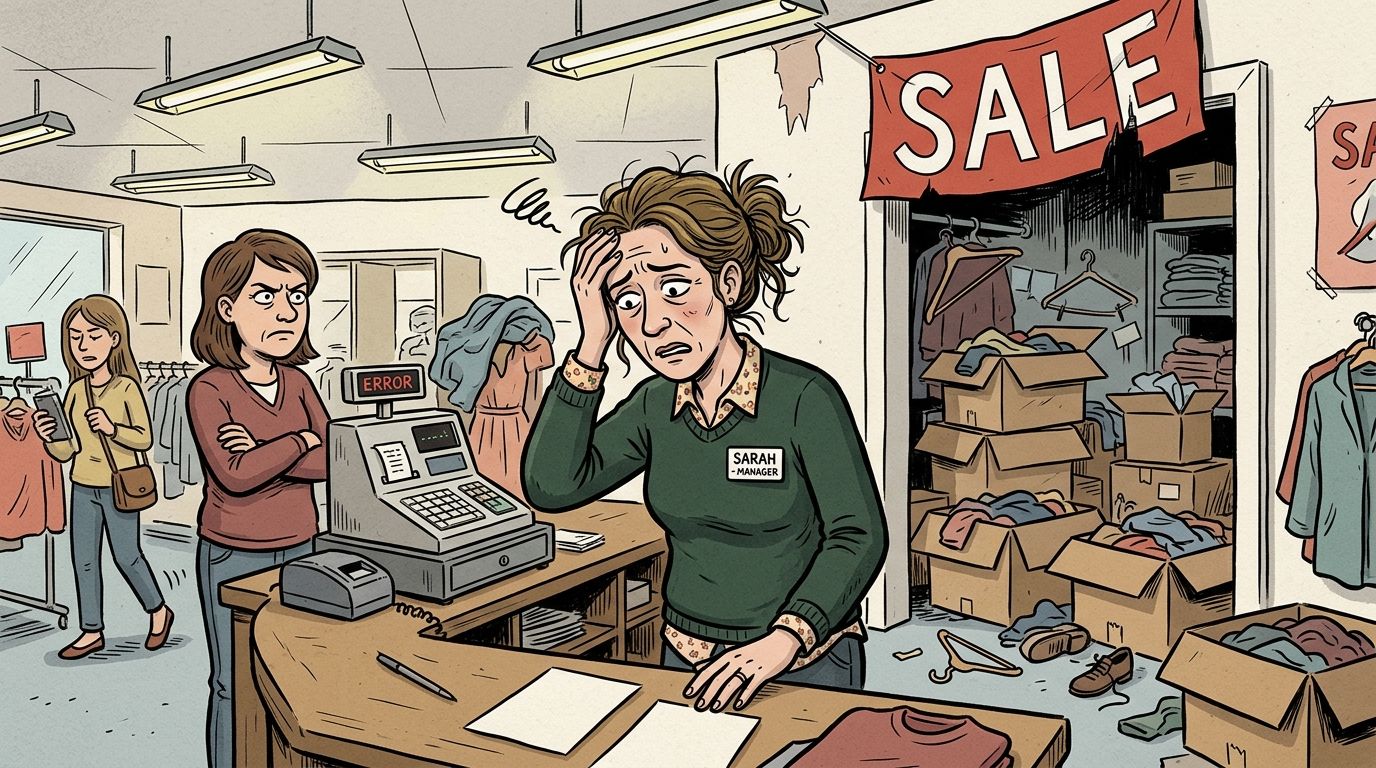
The industry talks a lot about theft, forecasting, and systems integration. Fair enough. But one of the ugliest retail problems is much more ordinary. 60% of retail shrinkage comes from internal process errors and communication breakdowns rather than external theft. That should change how managers think. Not every loss walks out the front door. A lot of it starts with bad handoff, unclear process, or a task that nobody owned.
What the failure looks like on the floor
The pattern is usually familiar:
The planogram changed, but the team resetting the aisle didn't see the update until after opening.
The stock issue was visible, but nobody logged it in a way the next shift could act on.
The promo terms were posted somewhere, but not where the cashier needed them during a customer conversation.
The receiving process broke, and the discrepancy sat unresolved because the right person was off that day.
These aren't glamorous failures. They're small misses that stack up. If you work in stores, you know how often operations falls apart this way. Not through one dramatic collapse, but through ten tiny disconnects before lunch.
Why binders don't fix this
Retail loves binders, SOP folders, laminated guides, and long email chains. They have their place. They are not a communication strategy.
The work on the floor changes by shift, by hour, and sometimes by minute. A static document can tell people the ideal process. It can't confirm that the right person saw the update, understood the priority, and finished the task. That's why so many stores feel “unglued” even when procedures technically exist.
A lot of this becomes clearer when you look at the larger flow of goods and information behind the store. This overview of warehouse operations is a useful reminder that what looks like a floor problem often starts earlier, then gets worse when nobody closes the communication loop at store level.
If frontline teams have to guess, you don't have an operations system. You have a hope-based system.
This is the breakdown. Not missing technology alone. Missing connection.
The Key Metrics That Actually Matter
Retail can drown in measurement. There's always another dashboard, another report, another score someone wants by Monday morning. Most of it doesn't help.
You do not need fifty metrics to run a good store. You need a handful that tell you whether stock is moving, labor is sensible, and customers are converting.
According to FocusCFO's breakdown of retail metrics, the five that matter most are Same-Store Sales, Inventory Turn, GMROI, Selling Cost, and Customer Conversion. They also make an important point. Most retailers fail to track GMROI and Inventory Turn together, which is exactly how teams end up proud of sales while cash gets trapped in the wrong stock.
Metrics that reveal the real story
Here's how I think about those five:
Metric | What it tells you | What can go wrong if you read it alone |
|---|---|---|
Same-Store Sales | Whether comparable stores are growing or slipping | Sales can rise while margin or labor discipline worsens |
Inventory Turn | How quickly stock moves | Fast turn alone can hide missed margin or chronic stockouts |
GMROI | Whether inventory is producing gross margin | Good margin on paper can still sit too long in stock |
Selling Cost | How much labor and overhead eat into sales | Cutting too hard can damage service and conversion |
Customer Conversion | Whether visitors actually buy | Strong conversion can hide low basket quality |
Don't worship formulas
The formula matters less than the question it triggers.
If inventory turn is weak, ask where stock is sticking and why. Is it the wrong assortment, poor placement, delayed markdowns, or late floor fills? If selling cost looks too high, ask whether the schedule is wrong or whether managers are burying skilled associates in low-value tasks. If conversion is soft, don't blame traffic first. Watch the floor. The answer is often in greeting, queue management, or shelf availability.
Numbers don't run the store. They tell you where to look.
One more thing. Metrics should lead to action at store level, not just reporting upward. If your team can't connect yesterday's numbers to today's priorities, the dashboard is decoration.
For teams trying to tighten that loop, this guide on how to improve operational efficiency is worth a look because it brings process discipline back to practical daily work instead of abstract reporting.
Unifying Your Team with Modern Tools
Saturday, 11:40 a.m. A customer asks for a size that shows in stock online. One associate checks the back room. Another messages the supervisor. The shift lead is updating a promo endcap from a note printed before opening. Ten minutes later, the item is still “somewhere,” the customer is annoyed, and three people have touched the same problem without owning it.
That is a communication failure disguised as an inventory issue.
Retailers often blame the stack first. On the floor, the bigger problem is usually fractured execution. Lightspeed's retail operations guide says 70% of omnichannel failures come from disjointed staff execution, and only 10% of retailers achieve smooth endless-aisle execution https://www.lightspeedhq.com/blog/retail-operations/. I believe that. I have seen stores with decent POS and inventory systems still disappoint customers because the team was working from four different versions of the truth.
What a useful tool actually does
A useful frontline tool brings daily store communication into one operating rhythm. It should handle three jobs well.
Send updates where people will see them. Shift changes, promo corrections, and stock issues cannot live across email, paper notices, and side conversations.
Turn a message into an assigned task. If nobody owns the follow-up, the work gets repeated, delayed, or dropped.
Keep operating knowledge close to the job. Return rules, merchandising instructions, and promo details should be available during the shift, on a phone, without a scavenger hunt.
That sounds basic because it is. Yet, stores lose hours every week in this area.
One example of the right shape
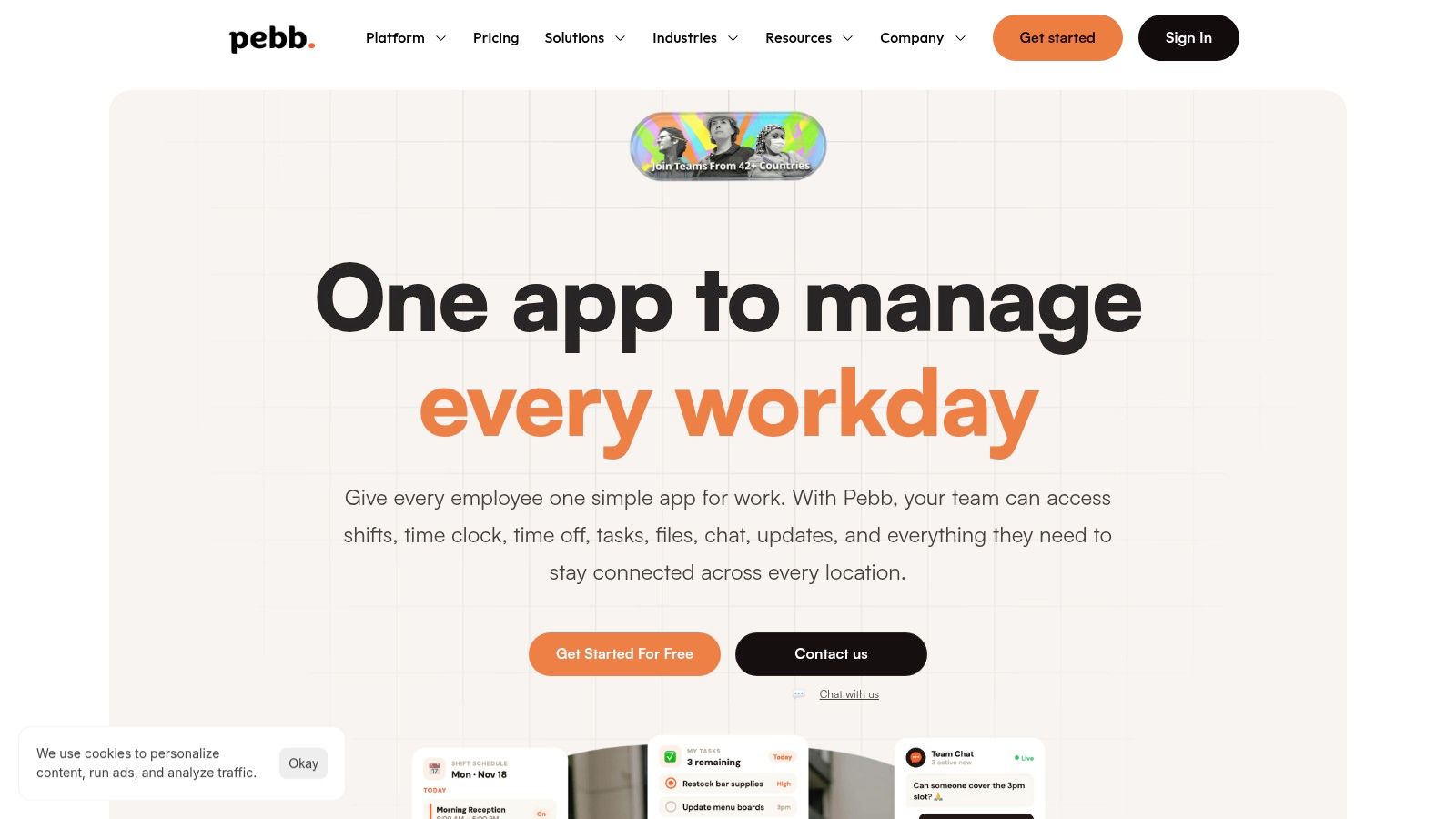
Pebb is one example of that setup. It combines team communication, tasks, file sharing, a knowledge library, and shift-related workflows in a mobile-first app. That matters because the real question in retail ops is rarely whether information was sent. The real question is whether the right person saw it in time, understood it, and acted on it correctly.
A planogram update reaches the team responsible for that zone. A stock issue becomes a task with an owner and status. A new hire checks the return policy on their phone instead of asking three coworkers and getting three different answers.
That is the trade-off worth making. Fewer tools. Clearer handoffs. Less manager time spent repeating instructions that should already be visible and usable.
Software does not fix weak store leadership. Managers still need to set priorities, coach standards, and keep the day focused. But the right tool closes the communication gaps that break execution, and on most sales floors, those gaps cause more damage than the systems leaders usually blame.
A Practical Checklist to Get Started
Most stores don't need a grand transformation plan. They need a cleaner Monday.
If you want to improve retail operations, start smaller than you think. Watch what happens. Listen to the people doing the work. Fix one process that causes daily friction. Then do it again.

A short list that works
Stand on the floor for an hour and say very little.
Watch where associates hesitate, where customers wait, and where tasks pile up. Stores reveal their weak points fast when you stop managing from the office.Ask three frontline employees the same question.
Ask what slows them down every day. If you hear the same answer three times, that's not complaining. That's a signal.Map one common process from start to finish.
Pick returns, receiving, replenishment, or promo setup. Follow it step by step. Most stores discover the breakdown in handoff, not in policy.Cut the number of places people must check for instructions.
If updates live in email, paper notices, chat threads, and verbal briefings, the system is already too messy.Choose a few daily checks and do them consistently.
Shelf availability, pricing accuracy, queue conditions, and unresolved tasks tell you more than a giant weekly report.Review yesterday with the team in plain language.
Not a long meeting. Just what worked, what slipped, and what matters today.
What not to do
Don't start by writing a thick SOP manual nobody will read during a rush. Don't buy software before you understand the handoffs that are failing. Don't assume the problem is laziness when the process itself is clumsy.
Small fixes applied daily beat big plans that never reach the floor.
The best operations aren't the most complicated. They're the easiest to follow under pressure. That's the standard worth chasing. Not impressive slides. Not elegant org charts. A store where the team knows what matters, the work is visible, and customers feel the calm.
If your store teams are juggling chat threads, paper notes, scattered tasks, and hard-to-find policies, Pebb is worth a look. It gives frontline and office teams one mobile-first place for communication, tasks, knowledge, files, and shift coordination, which makes retail operations a lot easier to run.
