
Understanding Warehouse Operations from the Floor Up
A practical guide to understanding warehouse operations. We cover core processes, KPIs, bottlenecks, and the human element behind a smooth-running facility.
Dan Robin
At 7 AM, the dock door rolls up and the day starts telling the truth. You can tell in ten minutes whether a warehouse is running on discipline or on hope.
The paperwork might say everything is under control. The floor never lies.
More Than Just Boxes on Shelves
Warehouse operations are commonly understood as involving storing inventory and getting orders out the door. That's part of it, but it overlooks the core function. A warehouse is a moving system of people, product, equipment, timing, and information. If one part slips, the whole day gets harder.
I've always thought understanding warehouse operations starts with watching the first hour of a shift. In a good building, receiving knows what's coming. Put-away isn't guessing where product belongs. Pickers don't start the day chasing missing stock. Supervisors aren't stuck in the office trying to piece together what happened on the last shift. The place feels calm, even when it's busy.
In a bad building, the signs show up early.
A trailer arrives without clean paperwork. A pallet gets set in a staging lane “just for now.” Someone prints a list because the system isn't trusted. A lead spends the morning answering the same question five times. By lunch, people say the warehouse is slammed. Usually it isn't slammed. It's just leaking time from a dozen small failures.
Growth changed the job
Warehousing got bigger, faster, and less forgiving. In the U.S., the number of warehouses and storage facilities grew by 26% from 2011 to 2020, and 65% of warehouses employ predictive analytics to forecast demand, manage inventory, and optimize resources, according to Infoplus reporting on warehouse management statistics.
That matters because the old way of “just work harder” doesn't scale. More volume creates more handoffs. More handoffs create more chances for confusion. Once that happens, the warehouse stops being a storage problem and becomes a coordination problem.
A well-run warehouse doesn't look dramatic. It looks boring in the best possible way.
What the floor is really measuring
You're not only moving cartons. You're testing whether your operation can stay aligned under pressure.
That's why understanding warehouse operations means looking past the org chart and the software demo. Watch how information moves. Watch how the day shift hands off to nights. Watch whether leads spend their time coaching or chasing. Watch what happens when one inbound load is late. The answer tells you more than any polished dashboard ever will.
The Six Rhythms of a Warehouse
Every warehouse has a rhythm. When it's healthy, work flows from one step to the next with very little drama. When it's unhealthy, one weak step keeps echoing through the rest of the day.
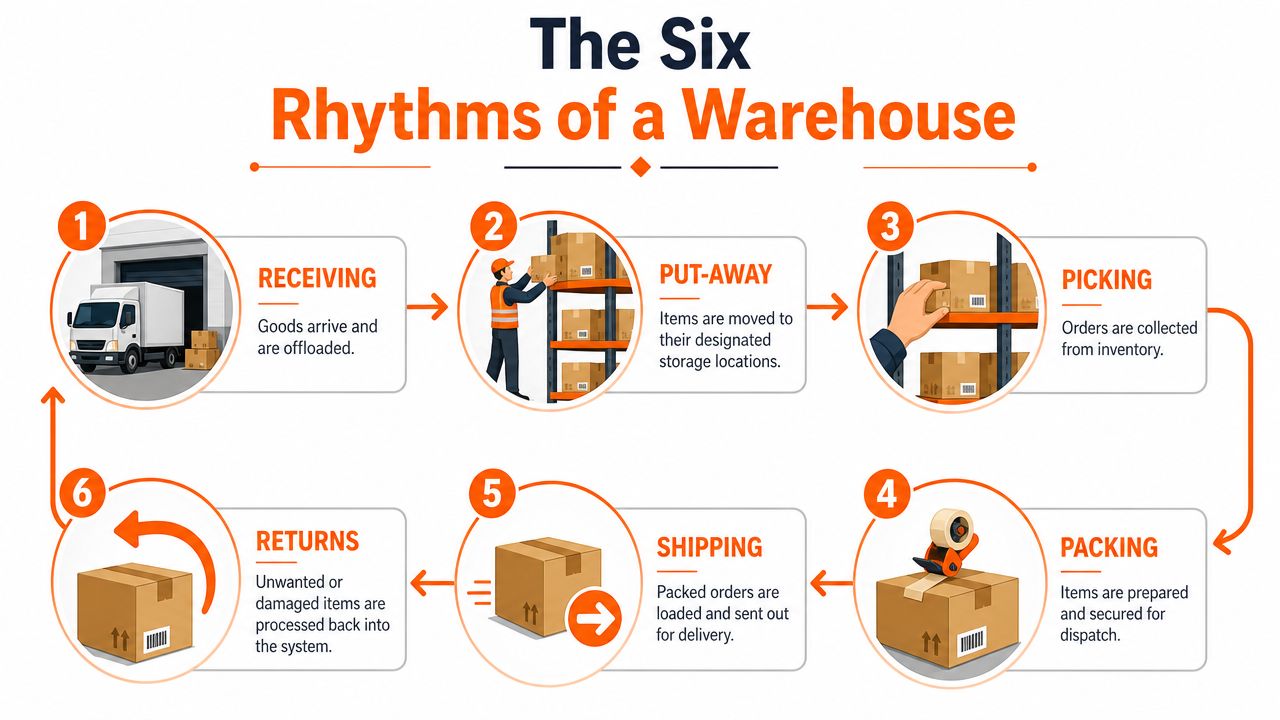
I think of the core work in six rhythms: receiving, put-away, picking, packing, shipping, and returns. People often treat them like separate departments. They're not. They're one continuous chain.
Receiving and put-away
Receiving sets the tone. Product comes in, gets checked, counted, and entered correctly. If receiving gets sloppy, everything downstream turns into detective work. Pickers blame inventory. Inventory blames suppliers. Customer service blames the warehouse. But the trouble usually started at the dock.
Put-away sounds simple, but it's where good intentions often go to die. Product needs to land in the right location, in a way the next person can trust. “We'll fix it later” is how locations get corrupted and travel time balloons.
A practical rule I've used for years is this:
If it isn't received cleanly: don't release it to the floor.
If it isn't put away correctly: don't pretend inventory is accurate.
If the location logic is messy: picking will pay for it.
Picking and packing
Picking is where the warehouse feels its own mistakes. Bad slotting, unclear replenishment, weak labeling, and poor handoff notes all show up here. When leaders say picking is slow, I usually ask a different question. What did we do earlier that made picking hard?
Packing is the final quality checkpoint before the order leaves your hands. This step catches the quiet failures. Wrong item. Missing item. Damaged item. Bad labeling. If the packing bench is constantly fixing errors, the operation doesn't have a packing problem. It has an upstream problem.
Practical rule: If one area keeps “saving the day,” another area is probably being allowed to fail.
Shipping and returns
Shipping is more than loading trailers. It's commitment. The warehouse has to convert internal activity into an outbound result that another team, carrier, or customer can rely on. Good shipping teams protect cutoff times and communicate early when the day is slipping.
Returns deserve more respect than they usually get. They tell you where product quality, fulfillment accuracy, or customer expectations broke down. They also put pressure back on receiving, inventory, and available space. If returns are handled as an afterthought, they clog the building.
Here's the cycle in plain terms:
Receive it right so the system starts clean.
Put it away with discipline so storage supports speed.
Pick with confidence because locations and quantities can be trusted.
Pack with care so errors stop before they leave.
Ship on purpose so commitments stay real.
Process returns intelligently so mistakes turn into learning.
That's the heartbeat. Miss one beat and the rest of the shift starts compensating.
What Actually Matters The Numbers That Tell the Story
A warehouse can drown in metrics. Most of them don't help. You don't need a giant scorecard to understand what's going on. You need a few vital signs that tell you whether the building is healthy or just surviving.
The metrics I trust most are inventory accuracy, order accuracy, order cycle time, and on-time shipping rate. Not because they sound impressive, but because each one points to a different kind of operational truth.
Four KPIs worth your attention
KPI | What It Measures | What It Really Tells You |
|---|---|---|
Inventory Accuracy | Whether system stock matches physical stock | If your team can trust locations, counts, and replenishment decisions |
Order Accuracy | Whether the customer received the correct order | How well picking, packing, labeling, and verification are working together |
Order Cycle Time | How long it takes to move an order from release to shipment | Whether flow is smooth or clogged by waiting, travel, rework, or poor prioritization |
On-Time Shipping Rate | Whether orders leave when promised | If planning, labor coordination, and cutoff discipline are strong enough to protect commitments |
Read the metric like a symptom
A drop in inventory accuracy rarely means “count better.” It usually means the operation is cutting corners somewhere. Product is being staged without a clean transaction. Replenishment is happening late. Returns are sitting in limbo. Somebody moved stock to keep work going and never closed the loop.
A dip in order accuracy is often a training issue, a location issue, or a clarity issue. People like to blame the picker. Sometimes the picker deserves it. Often the process put the picker in a bad spot.
Order cycle time is where hidden waste shows itself. Long cycle time doesn't always mean people are slow. It may mean orders sit unassigned, waves are released poorly, or teams keep switching priorities midstream. Warehouses lose hours in waiting long before they lose them in motion.
If a KPI moves, don't ask who to blame first. Ask what the number is trying to tell you.
Keep the scorecard small
I've seen managers ask for more dashboards when they really need better conversations. A short KPI list creates focus. It forces leads to connect numbers to behaviors on the floor.
That's the point. Metrics should help supervisors coach better today, not admire charts tomorrow.
Where Things Break Down Common Bottlenecks
Most bottlenecks don't look dramatic at first. They show up as small delays, repeated questions, and workarounds that become normal. Then one day the building feels heavy. Orders are late, tempers are short, and everybody says the same thing: “We're doing our best.”
That can be true and still not be enough.
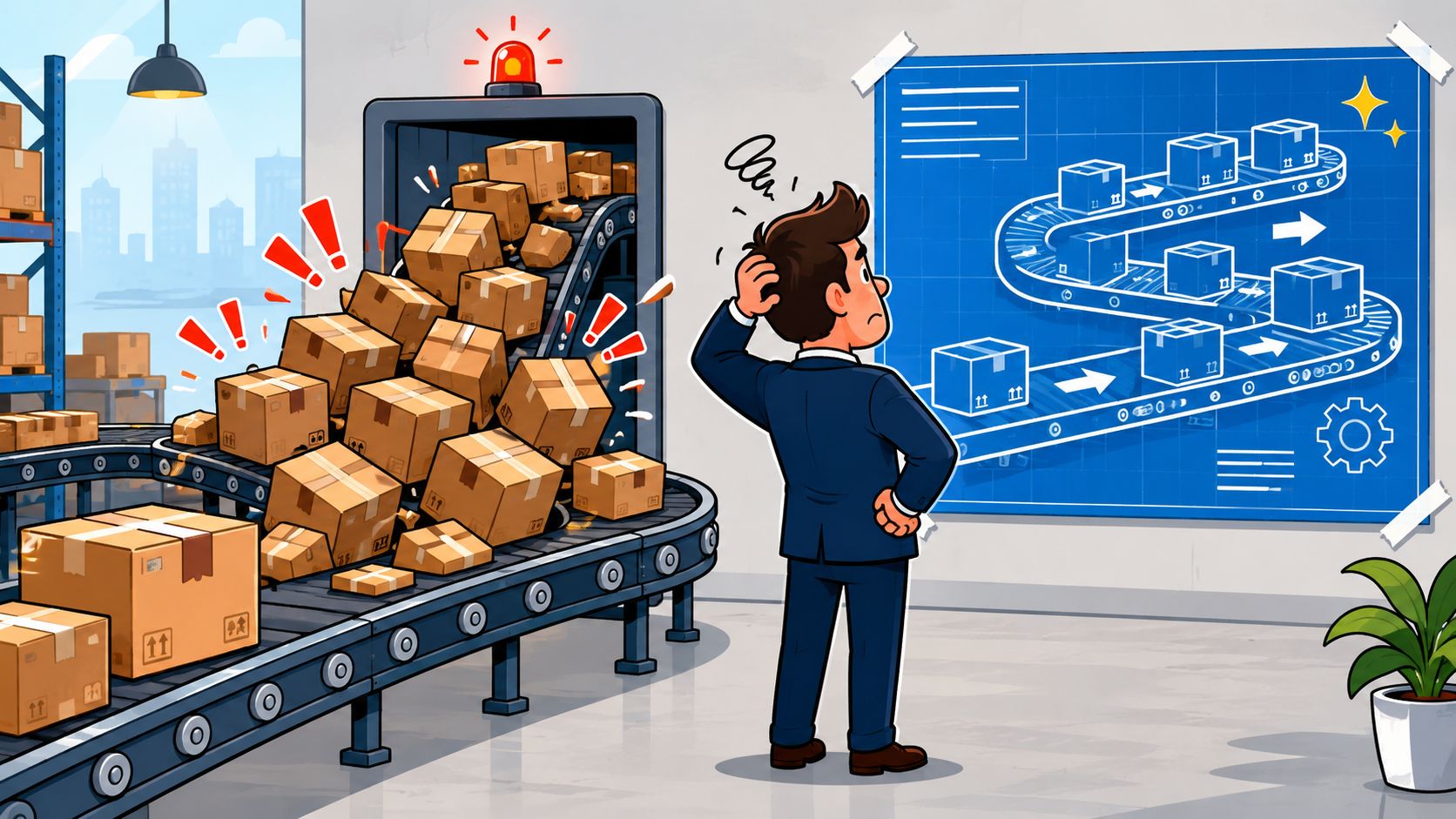
A lot of leaders look for bottlenecks in the obvious places. They blame aisle congestion, dock scheduling, or pick paths. Those things matter. But many warehouses are slowed down by something less visible. The people doing the work don't have the same picture of the work.
The hidden friction nobody likes to admit
One shift changes a staging rule. The next shift never hears about it. A supervisor writes notes on paper, then goes home. A new hire learns from whoever happens to be nearby. Maintenance knows a piece of equipment is touchy, but operations doesn't change the plan. None of this sounds huge. Together, it burns the day down.
That's why I'm skeptical when someone says the answer is more space or another tool. Sometimes it is. Often it isn't.
Independent industry commentary on warehouse challenges points to an expertise gap, where growth outpaces the team's ability to manage more complex logistics. That gap creates hidden costs through rush shipping, overstocking, and poor inventory control, as noted in WSI's discussion of warehouse challenges.
What bottlenecks usually look like in real life
Shift-to-shift drift. Day shift thinks night shift will finish the cleanup. Night shift thinks day shift already handled it.
Supervisors chasing information. They spend the morning finding paper, checking texts, and asking for status updates instead of removing blockers.
Local fixes that damage the whole system. One team creates a shortcut that helps their area and confuses everyone else.
Growth without operating depth. Sales rise, SKU complexity rises, customer promises tighten, but the management habits stay small.
The warehouse rarely breaks because people stop caring. It breaks because the operation got more complex than the communication around it.
The real test
If you want to find the true bottleneck, don't start with the org chart. Walk the floor and ask three questions.
What are people waiting on?
What do they have to ask twice?
What work depends on one person knowing everything?
Those answers usually point straight to the friction. And once you see it, you stop treating symptoms and start fixing how the building runs.
The People and The Plan Staffing Safety and Shifts
A warehouse doesn't become reliable because the process map looks good. It becomes reliable because the people inside it know what safe work looks like, what the priority is, and what changed since yesterday.
That starts with safety. Not as a poster on the wall. As operating discipline. Warehouse work carries a heavier burden than many leaders admit. The U.S. Bureau of Labor Statistics reporting cited by Voxel AI shows 4.8 injury cases per 100 full-time equivalent workers in warehousing and storage, compared with 2.3 per 100 across all industries. The same source notes that forklifts cause 35,000 to 62,000 injuries annually in the United States, according to this warehouse safety statistics summary.
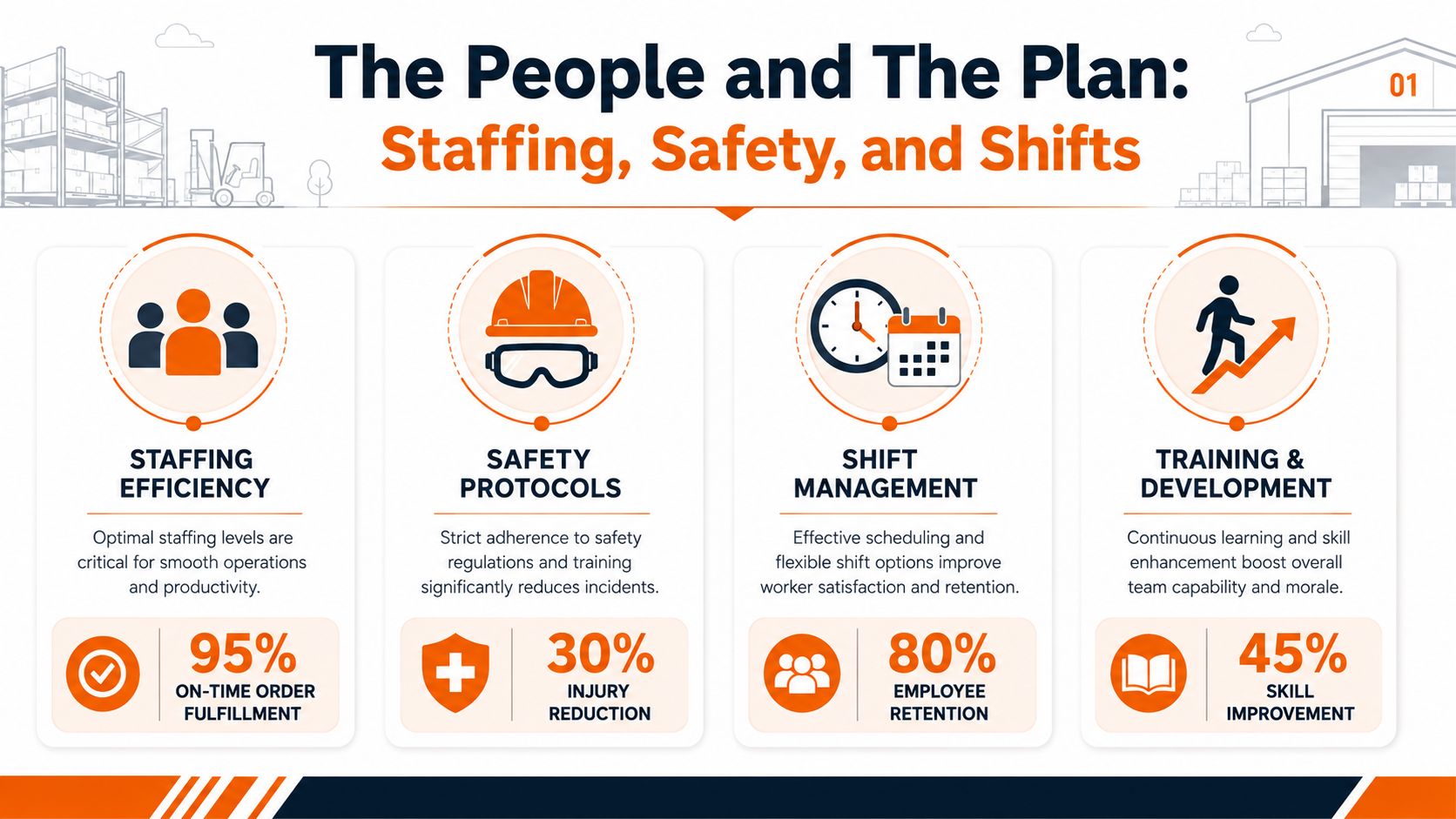
Those numbers matter because safety and performance aren't separate conversations. A warehouse with poor pedestrian control, weak forklift discipline, and sloppy handoffs isn't just unsafe. It's operationally loose.
Staffing is a daily planning problem
I've never seen a warehouse stay efficient by treating labor as fixed. Demand moves. Absenteeism happens. One area gets buried while another goes quiet. If the plan can't flex, the building starts borrowing people in the least efficient way possible.
Good operations cross-train on purpose. They don't wait for a bad day to discover who can help where. They also give supervisors live visibility into staffing, attendance, and work mix, which is why practical guidance on warehouse workforce management matters more than another abstract productivity lecture.
A solid staffing habit usually includes:
Cross-training with intent so teams can move without chaos.
Clear shift handoff notes so each crew starts with context, not rumors.
Visible task priorities so people know what matters now.
Simple escalation paths so leads don't improvise every exception.
Maintenance is part of safety planning
Equipment reliability belongs in the staffing conversation because breakdowns change labor deployment fast. If a forklift, dock leveler, or hydraulic lift starts acting up, the safest shift plan on paper can unravel in an hour.
That's why preventive work matters. A practical reference for this is MA Hydraulics maintenance planning, especially for teams trying to reduce surprise equipment issues instead of reacting to them mid-shift.
Good shift management isn't only about filling the roster. It's about protecting flow without putting people in bad positions.
Keep the human side visible
Supervisors need more than a labor number. They need to know who is new, who is certified, who can float, who needs support, and what the last shift left unresolved.
That's the part many warehouse guides skip. Understanding warehouse operations means understanding that the plan only works if the people can execute it together.
The Right Tools for the Job From WMS to Unified Apps
A Warehouse Management System, or WMS, is the operational brain of the building. It tracks inventory, locations, transactions, and order flow. You need that. Without it, you end up relying on memory, paper, and a lot of luck.
At the architecture level, the dependable pattern is a layered data setup that centralizes source data, transforms it in a staging or warehouse layer, and exposes curated data through reporting tools, which IBM describes in its overview of data warehouse architecture. In practical warehouse terms, that means the business should have one trusted place for operational data instead of ten partial versions of the truth.
But a WMS doesn't solve every warehouse problem. It can tell you where stock should be. It often doesn't tell the night shift what changed in the morning meeting. It can process transactions. It usually doesn't coach a new associate through exceptions, safety reminders, or task changes in real time.
Where traditional systems leave gaps
The biggest efficiency gains often come from better labor allocation and coordination, not just automation. Operational guidance on warehouse operations has increasingly emphasized workforce volatility, disconnected systems, and the value of unified visibility across shifts and tasks, as discussed in WareGo's warehouse operations guide.
That lines up with what a lot of floor leaders already know. The pain usually sits between systems.
The WMS knows the task, but the employee doesn't know the priority.
The schedule exists, but last-minute changes live in texts and phone calls.
The SOP is written, but the new hire can't find it when the exception happens.
The manager has updates, but one shift never receives them cleanly.
What a unified frontline app changes
A unified frontline app offers assistance. Tools in this category handle the work around the work: shift communication, task assignment, updates, file access, team chat, and basic coordination. For teams comparing options, this kind of logistics workforce management software fills a gap that a WMS usually leaves open.
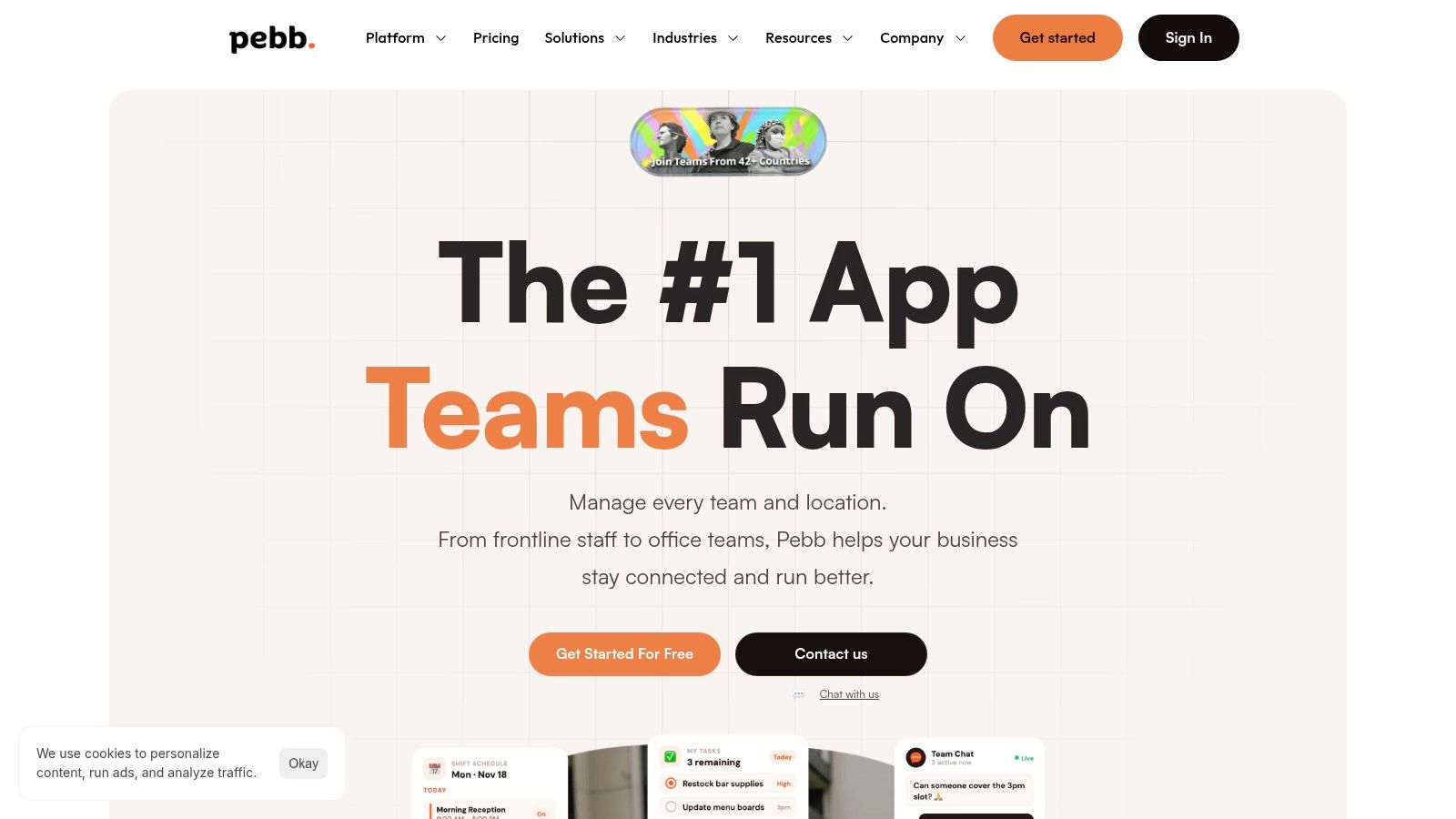
One example is Pebb, which combines team communication, scheduling, tasks, file sharing, and knowledge access in one place. That matters in a warehouse because supervisors can coordinate shift changes from a phone, share safety updates without chasing paper, and give new hires a single place to find procedures and training materials.
You still need the WMS. You also need the communication layer that keeps humans aligned around the work the WMS is tracking.
It All Comes Down to Clarity
The warehouses I respect most aren't perfect. They're clear.
People know what matters today. They know where to look when something changes. They know who owns the next decision. When the day gets messy, and it always does, the operation bends without turning into confusion.
That's really what understanding warehouse operations comes down to. Not memorizing process names. Not buying software and hoping it fixes weak habits. It's learning how goods, information, equipment, and people move together. Then protecting that flow with discipline.
A strong operation usually feels quieter than expected. Fewer surprises. Fewer side conversations. Fewer heroics. More shared understanding.
If your warehouse feels harder to run than it should, don't start by assuming you need more complexity. Start with clarity. Clean handoffs. Simple priorities. Better visibility. A plan the next shift can use. That's the work behind operational excellence strategies, and it's usually where the biggest improvements begin.
The building tells the truth every day. The question is whether the team can see it clearly enough to act on it.
If your warehouse teams are juggling chats, shift updates, task notes, policy documents, and scheduling across too many tools, Pebb gives you one place to keep communication, operations, and frontline coordination together. For warehouses, that can mean fewer missed handoffs, faster updates across shifts, and less time spent hunting for information.
